
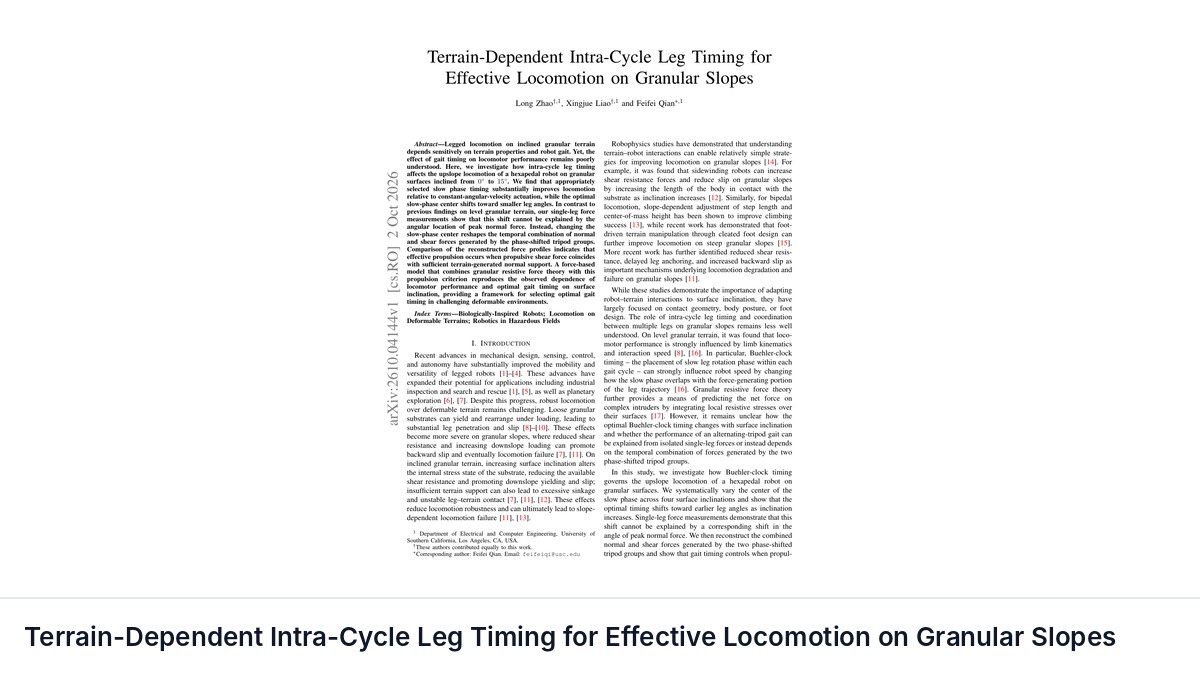
Terrain-Dependent Intra-Cycle Leg Timing for Effective Locomotion on Granular Slopes
Long Zhao, Xingjue Liao, Feifei Qian · N/A · 2026
Framework
N/A
License
N/A
Stars
N/A
Summary
Locomotion on granular slopes such as sand dunes remains a fundamental challenge for legged robots due to reduced shear strength and gravity-induced anisotropic yielding of granular media.
Abstract Summary
Key Points
- Locomotion on granular slopes such as sand dunes remains a fundamental challenge for legged robots due to reduced shear strength and gravity-induced anisotropic yielding of granular media.
- Using a hexapedal robot on a tiltable granular bed, we systematically measure locomotion speed together with slope-dependent normal and shear granular resistive forces.
- While normal penetration resistance remains nearly unchanged with inclination, shear resistance decreases substantially as slope angle increases.
- Guided by these measurements, we develop a simple robot-terrain interaction model that predicts anchoring timing, step length, and resulting robot speed, as functions of terrain strength and slope angle.
- The model reveals that slope-induced performance loss is primarily governed by delayed anchoring and increased backward slip rather than excessive sinkage.
Materials and Methods
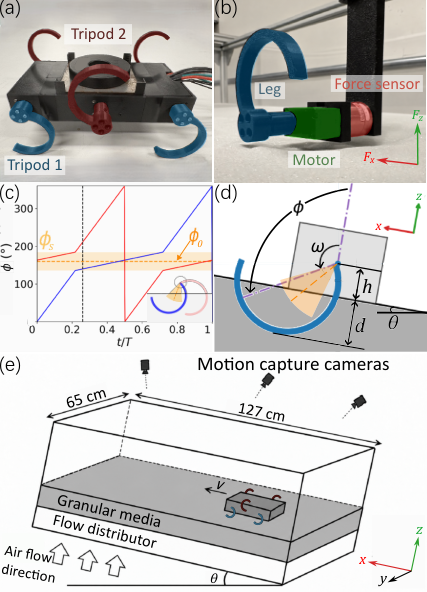
A small RHex-type [ 18 ] robot (Fig. 1 a) was used to investigate locomotion on level and inclined granular surfaces [ 18 ] . The robot body measured 22 cm in length and 10 cm in width, with a total mass of 1.5 kg. It was equipped with six C-shaped rotary legs, each with a radius, $R$, of 3 cm, a width of 0.8 cm, and an arc span of $225^{\circ}$.
The angular positions of the robot legs, $\phi$, were controlled using a microcontroller (Arduino Uno), and actuated by servo motors (Dynamixel XL330).
Model generalization and broader applicability
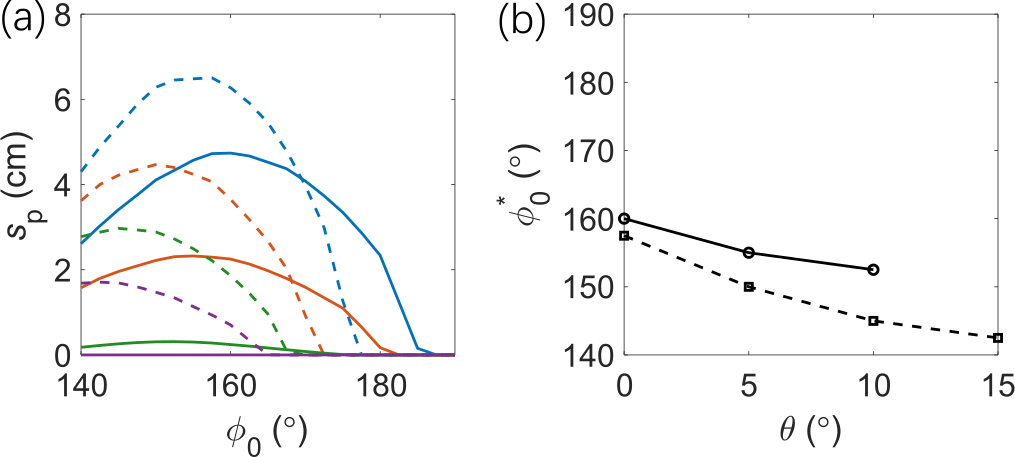
While the analysis in Sec. 3.4 explains the observed locomotion performance, its reliance on measured force profiles and robot kinematics limits its application to conditions that have already been tested.
To achieve a more general framework that predicts locomotion performance directly from the robot, gait, and terrain parameters, we use granular resistive force theory (RFT) to predict the leg-terrain force profiles, and then use the predicted forces to determine the effective propulsion window and estimate the resulting step length.
Sources and Demonstrations
Figures are reproduced from Zhao et al. See the full paper for experimental details and the project page, when the paper links one, for demonstrations and videos.
Related Papers
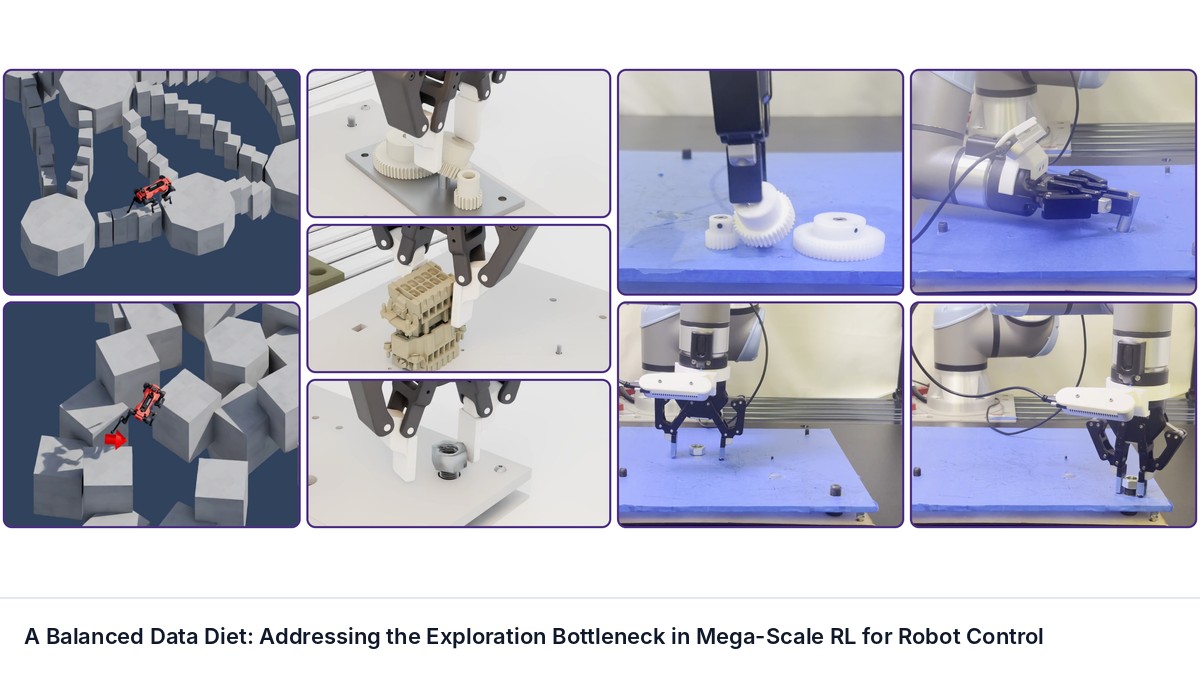
A Balanced Data Diet: Addressing the Exploration Bottleneck in Mega-Scale RL for Robot Control
Octi Zhang, Mateo Guaman Castro, Patrick Yin et al.
General-purpose robots must perform a wide range of tasks from agile locomotion to dexterous manipulation.
A Heterogeneous Architecture for Robot RL Beyond GPU-Dominant Paradigms
Yufei Jia, Zhanxiang Cao, Mingrui Yu et al.
Simulation-based RL for contemporary robot control is increasingly organized around GPU-resident simulation: physics, rollout collection, and learning are placed on a single GPU-centric execution path
A Mode-Unified, Continuous, and Biomimetic Control Strategy of a Robotic Lower Limb Prosthesis
Hanjun Kim, Sixu Zhou, John Shim et al.
Existing biomimetic lower-limb prosthesis controllers are commonly designed for discrete locomotion modes, requiring separate parameterizations for level walking, ramps, and stairs.

A Unified Kinematic Representation Enables Reusable Biological Joint Moment Estimation
Jinwoo Hwang, Ilseung Park, Changseob Song et al.
Objective: Data-driven models that estimate physiological states, particularly biological joint moments, are widely used in exoskeleton control.