
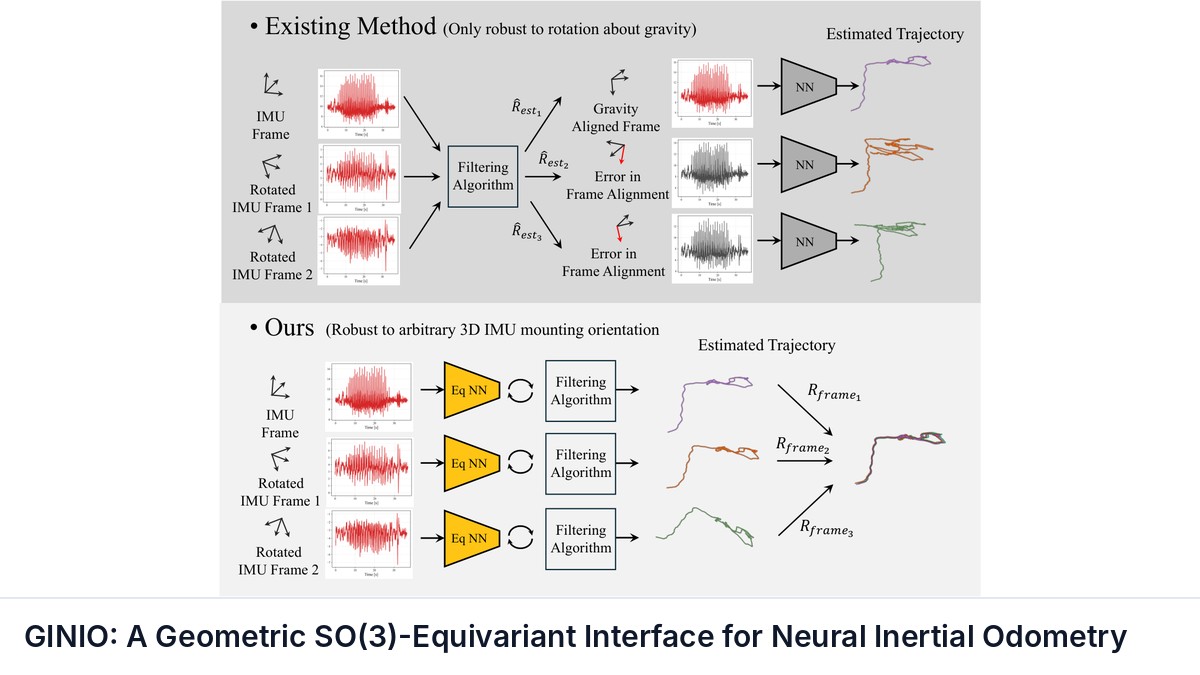
GINIO: A Geometric SO(3)-Equivariant Interface for Neural Inertial Odometry
Chankyo Kim, Minghan Zhu, Tzu-Yuan Lin, Avantika Rattan, Maani Ghaffari · N/A · 2026
Framework
N/A
License
N/A
Stars
N/A
Summary
Neural inertial odometry increasingly uses networks as learned measurements inside filtering pipelines.
Abstract Summary
Key Points
- Neural inertial odometry increasingly uses networks as learned measurements inside filtering pipelines.
- Such measurements should transform consistently under arbitrary IMU mounting conventions: their mean must transform as a vector, and their covariance must transform congruently as a second-order tensor.
- We present GINIO, a geometric SO(3)-equivariant interface for neural inertial odometry under arbitrary rotations of the IMU measurement frame.
- Given calibrated IMU windows, our framework predicts a motion measurement and uncertainty obeying these tensorial laws.
- To support efficient sensor-frame learning, we introduce Last-Frame Alignment (LFA), a deterministic preprocessing step that is provably equivalent to world-frame training for SO(3)-equivariant predictors.
Problem Setup and Methodology
Let $\bar{\mathbf{z}}^{s}_{i}=[(\bar{\mathbf{f}}^{s}_{i})^{\top},(\bar{\boldsymbol{\omega}}^{s}_{i})^{\top}]^{\top}\in\mathbb{R}^{6}$ denote a bias-corrected IMU sample with specific force and angular velocity expressed in the sensor frame.
A coordinate rotation $\mathbf{R}\in\mathrm{SO}(3)$ acts on the two vector channels by $\rho(\mathbf{R})=I_{2}\otimes\mathbf{R}$, applied componentwise to the window $\bar{\mathcal{Z}}^{s}=\{\bar{\mathbf{z}}^{s}_{i}\}_{i=1}^{n}$.

Experiments
We evaluate GINIO along three axes: filter-connected learned inertial odometry, aerial inertial prediction, and physical IMU remounting.
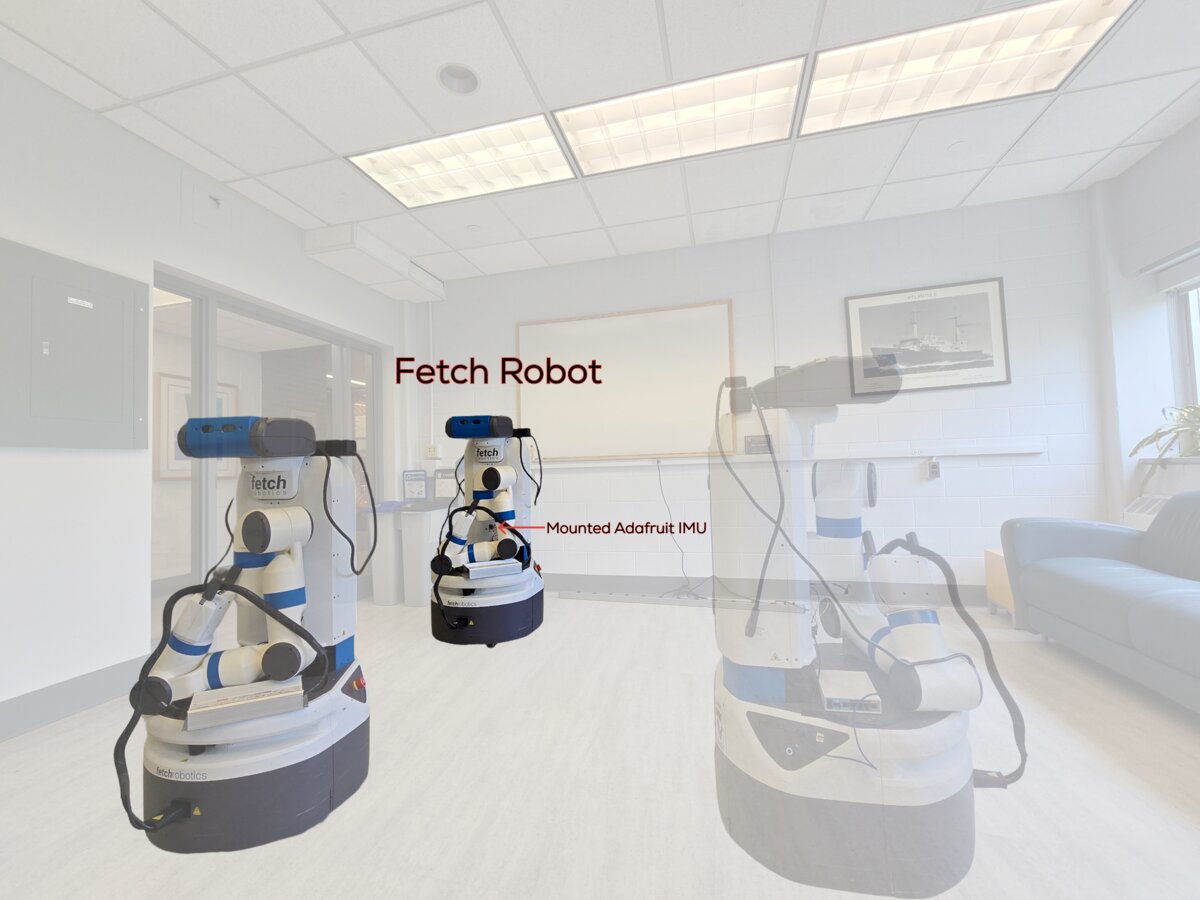
TLIO/RIDI test whether the interface improves standard filter-based NIO; NanoBench tests whether the same $\mathrm{SO}(3)$ principle transfers to aggressive nano-quadrotor dynamics; and Fetch remounting tests whether the learned predictor remains robust when the IMU is physically reinstalled.
Ablations and Stress Tests
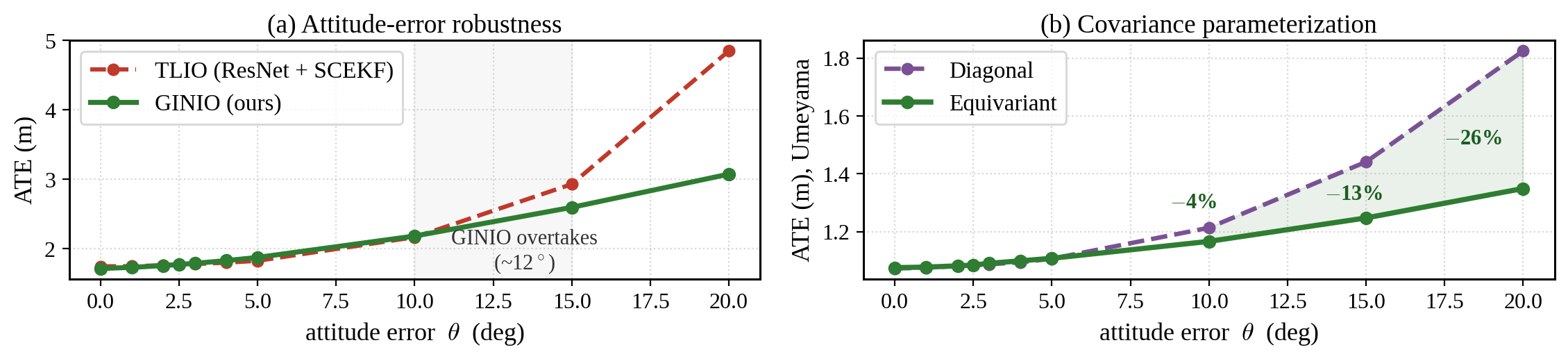
We isolate the mechanisms behind the main results: architectural equivariance rather than augmentation, tensor-consistent covariance rather than axis-aligned uncertainty, and the boundary between coordinate-frame rotations and frame-estimation mismatch. In our controlled TLIO ablation, architectural equivariance is more reliable than $\mathrm{SO}(3)$ augmentation for arbitrary 3D rotations.
A non-equivariant ResNet fails under ID/$\mathrm{SO}(3)$ (1.817 m $\rightarrow$ 108.235 m ATE).
Sources and Demonstrations
Figures are reproduced from Kim et al. See the full paper for experimental details and the project page, when the paper links one, for demonstrations and videos.
Related Papers
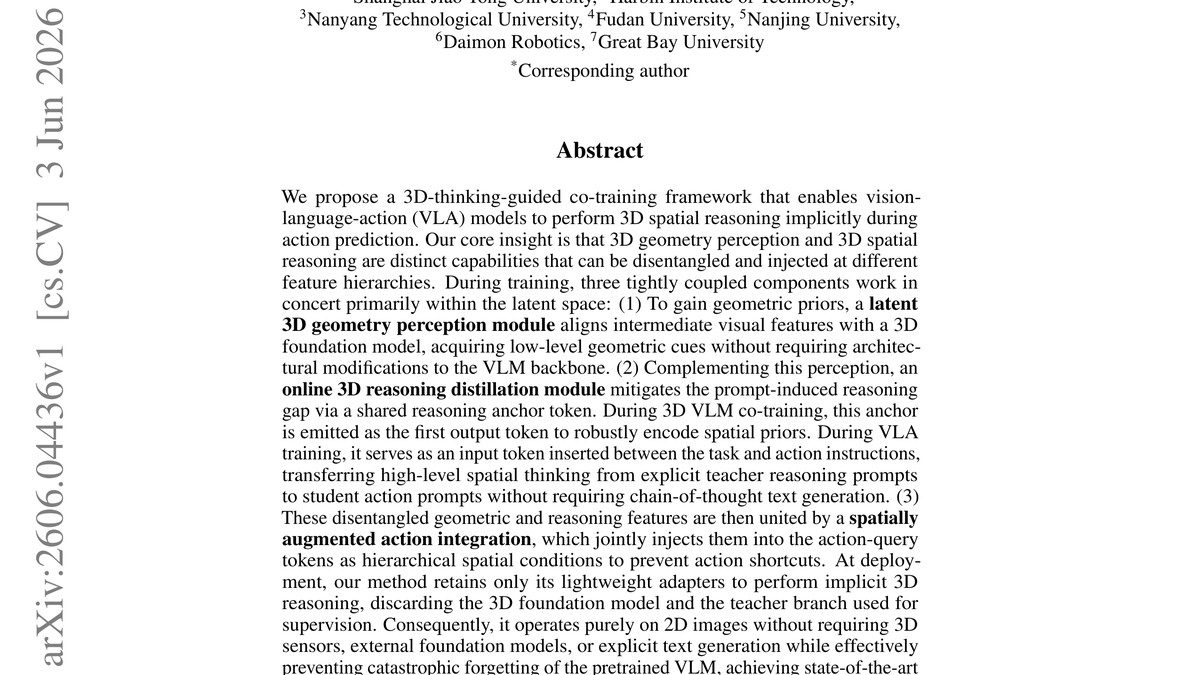
3DThinkVLA: Endowing Vision-Language-Action Models with Latent 3D Priors via 3D-Thinking-Guided Co-training
Jiaxin Shi, Xidong Zhang, Fucai Zhu et al.
We propose a 3D-thinking-guided co-training framework that enables vision-language-action (VLA) models to perform 3D spatial reasoning implicitly during action prediction.
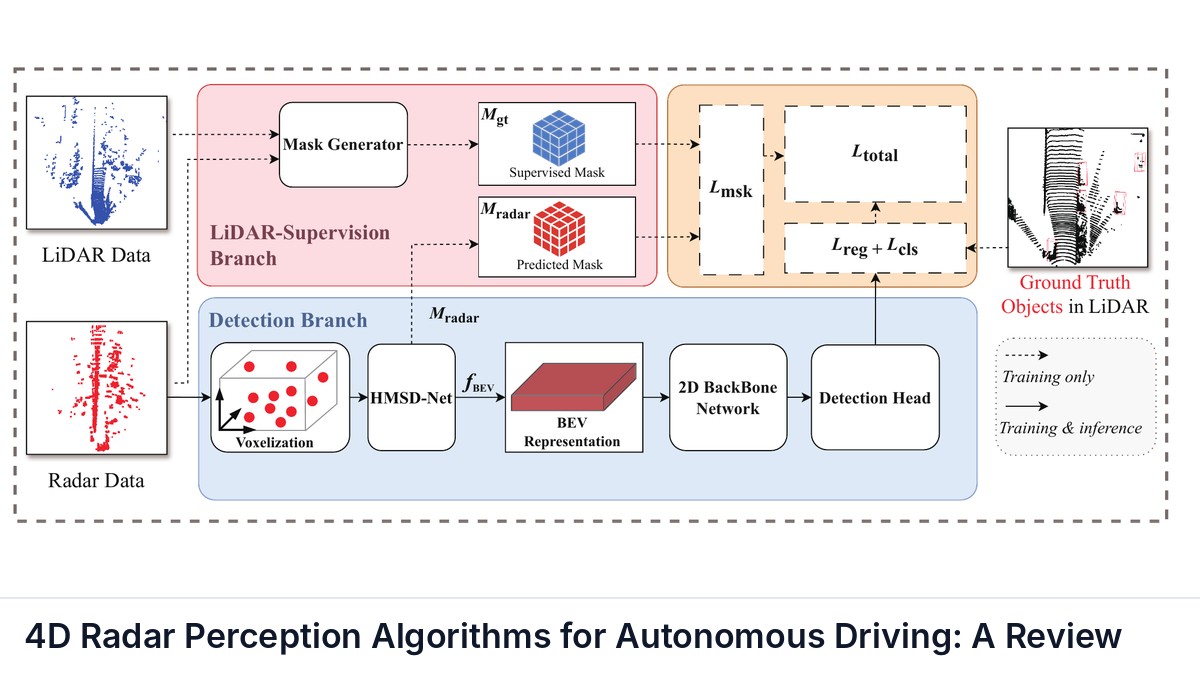
4D Radar Perception Algorithms for Autonomous Driving: A Review
Xumin Wu, Jun Zhou, Jilin Mei et al.
Research on 4D millimeter-wave radar perception algorithms has flourished in recent years, extending from signal processing and object detection to semantic segmentation, motion estimation, occupancy prediction, and dynamic scene reconstruction.
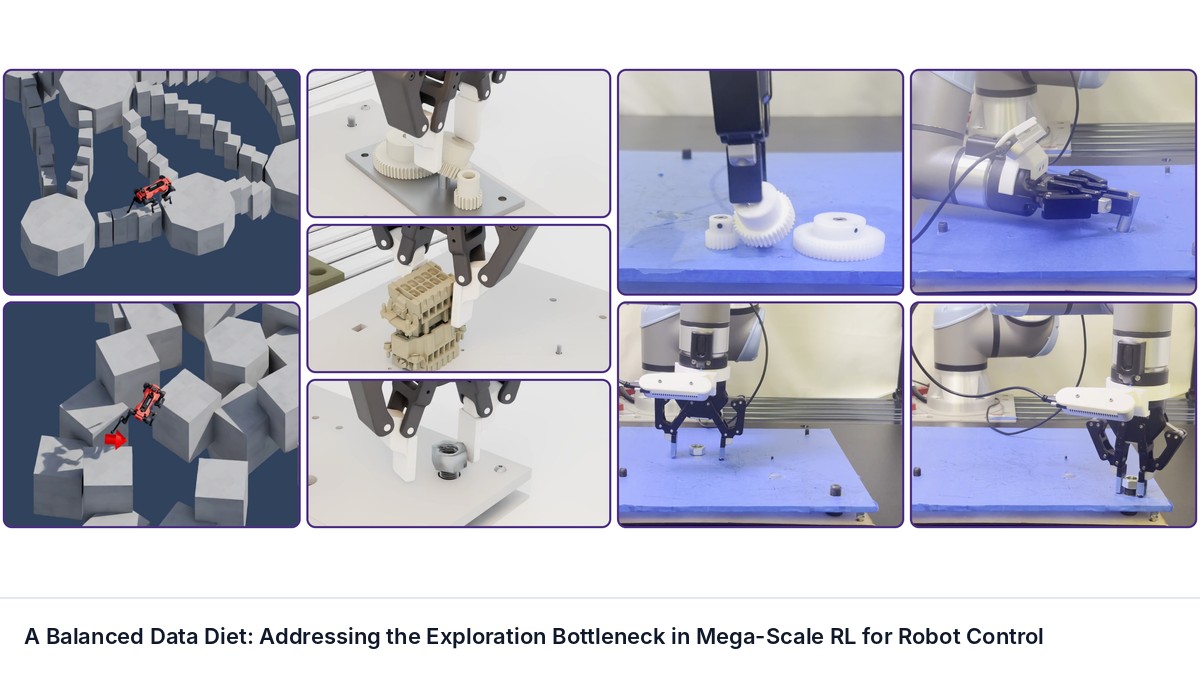
A Balanced Data Diet: Addressing the Exploration Bottleneck in Mega-Scale RL for Robot Control
Octi Zhang, Mateo Guaman Castro, Patrick Yin et al.
General-purpose robots must perform a wide range of tasks from agile locomotion to dexterous manipulation.
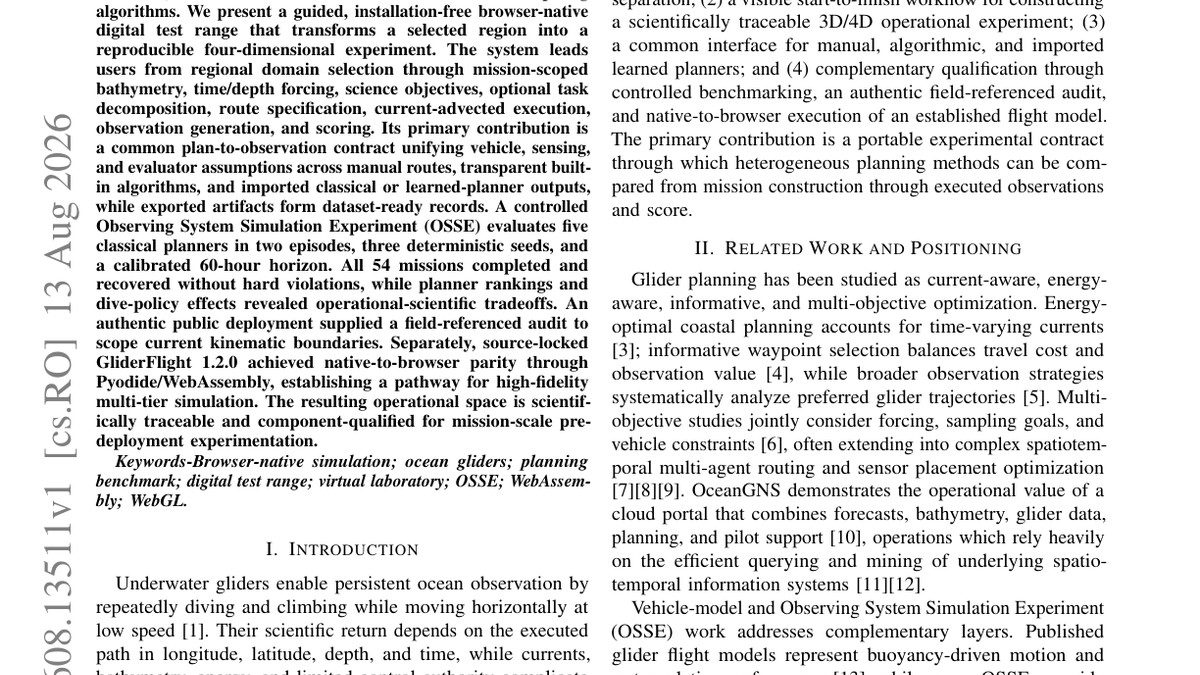
A Browser-Native Digital Test Range for Benchmarking 4D Ocean-Glider Planning Algorithms
Edward Holmberg, Elias Ioup, Mahdi Abdelguerfi
Repeated in-situ evaluation of ocean-glider planners requires scarce vehicles, operators, deployment and recovery resources, and ocean conditions that cannot be reset for competing algorithms.