
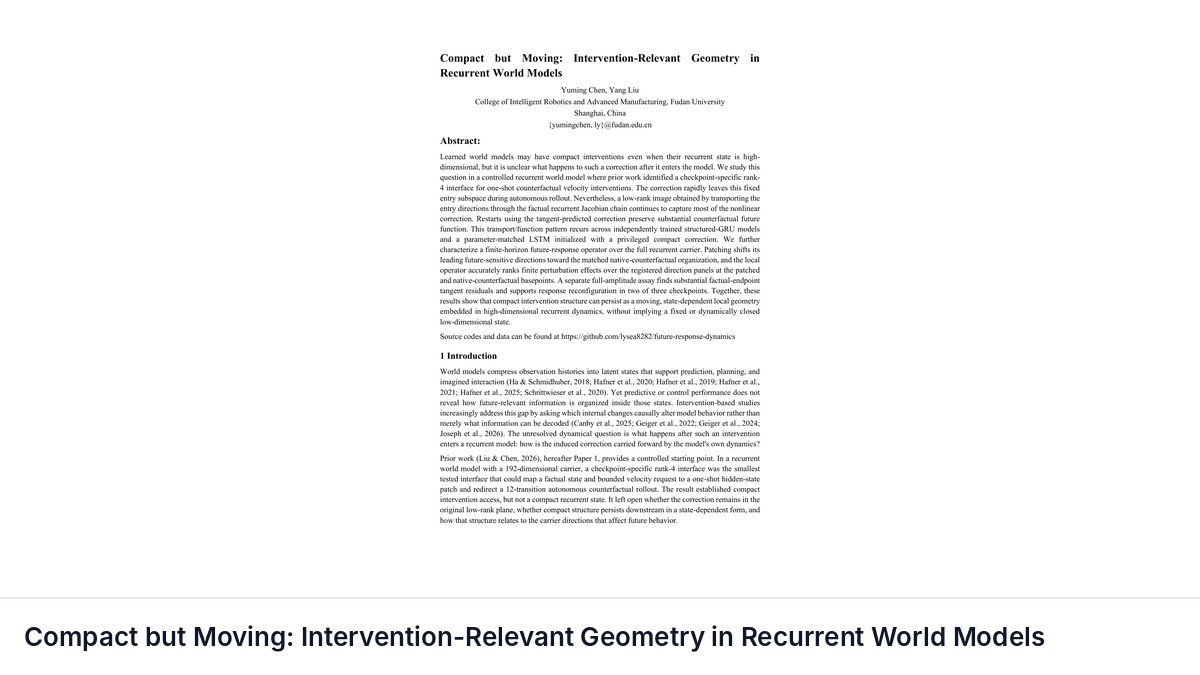
Compact but Moving: Intervention-Relevant Geometry in Recurrent World Models
Yuming Chen, Yang Liu · N/A · 2026
Framework
N/A
License
N/A
Stars
N/A
Summary
Learned world models may have compact interventions even when their recurrent state is high-dimensional, but it is unclear what happens to such a correction after it enters the model.
Abstract Summary
Key Points
- Learned world models may have compact interventions even when their recurrent state is high-dimensional, but it is unclear what happens to such a correction after it enters the model.
- We study this question in a controlled recurrent world model where prior work identified a checkpoint-specific rank-4 interface for one-shot counterfactual velocity interventions.
- The correction rapidly leaves this fixed entry subspace during autonomous rollout
- Nevertheless, a low-rank image obtained by transporting the entry directions through the factual recurrent Jacobian chain continues to capture most of the nonlinear correction.
- Restarts using the tangent-predicted correction preserve substantial counterfactual future function
Compact but Moving: Intervention-Relevant Geometry in Recurrent World Models
|Authors: Yuming Chen, Yang Liu
|Venue: arXiv preprint | Year: 2026
|arXiv: 2609.21787v1
Abstract
Learned world models may have compact interventions even when their recurrent state is high-dimensional, but it is unclear what happens to such a correction after it enters the model. We study this question in a controlled recurrent world model where prior work identified a checkpoint-specific rank-4 interface for one-shot counterfactual velocity interventions. The correction rapidly leaves this fixed entry subspace during autonomous rollout. Nevertheless, a low-rank image obtained by transporting the entry directions through the factual recurrent Jacobian chain continues to capture most of the nonlinear correction. Restarts using the tangent-predicted correction preserve substantial counterfactual future function. This transport/function pattern recurs across independently trained structured-GRU models and a parameter-matched LSTM initialized with a privileged compact correction. We further characterize a finite-horizon future-response operator over the full recurrent carrier. Patching shifts its leading future-sensitive directions toward the matched native-counterfactual organization, and the local operator accurately ranks finite perturbation effects over the registered direction panels at the patched and native-counterfactual basepoints. A separate full-amplitude assay finds substantial factual-endpoint tangent residuals and supports response reconfiguration in two of three checkpoints. Together, these results show that compact intervention structure can persist as a moving, state-dependent local geometry embedded in high-dimensional recurrent dynamics, without implying a fixed or dynamically closed low-dimensional state.
Key Contributions
- Learned world models may have compact interventions even when their recurrent state is high-dimen…
- We study this question in a controlled recurrent world model where prior work identified a checkp…
- The correction rapidly leaves this fixed entry subspace during autonomous rollout
- Nevertheless, a low-rank image obtained by transporting the entry directions through the factual …
- Restarts using the tangent-predicted correction preserve substantial counterfactual future function
Topics
- vision
- reinforcement-learning
- control
Code & Data
- GitHub repository: https://github.com/lysea8282/future-response-dynamics
BibTeX
@article{Chen2026_260921787v1,
  title     = {Compact but Moving: Intervention-Relevant Geometry in Recurrent World Models},
  author    = {Yuming Chen and Yang Liu},
  year      = {2026},
  eprint    = {2609.21787v1},
  archivePrefix = {arXiv},
  primaryClass  = {cs.RO},
  url       = {https://arxiv.org/abs/2609.21787v1}
}
Related Papers
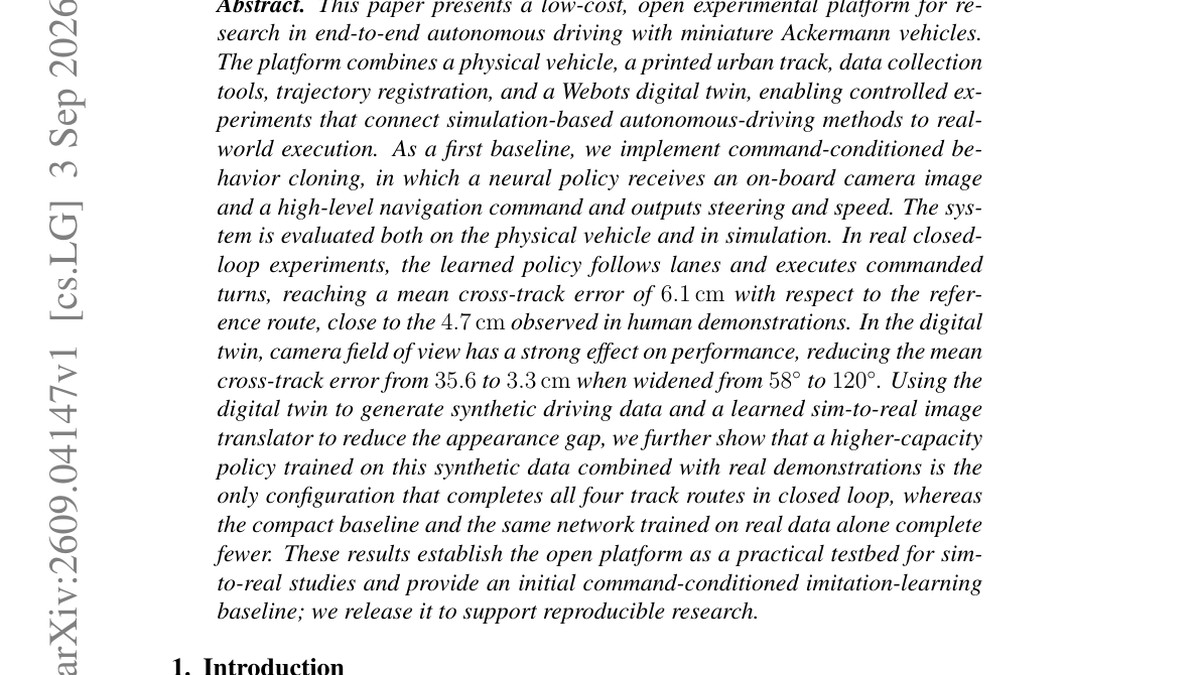
A Low-Cost, Open Platform for End-to-End Autonomous Driving on a Miniature Ackermann Vehicle
Gustavo Claudio Karl Couto, Eric Aislan Antonelo, Gabriel George Zipperer
This paper presents a low-cost, open experimental platform for research in end-to-end autonomous driving with miniature Ackermann vehicles.
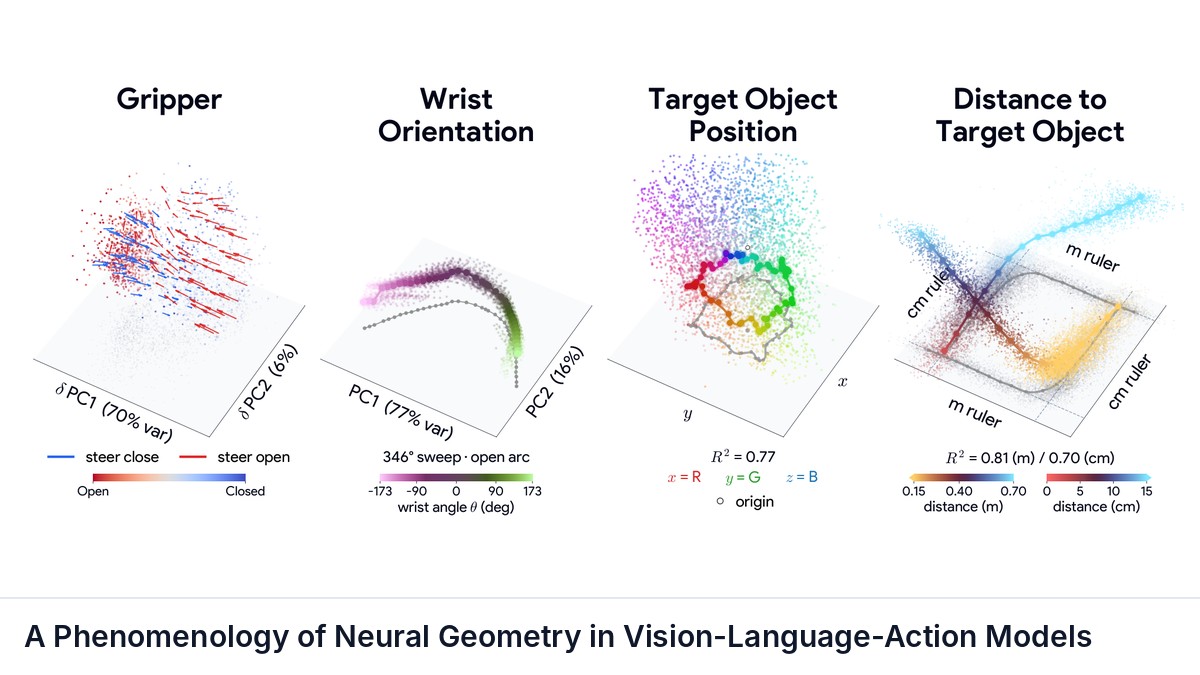
A Phenomenology of Neural Geometry in Vision-Language-Action Models
Mozes Jacobs, Aiden Swann, Mathilde Papillon et al.
Robotic manipulation is inherently geometric, but what shape does the world take inside the policy that performs it?

A Sim-to-Real Integration Pipeline for Training and Deployment of Chunk-Based VLA Manipulation Policies
Mathilde Kappel, Clémence Grislain, Mohamed Chetouani et al.
Vision-Language-Action (VLA) models have become a prominent paradigm for mapping multimodal inputs, including semantic instructions, visual observations of the scene, and proprioceptive observations, to robot actions.
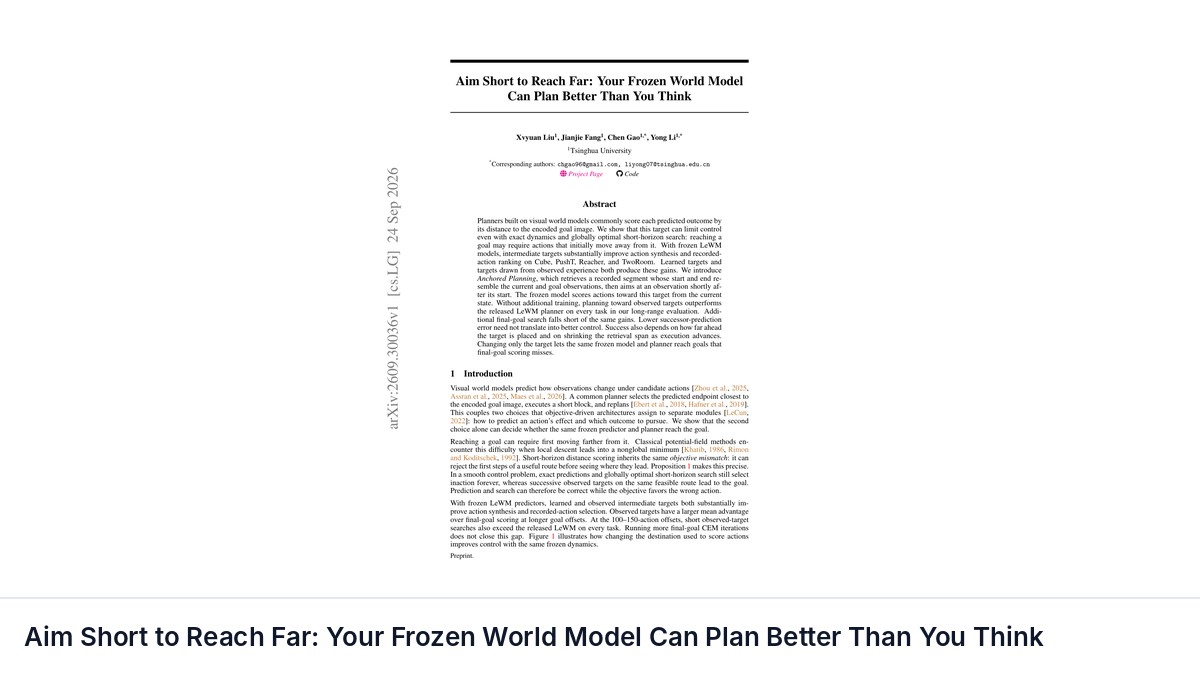
Aim Short to Reach Far: Your Frozen World Model Can Plan Better Than You Think
Xvyuan Liu, Jianjie Fang, Chen Gao et al.
Planners built on visual world models commonly score each predicted outcome by its distance to the encoded goal image. We show that this target can limit control even with exact dynamics and globally optimal short-horizon search: reaching a goal may require actions that initially move away from it.