
Probabilistic Plan Legibility with Off-the-shelf Planners
Michele Persiani, Thomas Hellstr\"om · N/A · 2026
Framework
N/A
License
N/A
Stars
N/A
Summary
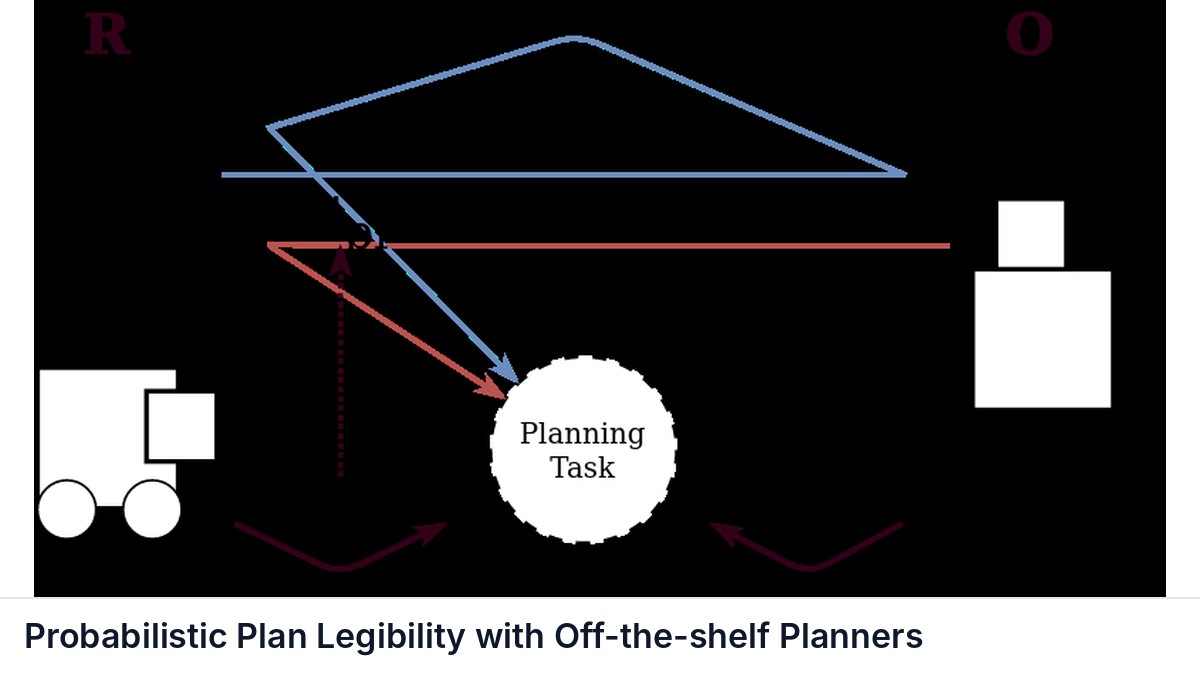
Legible planning is the creation of plans that best disambiguate their goals from a set of other candidates from an observer's perspective.
Abstract Summary
Key Points
- Legible planning is the creation of plans that best disambiguate their goals from a set of other candidates from an observer's perspective.
- In this paper we propose a method for legible planning for arbitrary PDDL domains, by extending previous research on legibility to classical planning without requiring to construct ad-hoc planners.
- We also discuss how the observer perspective may be estimated through a second order theory of mind that connects the planner's and the observer's task spaces.
- Our solution can for example be deployed in human-robot teaming scenarios, where an autonomous robot in a team can implicitly communicate its goal by producing legible plans.
- We present benchmark results on several PDDL planning domains
llustrative Example
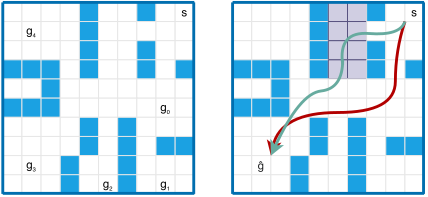
To illustrate the production of legible plans we propose the following example in the Human-Robot teaming scenario shown in Figure 2 . It is a rescue scenario where an autonomous scout robot is moving in a dangerous environment (e.g. a laboratory filled with toxic gases) searching for people, while a commander supervisions the operations on its computer interface from outside of the building.
Both have access to a map of the environment in the form of a grid-world on which the robot’s position is being tracked.
Sources and Demonstrations
Figures are reproduced from Persiani et al. See the full paper for experimental details and the project page, when the paper links one, for demonstrations and videos.
Related Papers
A Browser-Native Digital Test Range for Benchmarking 4D Ocean-Glider Planning Algorithms
Edward Holmberg, Elias Ioup, Mahdi Abdelguerfi
Repeated in-situ evaluation of ocean-glider planners requires scarce vehicles, operators, deployment and recovery resources, and ocean conditions that cannot be reset for competing algorithms.

Aim Short to Reach Far: Your Frozen World Model Can Plan Better Than You Think
Xvyuan Liu, Jianjie Fang, Chen Gao et al.
Planners built on visual world models commonly score each predicted outcome by its distance to the encoded goal image. We show that this target can limit control even with exact dynamics and globally optimal short-horizon search: reaching a goal may require actions that initially move away from it.
Beyond Episodic Evaluation: Memory Architectural Bottlenecks in Sequential Embodied Question Answering
Zikui Cai, Kaushal Janga, Tan Dat Dao et al.
Embodied question answering (EQA) is traditionally evaluated under an episodic formulation, where agents solve each task independently and reset internal state between episodes.
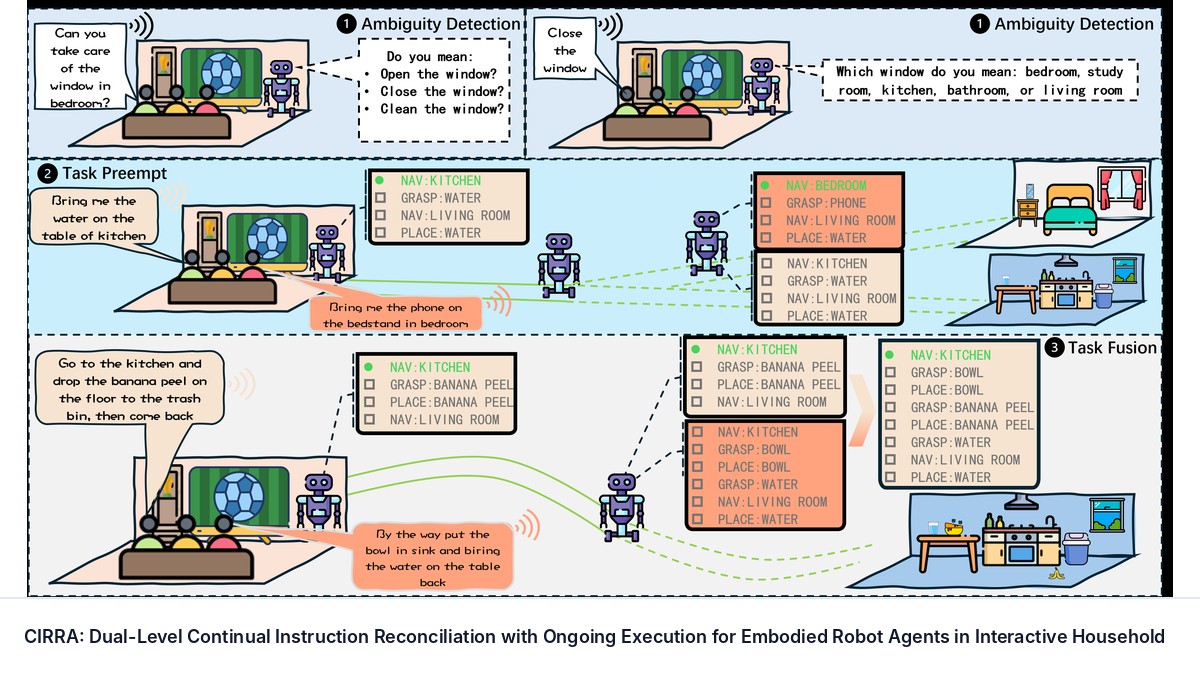
CIRRA: Dual-Level Continual Instruction Reconciliation with Ongoing Execution for Embodied Robot Agents in Interactive Household Tasks
Ci Zhang, Enfu Nan, Arman Akbari et al.
Household robots must accommodate new user instructions while executing ongoing tasks. Existing agents often regenerate or extensively revise the remaining task sequence, introducing plan ambiguity, logical inconsistency, and redundant execution.