
BRAVE-6D: Benchmark for Robotic Active Vision in 6DOF Pose Estimation
Philipp Ausserlechner, Bernhard Neuberger, Alessandro Scherl, Michael Schebek, Stefan Thalhammer, Markus Vincze · N/A · 2026
Framework
N/A
License
N/A
Stars
N/A
Summary
Detecting and grasping small objects remains a significant challenge in robotics. Active vision, where the robot moves closer to the object, is an intuitive solution, yet comparing approaches on common ground is difficult since identical physical scene setups are required.
Abstract Summary
Key Points
- Detecting and grasping small objects remains a significant challenge in robotics
- Active vision, where the robot moves closer to the object, is an intuitive solution, yet comparing approaches on common ground is difficult since identical physical scene setups are required.
- Hence, we introduce BRAVE-6D, a benchmark designed to evaluate robotic active vision systems for object pose estimation, a crucial first step in grasping objects.
- BRAVE-6D leverages view synthesis based on Gaussian Splats (3DGS) to provide scenes and tools for benchmarking active vision systems.
- We show baseline solutions performing visual servoing within the scene and accurately estimating the poses of small objects.
BRAVE-6D
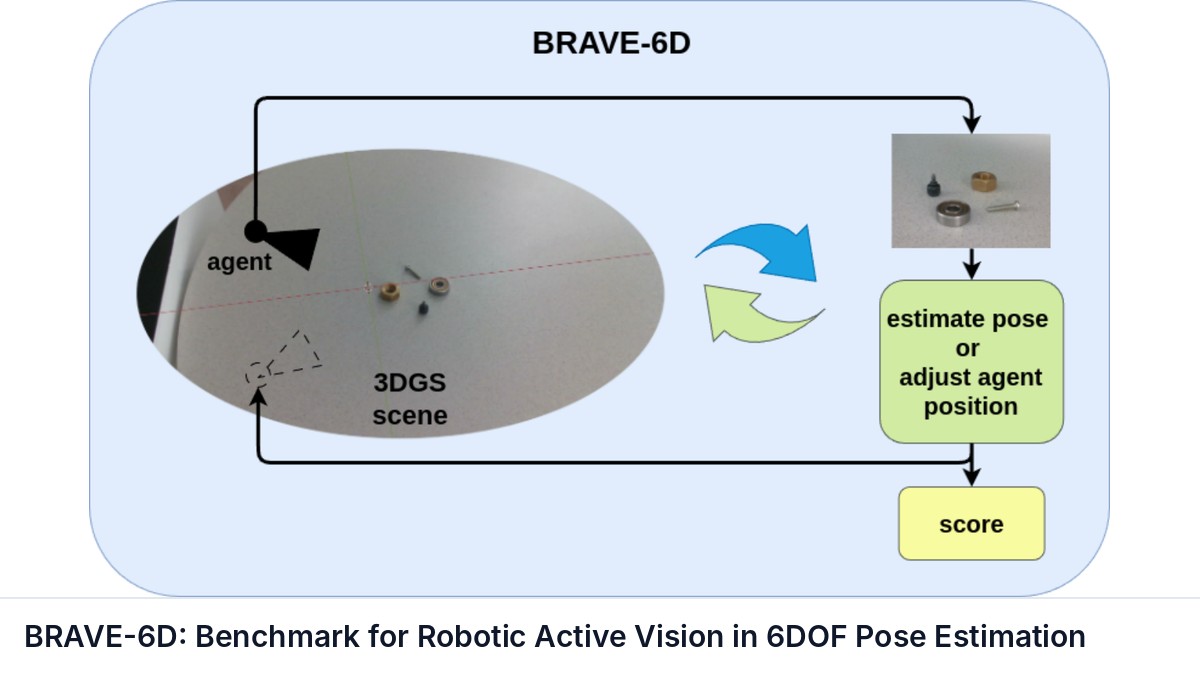
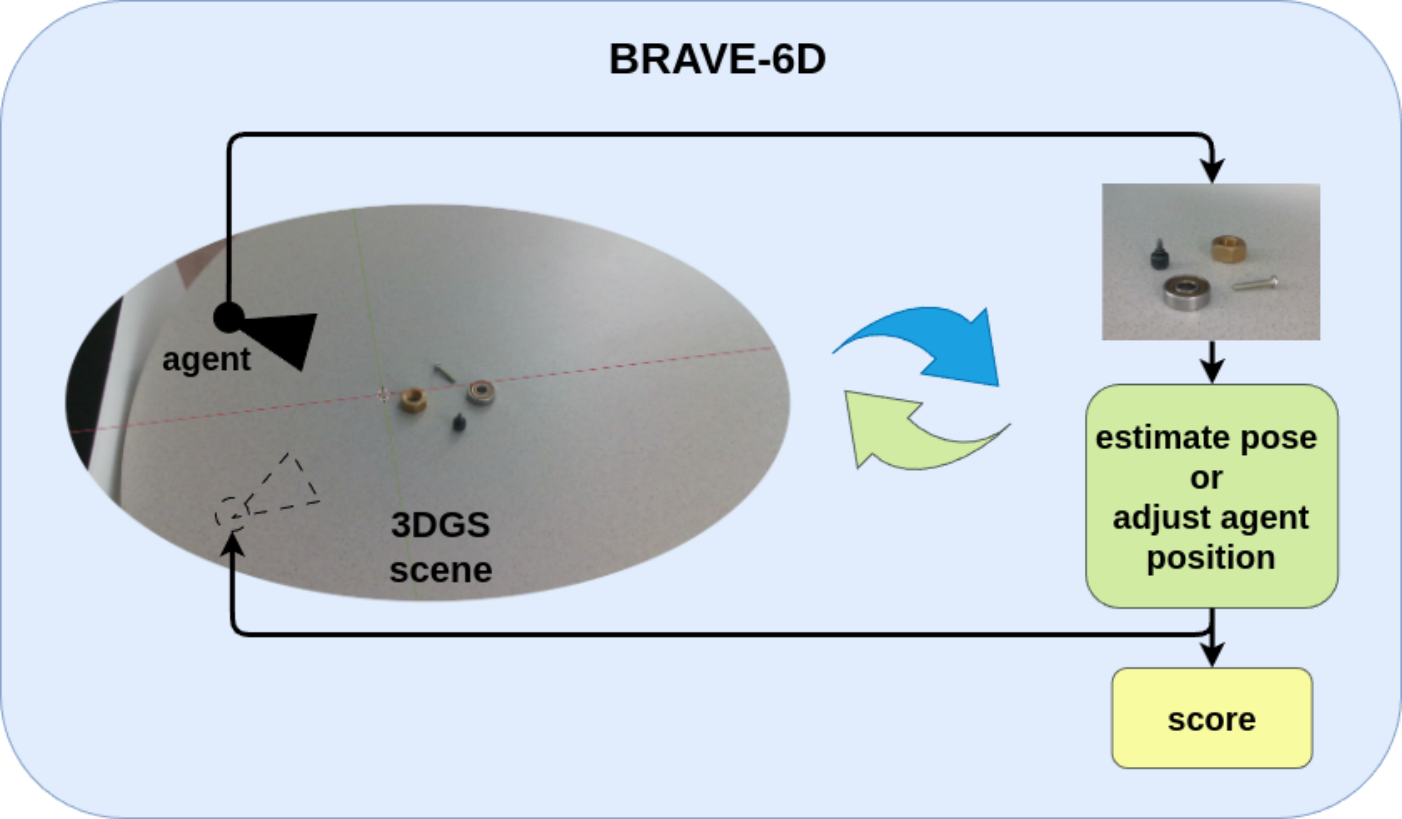
Figure 2 gives an overview of BRAVE-6D and illustrates the feedback loop between the agent and the interactive dataset. We utilize 3D Gaussian Splatting (3DGS) for scene representation due to its capability for real-time view synthesis. The agent interacts with the scene through the ROS interface, deciding whether to move to a new position or to estimate the 6D object pose in camera coordinates.
The 3DGS scenes were collected using a camera mounted on a robotic arm, ensuring precise knowledge of the camera poses.
Sources and Demonstrations
Figures are reproduced from Ausserlechner et al. See the full paper for experimental details and the project page, when the paper links one, for demonstrations and videos.
Related Papers

A Sim-to-Real Integration Pipeline for Training and Deployment of Chunk-Based VLA Manipulation Policies
Mathilde Kappel, Clémence Grislain, Mohamed Chetouani et al.
Vision-Language-Action (VLA) models have become a prominent paradigm for mapping multimodal inputs, including semantic instructions, visual observations of the scene, and proprioceptive observations, to robot actions.

AXIS: A Growable Community-Driven Data Engine for Scalable Robot Manipulation
Mengfei Zhao, Dihong Huang, Yikai Tang et al.
Learning effective robot manipulation policies requires diverse, high-quality demonstrations, yet existing data pipelines are often difficult to scale because they rely on specialized hardware, centralized operators, or fixed task suites.
Beyond Reconstruction: What Matters in Action Tokenization for Robot Policies?
Haoran Chen, Jingtian Ji, Samuel Wheeler et al.
Autoregressive action-token policies such as vision-language-action models require action tokenizers to translate discrete token sequences into precise control actions in continuous space. Many action tokenizers learn the mapping between tokens and actions via a reconstruction objective.

Capability-Aware Arbitration for Semantic Intent-Based Shared Control
Zhaoda Du, Michael Bowman, Xiaoli Zhang
Shared control often allocates robot authority based on confidence in inferred human intent, assuming reliable autonomous execution. When this assumption fails, high intent confidence can cause over-helping.