
Formation Matrix and Energy-based Control of Multi-Agent Systems
Martín Crespo, Sergio Junco, Matías Nacusse · N/A · 2026
Framework
N/A
License
N/A
Stars
N/A
Summary
This paper presents an energy-based controller for a multiagent robotic system designed to achieve and maintain a specific formation while moving on a plane and avoiding collisions between agents. The controller emulates a network of elementary spring-damper modules connecting pairs of agents.
Abstract Summary
Key Points
- This paper presents an energy-based controller for a multiagent robotic system designed to achieve and maintain a specific formation while moving on a plane and avoiding collisions between agents.
- The controller emulates a network of elementary spring-damper modules connecting pairs of agents
- This network, with its de-energized states representing the desired formation, determines the system's dynamics, which is fully encapsulated by a bond graph model.
- The modeling is further enhanced through the introduction of a formation matrix, using a graph-theoretic approach, that describes both the distances and relative velocities among the agents of the arrangement.
- This matrix mathematically represents the interconnection and energy-exchange structure of the bond graph, allowing us to put it in correspondence with the control-by-interconnection CbI-scheme of the IDA-PBC theory, facilitating the solution of the formation control problem within the port-Hamiltonian system framework.
Preliminaries
This section introduces the notation, an overview of the pHS and graph theory, the model of the agents to be used, and the problem statement. These concepts will be used throughout the remainder of the paper. We denote the $n$-dimensional identity matrix by $\boldsymbol{I}_{n}$ and $\boldsymbol{0}_{n\times m}$ represents a matrix of zeros of size $n$ by $m$.
$A=\text{diag}\{[a_{1},\cdots,a_{n}]\}$ denotes the block diagonal matrix such that $a_{n}$ is its $n$-th diagonal element.
Formation Matrix
In this section, we introduce the Formation Matrix concept, which will be crucial for modeling the IPS of Fig. 1 . It serves to compactly express both the dependence of the edges’ lengths on the robots’ positions and the rates of change of the lengths with respect to the robot velocities, i.e., the kinematic and differential kinematic constraints of the setup.
Let’s consider any two neighbor nodes in a graph $\mathcal{G}$, as shown in Fig. 2 .
Interconnected Physical Structure
In this section, we present the pH and BG energy-based models for both a single ECB and the MAS. These models underscore the energy storage, the interconnection structure, and the dynamic behavior of the spring of the ECB. Next, we present the pH and BG model of the ECB.
Formation Control
In this section we demonstrate that the BG model in Fig. 5 , can be transformed into a CbI scheme, with the agents and the ECBs modeled as pHS. In doing so we push forward the assignment of physical attributes to the graph: as we associate to each edge an ECB, the overall interconnection structure of the MAS can be related to the Formation Matrix .
Furthermore, we reveal that the CbI scheme naturally generates Casimir functions and that all the mathematical properties associated with the proposed IPS emerge naturally.
Leader Agent Control
In this section we enhance the formation control law with a leader-follower strategy to place the interconnected MAS at a specific position and orientation in the plane. Finally, we demonstrate convergence to the equilibrium point through the direct method of Lyapunov.
To this end, we select any two neighboring nodes, define one of them as the leader, and apply an additional control law to regulate the position and orientation of the MAS. Let’s consider the leader node and one of the edges that connects it to one of its neighboring agents.
Position Control
In this section, we keep the same physical approach with ECBs presented to solve the collision avoidance problem and configure the external control signal $\nu$ from equation ( 13 ) to implement a position-based formation control. Additionally, we introduce the third extra control signal $\omega$ to ensure the asymptotic stability of the equilibrium point.
We start by defining a Virtual Reference Structure (VRS), composed of a collection of $n$ Virtual Reference Points (VRP) that move in the plane along a predetermined trajectory.
Simulations
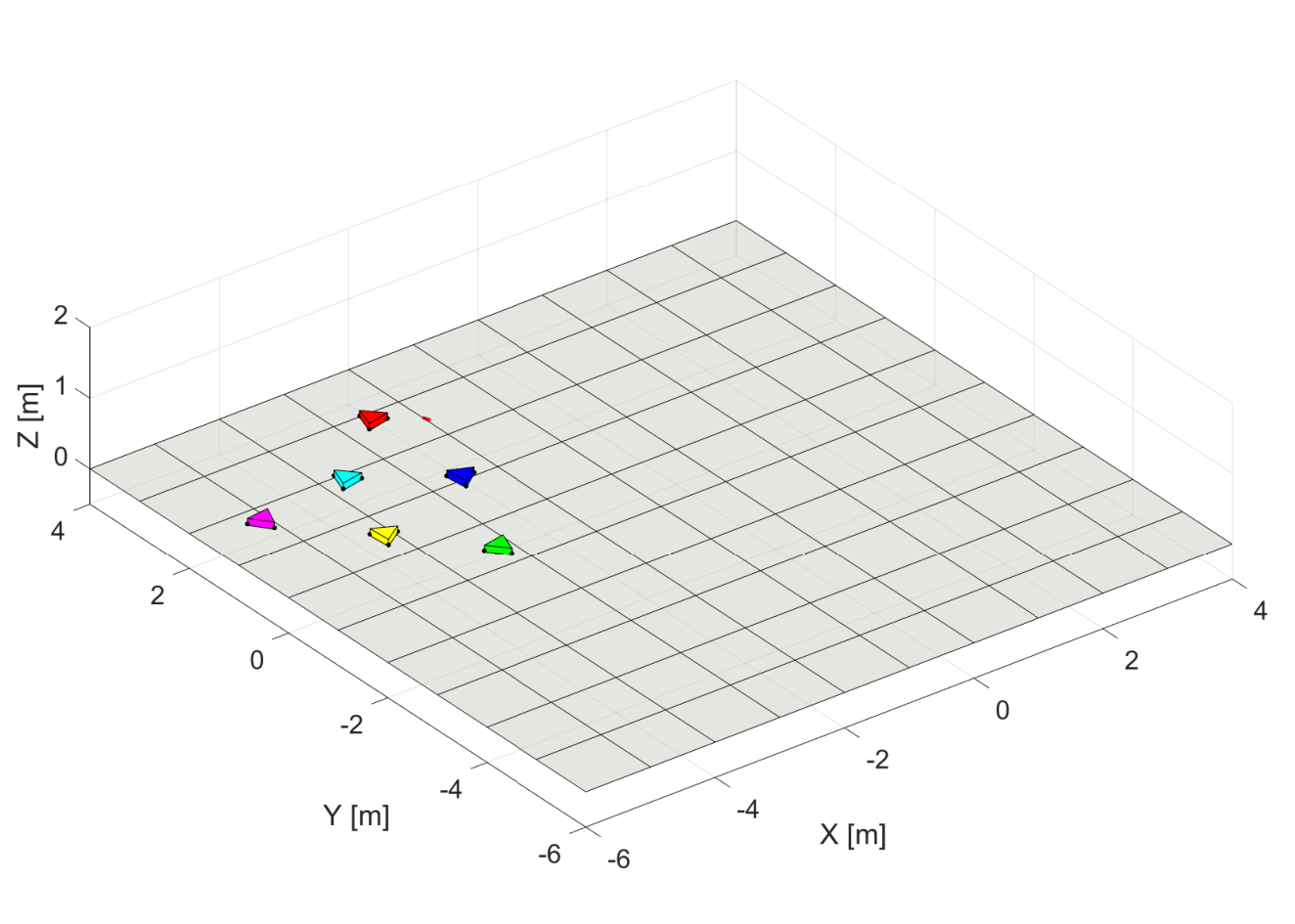
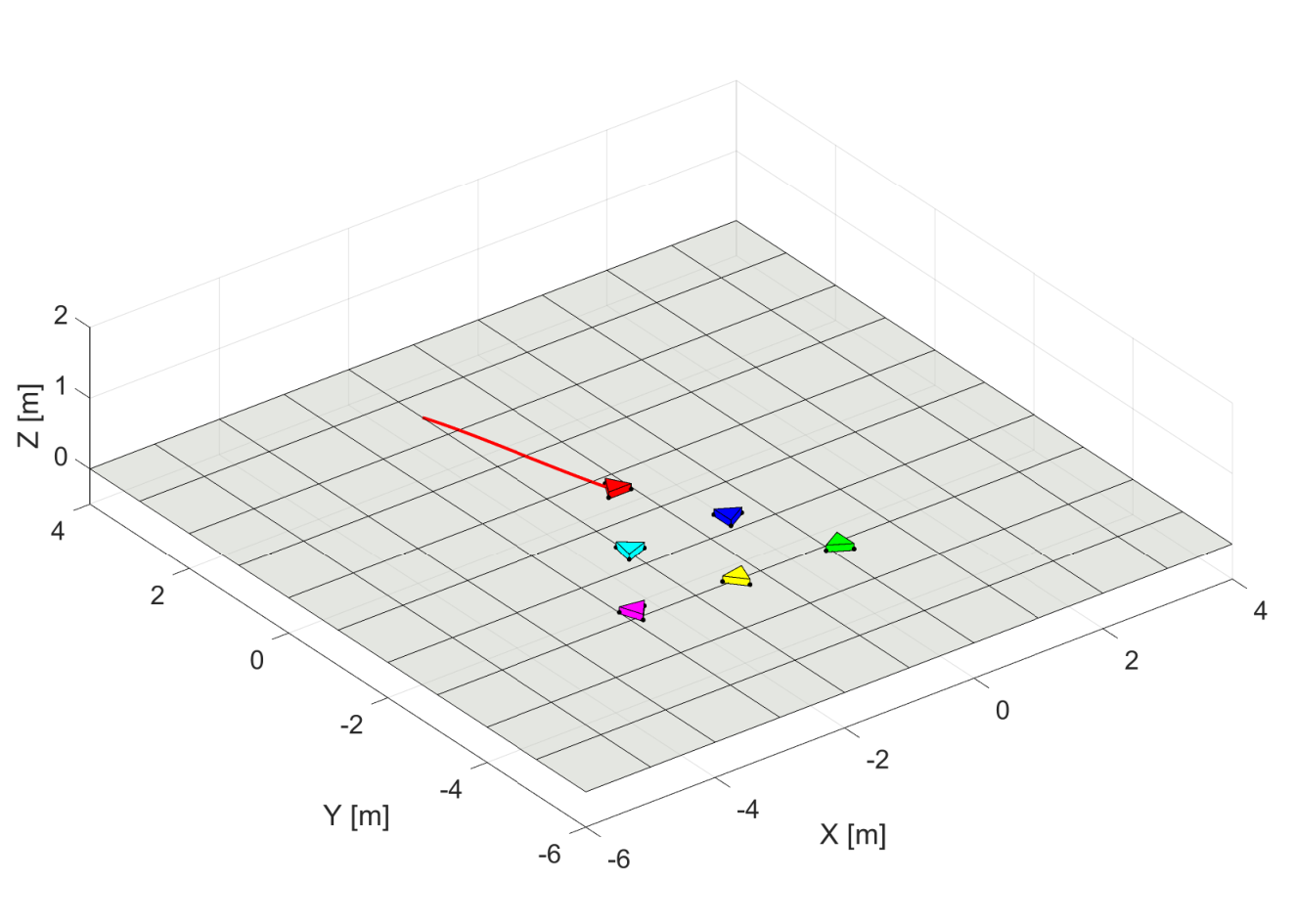
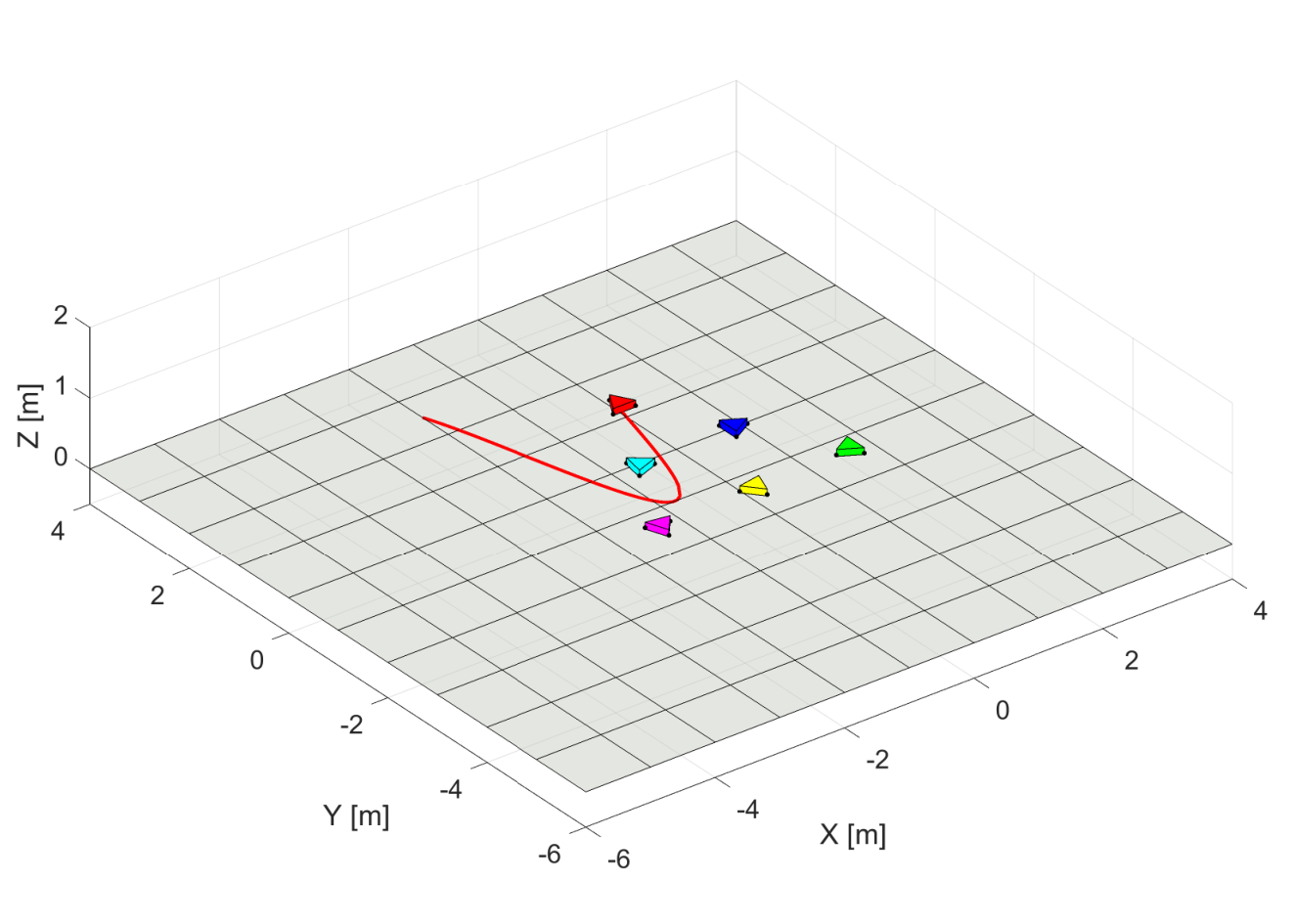
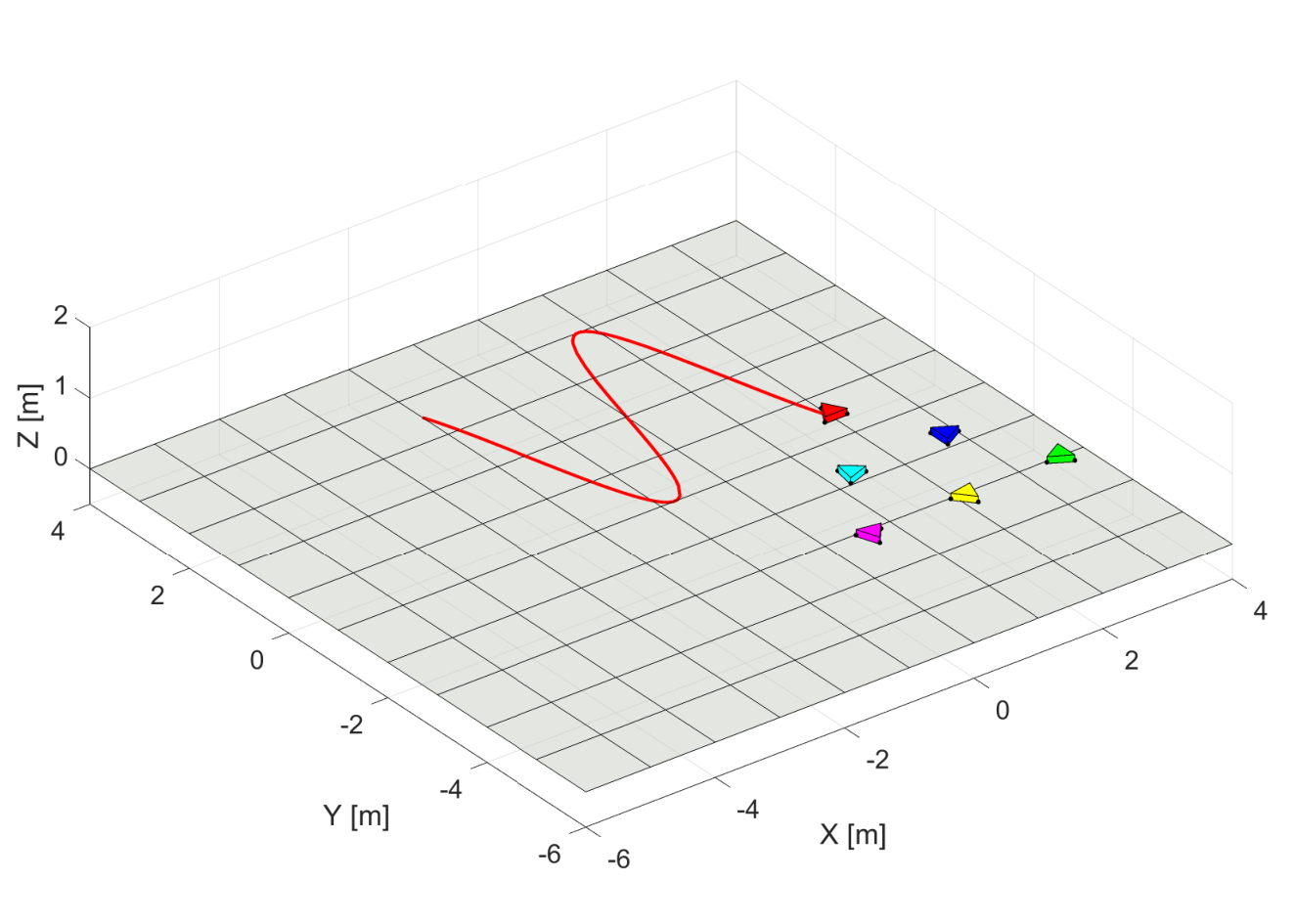
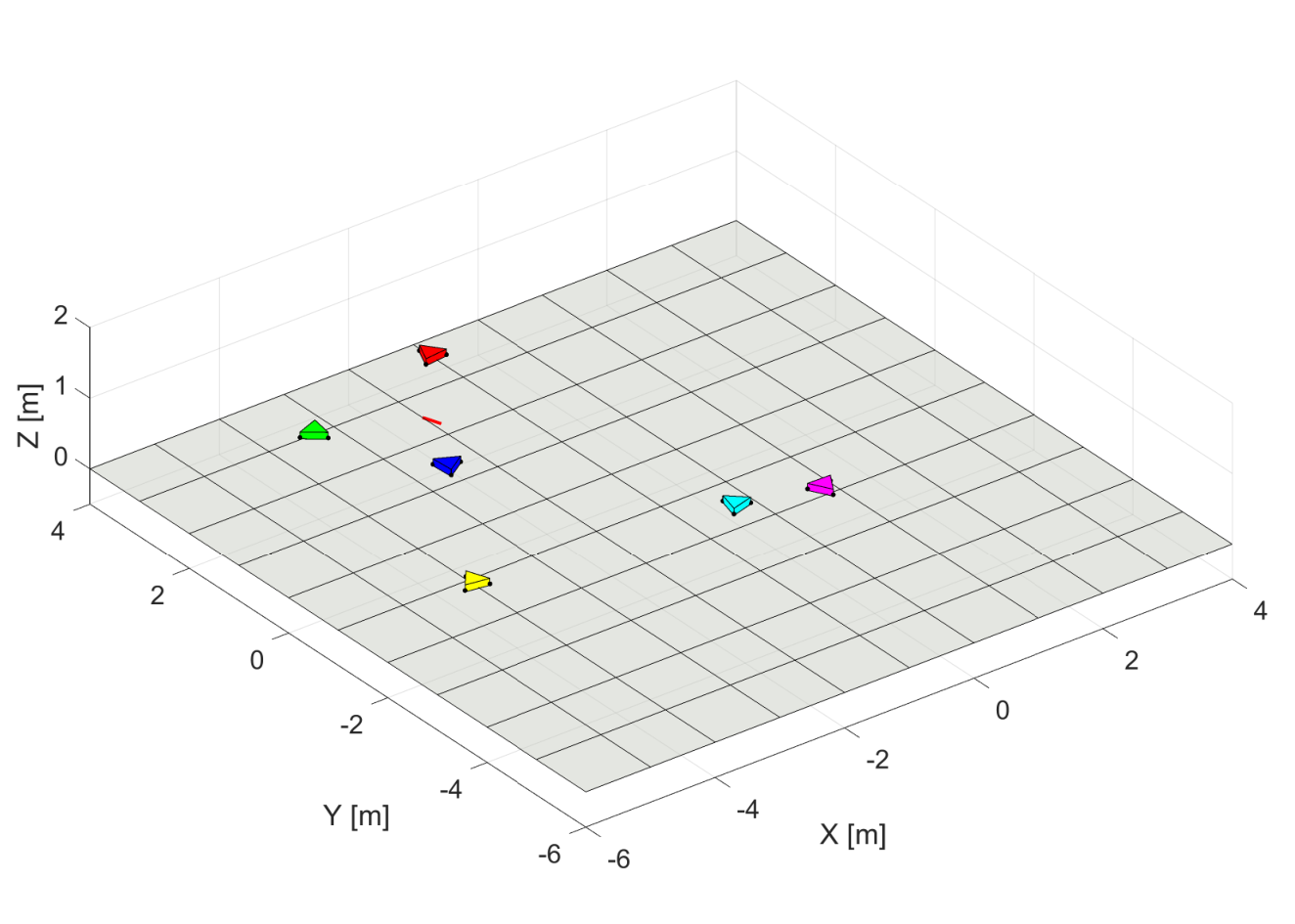
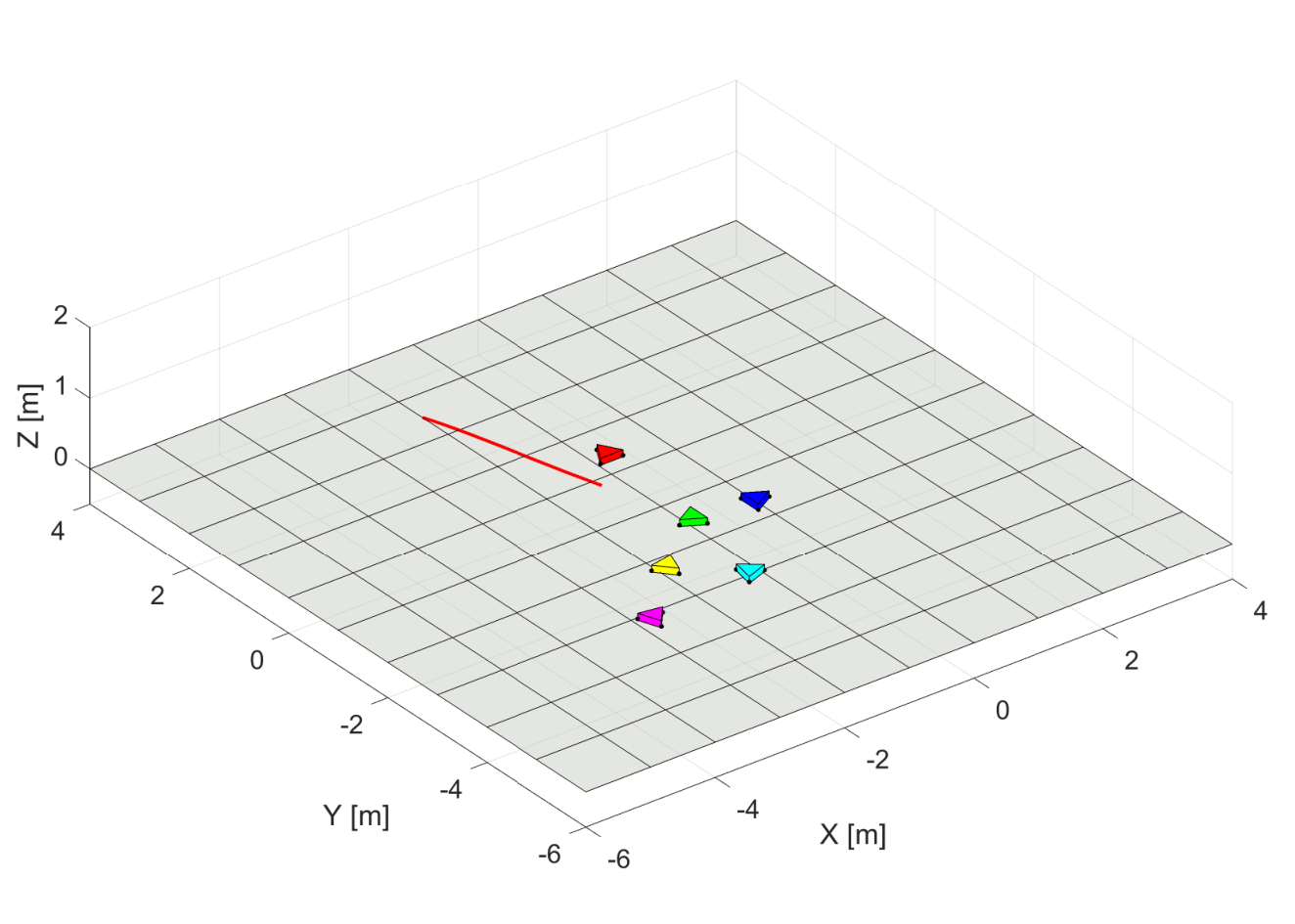
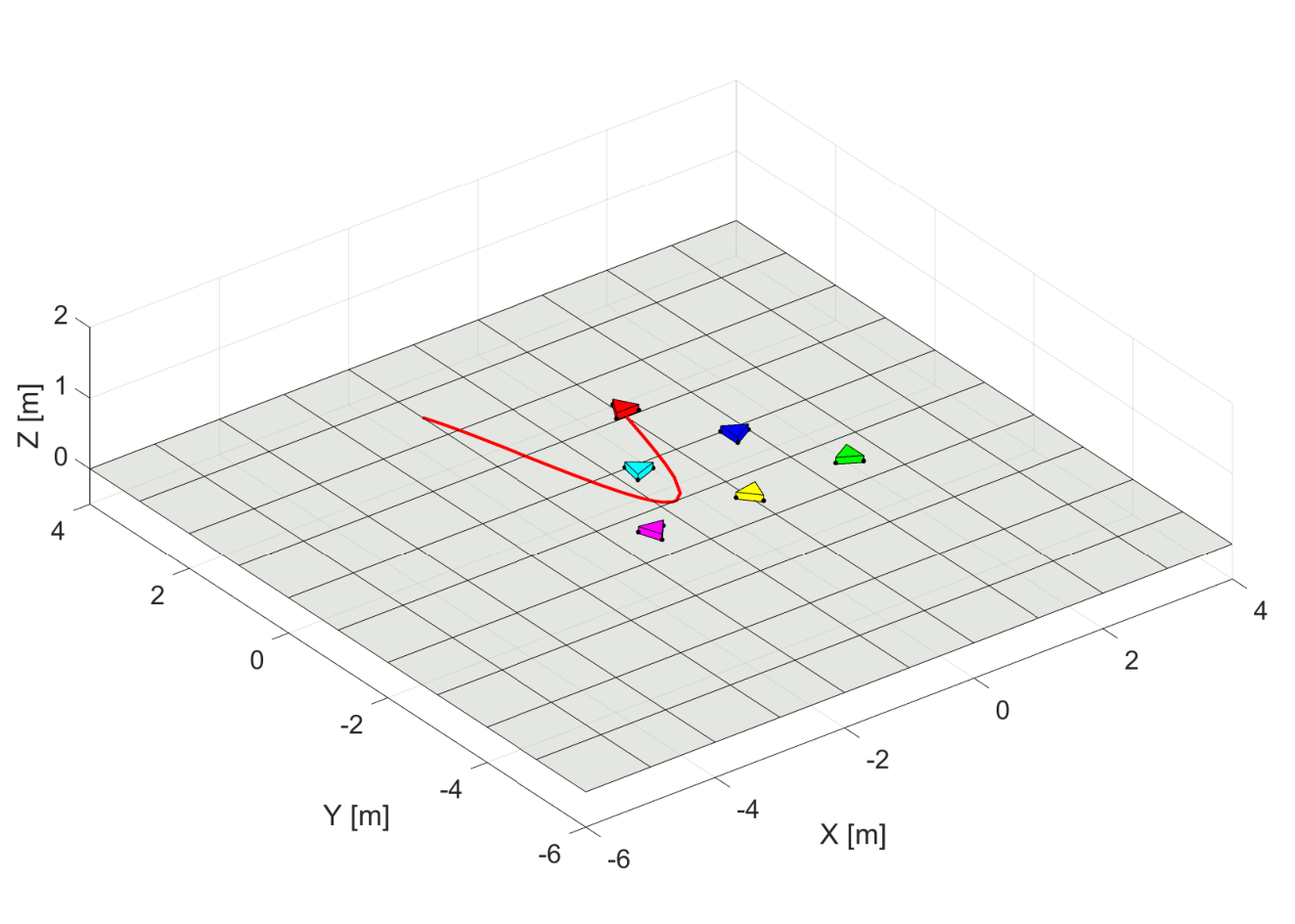
In this section, through two different scenarios, we present simulation results that validate the correct performance of the control strategies presented above. The simulated MAS consists of six agents moving in a horizontal plane, modeled as rigid bodies. The desired topology and orientation are shown in Fig. 8(a) .
Depending on the scenario to be simulated, the MAS can be represented by the minimally rigid directed graph $\mathcal{G}_{1}$ with $m=9$ (Fig. 8(b) ) or a rigid graph $\mathcal{G}_{2}$ with $m=m_{max}=15$ (Fig. 8(c) ). In Fig.
Sources and Demonstrations
Figures are reproduced from Crespo et al. See the full paper for experimental details and the project page, when the paper links one, for demonstrations and videos.
Related Papers

3D Euler-Angle Orientation Control for Two-Ray Fading Mitigation in Maritime Air-to-Sea Communications
Mohammed Bajja, Abdoul Karim A. H. Saliah, Hajar El Hammouti et al.
Maritime Air-to-Sea links are dominated by a line-of-sight ray and a sea-surface reflected ray whose destructive combination produces deep fades. Existing mitigation strategies optimize Unmanned Aerial Vehicle position or trajectory but leave attitude unexploited.
A Balanced Data Diet: Addressing the Exploration Bottleneck in Mega-Scale RL for Robot Control
Octi Zhang, Mateo Guaman Castro, Patrick Yin et al.
General-purpose robots must perform a wide range of tasks from agile locomotion to dexterous manipulation.
A bioinspired internal model-based online estimator for planar pursuit
Tengyue Liu, Xincheng Li, Sofia Morales Ferreira et al.
Bioinspired feedback controls for pursuit, tracking, and collective motion are often expressed in terms of the relative configuration between interacting agents.
A Biomimetic Gaze Control to Restore Head-Neck Movements
Colin Rubow, Haohan Zhang
Powered neck exoskeletons are developed to restore head-neck motions for those with neck muscle weakness. Current methods using hand-held input devices to control these robotic systems are unintuitive or non-viable for these populations.