
Training-Free Diffusion Planning with Analytical Local Scores
Michael Y. Fatemi, Jinhao Liang, Ferdinando Fioretto · N/A · 2026
Framework
N/A
License
N/A
Stars
N/A
Summary
Path finding and multi-robot motion planning require trajectories that are smooth, goal-directed, and collision-free in environments with complex geometric constraints.
Abstract Summary
Key Points
- Path finding and multi-robot motion planning require trajectories that are smooth, goal-directed, and collision-free in environments with complex geometric constraints.
- Recent diffusion-based planners have shown that trajectory generation can be cast as iterative denoising which has opened the doors to learning-based approaches that can handle multi-modal trajectory distributions and refine entire trajectories.
- However, a key limitation is that diffusion planners require training on large collections of feasible trajectories, rendering them map-specific, and difficult to deploy when high-quality demonstrations are unavailable.
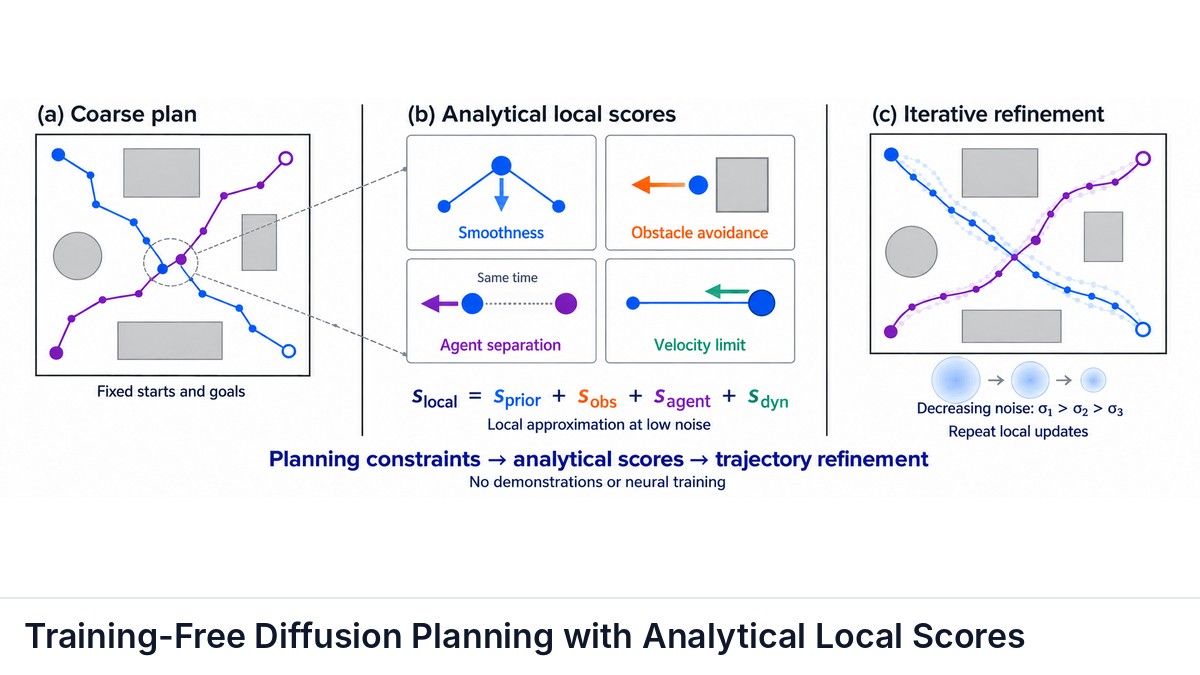
- This paper introduces a training-free diffusion-based motion planner that replaces learned global trajectory scores with analytical local scores derived from obstacle, smoothness, velocity, and inter-agent feasibility terms.
- The proposed idea relies on a key observation: the score of a trajectory can be reconstructed by considering only local interactions between neighboring waypoints and nearby constraints.
Preliminaries
Multi-agent path planning. Multi-agent path planning involves computing collision-free trajectories for multiple agents navigating a shared environment from designated start positions to goal states.
Let $\mathcal{A}=\{a_{1},\dots,a_{N_{a}}\}$ be a set of $N_{a}$ robots that move in a bounded, planar workspace $\mathcal{W}\subset\mathbb{R}^{2}$ containing a set of static obstacles $\mathcal{O}=\{o_{1},\dots,o_{N_{o}}\}$.
Training-Free Diffusion-based Planning (TFDP)
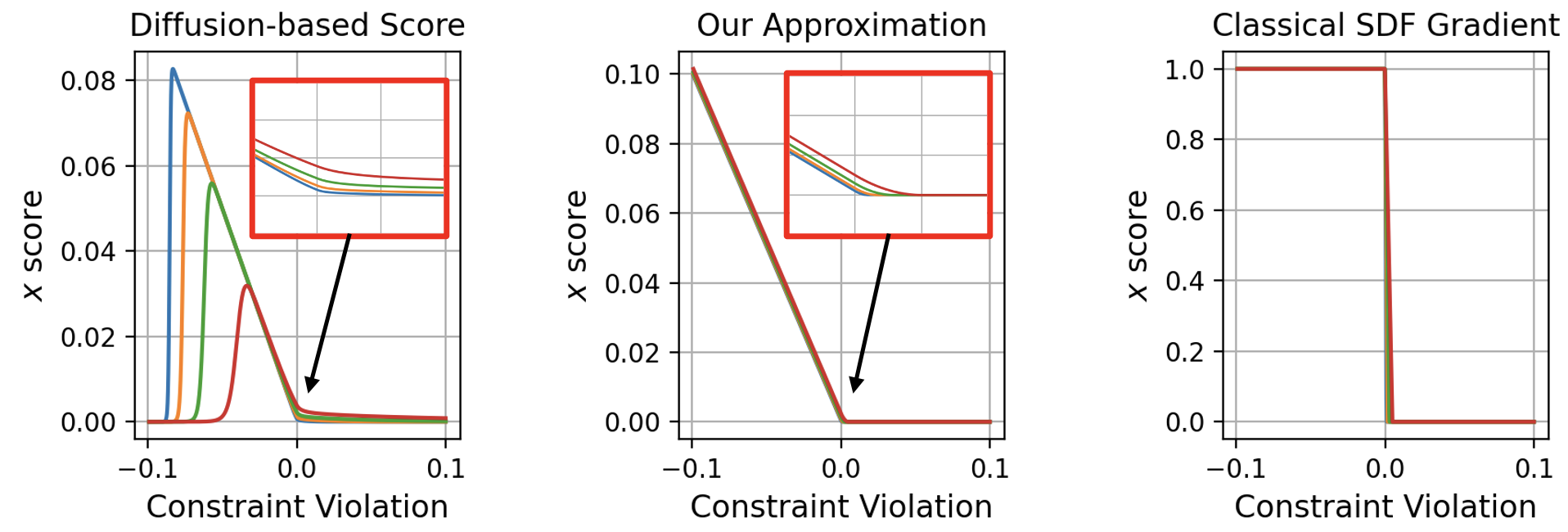
This section presents Training-Free Diffusion-based Planning (TFDP), a method that performs iterative denoising without a learned score model. The key idea is to replace the unknown global score $\nabla_{\pi}\log p_{\sigma}(\pi\mid\mathcal{O},s,g)$ of the data distribution with the score of an explicitly constructed surrogate target, whose factors are dictated by the locality of the planning problem itself.
Experiments
Settings. To evaluate the performance of various multi-agent path planning algorithms, we design two experimental settings targeting different aspects of the problem: 1.
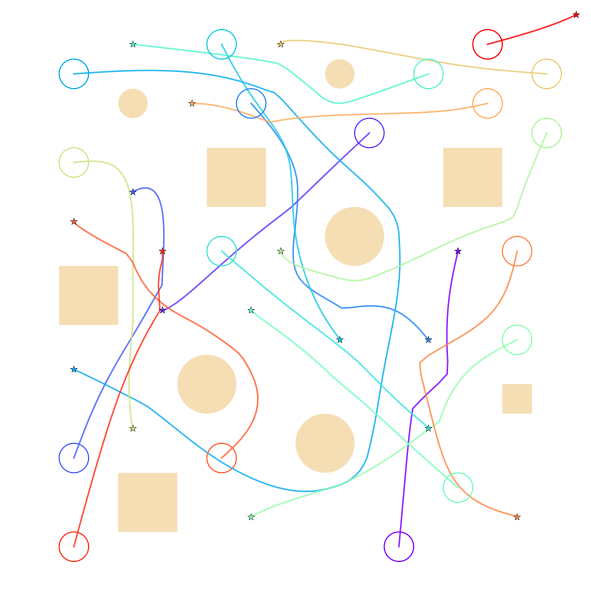
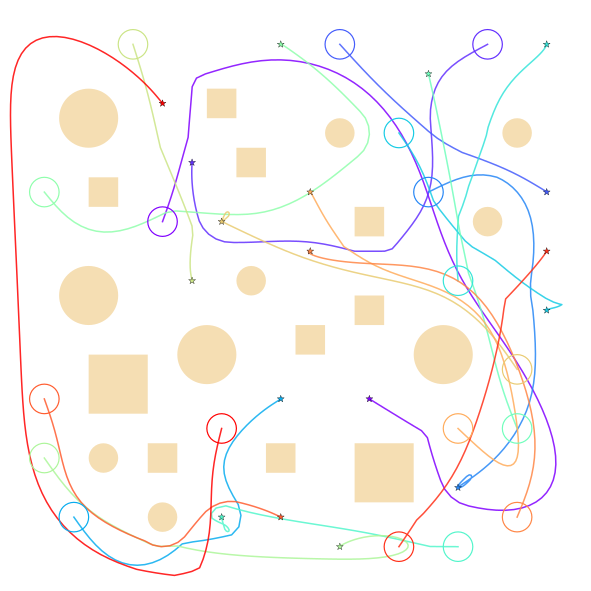
Feasibility, Efficiency, Quality: We adopt a recent multi-agent path planning benchmark ( Liang et al., 2026a ) which includes four representative map types: random maps with varying obstacle densities (basic and dense), and structured maps mimicking real-world environments (room and shelf layouts).
Sources and Demonstrations
Figures are reproduced from Fatemi et al. See the full paper for experimental details and the project page, when the paper links one, for demonstrations and videos.
Related Papers
A Low-Cost, Open Platform for End-to-End Autonomous Driving on a Miniature Ackermann Vehicle
Gustavo Claudio Karl Couto, Eric Aislan Antonelo, Gabriel George Zipperer
This paper presents a low-cost, open experimental platform for research in end-to-end autonomous driving with miniature Ackermann vehicles.
AHEAD: Anticipatory Hand-Driven Teleoperation via Human Intent Prediction
Seok Joon Kim, Junho Lee, Federica Spinola et al.
Direct hand-driven teleoperation maps an operator's hand motion to robot end-effector commands at every frame, enabling precise control, but it requires constant monitoring and correction during approach, grasp, and placement, which can be slow and fatiguing.
Collective Learning for Unified Robotic Manipulation via Predictive Dynamics Adaptation
Shaocheng Liu, Yuan Meng, Zhenshan Bing et al.
Learning a collective policy for state-based Cartesian manipulation across diverse robotic embodiments presents a fundamental challenge due to embodiment-dependent transition dynamics.
Dexterity from Supervised Play
Botao He, Yiming Dou, Yiannis Aloimonos et al.
How can robots autonomously collect the contact-rich experience needed to learn dexterous manipulation?