
Keep the Effect, Drop the Actor: Programmable Effect-to-Execution World-Action Models
Junyi Hu, Zhewen He, Zhenhua Li, Yi Fang · N/A · 2026
Framework
N/A
License
N/A
Stars
N/A
Summary
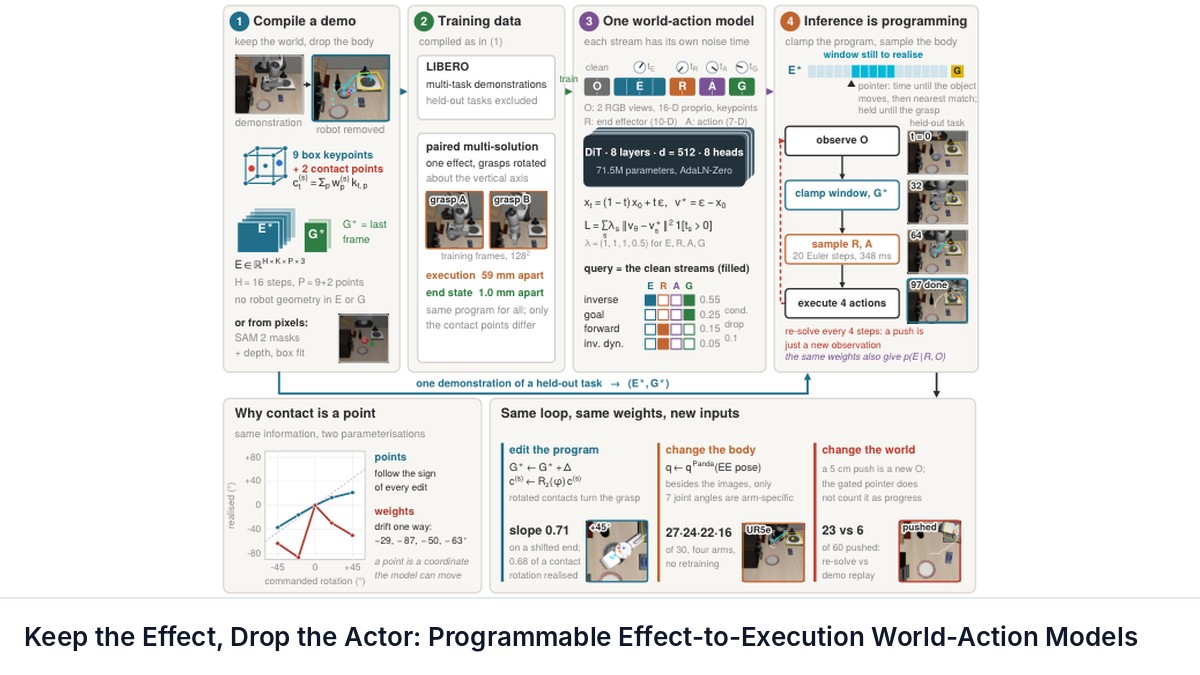
A robot demonstration records two things in the same frames: what happened to the objects, and how one particular arm made it happen. We condition on the first.
Abstract Summary
Key Points
- A robot demonstration records two things in the same frames: what happened to the objects, and how one particular arm made it happen.
- We condition on the first
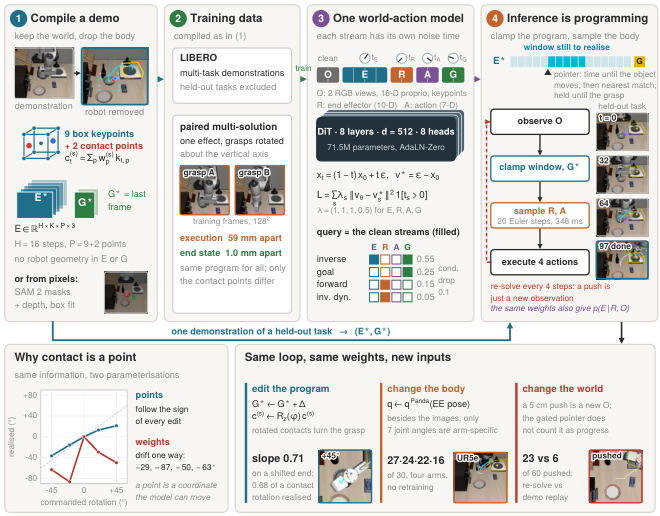
- A demonstration is compiled into an effect program: the 3D keypoint trajectories of the objects that moved, two points marking where each was held, and the configuration the scene ends in, with the demonstrator removed.
- PEWAM, a 71.5M-parameter world-action model, generates effect, robot execution, action and terminal state as four streams with independent flow-matching times, so clamping a program and sampling the execution turns inference into programming, re-solved closed loop from the live scene.
- On held-out LIBERO-Goal tasks, one demonstration's program completes 40 of 90 episodes, where the same backbone given a goal image or language, and published demonstration-conditioned methods, complete at most 19; on three of Meta-World's held-out classes it exceeds the best published results, though not on the five-class mean.
Method
The observation $O_{t}$ holds two RGB views, proprioception and the entities’ current keypoints as an anchor.
For $K$ entities, the effect $E\in\mathbb{R}^{H\times K\times P\times 3}$ is the world-frame trajectory, over a horizon $H{=}16$, of $P$ points per entity: the eight corners and the centre of its oriented box, plus two contact points $c^{(1)},c^{(2)}$ at the centroids of the two finger-side contact patches at the moment of grasp.
Experiments
We evaluate on held-out tasks and objects of LIBERO, on the test classes of Meta-World ML10 and ML45, on RLBench, on four robot arms and on a real Franka arm programmed by human video (Table 6 ); simulated rollouts use the benchmark’s own success check. LIBERO episodes re-plan every $K_{\text{exec}}{=}4$ steps under a 400-step cap, with one fixed environment and sampling seed and 30 episodes per task and cell.

Sources and Demonstrations
Figures are reproduced from Hu et al. See the full paper for experimental details and the project page, when the paper links one, for demonstrations and videos.
Related Papers

A Sim-to-Real Integration Pipeline for Training and Deployment of Chunk-Based VLA Manipulation Policies
Mathilde Kappel, Clémence Grislain, Mohamed Chetouani et al.
Vision-Language-Action (VLA) models have become a prominent paradigm for mapping multimodal inputs, including semantic instructions, visual observations of the scene, and proprioceptive observations, to robot actions.

Capability-Aware Arbitration for Semantic Intent-Based Shared Control
Zhaoda Du, Michael Bowman, Xiaoli Zhang
Shared control often allocates robot authority based on confidence in inferred human intent, assuming reliable autonomous execution. When this assumption fails, high intent confidence can cause over-helping.
Design and Evaluation of a Touchscreen-Based Teleoperation Interface for Robotic Manipulators
Juan José García Cárdenas, Alperen Kenan, Hamidreza Raei et al.
Intuitive teleoperation interfaces are crucial for the safe and effective operation of robotic manipulators in challenging environments.
DexVerse: A Modular Benchmark for Multi-Task, Multi-Embodiment Dexterous Manipulation
Yunchao Yao, Zhuxiu Xu, Tianqi Zhang et al.
Building general-purpose dexterous manipulation policies requires benchmarks that go beyond isolated tasks to systematically evaluate policies across diverse interaction modes, sensory conditions, and robot embodiments.