
DeViGrasp: Robust Visual Mobile Grasping for Quadruped Manipulators under Degraded Perception
Liang Zhou, Jiaming Su, Yancong Wei, Kangkang Dong, Houde Liu · N/A · 2026
Framework
N/A
License
N/A
Stars
N/A
Summary
Quadruped manipulators enable mobile grasping in complex environments, yet their whole-body control policies remain vulnerable to unreliable onboard visual perception.
Abstract Summary
Key Points
- Quadruped manipulators enable mobile grasping in complex environments, yet their whole-body control policies remain vulnerable to unreliable onboard visual perception.
- Existing methods are typically developed under relatively reliable observations and have not systematically examined how occlusion, segmentation-mask dropout, depth noise, and target-localization jitter affect grasp reasoning and target tracking.
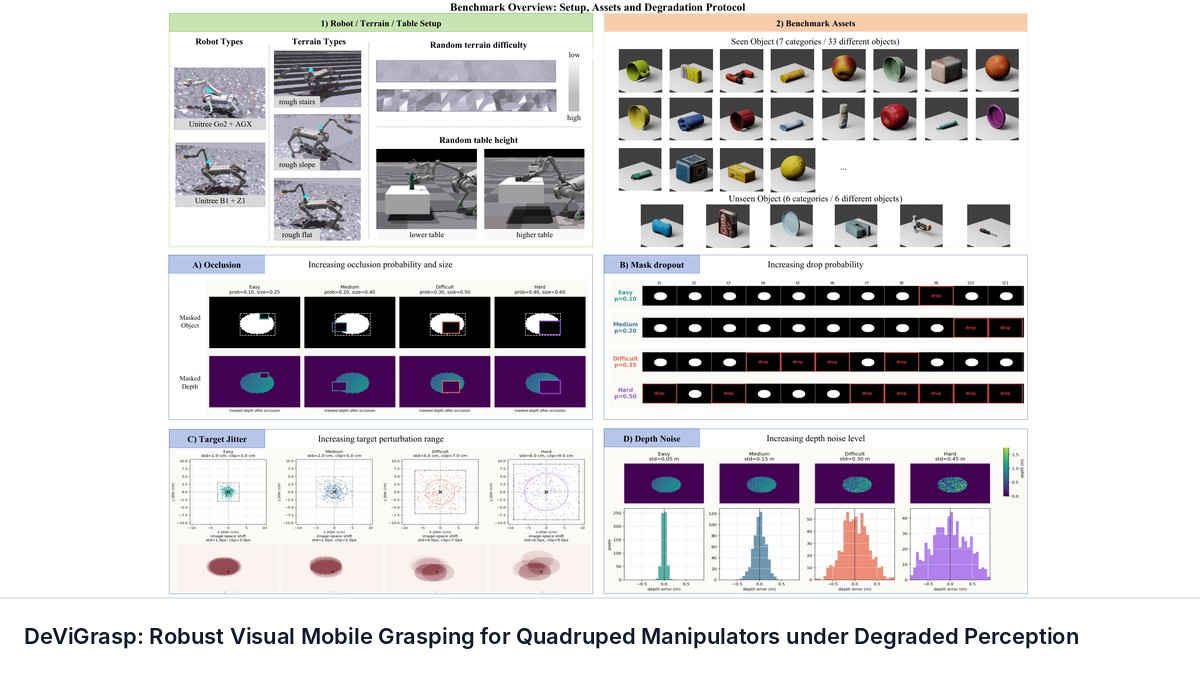
- To address this gap, we introduce DeViGrasp-Bench, a benchmark for mobile grasping under degraded vision that incorporates controlled visual degradations, seen and unseen objects, multiple difficulty levels, and complex terrains, and evaluates task success, execution efficiency, and action smoothness.
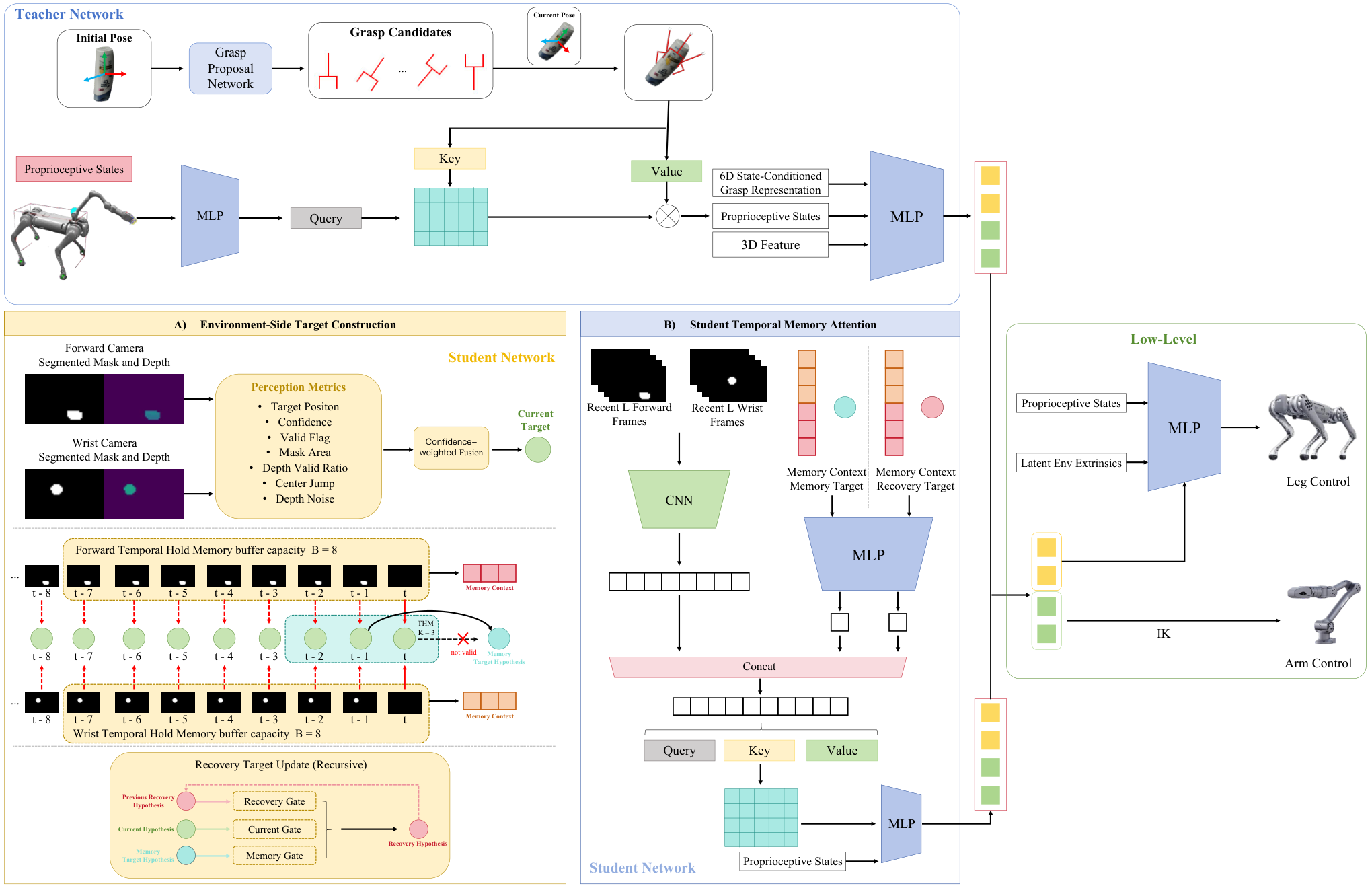
- We further propose DeViGrasp-Net, a teacher--student framework that combines state-conditioned grasp reasoning with reliability-aware temporal target estimation.
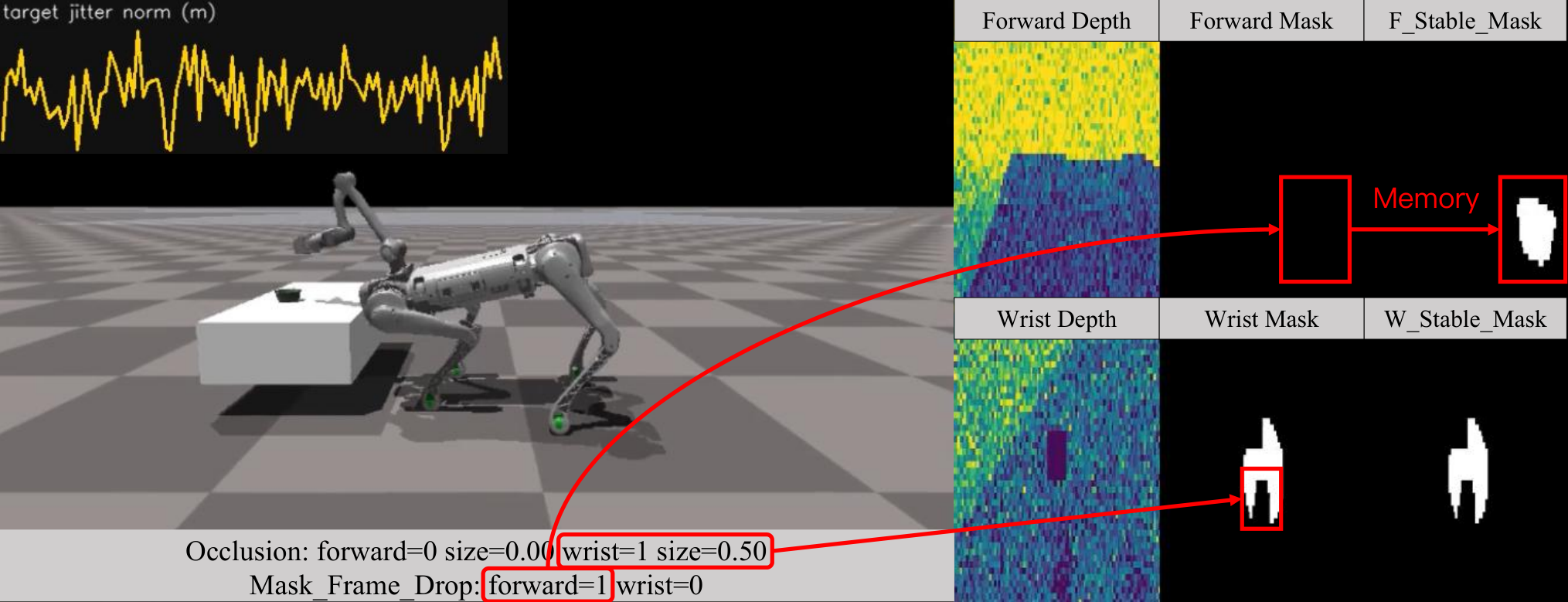
- The privileged teacher attends to offline grasp candidates conditioned on object, robot, end-effector, and task states, while the deployable student fuses dual-view segmented-depth observations with current, memory, and recovery target hypotheses through Target Hold Memory and Temporal Memory Attention.
DeViGrasp-Bench: Degraded Vision Grasping Benchmark
Quadruped manipulators rely on moving onboard cameras to observe target objects, making visual perception vulnerable to environmental occlusion, arm self-occlusion, segmentation-mask dropout, depth noise, and target-localization errors. To systematically study how these failures affect closed-loop mobile grasping, we introduce DeViGrasp-Bench , a degraded-vision grasping benchmark for quadruped manipulators.
An overview of the benchmark is shown in Fig. 1 . DeViGrasp-Bench is built in Isaac Gym.
Method
We propose DeViGrasp-Net , a teacher–student framework for robust quadruped mobile grasping under degraded visual perception. As illustrated in Fig. 2 , the framework addresses two complementary challenges: selecting grasp candidates that match the current whole-body state and maintaining a reliable target representation under intermittent visual failures.
Experiments
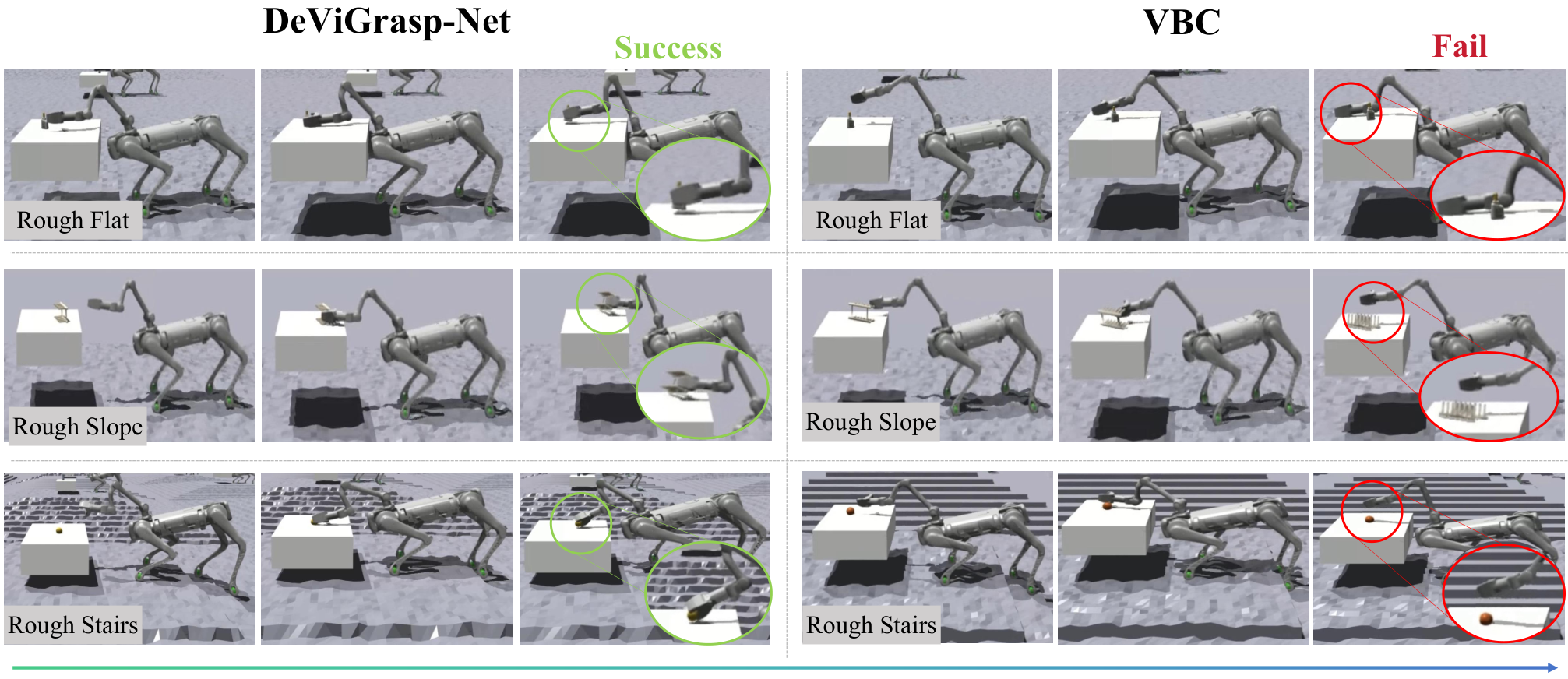
We evaluate DeViGrasp-Net on DeViGrasp-Bench . The experiments are designed to answer four questions: (1) whether DeViGrasp-Net improves robustness under different levels of visual degradation; (2) how each proposed component contributes to performance; (3) whether the learned policy generalizes to unseen objects; and (4) whether the method remains effective on complex terrain.
All experiments use Isaac Gym on a single NVIDIA RTX 3090 Ti with a Unitree B1–Z1 platform.
Sources and Demonstrations
Figures are reproduced from Zhou et al. See the full paper for experimental details and the project page, when the paper links one, for demonstrations and videos.
Related Papers
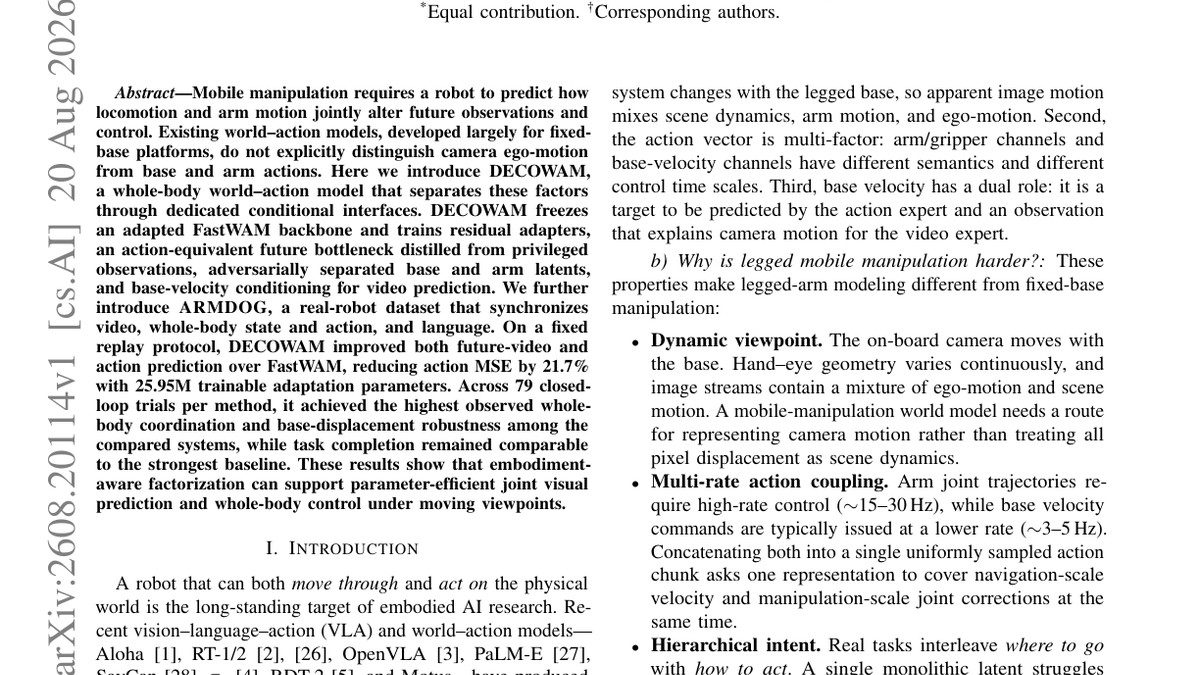
DECOWAM: Decoupled Whole-Body World-Action Model for Legged Mobile Manipulation
Siyuan Ma, Boshi Zhang, Yutian Zhang et al.
Mobile manipulation requires a robot to predict how locomotion and arm motion jointly alter future observations and control. Existing world-action models, developed largely for fixed-base platforms, do not explicitly distinguish camera ego-motion from base and arm actions.
DUET: Decoupled Upper- and Lower-Body Execution for Task-Agnostic Humanoid Loco-Manipulation
Kapalik Khanal, Biswash Khatiwada, Stephen Afrifa et al.
Changing a humanoid robot's manipulation policy should not require retraining the controller that maintains the robot's balance.
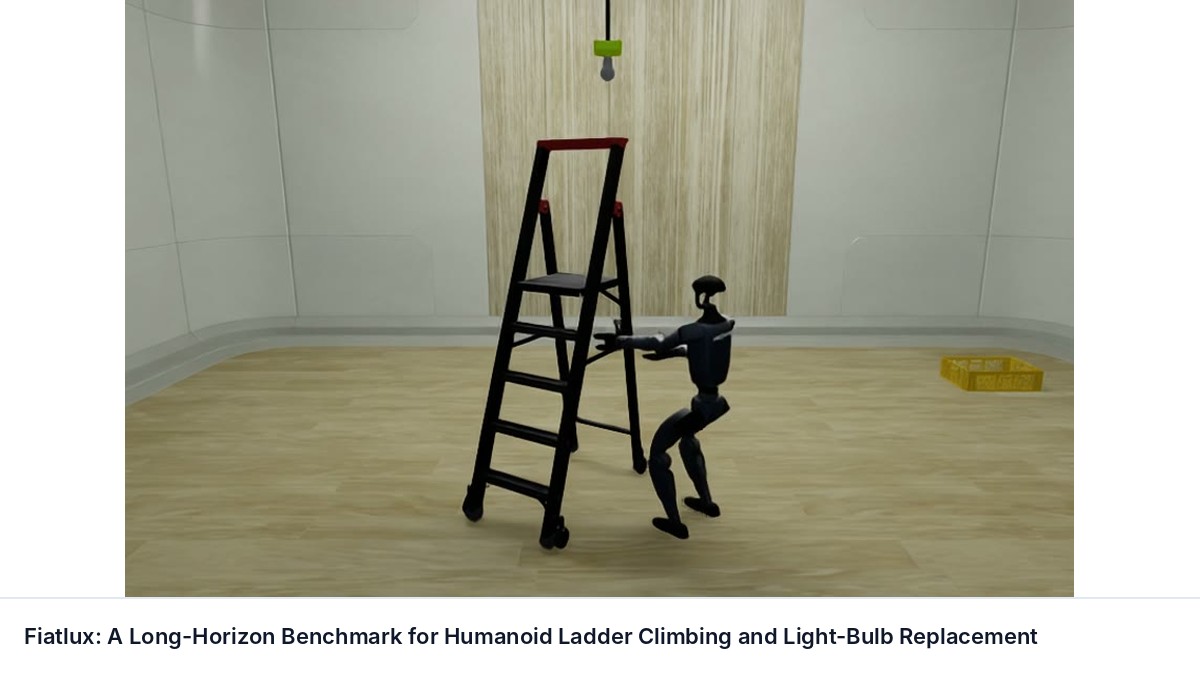
Fiatlux: A Long-Horizon Benchmark for Humanoid Ladder Climbing and Light-Bulb Replacement
Pavel Bushuyeu, Yujin Chen, Anton Nikolaev et al.
Existing benchmarks evaluate tabletop manipulation, flat-floor household activity, or humanoid locomotion and manipulation as separate task groups; none scores vertical mobility and dexterous work on a fragile payload in one long-horizon episode.
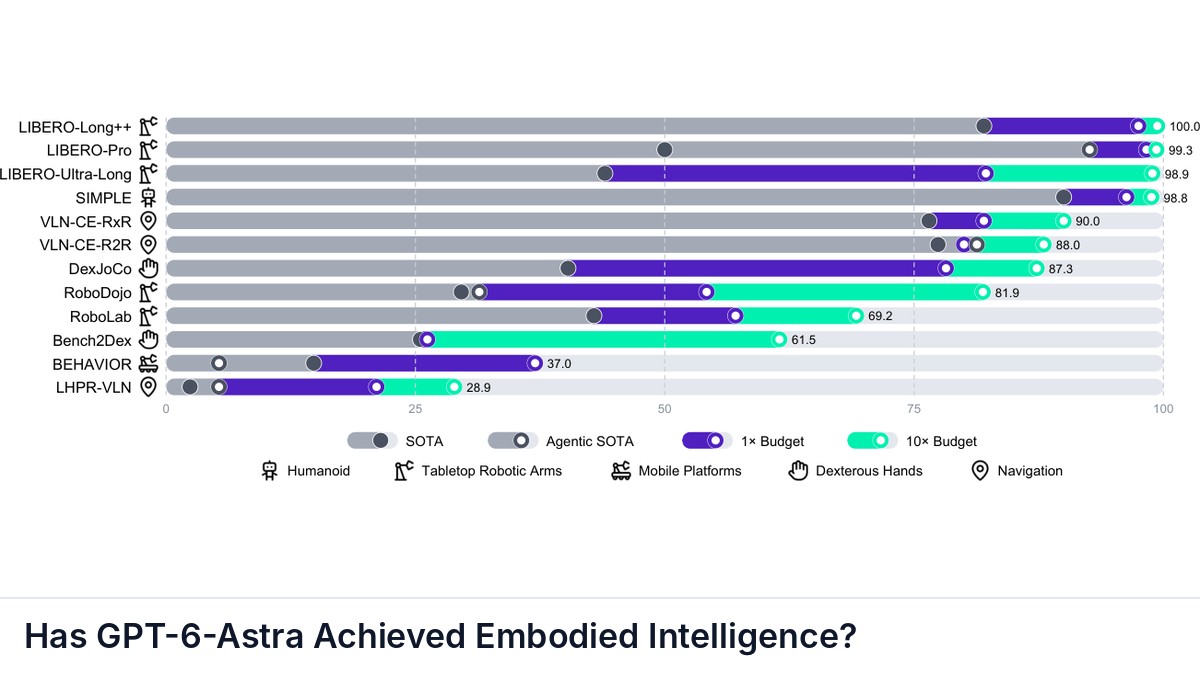
Has GPT-6-Astra Achieved Embodied Intelligence?
SenseNova, Joint Research Team, : et al.
GPT-6-Astra demonstrates a level of competence in robotic manipulation and navigation that challenges the conventional paradigm of building specialized models for individual tasks and embodiments.