
Do Spinning Radar Doppler Velocity Measurements Improve Vehicle Detection and Tracking?
Eric Xie, Daniil Lisus, Timothy D. Barfoot · N/A · 2026
Framework
N/A
License
N/A
Stars
N/A
Summary
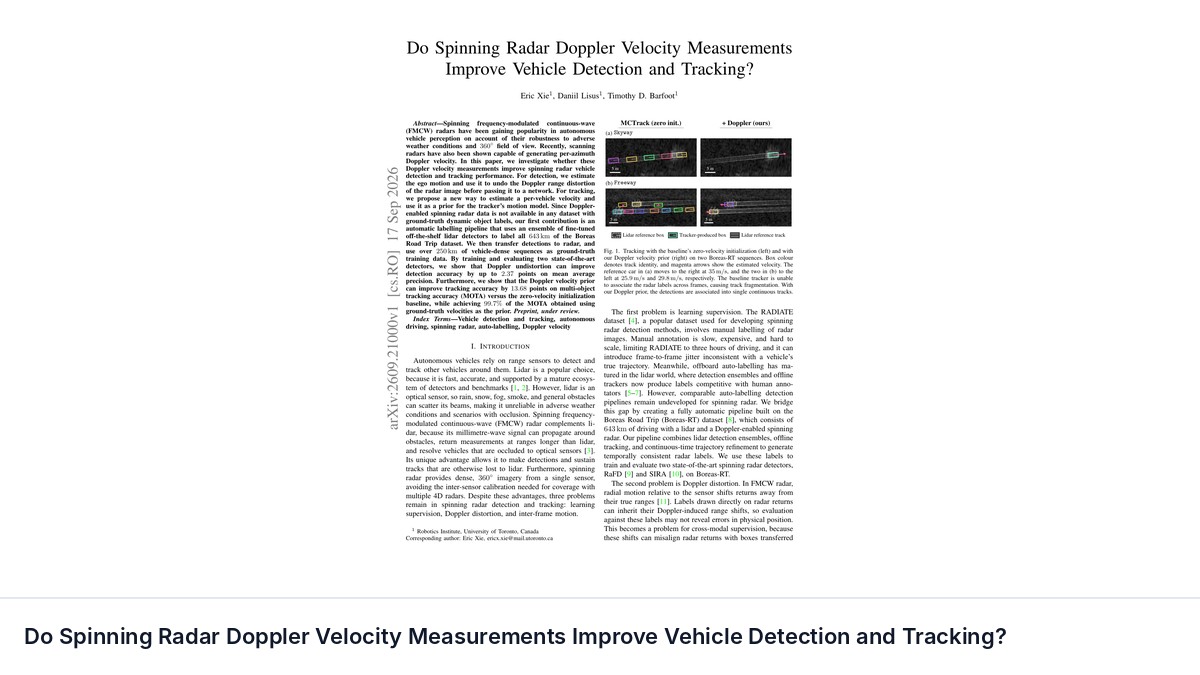
Spinning frequency-modulated continuous-wave (FMCW) radars have been gaining popularity in autonomous vehicle perception on account of their robustness to adverse weather conditions and 360{\deg} field of view.
Abstract Summary
Key Points
- Spinning frequency-modulated continuous-wave (FMCW) radars have been gaining popularity in autonomous vehicle perception on account of their robustness to adverse weather conditions and 360{\deg} field of view.
- Recently, scanning radars have also been shown capable of generating per-azimuth Doppler velocity
- In this paper, we investigate whether these Doppler velocity measurements improve spinning radar vehicle detection and tracking performance.
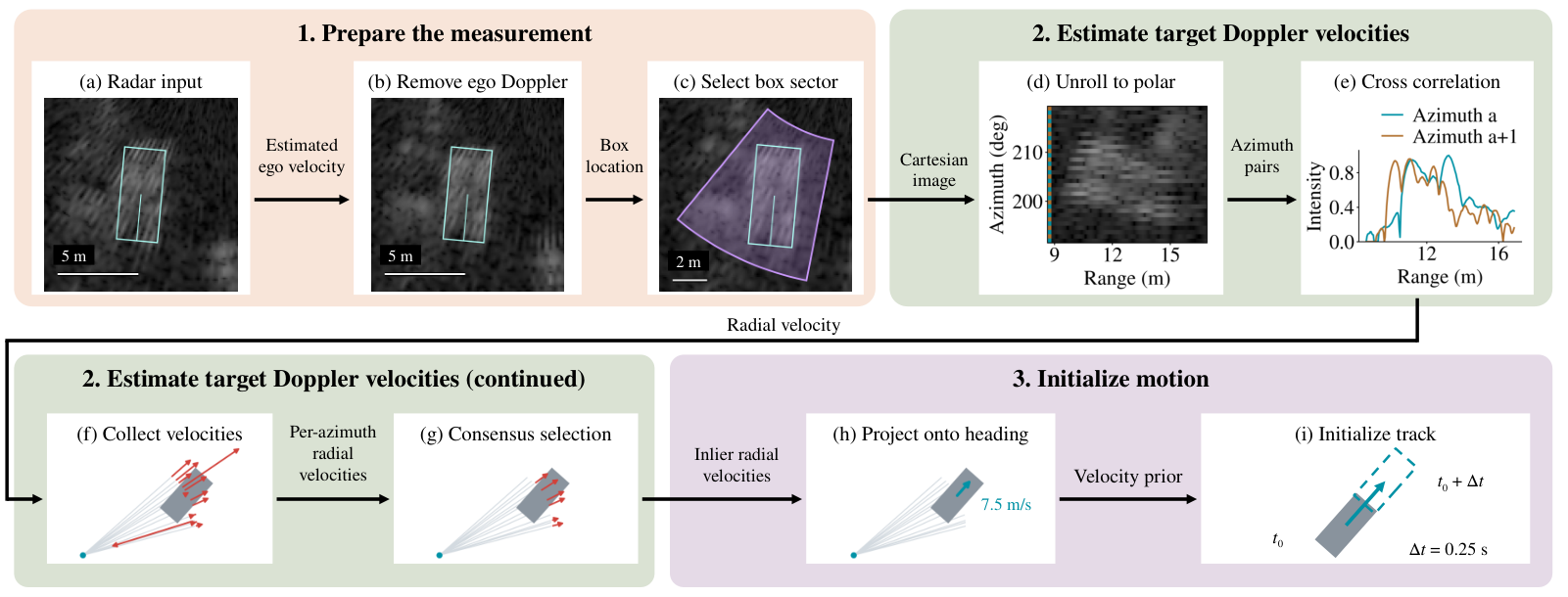
- For detection, we estimate the ego motion and use it to undo the Doppler range distortion of the radar image before passing it to a network.
- For tracking, we propose a new way to estimate a per-vehicle velocity and use it as a prior for the tracker's motion model.
Methodology
Our labelling pipeline uses lidar observations to generate vehicle boxes, track identities, and velocities for spinning radar data. It runs offline on each sequence of Boreas-RT [ 18 ] , using its $10\text{\,}\mathrm{Hz}$, 128-beam Velodyne Alpha Prime lidar, $4\text{\,}\mathrm{Hz}$ Navtech RAS6 spinning radar, calibrated sensor extrinsics, and post-processed GNSS–INS poses.
Figure 2 follows the same vehicles through four stages: detect and fuse, track offline, fit trajectories, and transfer to radar.
Experiments
We present the labels from our pipeline, then use them to evaluate Doppler undistortion for detection and the estimated prior for tracking. We summarize the generated labels here and assess them in the two parts that follow. The pipeline produced over $9.1$ million lidar boxes and over $3.7$ million radar boxes across 60 Boreas-RT sequences spanning $643\text{\,}\mathrm{km}$ of driving.
Table I reports the final outputs by route category. Figure 5 shows four MCTrack failure modes and how refinement resolves them.
Sources and Demonstrations
Figures are reproduced from Xie et al. See the full paper for experimental details and the project page, when the paper links one, for demonstrations and videos.
Related Papers
4D Radar Perception Algorithms for Autonomous Driving: A Review
Xumin Wu, Jun Zhou, Jilin Mei et al.
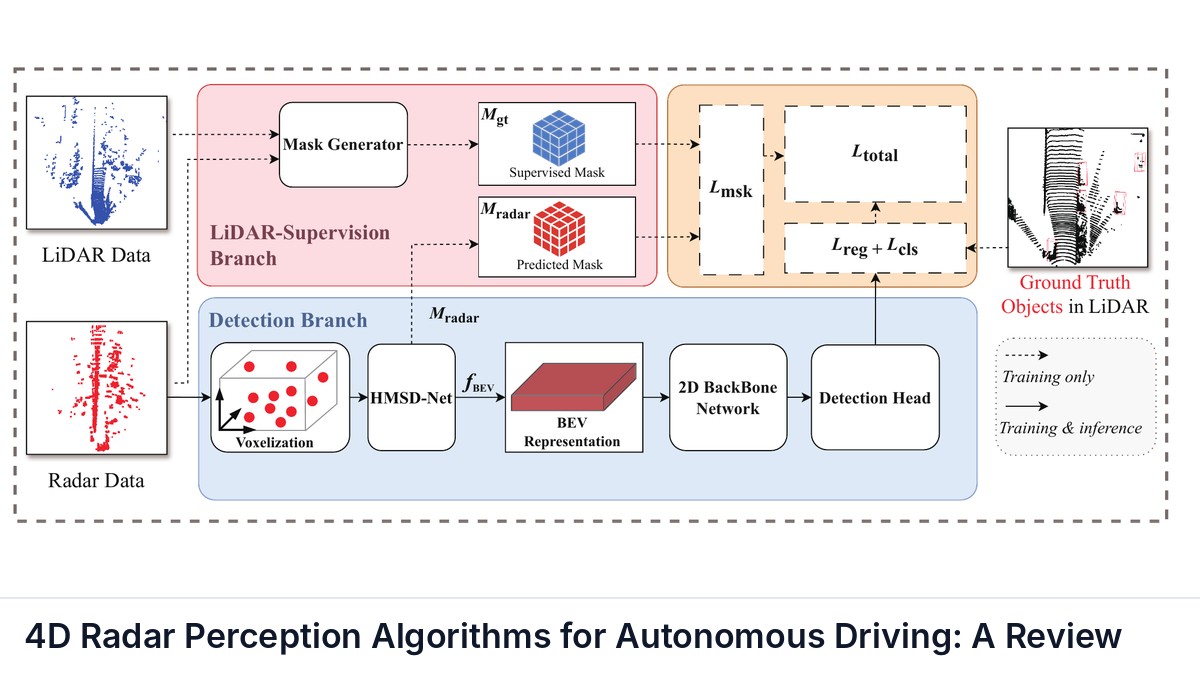
Research on 4D millimeter-wave radar perception algorithms has flourished in recent years, extending from signal processing and object detection to semantic segmentation, motion estimation, occupancy prediction, and dynamic scene reconstruction.
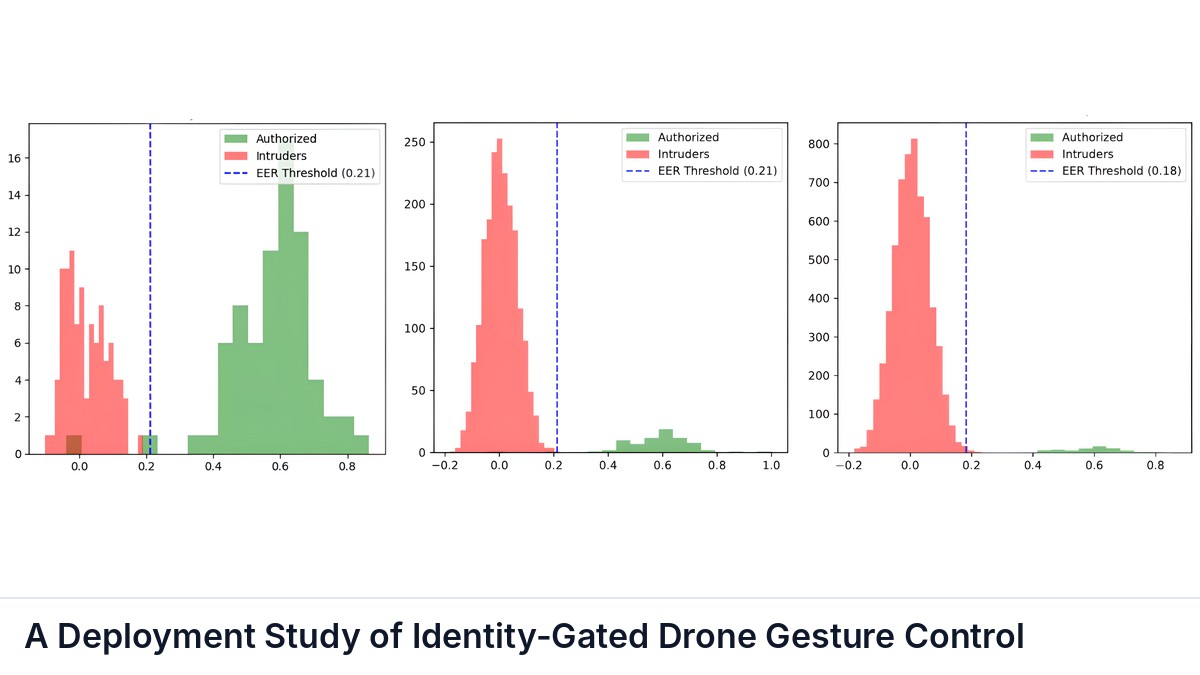
A Deployment Study of Identity-Gated Drone Gesture Control
Diyari Mohammed Salih, Ilyes Chaabeni, Naima Ait Oufroukh
Vision-based gesture control accepts commands from any hand in the camera field of view, which is unsafe in shared indoor spaces.
A Review Of Robotic World Models For Dynamic Environments Based On Factor And Scene Graphs
Marco Giberna, Miguel Fernandez-Cortizas, Jose Luis Sanchez Lopez et al.
Models based on graphs have emerged in robotics as a powerful foundation for internal world representations, where factor and scene graphs are among the most prominent model types found in the related literature and in successful robotic solutions.

A Sim-to-Real Integration Pipeline for Training and Deployment of Chunk-Based VLA Manipulation Policies
Mathilde Kappel, Clémence Grislain, Mohamed Chetouani et al.
Vision-Language-Action (VLA) models have become a prominent paradigm for mapping multimodal inputs, including semantic instructions, visual observations of the scene, and proprioceptive observations, to robot actions.