
ENCP: Episode-Normalized Conformal Prediction for Vision-and-Language Navigation
Vicky Feliren, A. Taufiq Asyhari, Muhamad Risqi U. Saputra · N/A · 2026
Framework
N/A
License
N/A
Stars
N/A
Summary
Uncertainty estimation for Vision-Language-Navigation (VLN) models is a critical task since it can help identify ambiguous and unreliable predictions, enabling agents to make safer navigation decisions.
Abstract Summary
Key Points
- Uncertainty estimation for Vision-Language-Navigation (VLN) models is a critical task since it can help identify ambiguous and unreliable predictions, enabling agents to make safer navigation decisions.
- As one of the most advanced uncertainty estimation frameworks, conformal prediction (CP) offers a promising approach for uncertainty estimation in VLN.
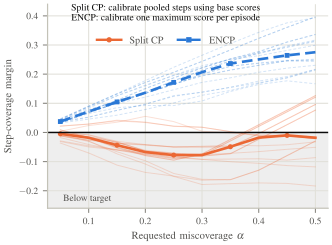
- However, given that VLN agent requires a sequence of steps, standard calibration in conformal prediction fails to provide coverage guarantee it promises over a dependent, variable-length VLN episode.
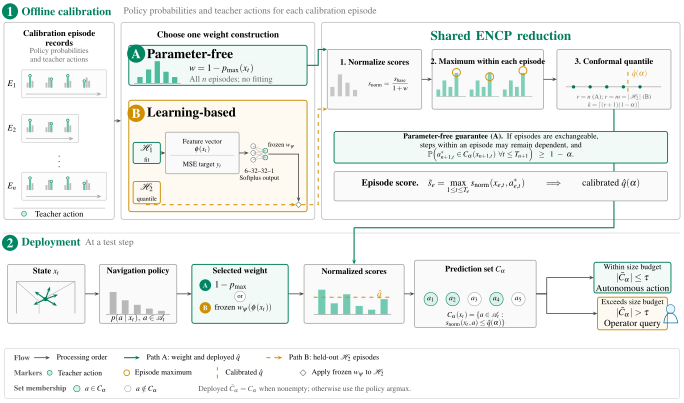
- To this end, we propose Episode-Normalized Conformal Prediction (ENCP), which rescales a nonconformity score by the policy's residual confidence and calibrates one maximum score per episode.
- Under exchangeable calibration and test episodes, this construction covers the ground truth at every step with probability at least $1 - α$, while allowing dependence among steps within an episode.
Problem Formulation
In this section, we formulate VLN as sequential classification in discrete graph, define the 3 nonconformity scores used in commonly used CP, and show why calibration over pooled steps does not yield trajectory-level coverage. An experimental condition is one policy–dataset pair. An episode is one attempt to follow an instruction $L$ from a given start node.
The agent moves on an undirected graph of panoramic Matterport3D viewpoints [ 21 ] and terminates by selecting stop .
Episode-Normalized Conformal Prediction
Standard CP calibration fails to provide coverage guarantees in sequential VLN due to intra-episode step dependencies and dynamic action spaces.
To resolve this, Episode-Normalized Conformal Prediction (ENCP) derives its name from two core mechanisms: episode-level calibration , which collapses dependent trajectory steps into a single worst-case metric to restore finite-sample guarantees, and score normalization , which adjusts nonconformity scores relative to step-varying policy confidence.
Coverage Guarantee
This section proves coverage for parameter-free ENCP. For this purpose, before calibration, we freeze the navigation policy, a base score $s_{\mathrm{base}}$, and $w_{\mathrm{pf}}(x_{t})=1-p_{\max}(x_{t})$. For episode $E_{i}$, let $x_{i,t}$ and $a_{i,t}^{*}$ denote the decision context and ground-truth action at step $t$, and let $T_{i}=T(E_{i})\geq 1$.
Throughout this section, $s_{\mathrm{norm}}$ denotes the parameter-free score.
Experiments
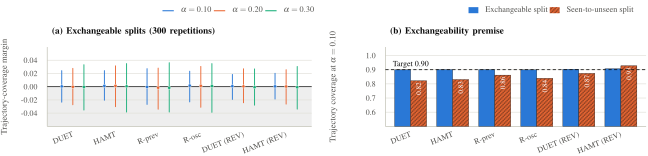
We calibrate on the R2R validation-seen, whose buildings occur in training, and test on validation-unseen (val-unseen) episodes from disjoint building scans [ 1 ] . We also experiment this in REVERIE [ 23 ] for a better generalization. We evaluate four VLNs from three architecture families: DUET [ 9 ] , HAMT [ 8 ] , and Recurrent VLN-BERT with PREVALENT and OSCAR initialization (R-prev and R-osc) [ 7 ] .
Our runs reproduce each published val-unseen success rate to within one percentage point.
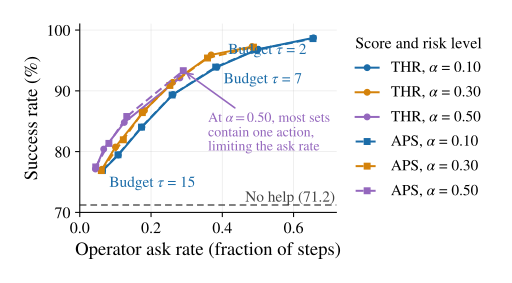
Sources and Demonstrations
Figures are reproduced from Feliren et al. See the full paper for experimental details and the project page, when the paper links one, for demonstrations and videos.
Related Papers
Aim Short to Reach Far: Your Frozen World Model Can Plan Better Than You Think
Xvyuan Liu, Jianjie Fang, Chen Gao et al.
Planners built on visual world models commonly score each predicted outcome by its distance to the encoded goal image. We show that this target can limit control even with exact dynamics and globally optimal short-horizon search: reaching a goal may require actions that initially move away from it.
Beyond Episodic Evaluation: Memory Architectural Bottlenecks in Sequential Embodied Question Answering
Zikui Cai, Kaushal Janga, Tan Dat Dao et al.
Embodied question answering (EQA) is traditionally evaluated under an episodic formulation, where agents solve each task independently and reset internal state between episodes.
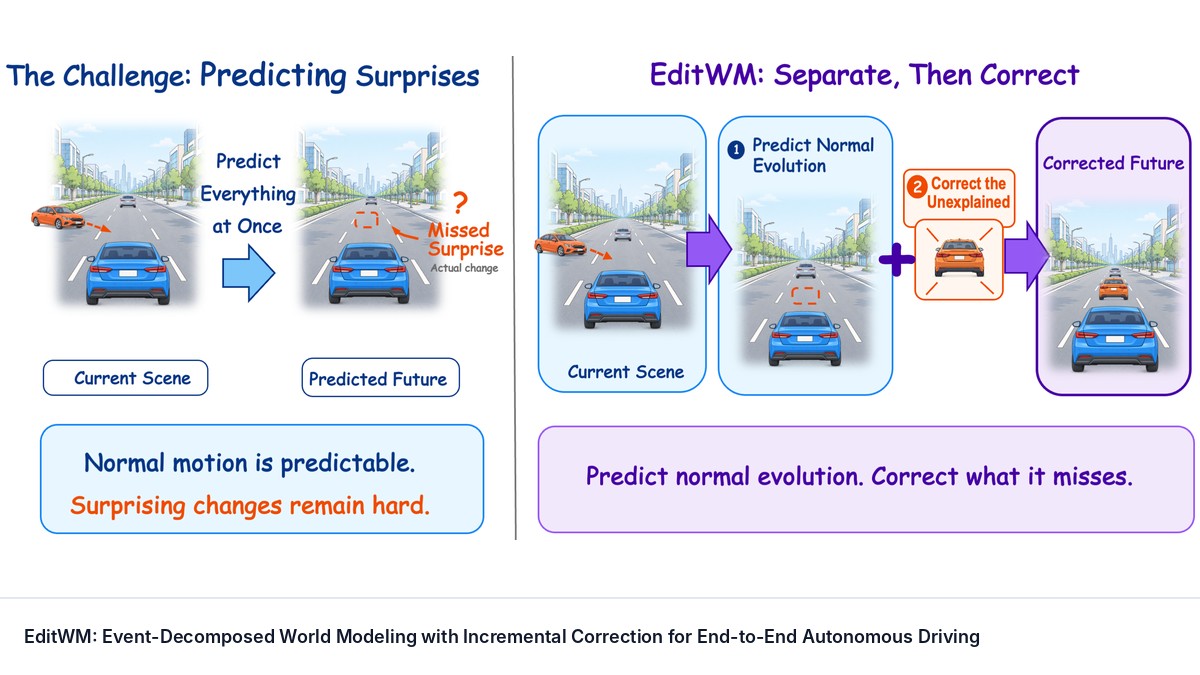
EditWM: Event-Decomposed World Modeling with Incremental Correction for End-to-End Autonomous Driving
Junjie Yang, Qingwei Zeng, Youyou Li et al.
World models support autonomous driving by predicting the scene evolution associated with candidate trajectories. Driving dynamics differ in predictability, motivating a distinction between regular evolution and event-induced deviations that call for selective correction.
Embodied Scene Rearrangement Planning
Canzhi Chen, Zan Wang, Siqi Zhu et al.
This paper introduces Embodied Scene Rearrangement Planning (ESRP), a novel task requiring embodied agents to rearrange furniture in 3D scenes to match a target configuration using only egocentric observations and a top-down target layout.