
EditWM: Event-Decomposed World Modeling with Incremental Correction for End-to-End Autonomous Driving
Junjie Yang, Qingwei Zeng, Youyou Li, Zicheng Ding, Ziyi Shi, Shuqi Shen, Hongliang Lu, Hai Yang · N/A · 2026
Framework
N/A
License
N/A
Stars
N/A
Summary
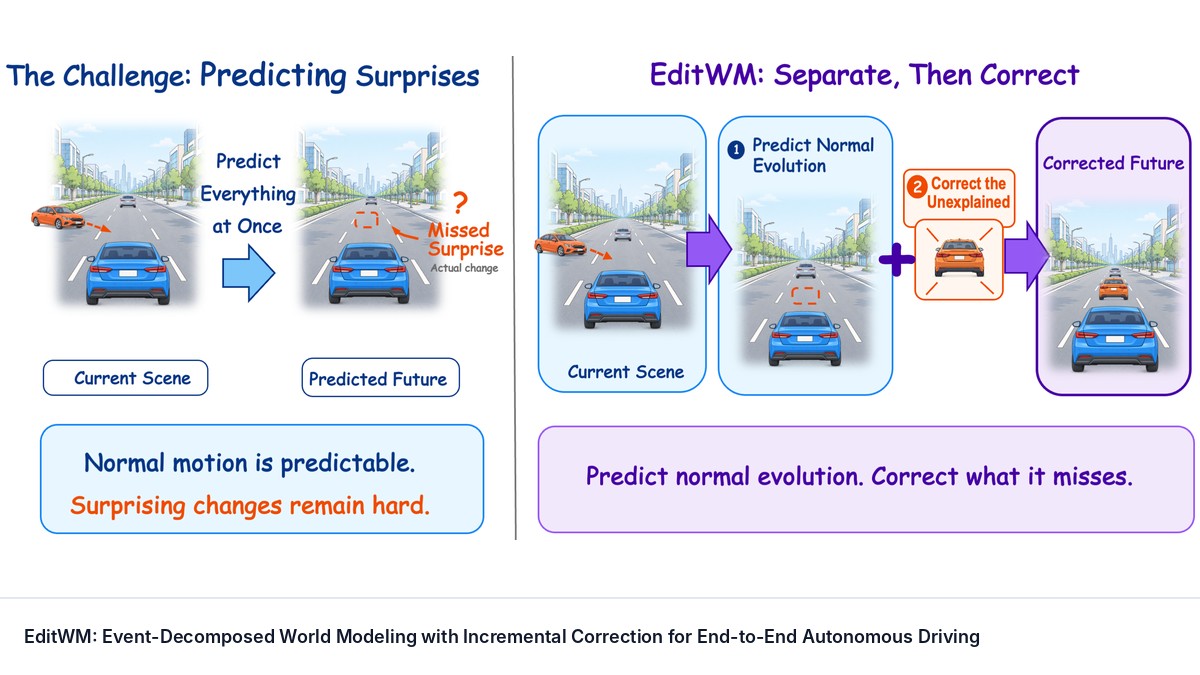
World models support autonomous driving by predicting the scene evolution associated with candidate trajectories. Driving dynamics differ in predictability, motivating a distinction between regular evolution and event-induced deviations that call for selective correction.
Abstract Summary
Key Points
- World models support autonomous driving by predicting the scene evolution associated with candidate trajectories.
- Driving dynamics differ in predictability, motivating a distinction between regular evolution and event-induced deviations that call for selective correction.
- We propose EditWM, a world model that decomposes future prediction into normal evolution and event-driven incremental correction in compact visual feature space.
- A trajectory-conditioned normal predictor provides the base forecast and is then frozen for correction learning.
- A correction decoder compares this forecast with observation history and planned actions, producing a bounded feature update whose contribution is regulated by a learned gate.
Method
At time $t$, a frozen DINOv2-based encoder [ 23 ] maps multi-view images to history $\mathcal{H}_{t}=\{Z_{t-L+1},\ldots,Z_{t}\}$. Each of the $L$ frames contains $N$ visual tokens of dimension $d$, giving $Z\in\mathbb{R}^{N\times d}$.
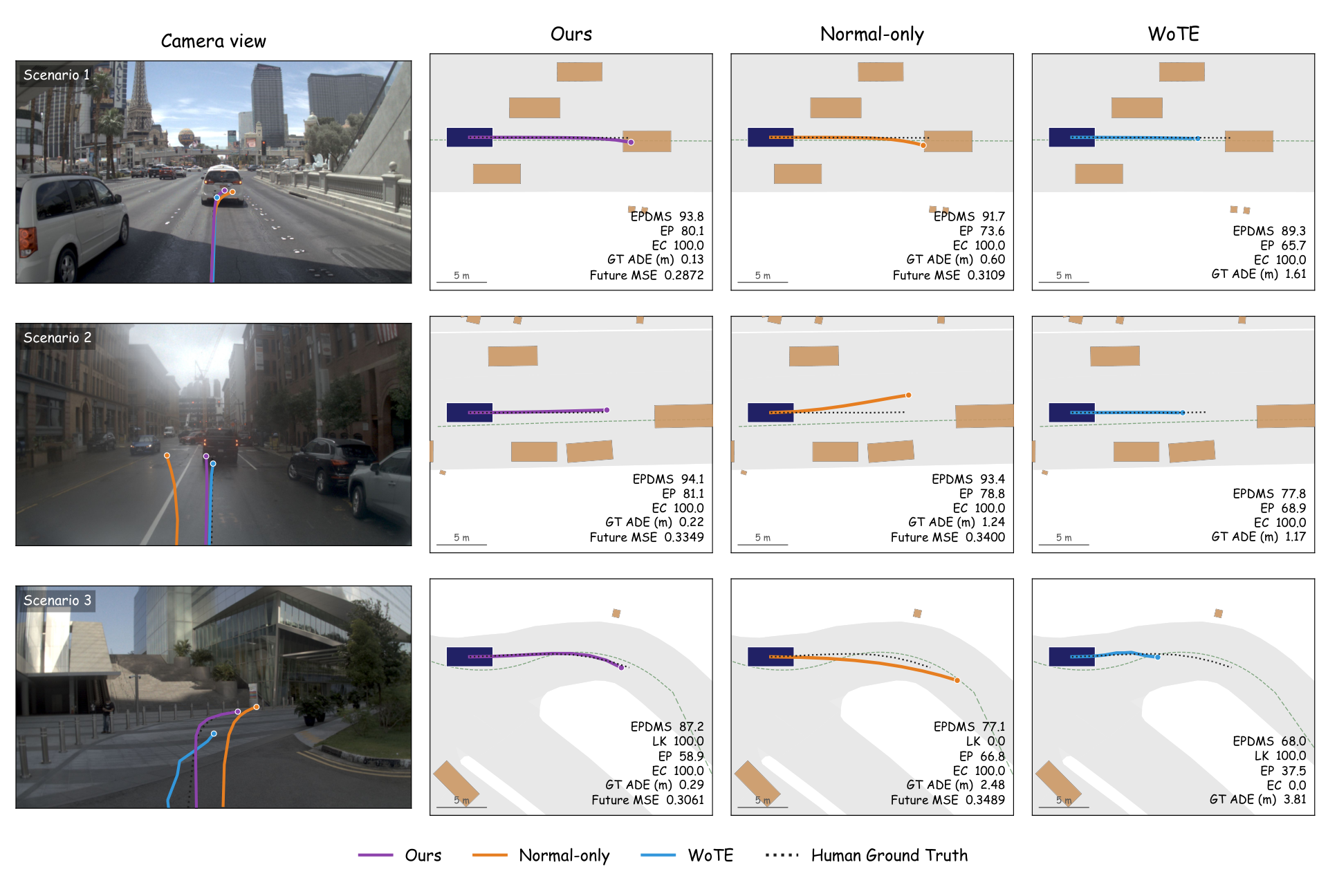
The planner also receives ego state $e_{t}$ and candidates $\mathcal{C}_{t}=\{\tau_{i}\}_{i=1}^{K}$, where $K$ is the candidate count and $\tau_{i}\in\mathbb{R}^{H\times 3}$ contains $H$ time-indexed planar positions and headings in the current ego frame. As shown in Fig.
Experiments
∗ Original v2 evaluator before human-behavior filtering correction. Baseline results are taken from their reported evaluations. Best displayed values, including ties, are bold. We use NAVSIM [ 30 ] , training the trajectory scorer on all 103,288 navtrain scenes and evaluating on all 12,146 navtest scenes.
World-model training uses the 43,849 navtrain scenes with real future images, divided by source log into 39,337 fitting and 4,512 validation scenes. These world-model splits and navtest do not share physical frames.
Sources and Demonstrations
Figures are reproduced from Yang et al. See the full paper for experimental details and the project page, when the paper links one, for demonstrations and videos.
Related Papers
Aim Short to Reach Far: Your Frozen World Model Can Plan Better Than You Think
Xvyuan Liu, Jianjie Fang, Chen Gao et al.
Planners built on visual world models commonly score each predicted outcome by its distance to the encoded goal image. We show that this target can limit control even with exact dynamics and globally optimal short-horizon search: reaching a goal may require actions that initially move away from it.
Beyond Episodic Evaluation: Memory Architectural Bottlenecks in Sequential Embodied Question Answering
Zikui Cai, Kaushal Janga, Tan Dat Dao et al.
Embodied question answering (EQA) is traditionally evaluated under an episodic formulation, where agents solve each task independently and reset internal state between episodes.
Embodied Scene Rearrangement Planning
Canzhi Chen, Zan Wang, Siqi Zhu et al.
This paper introduces Embodied Scene Rearrangement Planning (ESRP), a novel task requiring embodied agents to rearrange furniture in 3D scenes to match a target configuration using only egocentric observations and a top-down target layout.
ENCP: Episode-Normalized Conformal Prediction for Vision-and-Language Navigation
Vicky Feliren, A. Taufiq Asyhari, Muhamad Risqi U. Saputra
Uncertainty estimation for Vision-Language-Navigation (VLN) models is a critical task since it can help identify ambiguous and unreliable predictions, enabling agents to make safer navigation decisions.