
REDACT: Robust Perceptive Locomotion under Unseen Visual Corruption
Natapat Kirdwichai, Tobias Driskell-Poole, Andrei Sontea, Jadu Dash, Muhammad Burhan Hafez, Danesh Tarapore · N/A · 2026
Framework
N/A
License
N/A
Stars
N/A
Summary
Depth-conditioned locomotion policies have demonstrated impressive agile maneuvers, but can be steered to unpredictable actions when observations are outside their training distribution.
Abstract Summary
Key Points
- Depth-conditioned locomotion policies have demonstrated impressive agile maneuvers, but can be steered to unpredictable actions when observations are outside their training distribution.
- Occlusion, invalid returns, sensor noise, and visual distractors can shift deployment observations away from nominal simulated depth.
- While synthetic sensor augmentation targets specified degradations, it does not by itself define behavior under corruption families omitted from training.
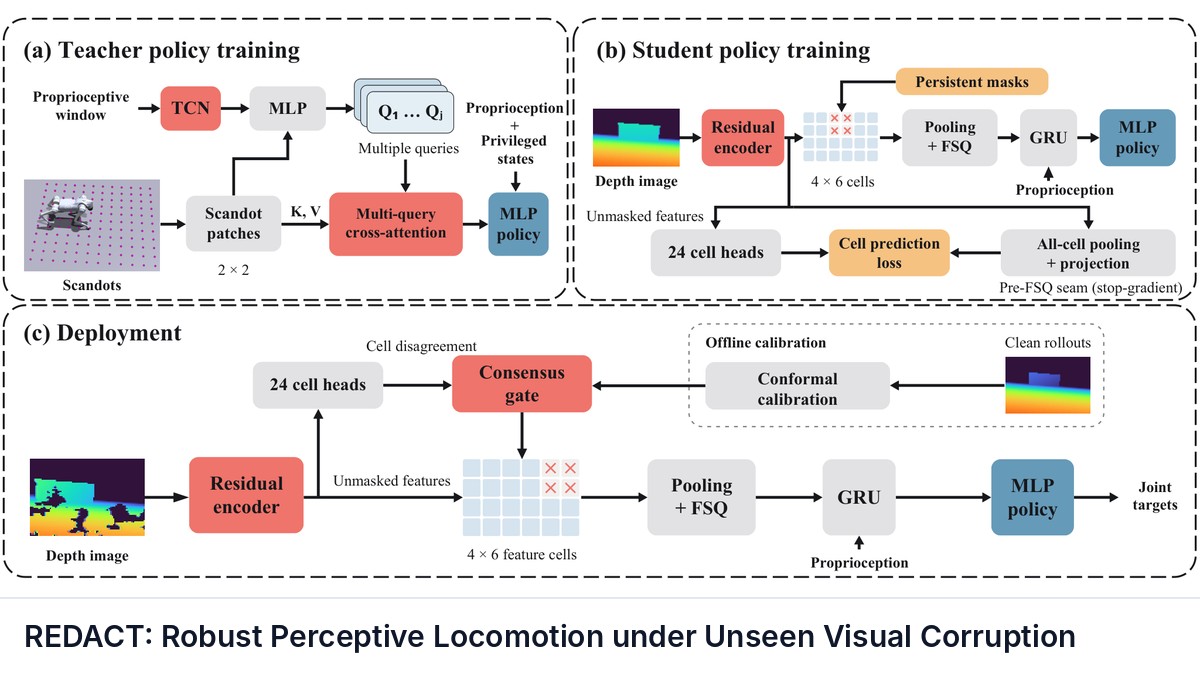
- To address gaps in training-time coverage, we present REDACT (Retaining Evidence Despite Artifacts for Continued Traversal), a teacher-student framework combining an improved visual encoder architecture, persistent feature masking, and a novel consensus-gating algorithm to retain useful depth information under unmodeled corruption.
- The gate uses approximate conformal calibration on clean observations alone, requiring no prior knowledge of the corruption type.
Method
We train a privileged teacher and a depth-conditioned student to retain terrain information needed for locomotion while limiting the influence of unseen visual corruption (Fig. 3 ). Regularized multi-query cross-attention first structures the teacher’s terrain representation to reduce dependence on privileged detail that onboard depth cannot recover.
The teacher then initializes a depth-conditioned student whose residual encoder is designed to limit sensitivity to visual perturbations while preserving spatial evidence for consensus gating.
Results
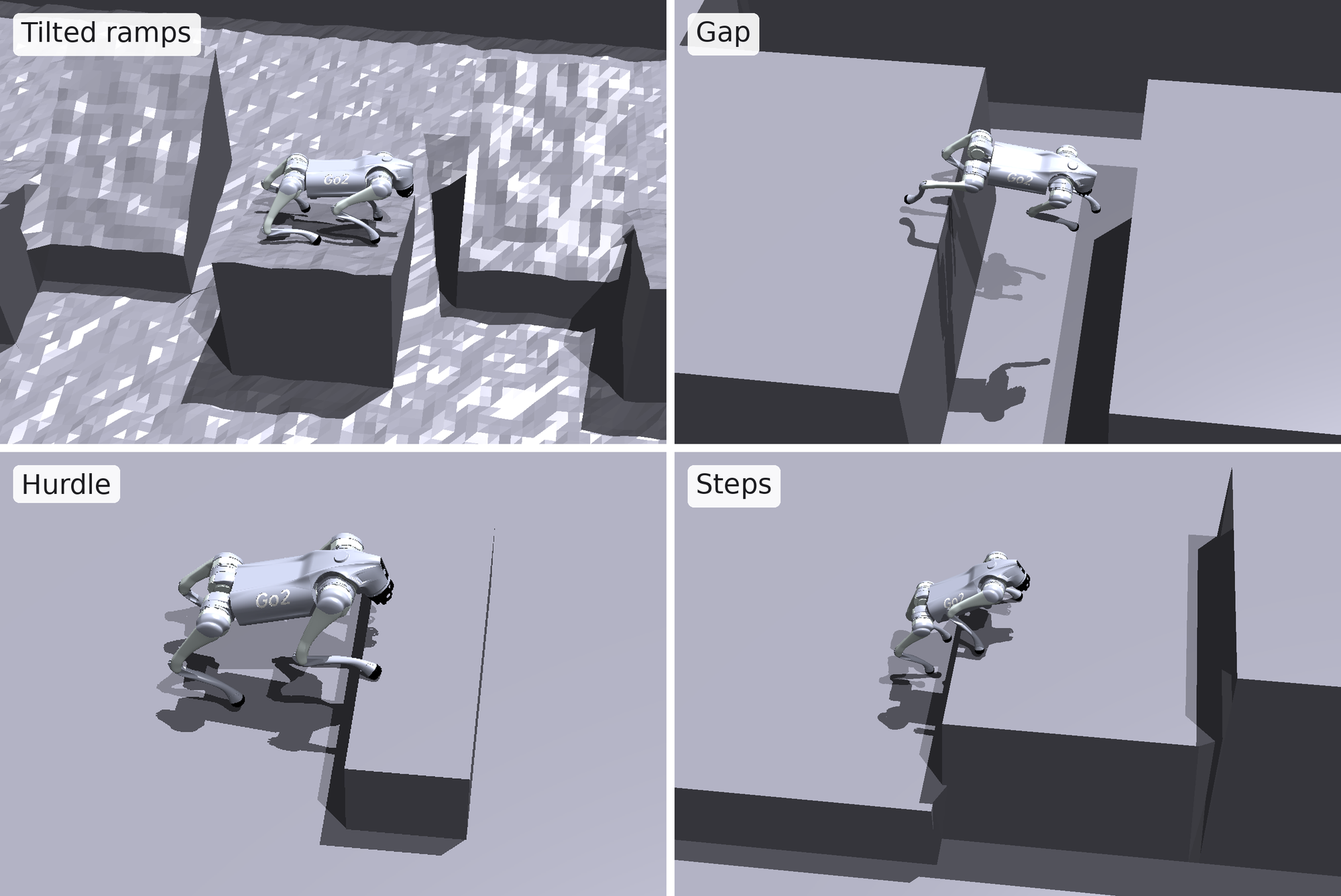
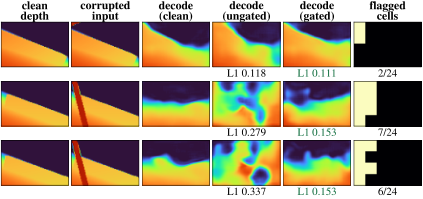
We evaluate whether REDACT maintains successful traversal when depth observations differ from those encountered during training. Comparisons with parkour baselines and augmentation-trained policies assess robustness beyond training coverage. We then examine the contributions of the encoder and selective rejection through component ablations and gate analysis.
Real-world trials assess zero-shot transfer to structured and forest environments. Training and Preprocessing.
Sources and Demonstrations
Figures are reproduced from Kirdwichai et al. See the full paper for experimental details and the project page, when the paper links one, for demonstrations and videos.
Related Papers
DECOWAM: Decoupled Whole-Body World-Action Model for Legged Mobile Manipulation
Siyuan Ma, Boshi Zhang, Yutian Zhang et al.
Mobile manipulation requires a robot to predict how locomotion and arm motion jointly alter future observations and control. Existing world-action models, developed largely for fixed-base platforms, do not explicitly distinguish camera ego-motion from base and arm actions.
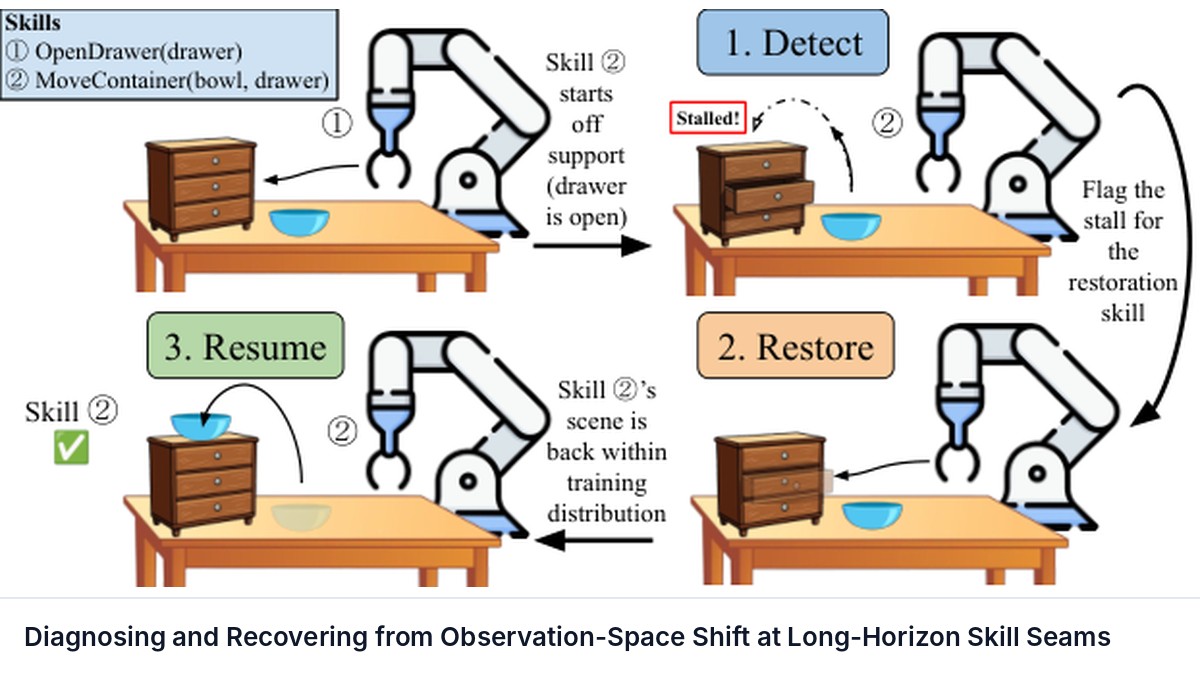
Diagnosing and Recovering from Observation-Space Shift at Long-Horizon Skill Seams
Pranav Wagh, Yu Fang, Yue Yang et al.
Long-horizon robotic manipulation is often built by chaining independently trained skills.
DUET: Decoupled Upper- and Lower-Body Execution for Task-Agnostic Humanoid Loco-Manipulation
Kapalik Khanal, Biswash Khatiwada, Stephen Afrifa et al.
Changing a humanoid robot's manipulation policy should not require retraining the controller that maintains the robot's balance.
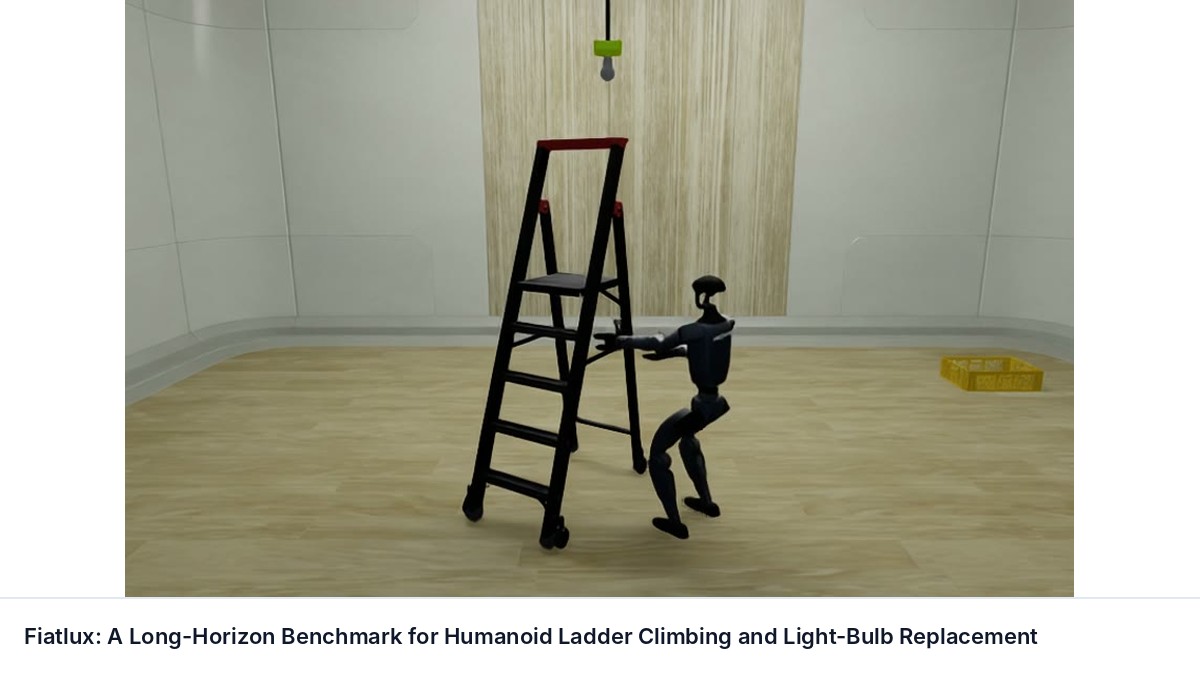
Fiatlux: A Long-Horizon Benchmark for Humanoid Ladder Climbing and Light-Bulb Replacement
Pavel Bushuyeu, Yujin Chen, Anton Nikolaev et al.
Existing benchmarks evaluate tabletop manipulation, flat-floor household activity, or humanoid locomotion and manipulation as separate task groups; none scores vertical mobility and dexterous work on a fragile payload in one long-horizon episode.