
Towards Adaptive Interaction Strategies for Human Companion Robot via Deep Reinforcement Learning
Cong-Thanh Vu, Yen-Chen Liu · N/A · 2026
Framework
N/A
License
N/A
Stars
N/A
Summary
In the field of Human-Robot Interaction (HRI), achieving flexibility in human-accompanying within real-world environments holds great potential for various applications but also poses significant challenges.
Abstract Summary
Key Points
- In the field of Human-Robot Interaction (HRI), achieving flexibility in human-accompanying within real-world environments holds great potential for various applications but also poses significant challenges.
- Traditional methods typically restrict robots to fixed positions relative to humans, such as tracking from behind, in front, or side-by-side, which limits robot adaptability in dynamic workspaces.
- This study introduces a novel human-companioning strategy that uses Reinforcement Learning (DRL) to enable mobile robots to dynamically adjust their tracking positions according to varying conditions.
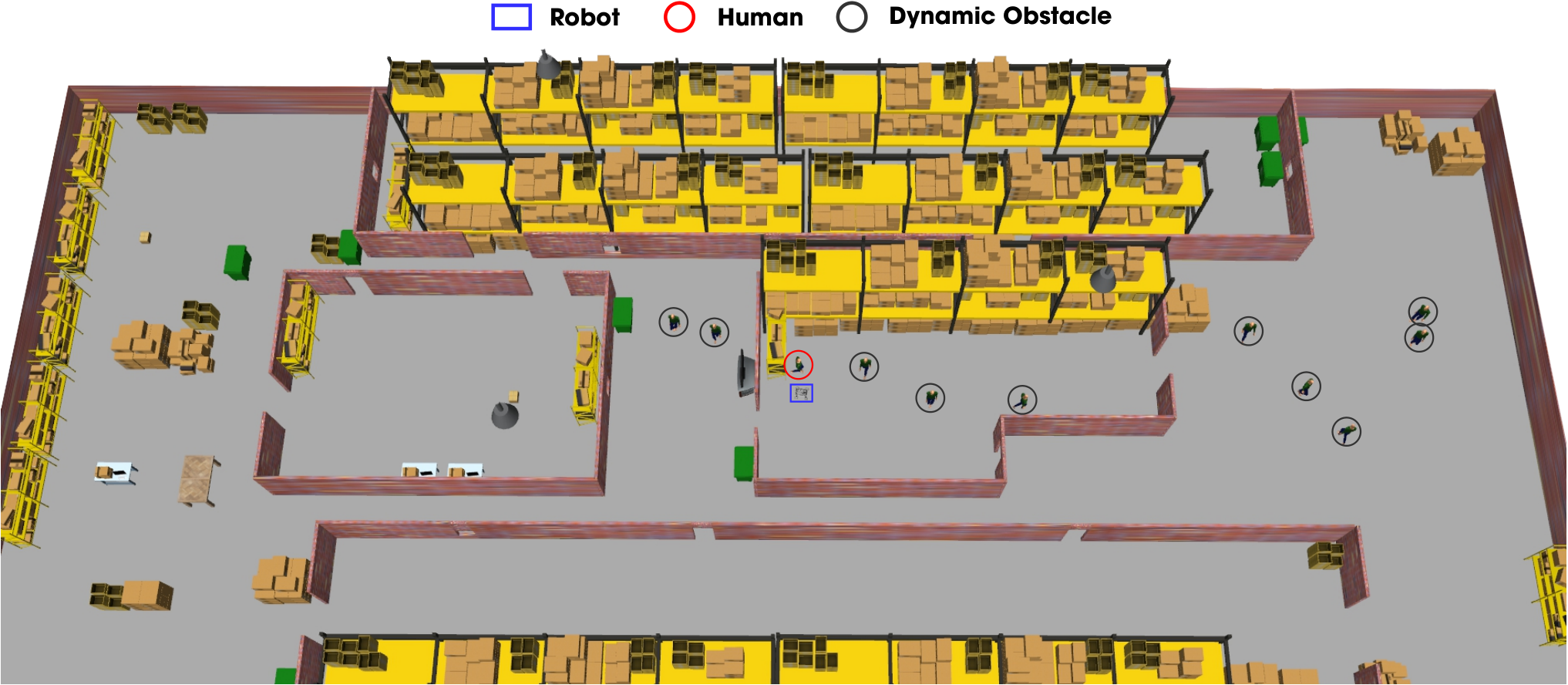
- An interaction space is defined to capture the relationship between the human and the robot while considering the environment, which serves as the basis for state spaces in DRL to assist the robot in adapting to environmental changes.
- A human-robot companion controller is developed by integrating Model Predictive Path Integral (MPPI) control with Control Barrier Functions (CBF), ensuring that the robot accurately follows the target's movement in both position and orientation while avoiding obstacles and enhancing social acceptance and safety.
System Design and Problem Formulation
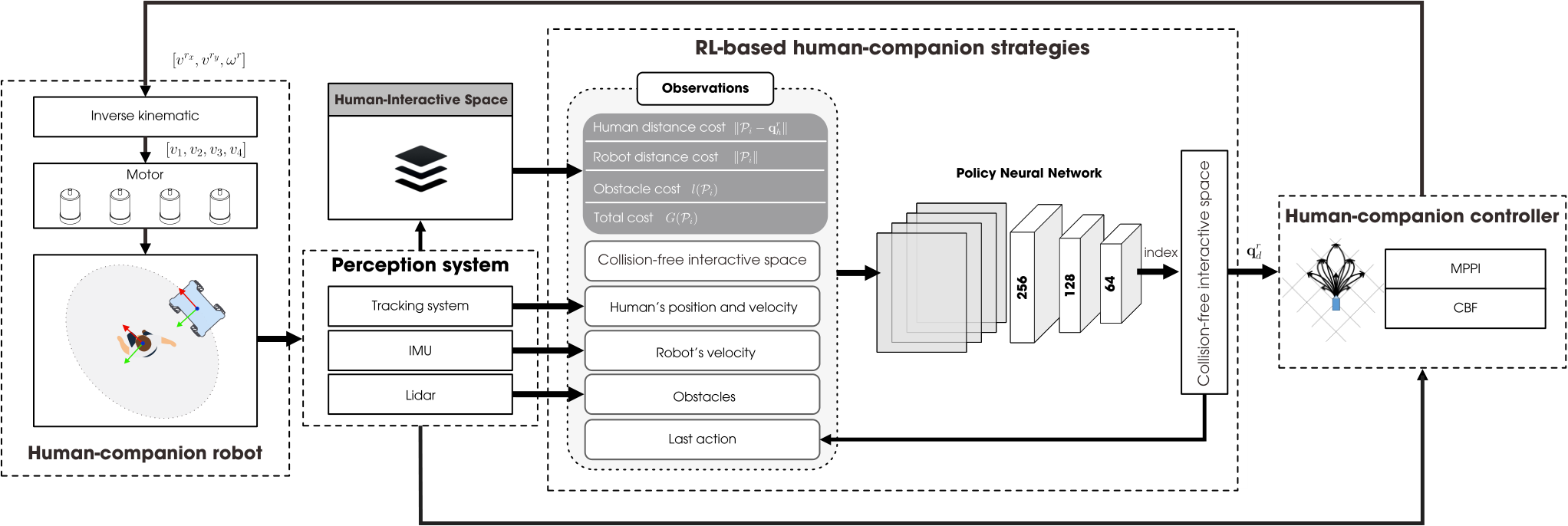
In this section, we present the design and hardware components of the human-companion robot and the problem formulation for the human-accompanying task. Fig. 1 illustrates the configuration of the human–companion robot system. The platform is equipped with a Velodyne VLP-16 Puck Lite 3D LiDAR for environmental perception and an Amfitrack Gen 3 electromagnetic tracker [ 1 ] for human tracking.
A source mounted on the robot and a sensor attached to the user enable reliable target identification while preventing confusion with nearby pedestrians.
Human-Robot Interactive Space
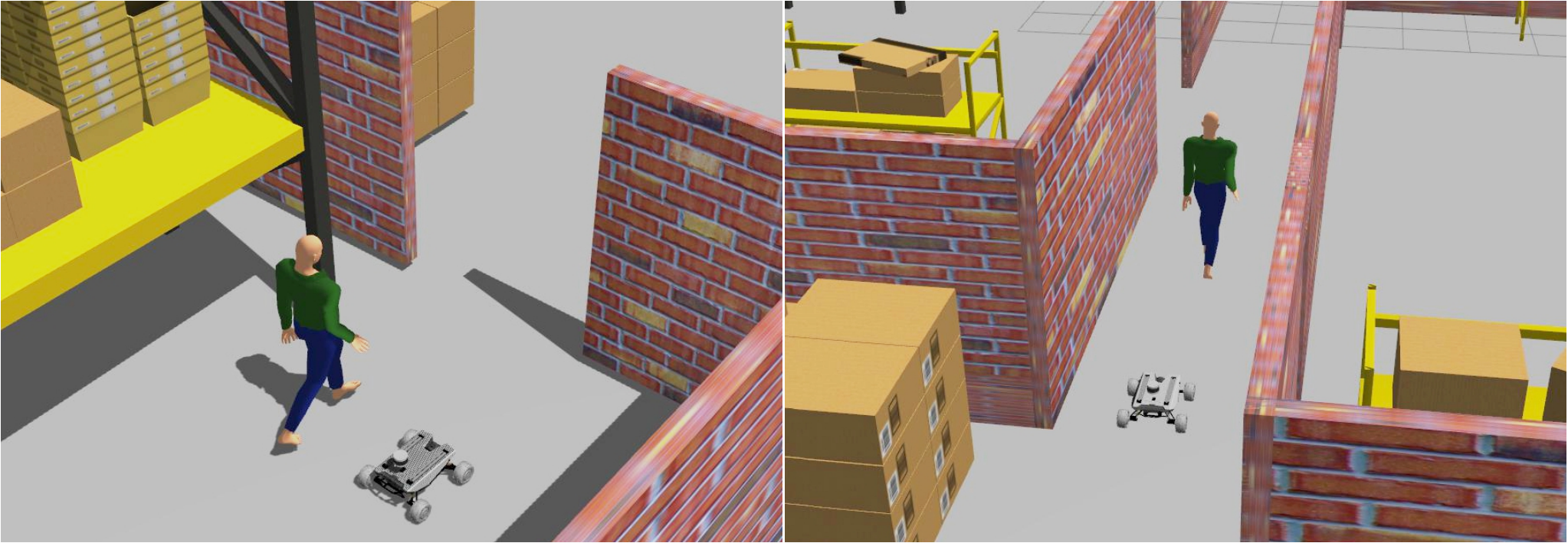
This section introduces a collision-free interactive space and cost functions for selecting the desired position. The interactive space $\mathcal{W}$ is defined as the set of $n$ design points $\mathbf{q}^{r}_{d,i}=[x^{r}_{d,i},y^{r}_{d,i},\theta^{r}_{d,i}]^{\text{T}}\in\mathbb{R}^{3}$ for $i=1,\ldots,n$ in the frame $\mathcal{R}$.
These points are located within an ellipse with a semi-major axis $a$ and a semi-minor axis $b$, centered at the human position.
RL-Based Human-Accompanying Strategies
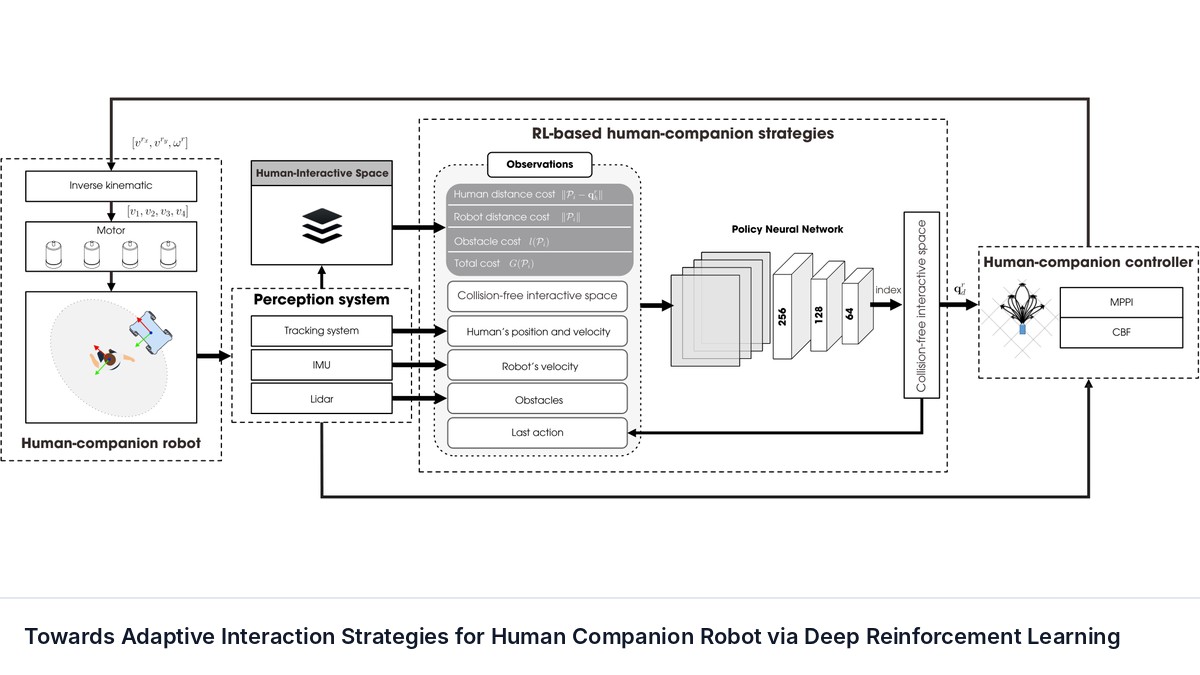
Unlike previous studies that used RL to follow the human by considering only the relative position between the human and the robot, we propose a novel approach that leverages the proposed interactive space as the state space for RL. Additionally, we design a new reward function specifically for the human-accompanying task and present the policy training process. The overall system architecture is illustrated in Fig.
Human-Companion Controller
In this section, we introduce a human-companion controller based on MPPI [ 43 ] , which integrates a CBF, adapted from [ 48 ] , as a safety mechanism to prevent the robot from entering the human’s intimate zone, thereby enhancing user safety and comfort.
Sources and Demonstrations
Figures are reproduced from Vu et al. See the full paper for experimental details and the project page, when the paper links one, for demonstrations and videos.
Related Papers
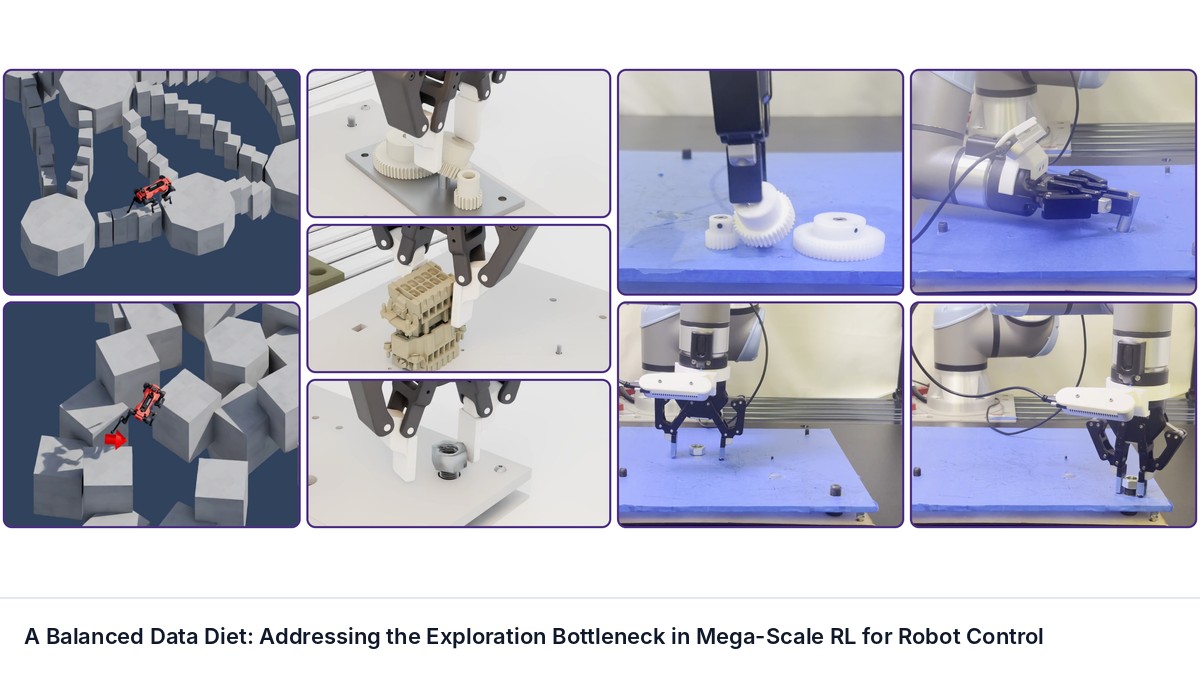
A Balanced Data Diet: Addressing the Exploration Bottleneck in Mega-Scale RL for Robot Control
Octi Zhang, Mateo Guaman Castro, Patrick Yin et al.
General-purpose robots must perform a wide range of tasks from agile locomotion to dexterous manipulation.
A Mode-Unified, Continuous, and Biomimetic Control Strategy of a Robotic Lower Limb Prosthesis
Hanjun Kim, Sixu Zhou, John Shim et al.
Existing biomimetic lower-limb prosthesis controllers are commonly designed for discrete locomotion modes, requiring separate parameterizations for level walking, ramps, and stairs.
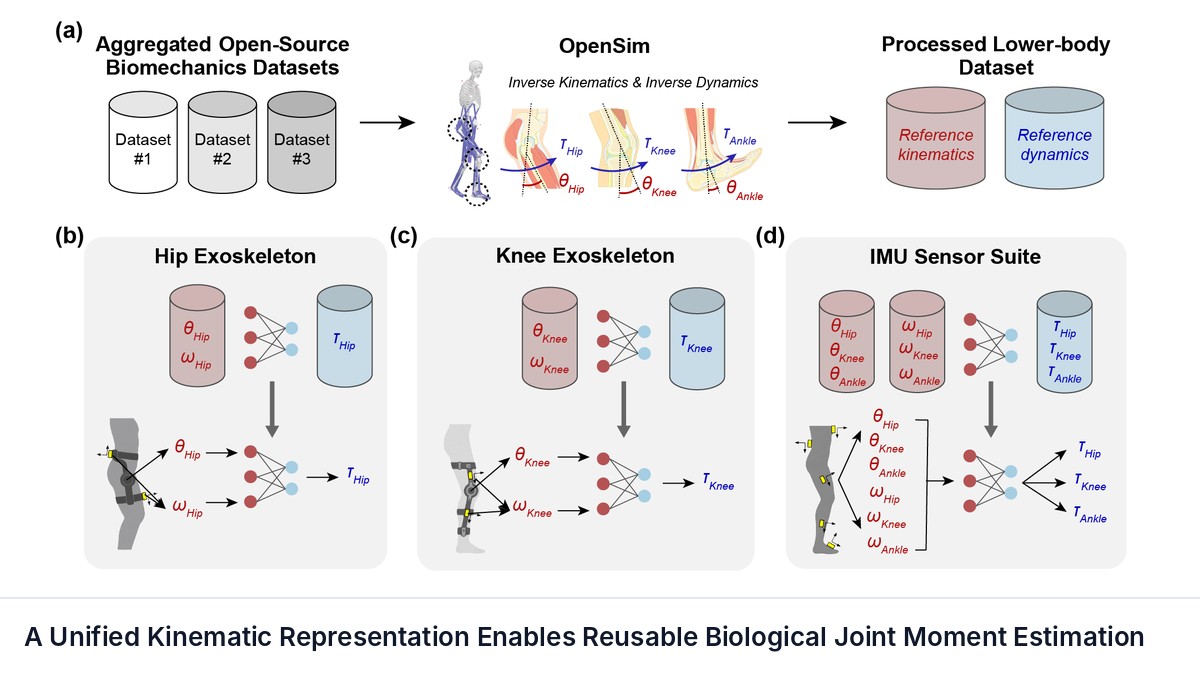
A Unified Kinematic Representation Enables Reusable Biological Joint Moment Estimation
Jinwoo Hwang, Ilseung Park, Changseob Song et al.
Objective: Data-driven models that estimate physiological states, particularly biological joint moments, are widely used in exoskeleton control.
Adaptive Rejection of Unknown Hybrid Sinusoidal Disturbances with Application to Humanoid Walking under Unknown Ground Motion
I-Chia Chang, Jacob Stewart, Petros A. Ioannou et al.
Legged robot control is not yet practical in non-inertial environments, where the ground and surroundings accelerate in the inertial Earth frame, mainly because of the unknown, time-varying, persistent perturbations caused by environmental motion, compounded by the associated hybrid robotic dynamics.