
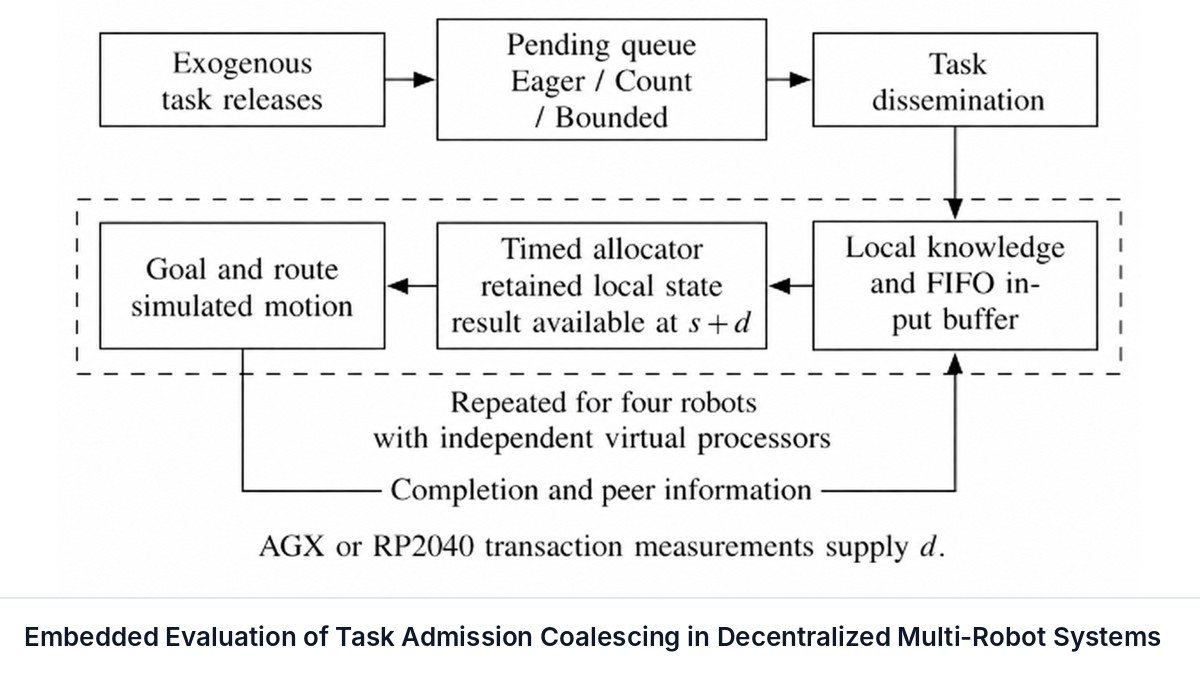
Embedded Evaluation of Task Admission Coalescing in Decentralized Multi-Robot Systems
James Lott, Vahraz Honary · N/A · 2026
Framework
N/A
License
N/A
Stars
N/A
Summary
Multi-robot task allocators in dynamic missions commonly admit newly released tasks immediately, potentially invoking allocation for each new arrival.
Abstract Summary
Key Points
- Multi-robot task allocators in dynamic missions commonly admit newly released tasks immediately, potentially invoking allocation for each new arrival.
- We evaluate task-admission coalescing as a mechanism for controlling allocator processor work while accounting for target-service latency, using CBAA, ACBBA, PI, and HIPC as a representative MRTA suite.
- The study comprises a 3,000-mission AGX Orin campaign with measured computation delay, 3,000 paired zero-compute missions, and a 96-mission Pololu 3pi+ RP2040 allocator hardware-in-the-loop campaign.
- Immediate (Eager) admission is compared with thresholds of two, four, and eight tasks and a four-task policy with a 10-s waiting bound across three arrival rates.
- Across the AGX experiments, coalescing reduces both allocator calls and processor work in 31 of 48 evaluated conditions, although the magnitude of the saving varies by allocator.
System Design and Admission Policies
The study extends the fixed-task Collaborative Visit framework in [ 10 ] to tasks released during execution. Four robots operate on an obstacle-free $19\times 19$ grid and must visit 50 distinct task cells. Eight tasks are released initially and 42 arrive online. For task $j$, let $r_{j}$, $a_{j}$, and $f_{j}$ denote its release, environmental admission, and first completion times.
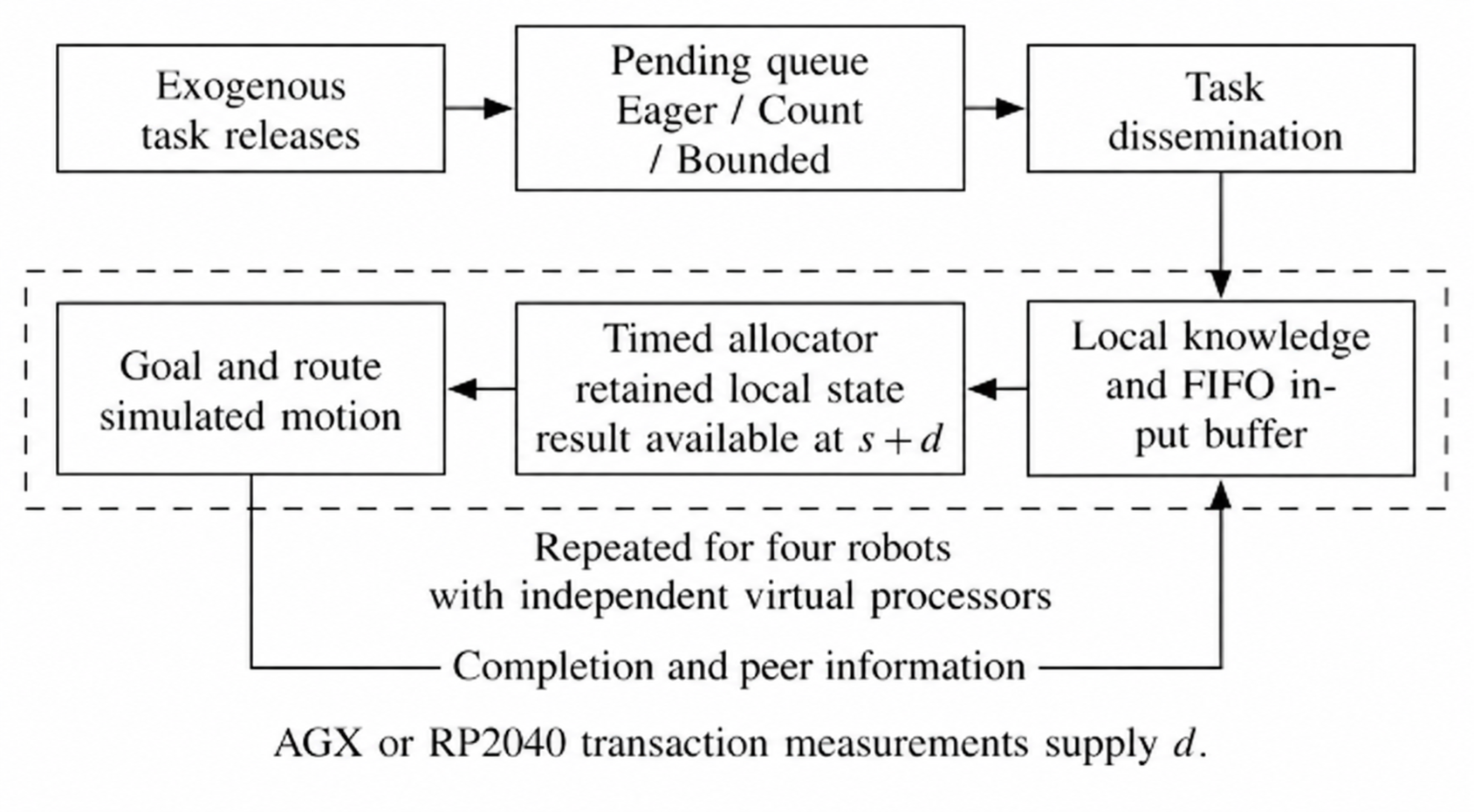
Experimental Methodology
Fifty scenario blocks are generated using separate deterministic spatial, arrival, and runtime streams. Robots start at $(0,0)$, $(0,6)$, $(0,12)$, and $(0,18)$, facing east. Task cells are sampled uniformly without replacement from the 357 non-start cells. For each scenario, 42 independent unit-exponential increments $e_{k}$ generate online release times rounded to nine decimal places.
Low, medium, and high arrival loads use $\lambda=0.075$, $0.30$, and $0.60$ tasks/s.
Sources and Demonstrations
Figures are reproduced from Lott et al. See the full paper for experimental details and the project page, when the paper links one, for demonstrations and videos.
Related Papers
A Browser-Native Digital Test Range for Benchmarking 4D Ocean-Glider Planning Algorithms
Edward Holmberg, Elias Ioup, Mahdi Abdelguerfi
Repeated in-situ evaluation of ocean-glider planners requires scarce vehicles, operators, deployment and recovery resources, and ocean conditions that cannot be reset for competing algorithms.
A Mode-Unified, Continuous, and Biomimetic Control Strategy of a Robotic Lower Limb Prosthesis
Hanjun Kim, Sixu Zhou, John Shim et al.
Existing biomimetic lower-limb prosthesis controllers are commonly designed for discrete locomotion modes, requiring separate parameterizations for level walking, ramps, and stairs.

A Sim-to-Real Integration Pipeline for Training and Deployment of Chunk-Based VLA Manipulation Policies
Mathilde Kappel, Clémence Grislain, Mohamed Chetouani et al.
Vision-Language-Action (VLA) models have become a prominent paradigm for mapping multimodal inputs, including semantic instructions, visual observations of the scene, and proprioceptive observations, to robot actions.
A Unified Kinematic Representation Enables Reusable Biological Joint Moment Estimation
Jinwoo Hwang, Ilseung Park, Changseob Song et al.
Objective: Data-driven models that estimate physiological states, particularly biological joint moments, are widely used in exoskeleton control.