
VkVIO: Cross-platform GPU Acceleration for Visual-Inertial Odometry with Vulkan
Ole Hoffmann, Mateo de Mayo, Daniel Cremers · N/A · 2026
Framework
N/A
License
N/A
Stars
N/A
Summary
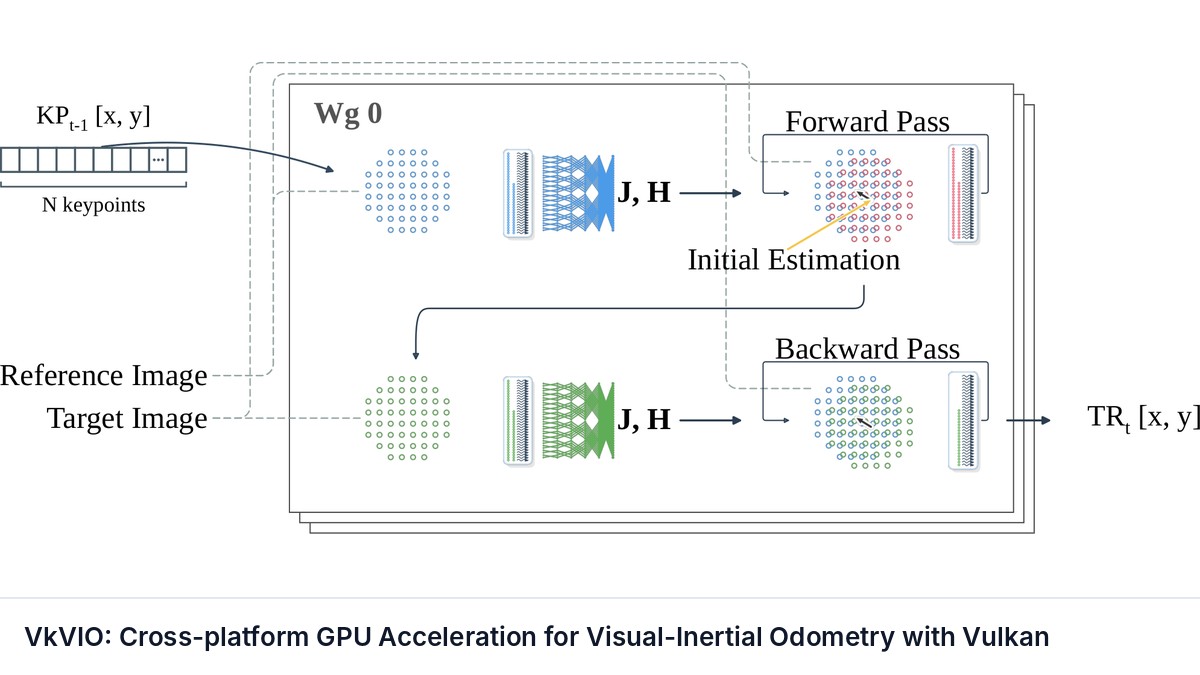
Perception in robotics and XR fundamentally relies on good state estimation. Visual-inertial odometry (VIO) and Simultaneous Localization and Mapping (VI-SLAM) are proven ways of achieving this goal in a cost-effective and accurate manner.
Abstract Summary
Key Points
- Perception in robotics and XR fundamentally relies on good state estimation
- Visual-inertial odometry (VIO) and Simultaneous Localization and Mapping (VI-SLAM) are proven ways of achieving this goal in a cost-effective and accurate manner.
- Efficiency in these systems allows for smaller, cooler, and lighter devices
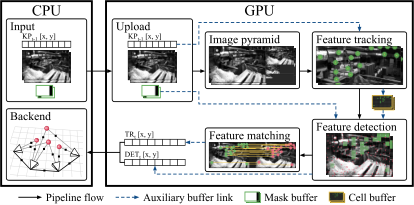
- GPU acceleration is a natural approach for reducing latency, thanks to their wide availability in platforms like embedded computers, mobile phones, and XR headsets.
- However, previous works in the literature have limited themselves to the use of CUDA for this task, significantly reducing deployment options to a single vendor.
Method
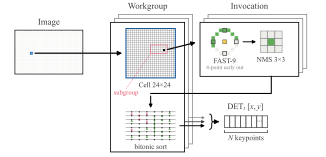
Vulkan is a cross-platform API for graphics and compute on modern GPUs. Its explicit programming model gives applications direct control over resource management, synchronization, and command submission, enabling high performance across many platforms [ 12 ] . Compute work is issued as dispatch commands, which are recorded into a command buffer and submitted to a queue for execution.
Each dispatch runs the compute pipeline bound at recording time and launches groupCountX $\times$ groupCountY $\times$ groupCountZ workgroups.
Results
For dataset selection, we prioritize a broad selection of devices over sequence count, to showcase the versatility of VkVIO and how its performance scales with input resolution. We utilize visual-inertial datasets from the SLAM literature centered around real-time robotics and XR. Fig.
5 shows an overview of the type of input data provided by each device in the datasets, with the pixel area of each device drawn to scale.
Sources and Demonstrations
Figures are reproduced from Hoffmann et al. See the full paper for experimental details and the project page, when the paper links one, for demonstrations and videos.
Related Papers
A Low-Cost, Open Platform for End-to-End Autonomous Driving on a Miniature Ackermann Vehicle
Gustavo Claudio Karl Couto, Eric Aislan Antonelo, Gabriel George Zipperer
This paper presents a low-cost, open experimental platform for research in end-to-end autonomous driving with miniature Ackermann vehicles.
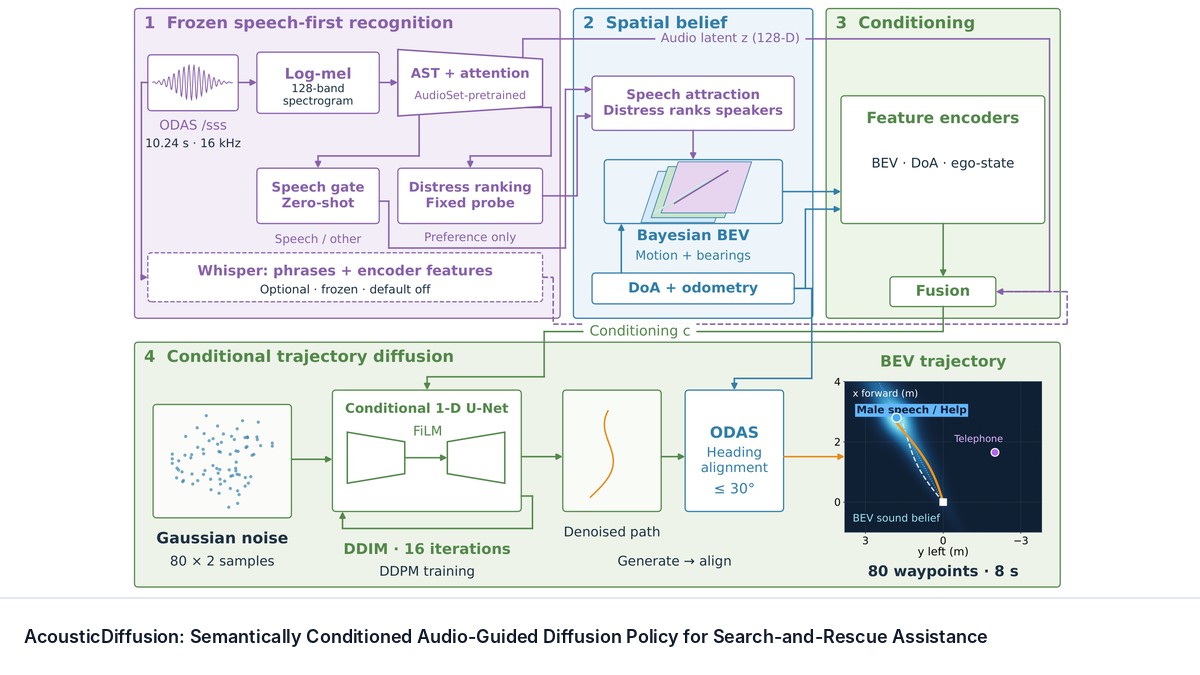
AcousticDiffusion: Semantically Conditioned Audio-Guided Diffusion Policy for Search-and-Rescue Assistance
Iana Zhura, Didar Seyidov, Dmitrii Plotnikov et al.
Navigating toward human callers is an important capability for rescue robots operating where visual contact is degraded or occluded. We present AcousticDiffusion, a semantically conditioned, audio-guided diffusion policy for human-directed navigation.
Adaptation Needs in Robotic Systems: Assessing Behavior Trees and Their Enhancement
Mehran Rostamnia, Gianluca Filippone, Ricardo Caldas et al.
Robotic systems increasingly operate in dynamic, uncertain, and open-ended environments, where design-time assumptions may no longer hold, and adaptation becomes necessary to maintain effective and safe operation.
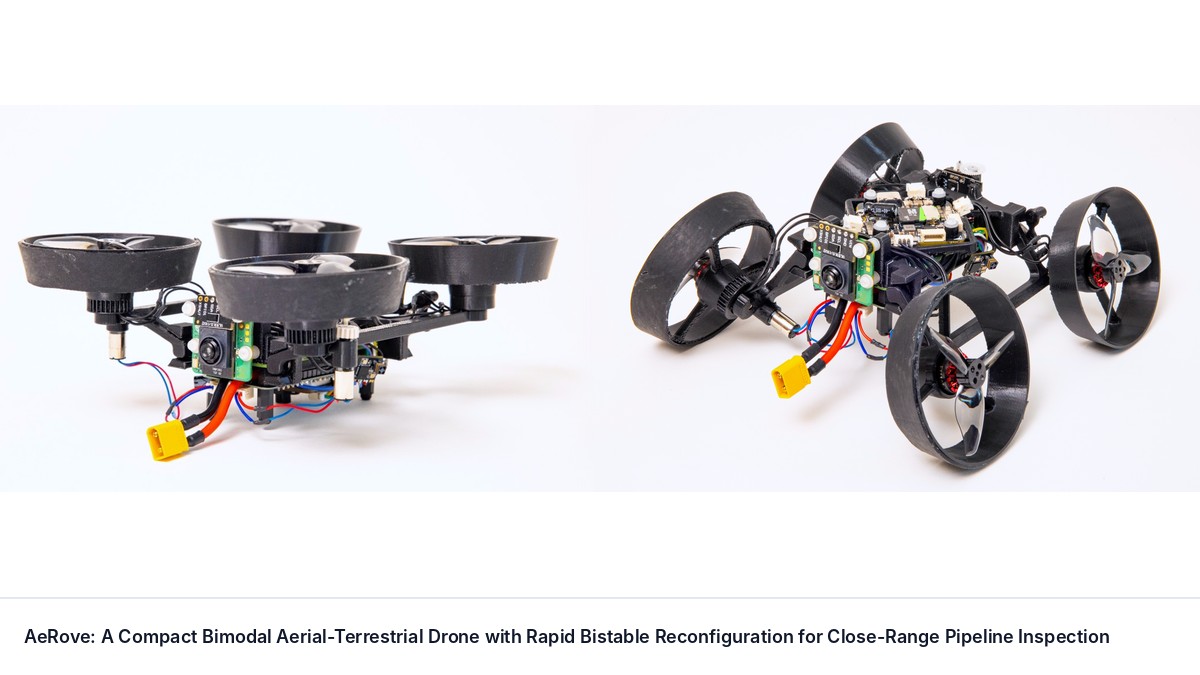
AeRove: A Compact Bimodal Aerial-Terrestrial Drone with Rapid Bistable Reconfiguration for Close-Range Pipeline Inspection
Caleb Polillio, Petras Swissler
Close-proximity pipeline inspection is challenging for standard drones due to high hovering power consumption, airflow sensitivity, and propeller wash interference with gas sensing. To address this, we present AeRove, a compact bimodal aerial-terrestrial robot.