
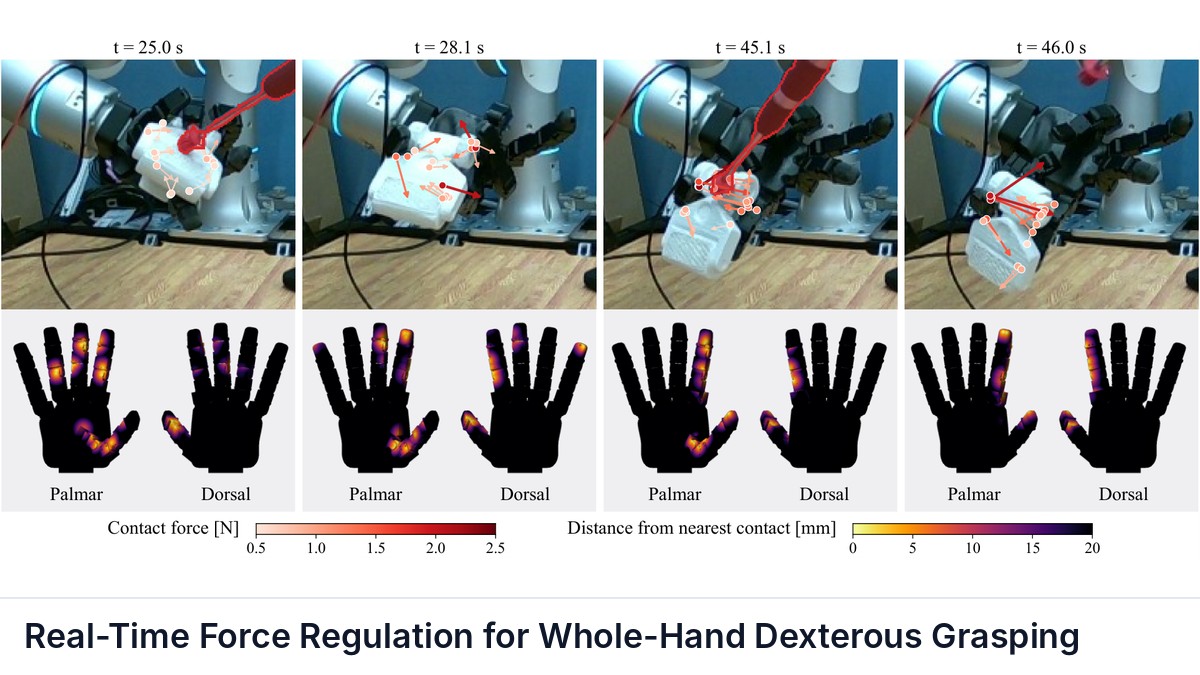
Real-Time Force Regulation for Whole-Hand Dexterous Grasping
Sang Min Kim, Alexander Alexiev, Tzu-Yuan Lin, Sangbae Kim, Young Min Kim, Yonghyeon Lee · N/A · 2026
Framework
N/A
License
N/A
Stars
N/A
Summary
Robust dexterous grasping requires maintaining physical stability despite contacts interactively evolving across the entire hand. A precomputed force distribution can easily fail under object motion, modeling errors, or external disturbances.
Abstract Summary
Key Points
- Robust dexterous grasping requires maintaining physical stability despite contacts interactively evolving across the entire hand.
- A precomputed force distribution can easily fail under object motion, modeling errors, or external disturbances.
- In this paper, we present a framework for real-time force regulation over dynamically changing whole-hand contacts.
- Our method geometrically estimates contacts across all hand links using a tracked object model and proprioception, without requiring tactile sensing at those contacts.
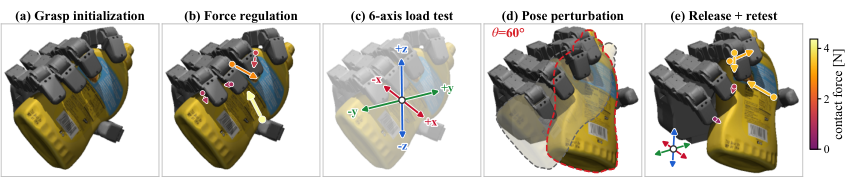
- It repeatedly recomputes the desired contact-force distribution subject to friction constraints, actuator limits, and an actuation-consistency constraint motivated by classical whole-limb force analysis.
Methodology
Our goal is to regulate contact forces in real time as the hand–object contact configuration evolves. We consider a dexterous hand with $n_{h}$ actuated degrees of freedom (DoF) and joint configuration $q\in\mathbb{R}^{n_{h}}$, together with a target object whose 6-DoF pose is continuously tracked.
The object mesh $\mathcal{M}$ is obtained from a CAD model in simulation or from an offline reconstruction of the physical object.
Experiments and Results
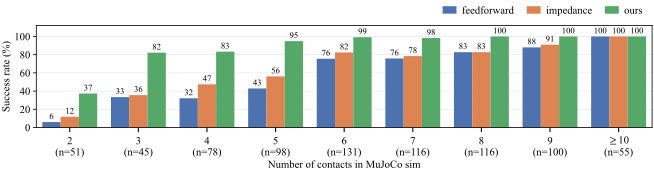
We evaluate the framework in simulation, where controlled perturbations allow quantitative comparison and ablation (Secs. IV-A and IV-B ), and on a physical arm–hand system under human disturbances (Sec. IV-C ). Unless otherwise noted, we use $\mu=0.7$, $f_{n,\min}=10$ N, $\tau_{\max}=0.2$ N$\cdot$m per joint, $d_{\mathrm{thresh}}=1$ cm, $K=5$, and $\epsilon_{\mathrm{margin}}=0.5$ N.
Sources and Demonstrations
Figures are reproduced from Kim et al. See the full paper for experimental details and the project page, when the paper links one, for demonstrations and videos.
Related Papers
Design and Evaluation of a Touchscreen-Based Teleoperation Interface for Robotic Manipulators
Juan José García Cárdenas, Alperen Kenan, Hamidreza Raei et al.
Intuitive teleoperation interfaces are crucial for the safe and effective operation of robotic manipulators in challenging environments.
DUET: Decoupled Upper- and Lower-Body Execution for Task-Agnostic Humanoid Loco-Manipulation
Kapalik Khanal, Biswash Khatiwada, Stephen Afrifa et al.
Changing a humanoid robot's manipulation policy should not require retraining the controller that maintains the robot's balance.
A Balanced Data Diet: Addressing the Exploration Bottleneck in Mega-Scale RL for Robot Control
Octi Zhang, Mateo Guaman Castro, Patrick Yin et al.
General-purpose robots must perform a wide range of tasks from agile locomotion to dexterous manipulation.
A Phenomenology of Neural Geometry in Vision-Language-Action Models
Mozes Jacobs, Aiden Swann, Mathilde Papillon et al.
Robotic manipulation is inherently geometric, but what shape does the world take inside the policy that performs it?