
Beyond the Flat Seafloor: A Closed-Form Two-View Constraint to Aid Sidescan Sonar Reconstruction
Kalin Norman, Joshua G. Mangelson · N/A · 2026
Framework
N/A
License
N/A
Stars
N/A
Summary
Sidescan sonar is a common sensor for both manned and autonomous marine exploration and mapping, yet very few methods build upon or exploit the geometric projection model of the sensor.
Abstract Summary
Key Points
- Sidescan sonar is a common sensor for both manned and autonomous marine exploration and mapping, yet very few methods build upon or exploit the geometric projection model of the sensor.
- As sidescan sonar is limited to a 1D range measurement, many approximations are frequently used, including the long-standing assumption of a flat seafloor.
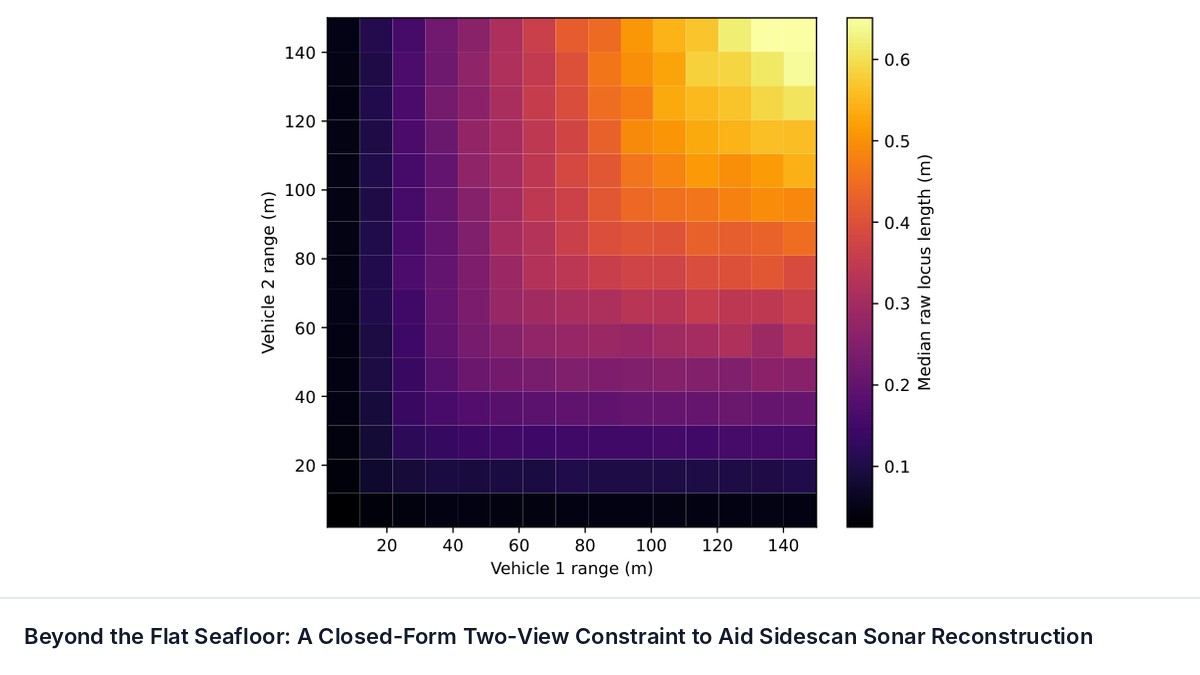
- Rather than make similar approximations, this paper focuses on a multi-view geometry based approach and formalizes a two-view geometric constraint and proves that a shared feature is constrained to a locus within the intersection of a sphere and a plane.
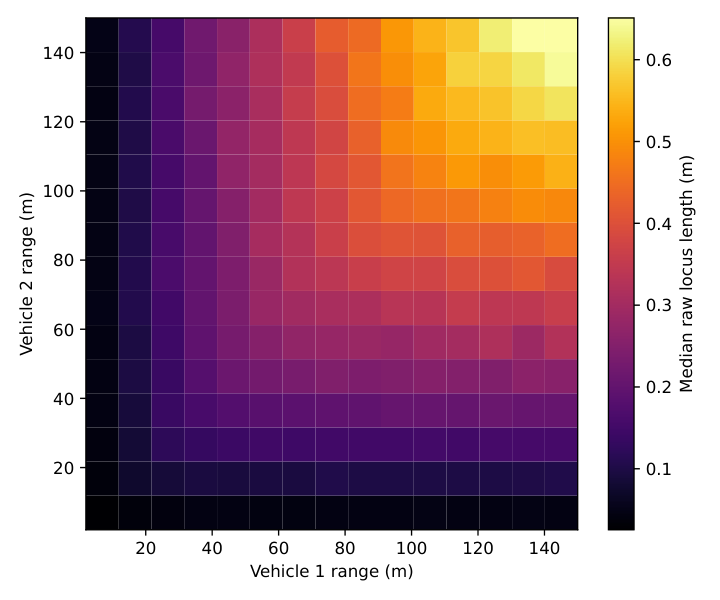
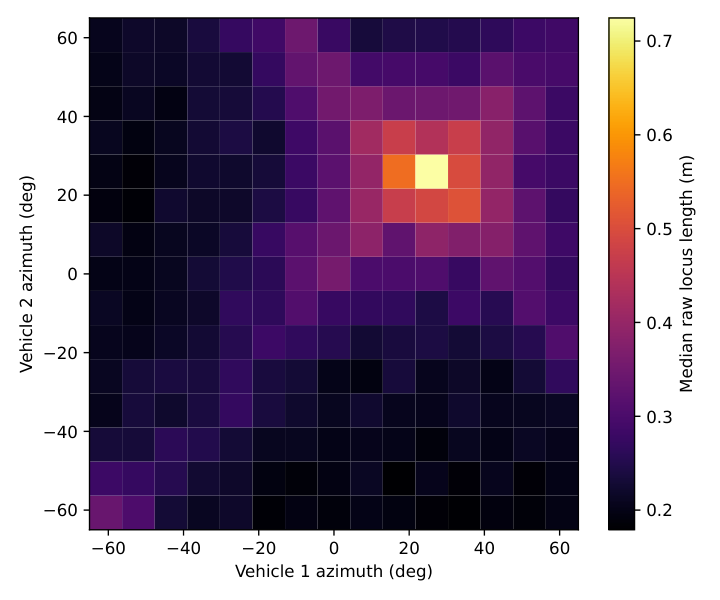
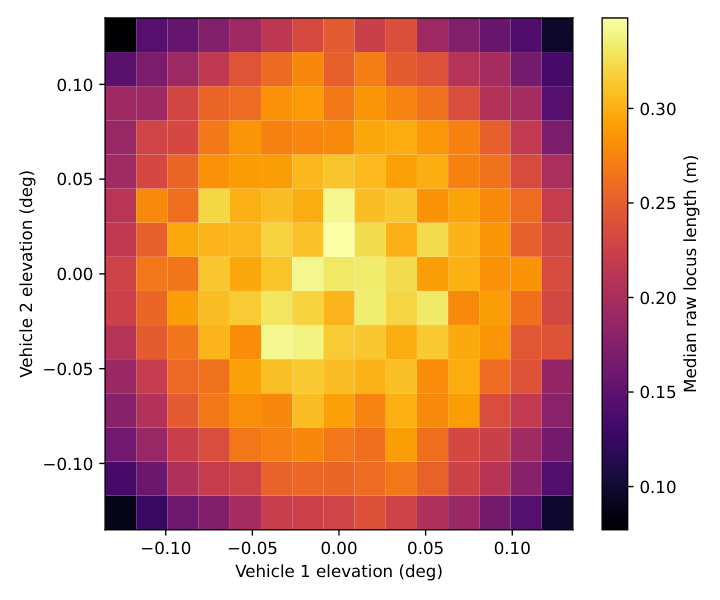
- In addition, we characterize what governs the size of the ambiguity locus through Monte Carlo simulation that is grounded in real aperture and mounting geometry for both a surface vessel and an underwater vehicle.
- We translate additional simulations of relative trajectories for both vehicle platforms into concrete survey-planning guidance.
Preliminaries
An SSS emits an acoustic ping at a known frequency (or range of frequencies) and measures the round-trip time of flight of any returns, converted via the local speed of sound into range measurements.
We adopt a local sensor coordinate frame, as in [ 10 ] , with the sensor oriented in the $+x$ direction, with $+y$ to the left of the sensor, and $+z$ up, and describe the location of a feature relative to the sensor in spherical coordinates $(r,\theta,\phi)$, the range, azimuth, and elevation, which are related to local Cartesian coordinates throu...
Closed-Form Geometric Constraint
Consider two SSS observations of the same feature from two distinct sensor poses, either from two separate measurements from the same vehicle, or observations from two different vehicles. Let $\mathbf{p}_{1}=[x_{1}\ y_{1}\ z_{1}]^{T}$ be the unknown location of the feature in the local frame of the first sensor.
Application and Analysis
Initially, we verified our approach on an idealized, unconstrained sensor pair and conducted a full-range Monte Carlo simulation over relative position and orientation.
However, we determined that this idealized sweep was not representative, as many of the sample relative orientations corresponded with vehicle attitudes that are either physically impossible or operationally impractical, such as an observation that comes from beneath the seafloor, or a vehicle rotated to be on its side.
Sources and Demonstrations
Figures are reproduced from Norman et al. See the full paper for experimental details and the project page, when the paper links one, for demonstrations and videos.
Related Papers
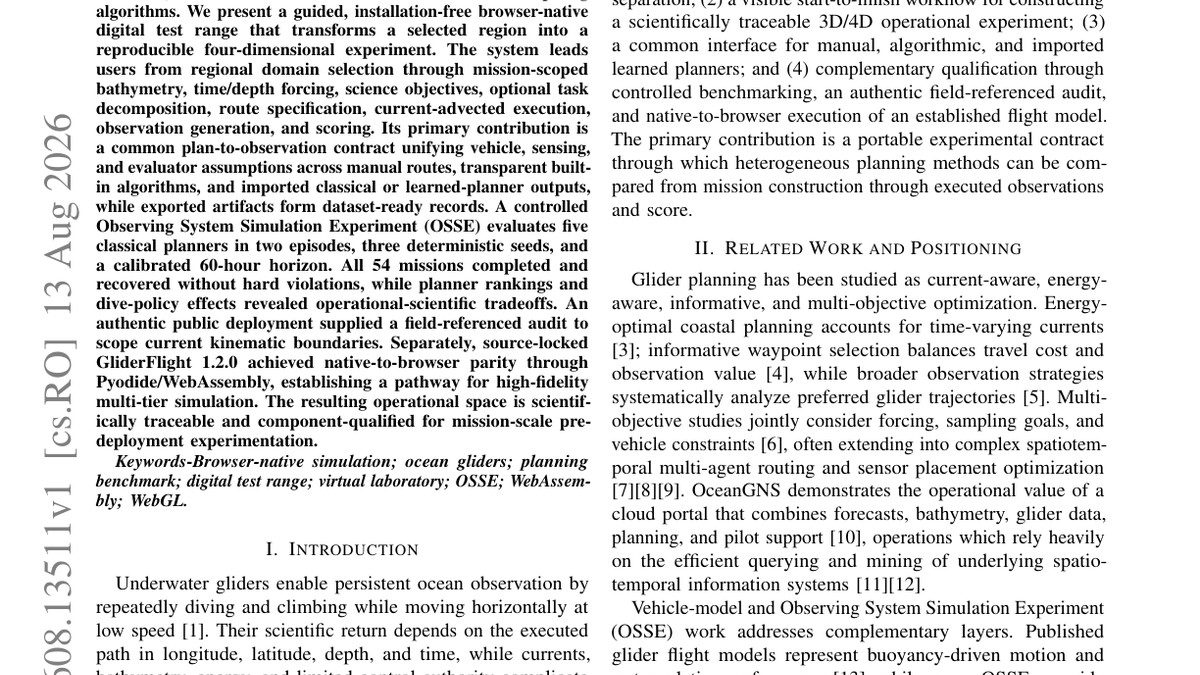
A Browser-Native Digital Test Range for Benchmarking 4D Ocean-Glider Planning Algorithms
Edward Holmberg, Elias Ioup, Mahdi Abdelguerfi
Repeated in-situ evaluation of ocean-glider planners requires scarce vehicles, operators, deployment and recovery resources, and ocean conditions that cannot be reset for competing algorithms.
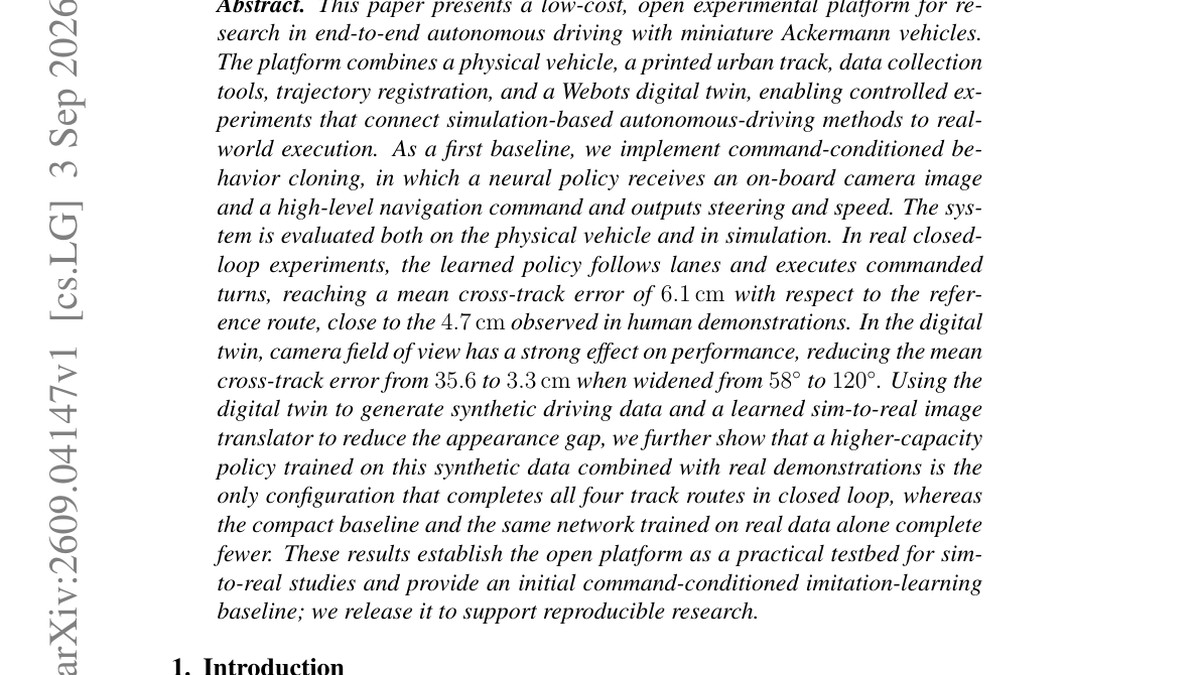
A Low-Cost, Open Platform for End-to-End Autonomous Driving on a Miniature Ackermann Vehicle
Gustavo Claudio Karl Couto, Eric Aislan Antonelo, Gabriel George Zipperer
This paper presents a low-cost, open experimental platform for research in end-to-end autonomous driving with miniature Ackermann vehicles.
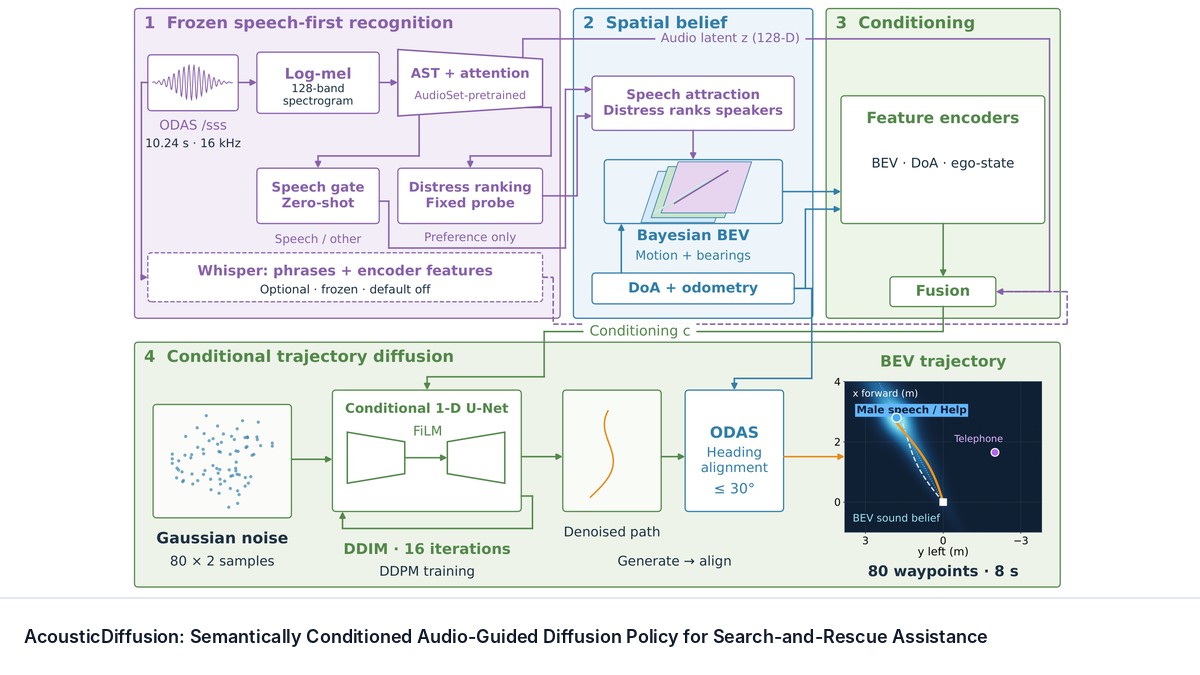
AcousticDiffusion: Semantically Conditioned Audio-Guided Diffusion Policy for Search-and-Rescue Assistance
Iana Zhura, Didar Seyidov, Dmitrii Plotnikov et al.
Navigating toward human callers is an important capability for rescue robots operating where visual contact is degraded or occluded. We present AcousticDiffusion, a semantically conditioned, audio-guided diffusion policy for human-directed navigation.
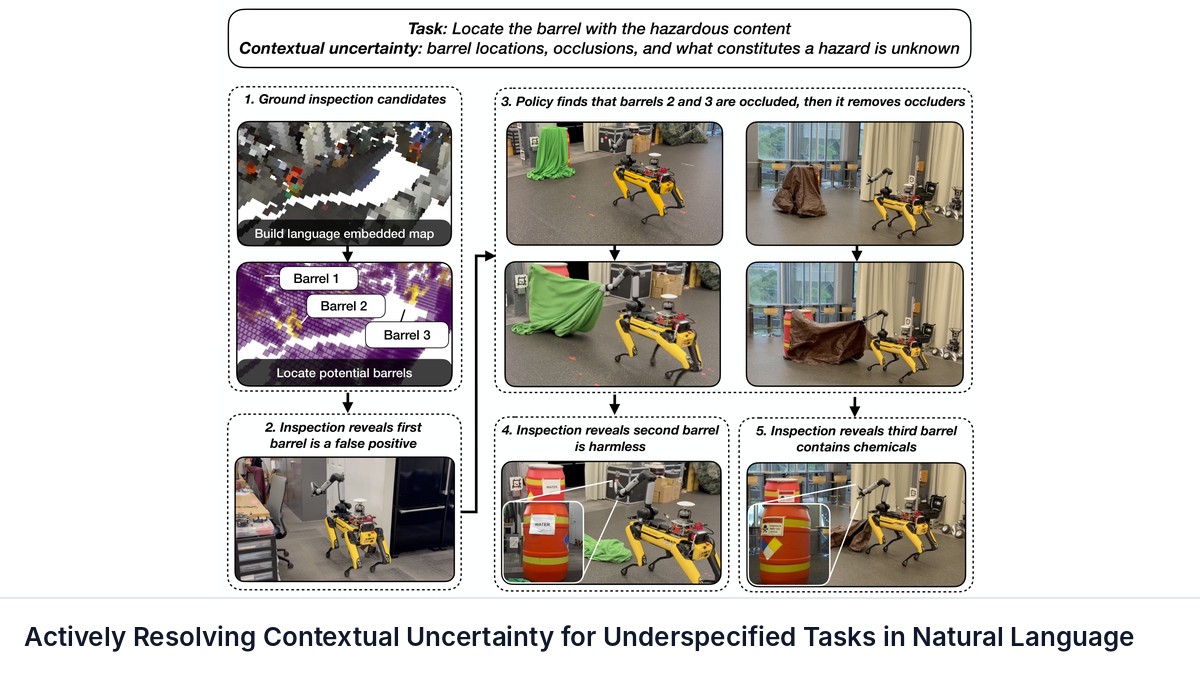
Actively Resolving Contextual Uncertainty for Underspecified Tasks in Natural Language
Zachary Ravichandran, Jonathan Diller, Fernando Cladera et al.
Foundation models provide robots with the ability to interpret natural language and reason about environmental context, yet most language-conditioned policies assume that goals are well-specified and that task-relevant information is provided upfront via a prior map.