
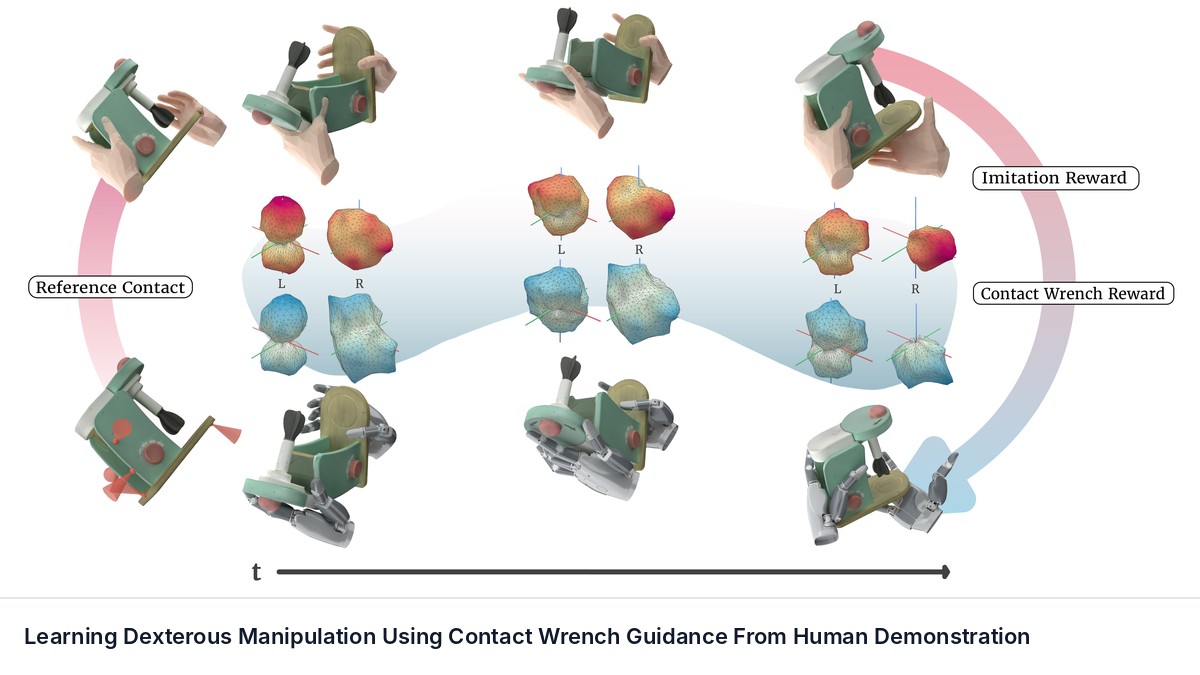
Learning Dexterous Manipulation Using Contact Wrench Guidance From Human Demonstration
Zhu, Xinghao, Liu, Zixi, Jain, Shalin, Li, Chenran, Noori, Milad, Lin, Michael Andres, Zhao, Huihua, Welsh, John, Verghese, Mrinal, Liu, Wei, Wang, Tingwu, Da, Xingye, Luo, Zhengyi, Kulkarni, Vishal, Bhatti, Naema, Zhu, Yuke, Fan, Linxi, Wen, Bowen, Xu, Danfei, Pouya, Soha, Chang, Yan · N/A · 2026
Framework
N/A
License
N/A
Stars
N/A
Summary
Dexterous robot manipulation can benefit from the abundance of human demonstrations, but transferring such demonstrations to robot policies remains challenging.
Abstract Summary
Key Points
- Dexterous robot manipulation can benefit from the abundance of human demonstrations, but transferring such demonstrations to robot policies remains challenging.
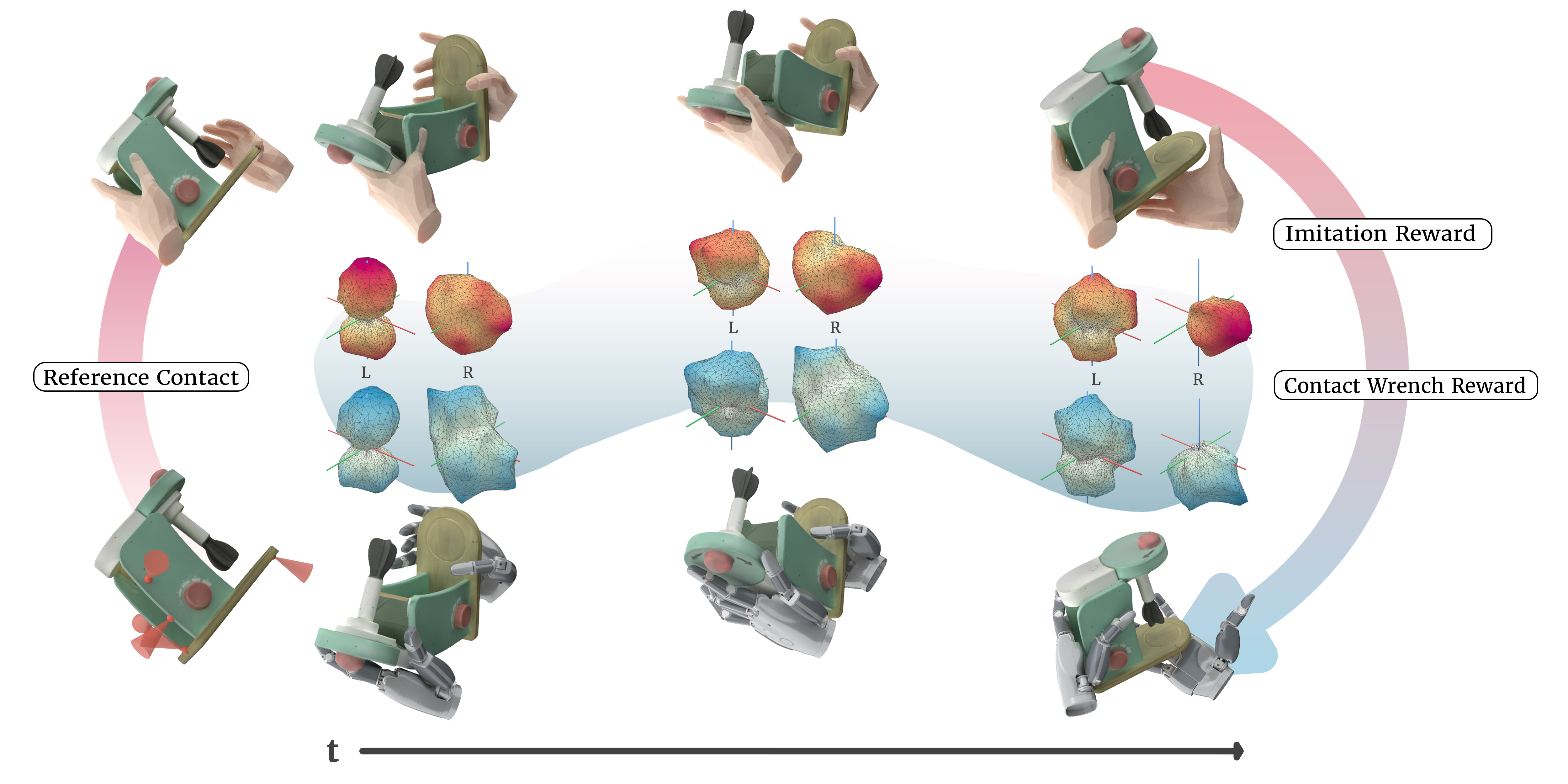
- We present Contact Wrench Guidance from Human Demonstration in Robotic Dexterous Manipulation (CHORD), a framework for long-horizon manipulation of rigid and articulated objects with reinforcement learning.
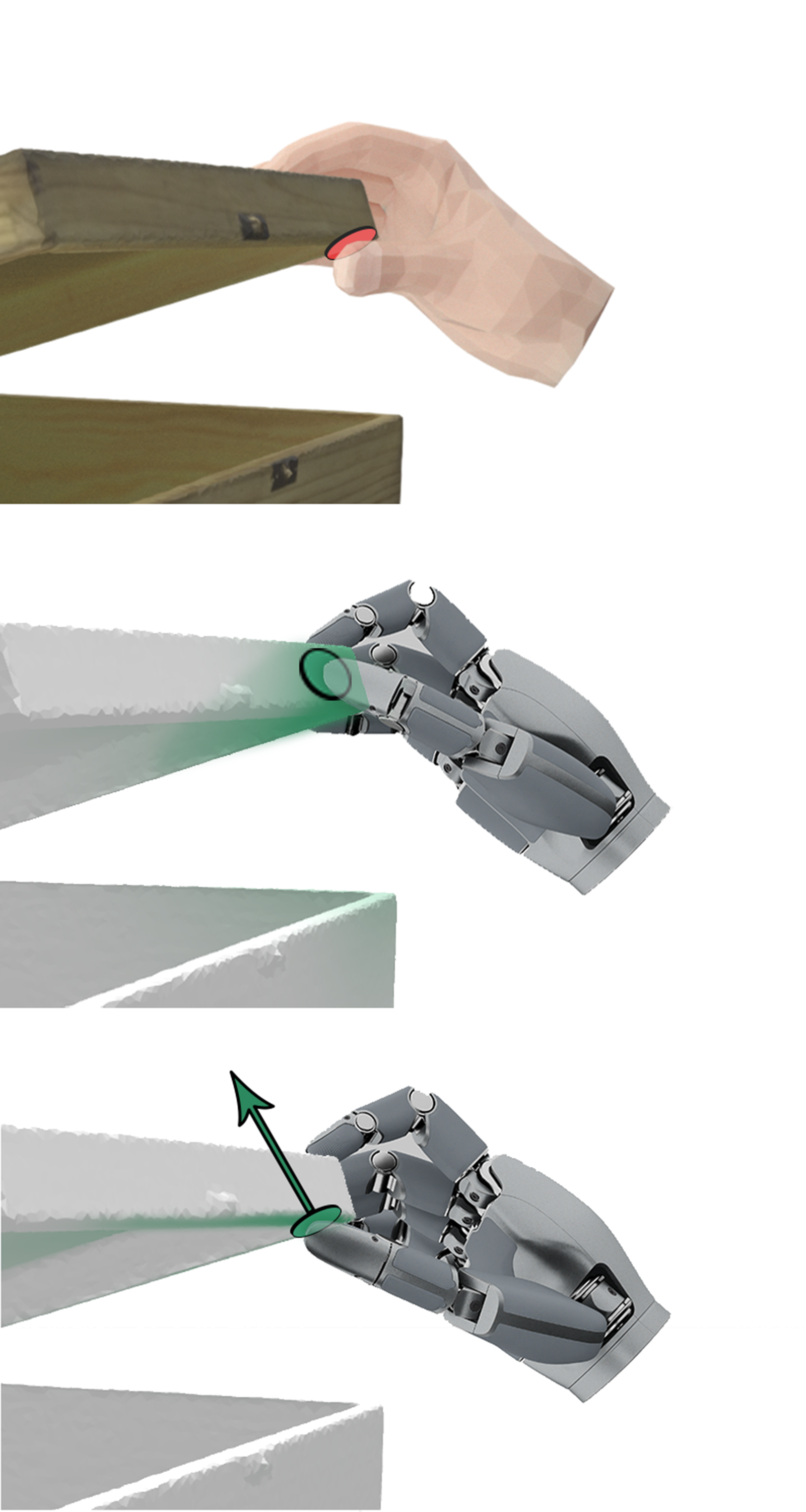
- The key idea is object-centric contact wrench space guidance: we represent human and robot motions by the forces and torques they can induce on the object, enabling similarity to be measured by the induced instantaneous motions.
- This guidance makes reinforcement learning more scalable for contact-rich dexterous manipulation
- We further introduce a large-scale simulation benchmark with 4,739 bimanual dexterous manipulation tasks, constructed from motion-capture datasets and reconstructed in-house videos.
Method
Our goal is to learn long-horizon manipulation of rigid and articulated objects from human demonstrations. We consider objects with $K$ rigid bodies, either as $K$ separate rigid objects or as an articulated object with $K$ parts.
Experiments
We conduct experiments to evaluate the scalability of CHORD on large-scale tasks and compare it against baseline methods ( Section 4.1 ). We then analyze the proposed contact-wrench reward, showing its advantages over prior objectives ( Section 4.2 ), its correlation with manipulation success ( Section 4.3 ), and its utility in learning long-horizon dexterous tasks ( Section 4.4 ).
Next, we demonstrate the generalizability of CHORD to whole-body manipulation ( Section 4.5 ) and real-world deployment ( Section 4.6 ).
Sources and Demonstrations
Figures are reproduced from Zhu et al. See the full paper for experimental details and the project page, when the paper links one, for demonstrations and videos.
Related Papers

A Sim-to-Real Integration Pipeline for Training and Deployment of Chunk-Based VLA Manipulation Policies
Mathilde Kappel, Clémence Grislain, Mohamed Chetouani et al.
Vision-Language-Action (VLA) models have become a prominent paradigm for mapping multimodal inputs, including semantic instructions, visual observations of the scene, and proprioceptive observations, to robot actions.
Behavioral Cloning Mystery
Seohong Park, Sergey Levine
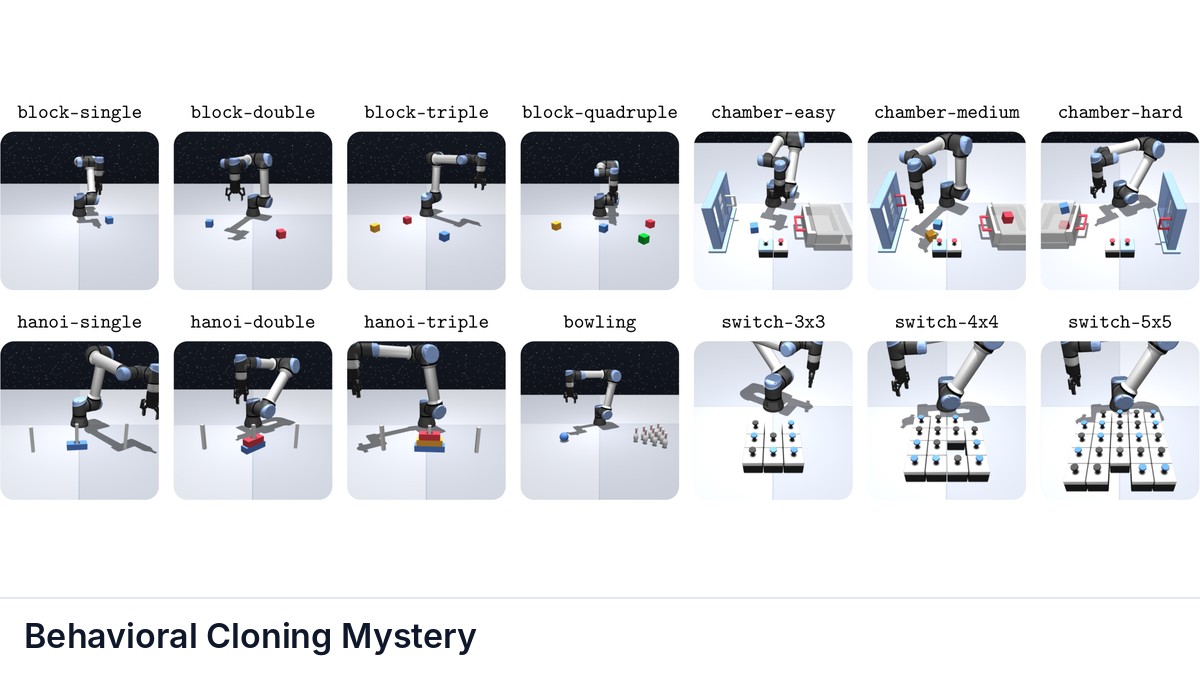
Behavioral cloning (BC), despite its simplicity, exhibits many counterintuitive phenomena in the real world. For example, the performance of BC often keeps increasing as the model overfits more to the dataset, and fully closed-loop policies often completely fail without action chunking.

Capability-Aware Arbitration for Semantic Intent-Based Shared Control
Zhaoda Du, Michael Bowman, Xiaoli Zhang
Shared control often allocates robot authority based on confidence in inferred human intent, assuming reliable autonomous execution. When this assumption fails, high intent confidence can cause over-helping.
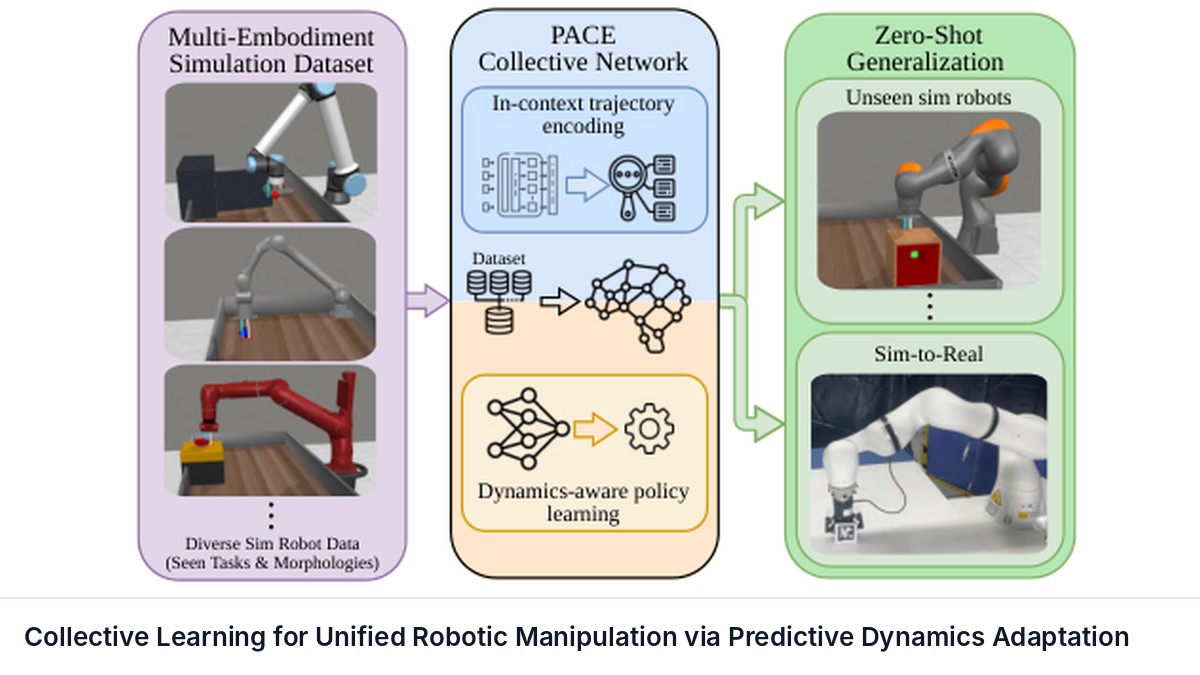
Collective Learning for Unified Robotic Manipulation via Predictive Dynamics Adaptation
Shaocheng Liu, Yuan Meng, Zhenshan Bing et al.
Learning a collective policy for state-based Cartesian manipulation across diverse robotic embodiments presents a fundamental challenge due to embodiment-dependent transition dynamics.