
IndoorBEV: A Lightweight Real-Time LiDAR BEV Perception System for Indoor Mobile Robots
Haichuan Li · N/A · 2026
Framework
N/A
License
N/A
Stars
N/A
Summary
Efficient indoor LiDAR perception is challenging because mobile robots must understand cluttered three-dimensional environments under strict latency and memory constraints.
Abstract Summary
Key Points
- Efficient indoor LiDAR perception is challenging because mobile robots must understand cluttered three-dimensional environments under strict latency and memory constraints.
- Existing point-based and voxel-based methods often incur substantial computational overhead, whereas conventional bird's-eye-view (BEV) representations improve efficiency at the cost of discarding vertical geometric information.
- We present IndoorBEV, a lightweight LiDAR perception framework that mitigates this tradeoff through a height-aware BEV representation and geometry-conditioned feature fusion.
- IndoorBEV summarizes the vertical point distribution in each BEV cell using statistical height features and multi-frequency height encoding, allowing informative three-dimensional cues to be processed efficiently by two-dimensional convolutions.
- A lightweight encoder then integrates complementary geometric features with multi-scale local representations and compact global scene context.
IndoorBEV: A Lightweight Real-Time LiDAR BEV Perception System for Indoor Mobile Robots
|Authors: Haichuan Li
|Venue: arXiv preprint | Year: 2026
|arXiv: 2610.00355
Abstract
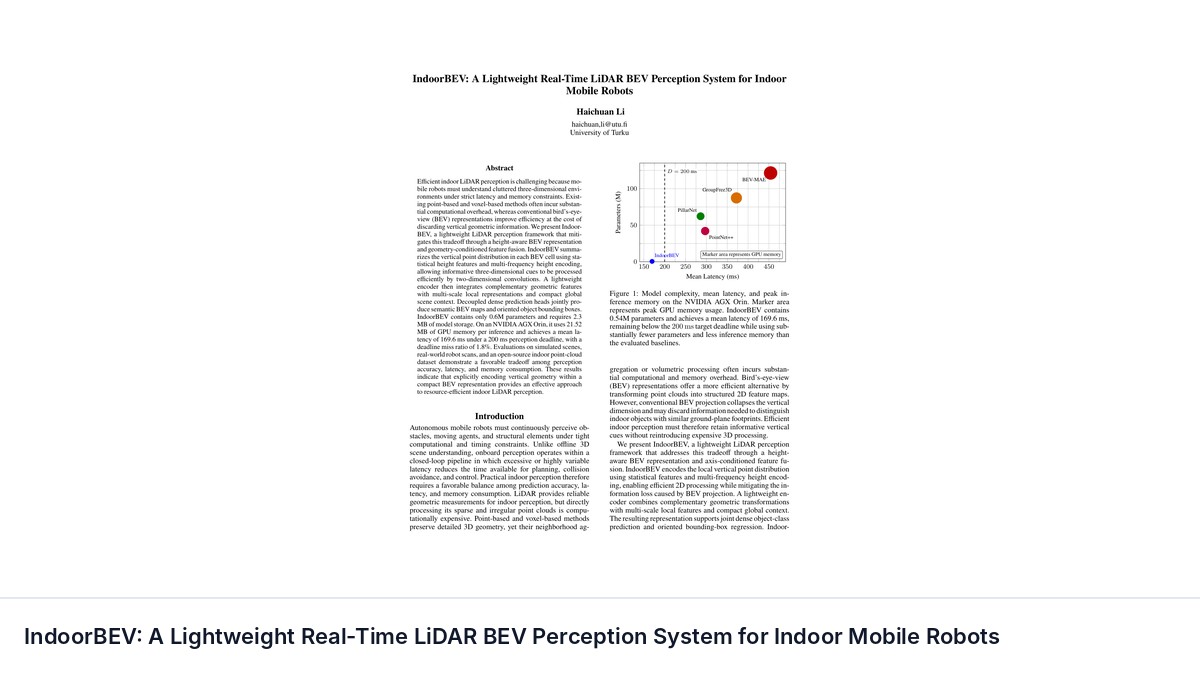
Efficient indoor LiDAR perception is challenging because mobile robots must understand cluttered three-dimensional environments under strict latency and memory constraints. Existing point-based and voxel-based methods often incur substantial computational overhead, whereas conventional bird’s-eye-view (BEV) representations improve efficiency at the cost of discarding vertical geometric information. We present IndoorBEV, a lightweight LiDAR perception framework that mitigates this tradeoff through a height-aware BEV representation and geometry-conditioned feature fusion. IndoorBEV summarizes the vertical point distribution in each BEV cell using statistical height features and multi-frequency height encoding, allowing informative three-dimensional cues to be processed efficiently by two-dimensional convolutions. A lightweight encoder then integrates complementary geometric features with multi-scale local representations and compact global scene context. Decoupled dense prediction heads jointly produce semantic BEV maps and oriented object bounding boxes. IndoorBEV contains only 0.6M parameters and requires 2.3 MB of model storage. On an NVIDIA AGX Orin, it uses 21.52 MB of GPU memory per inference and achieves a mean latency of 169.6 ms under a 200 ms perception deadline, with a deadline miss ratio of 1.8%. Evaluations on simulated scenes, real-world robot scans, and an open-source indoor point-cloud dataset demonstrate a favorable tradeoff among perception accuracy, latency, and memory consumption. These results indicate that explicitly encoding vertical geometry within a compact BEV representation provides an effective approach to resource-efficient indoor LiDAR perception.
Key Contributions
- Efficient indoor LiDAR perception is challenging because mobile robots must understand cluttered …
- Existing point-based and voxel-based methods often incur substantial computational overhead, wher…
- We present IndoorBEV, a lightweight LiDAR perception framework that mitigates this tradeoff throu…
- IndoorBEV summarizes the vertical point distribution in each BEV cell using statistical height fe…
- A lightweight encoder then integrates complementary geometric features with multi-scale local rep…
Topics
- vision
- reinforcement-learning
- benchmark
Code & Data
No code repository linked in paper metadata.
BibTeX
@article{Li2026_261000355,
  title     = {IndoorBEV: A Lightweight Real-Time LiDAR BEV Perception System for Indoor Mobile Robots},
  author    = {Haichuan Li},
  year      = {2026},
  eprint    = {2610.00355},
  archivePrefix = {arXiv},
  primaryClass  = {cs.RO},
  url       = {https://arxiv.org/abs/2610.00355}
}
Related Papers
4D Radar Perception Algorithms for Autonomous Driving: A Review
Xumin Wu, Jun Zhou, Jilin Mei et al.
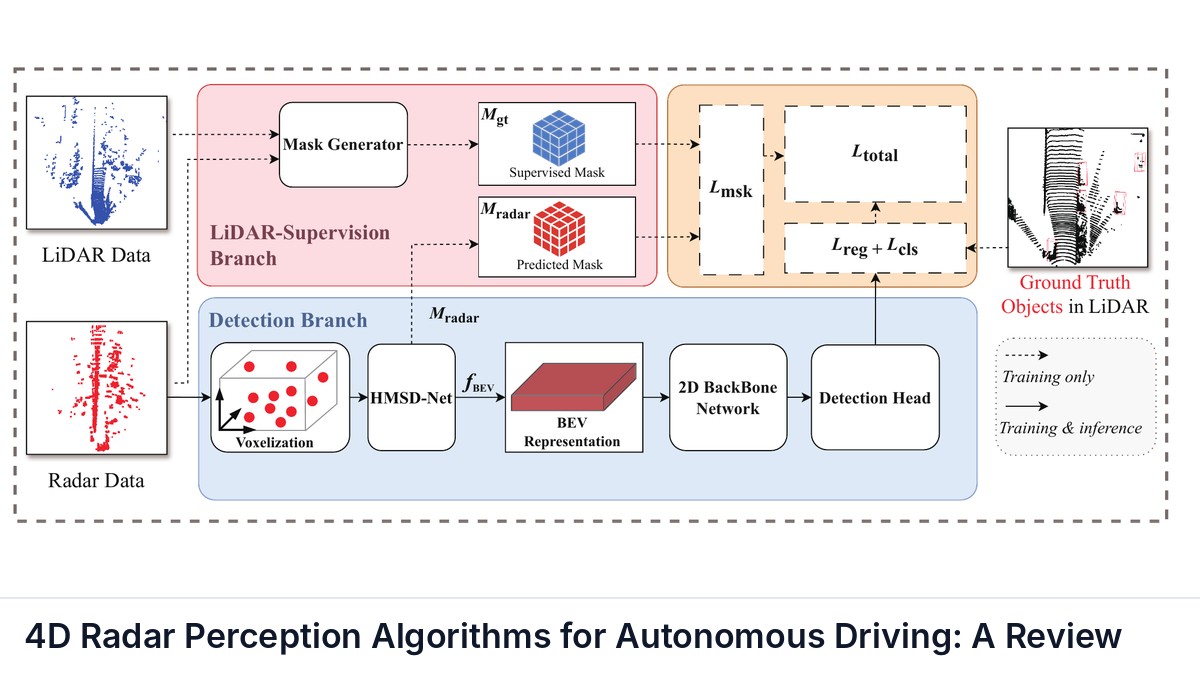
Research on 4D millimeter-wave radar perception algorithms has flourished in recent years, extending from signal processing and object detection to semantic segmentation, motion estimation, occupancy prediction, and dynamic scene reconstruction.
A Review Of Robotic World Models For Dynamic Environments Based On Factor And Scene Graphs
Marco Giberna, Miguel Fernandez-Cortizas, Jose Luis Sanchez Lopez et al.
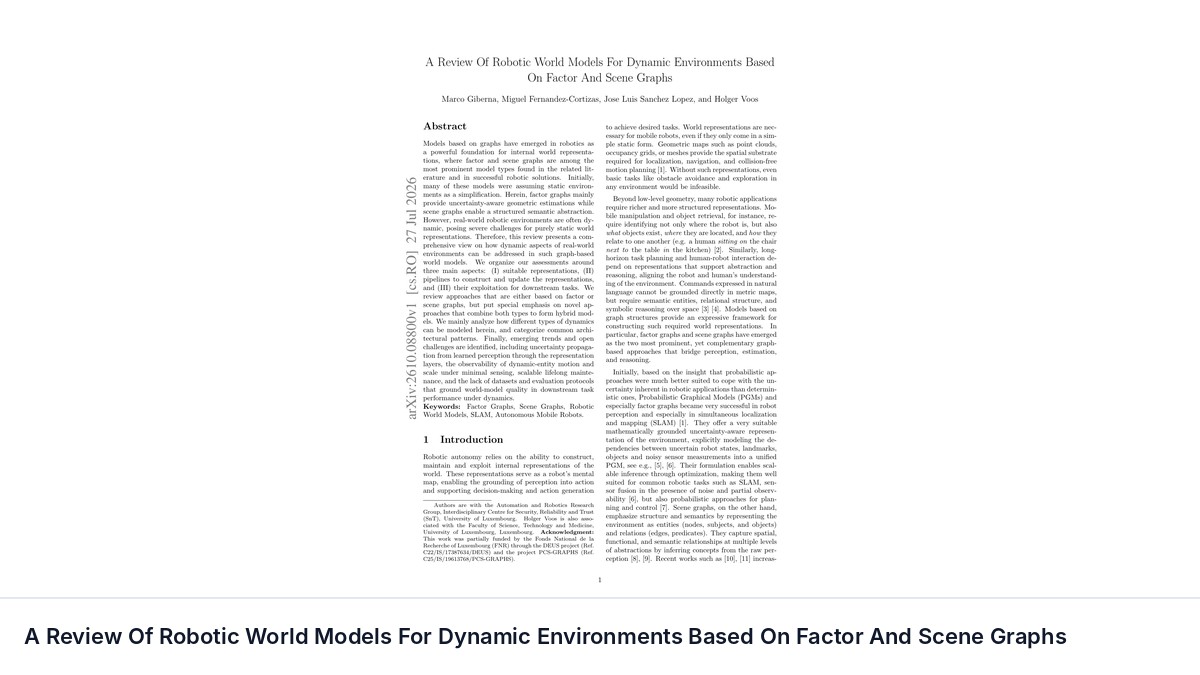
Models based on graphs have emerged in robotics as a powerful foundation for internal world representations, where factor and scene graphs are among the most prominent model types found in the related literature and in successful robotic solutions.

A Sim-to-Real Integration Pipeline for Training and Deployment of Chunk-Based VLA Manipulation Policies
Mathilde Kappel, Clémence Grislain, Mohamed Chetouani et al.
Vision-Language-Action (VLA) models have become a prominent paradigm for mapping multimodal inputs, including semantic instructions, visual observations of the scene, and proprioceptive observations, to robot actions.

Aim Short to Reach Far: Your Frozen World Model Can Plan Better Than You Think
Xvyuan Liu, Jianjie Fang, Chen Gao et al.
Planners built on visual world models commonly score each predicted outcome by its distance to the encoded goal image. We show that this target can limit control even with exact dynamics and globally optimal short-horizon search: reaching a goal may require actions that initially move away from it.