
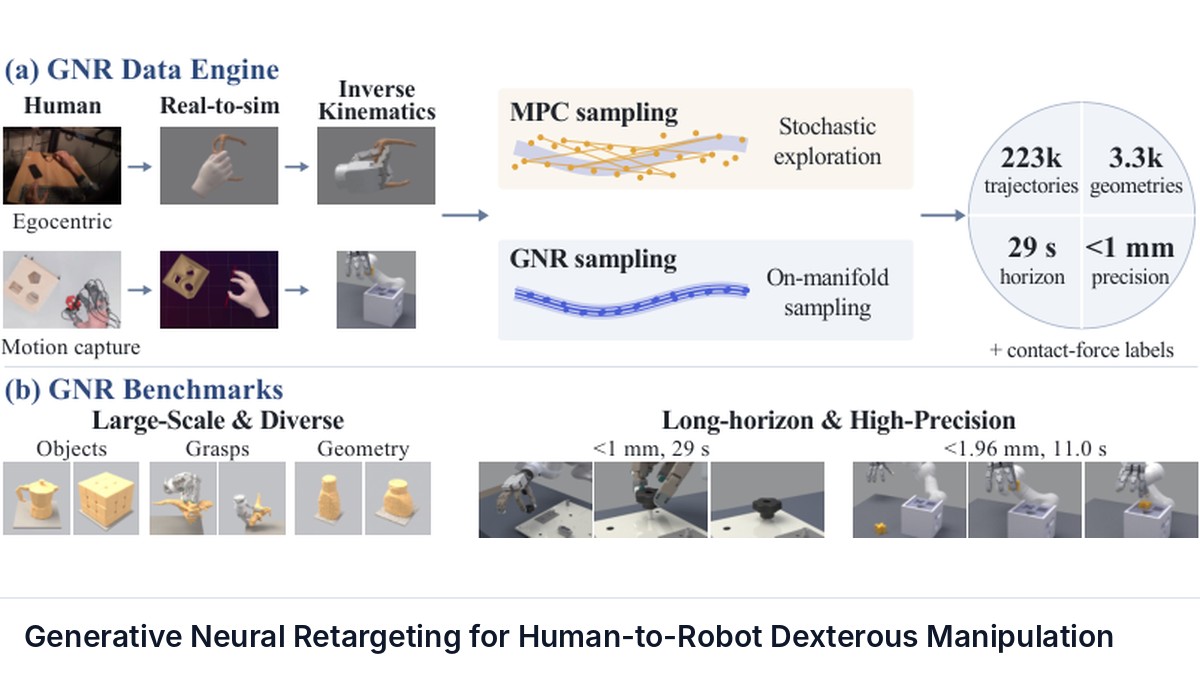
Generative Neural Retargeting for Human-to-Robot Dexterous Manipulation
Dechen Gao, Yue Yang, Ben Abbatematteo, Nathan Godwin, Pengcheng Wang, Roger Boldu, Steven Man, Zhiyang Dou, Chuan Qin, Sho Nakagome, Eric Whitmire · N/A · 2026
Framework
N/A
License
N/A
Stars
N/A
Summary
Human demonstrations are a scalable data source for learning dexterous manipulation, but the embodiment gap prevents human motion from being executed directly on robots. Inverse kinematics (IK) retargets human motion to robots efficiently but ignores dynamics, often producing infeasible motions.
Abstract Summary
Key Points
- Human demonstrations are a scalable data source for learning dexterous manipulation, but the embodiment gap prevents human motion from being executed directly on robots.
- Inverse kinematics (IK) retargets human motion to robots efficiently but ignores dynamics, often producing infeasible motions.
- Reinforcement learning (RL) and sampling-based model predictive control (MPC) are commonly employed to yield dynamically feasible motions, but both are sample-inefficient and sensitive to hyperparameters.
- RL suffers from costly and unstable training and tedious reward engineering; MPC avoids policy optimization, yet retargets each trajectory in isolation, and solving one does not make the next easier.
- Sampling cost grows rapidly with dataset size and task difficulty
Generative Neural Retargeting
Physics-based retargeting problem. Retargeting takes a human demonstration, represented either as human hand motion or as a robot kinematic reference obtained by IK, and asks for a dynamically feasible control sequence $\bm{u}_{0:T-1}$ over $T$ timesteps that reproduces the demonstrated behavior under physics.
We denote the reference motion as $\bar{\bm{x}}_{0:T}=(\bar{\bm{x}}_{0},\dots,\bar{\bm{x}}_{T})$, where each $\bar{\bm{x}}_{t}$ contains the robot and object states at timestep $0\leq t\leq T$.
A Human-to-Robot Data Engine
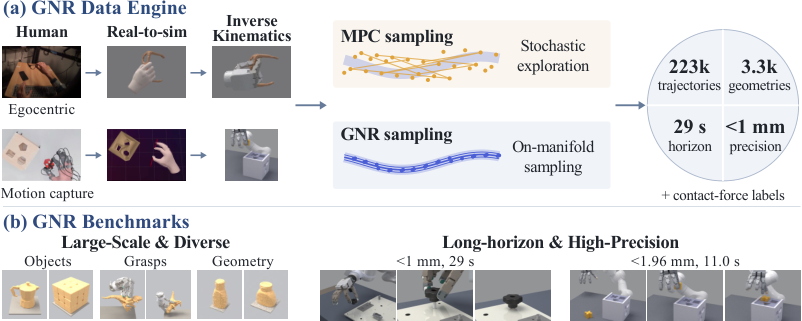
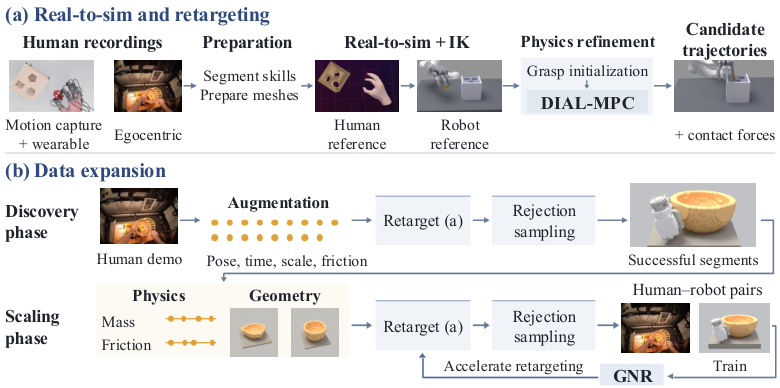
GNR accelerates physics-based retargeting and drives a human-to-robot data engine ( Figure 2 ) which produces feasible robot trajectories with simulation-derived contact-force annotations across both difficulty and diversity axes. We describe the retargeting pipeline in Section 4.1 and the discovery and scaling phases for expanding dataset diversity in Section 4.2 .
The data engine takes per-frame human hand motion, object poses, and an object surface mesh $\mathcal{M}$ as input.
Experiments
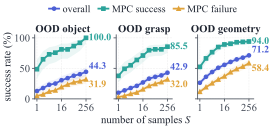
We evaluate GNR along the diversity and difficulty axes. We first describe the experimental settings ( Section 5.1 ), then evaluate GNR ’s performance and efficiency on large-scale, diverse egocentric demonstrations ( Section 5.2 ) and long-horizon, high-precision demonstrations ( Section 5.3 ). Simulator & Embodiment.
We use SuperDex Physics ( The Mochi Team, 2026 ) as the simulator, which supports non-convex collision geometry and spatially distributed 3-D contact forces, enabling dense contact-force annotations.
Sources and Demonstrations
Figures are reproduced from Gao et al. See the full paper for experimental details and the project page, when the paper links one, for demonstrations and videos.
Related Papers

A Sim-to-Real Integration Pipeline for Training and Deployment of Chunk-Based VLA Manipulation Policies
Mathilde Kappel, Clémence Grislain, Mohamed Chetouani et al.
Vision-Language-Action (VLA) models have become a prominent paradigm for mapping multimodal inputs, including semantic instructions, visual observations of the scene, and proprioceptive observations, to robot actions.
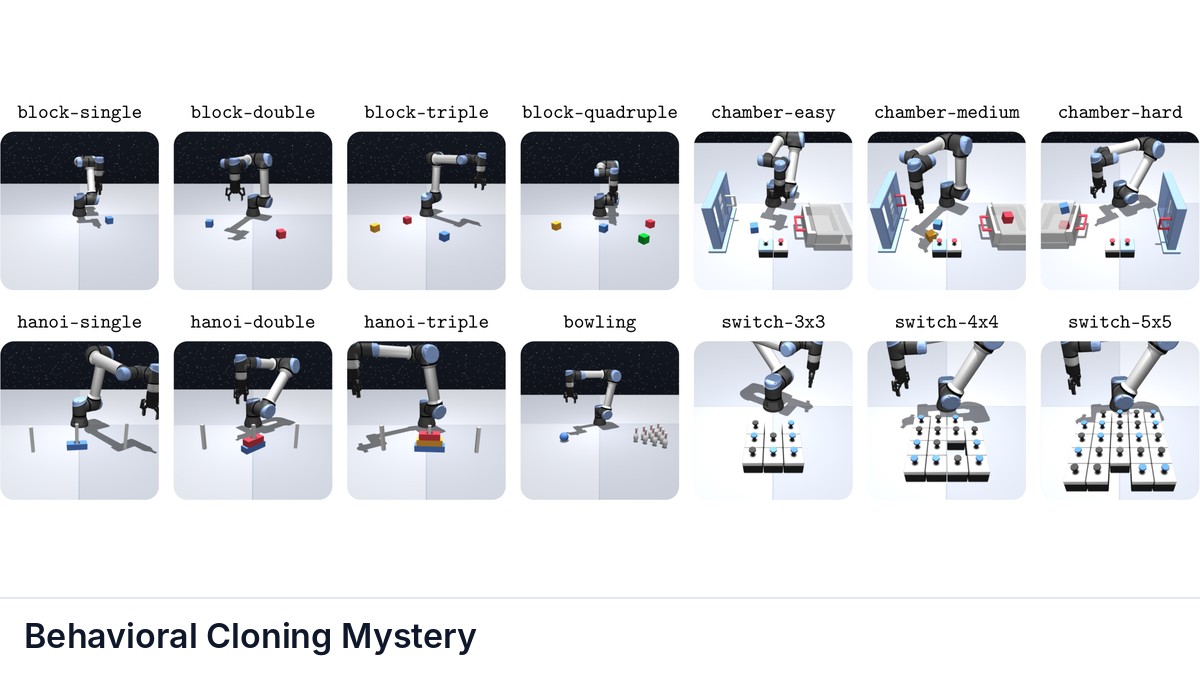
Behavioral Cloning Mystery
Seohong Park, Sergey Levine
Behavioral cloning (BC), despite its simplicity, exhibits many counterintuitive phenomena in the real world. For example, the performance of BC often keeps increasing as the model overfits more to the dataset, and fully closed-loop policies often completely fail without action chunking.

Capability-Aware Arbitration for Semantic Intent-Based Shared Control
Zhaoda Du, Michael Bowman, Xiaoli Zhang
Shared control often allocates robot authority based on confidence in inferred human intent, assuming reliable autonomous execution. When this assumption fails, high intent confidence can cause over-helping.
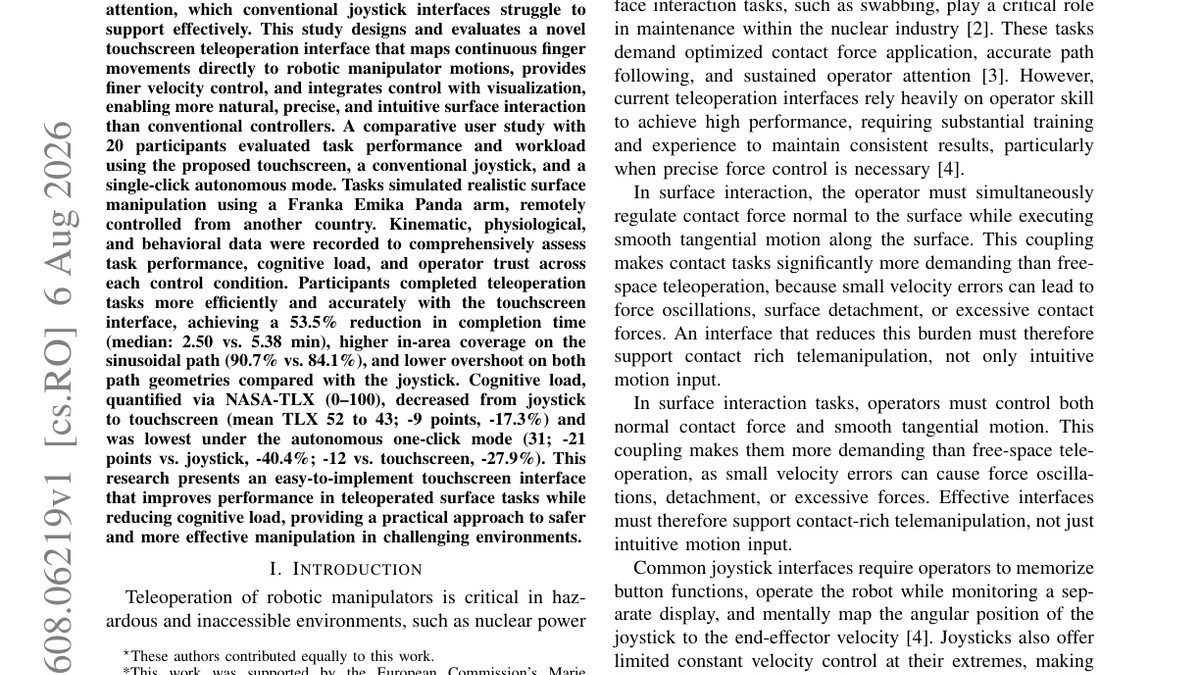
Design and Evaluation of a Touchscreen-Based Teleoperation Interface for Robotic Manipulators
Juan José García Cárdenas, Alperen Kenan, Hamidreza Raei et al.
Intuitive teleoperation interfaces are crucial for the safe and effective operation of robotic manipulators in challenging environments.