
Higher-Order Morphology Priors for Quadruped Reinforcement Learning Under Actuator Degradation
Derek You, Zafir Shamsi, Keqin Wang, Christine Allen-Blanchette · N/A · 2026
Framework
N/A
License
N/A
Stars
N/A
Summary
Actuator degradation turns quadruped locomotion into a coordination problem requiring joints to compensate for lost actuation. Prior work suggests that morphology-aware graph policies improve learning and generalization under body perturbations.
Abstract Summary
Key Points
- Actuator degradation turns quadruped locomotion into a coordination problem requiring joints to compensate for lost actuation.
- Prior work suggests that morphology-aware graph policies improve learning and generalization under body perturbations.
- We ask whether these benefits can be strengthened by explicitly modeling higher-order mechanical structure.
- We represent the Unitree Go1 as a cell complex with limb- and body-level rank-2 cells and apply Hodge-based message passing.
- Under degradation training, the node-edge-face Hodge actor achieves the highest return on unseen actuator degradations, with higher survival and lower velocity-tracking error.
Preliminaries
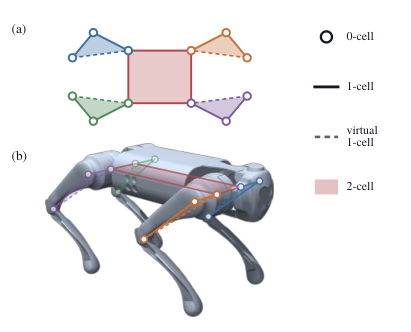
The Unitree Go1 is a 12-DoF quadruped with four three-joint legs attached to a rigid trunk (see Fig. 1 ). Each leg comprises a hip abduction/adduction joint and hip and knee flexion/extension joints. Two properties motivate the higher-order representation in Sec. III-C .
First, each leg acts as a mechanical unit: foot placement depends jointly on all three joints, so lost actuation at one must be compensated for by the others.
Method
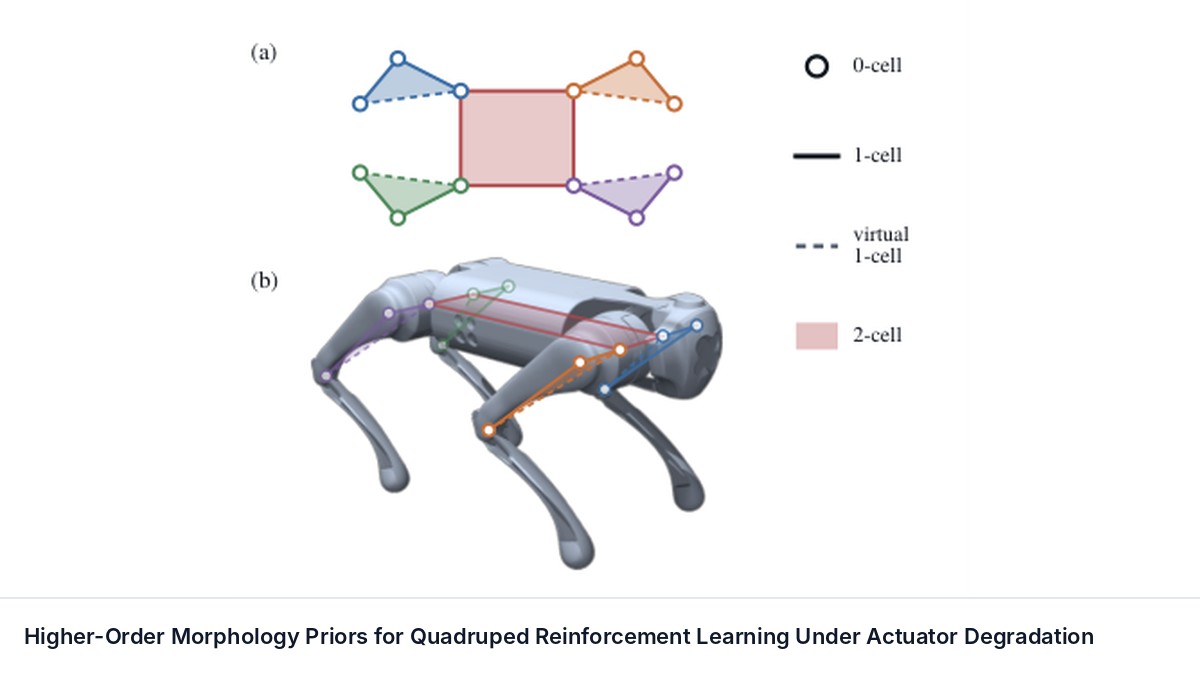
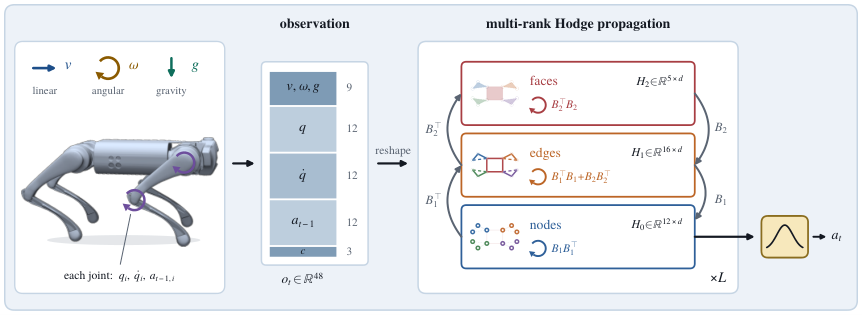
The Go1 cell-complex construction is shown in Fig. 1 . Each node (0-cell) corresponds to one of the twelve joints on the robot. Eight kinematic edges (1-cell) connect adjacent joints along the four legs. Four additional edges connect the hip joints around the body, while four hip-calf edges close the four limb cycles.
Experiments
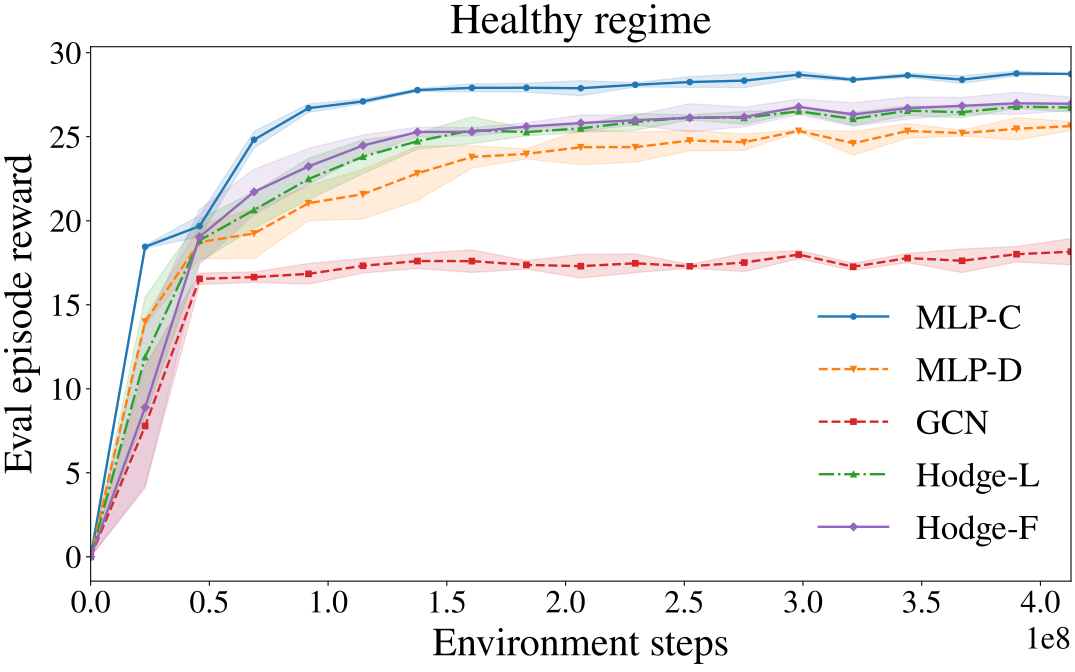
All experiments use the Unitree Go1 problem setting described in Sec. III-B . All actor variants share the same critic, reward, domain randomization, optimization setup, and training budget. Each policy is trained for 400M environment steps with seeds $\{11,12,13\}$. We compare five parameter-matched actor architectures: MLP-C : centralized MLP mapping the global 48-D observation directly to all joint outputs.
MLP-D : factorized per-joint MLP with shared weights and no inter-joint message passing.
Sources and Demonstrations
Figures are reproduced from You et al. See the full paper for experimental details and the project page, when the paper links one, for demonstrations and videos.
Related Papers
A Balanced Data Diet: Addressing the Exploration Bottleneck in Mega-Scale RL for Robot Control
Octi Zhang, Mateo Guaman Castro, Patrick Yin et al.
General-purpose robots must perform a wide range of tasks from agile locomotion to dexterous manipulation.
A Heterogeneous Architecture for Robot RL Beyond GPU-Dominant Paradigms
Yufei Jia, Zhanxiang Cao, Mingrui Yu et al.
Simulation-based RL for contemporary robot control is increasingly organized around GPU-resident simulation: physics, rollout collection, and learning are placed on a single GPU-centric execution path
A Mode-Unified, Continuous, and Biomimetic Control Strategy of a Robotic Lower Limb Prosthesis
Hanjun Kim, Sixu Zhou, John Shim et al.
Existing biomimetic lower-limb prosthesis controllers are commonly designed for discrete locomotion modes, requiring separate parameterizations for level walking, ramps, and stairs.
A Unified Kinematic Representation Enables Reusable Biological Joint Moment Estimation
Jinwoo Hwang, Ilseung Park, Changseob Song et al.
Objective: Data-driven models that estimate physiological states, particularly biological joint moments, are widely used in exoskeleton control.