
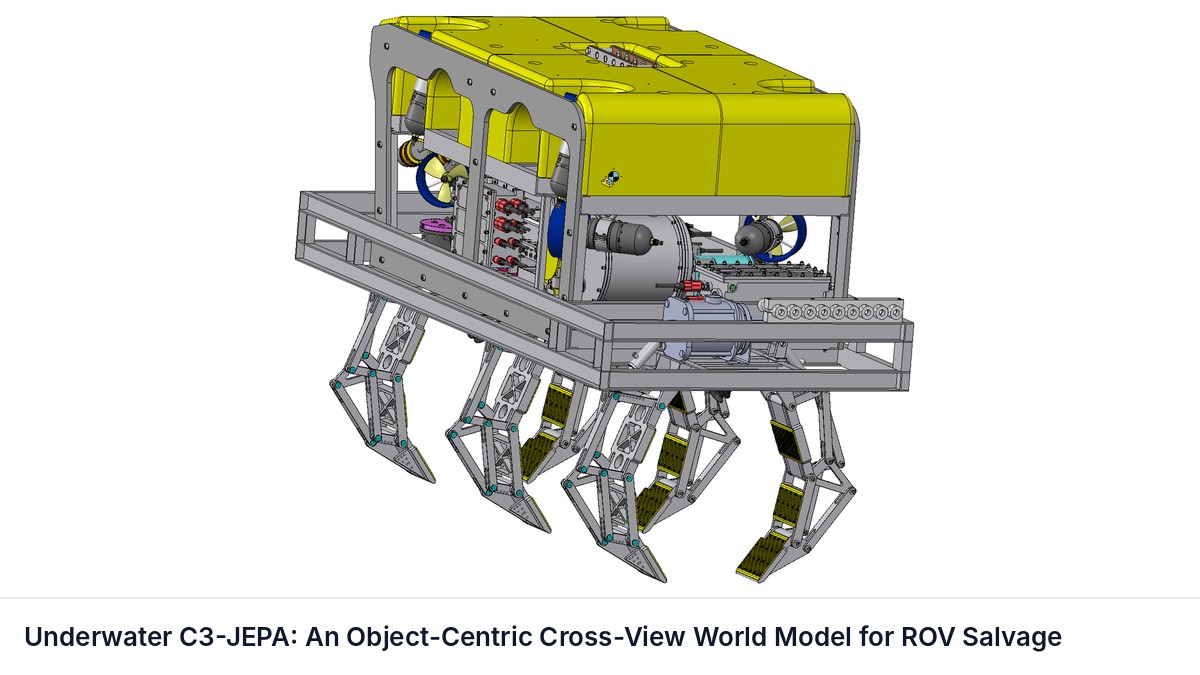
Underwater C3-JEPA: An Object-Centric Cross-View World Model for ROV Salvage
Yuncong Yang, Jinlong Li, Yulong Xue, Feng Wu, Chunwen Zhang, Lei Qiao, Xuyang Wang · N/A · 2026
Framework
N/A
License
N/A
Stars
N/A
Summary
We present Underwater C$^{3}$-JEPA (cross-view, control-conditioned, context-extended), an object-centric multi-view predictive world model for near-field heavy-load underwater ROV salvage.
Abstract Summary
Key Points
- We present Underwater C$^{3}$-JEPA (cross-view, control-conditioned, context-extended), an object-centric multi-view predictive world model for near-field heavy-load underwater ROV salvage.
- Without contact sensors, it predicts in latent space how the task-object state evolves through contact interaction and under the hydrodynamic lag of the vehicle, from synchronized multi-view RGB observations and vehicle control signals.
- C$^{3}$-JEPA encodes multi-camera observations into task-object and context tokens, fuses cross-camera evidence through held-out-view attention, and directly predicts future states conditioned on control.
- Weak binding anchors the target and gripper at low annotation cost, while SIGReg sharpens the geometric representation.
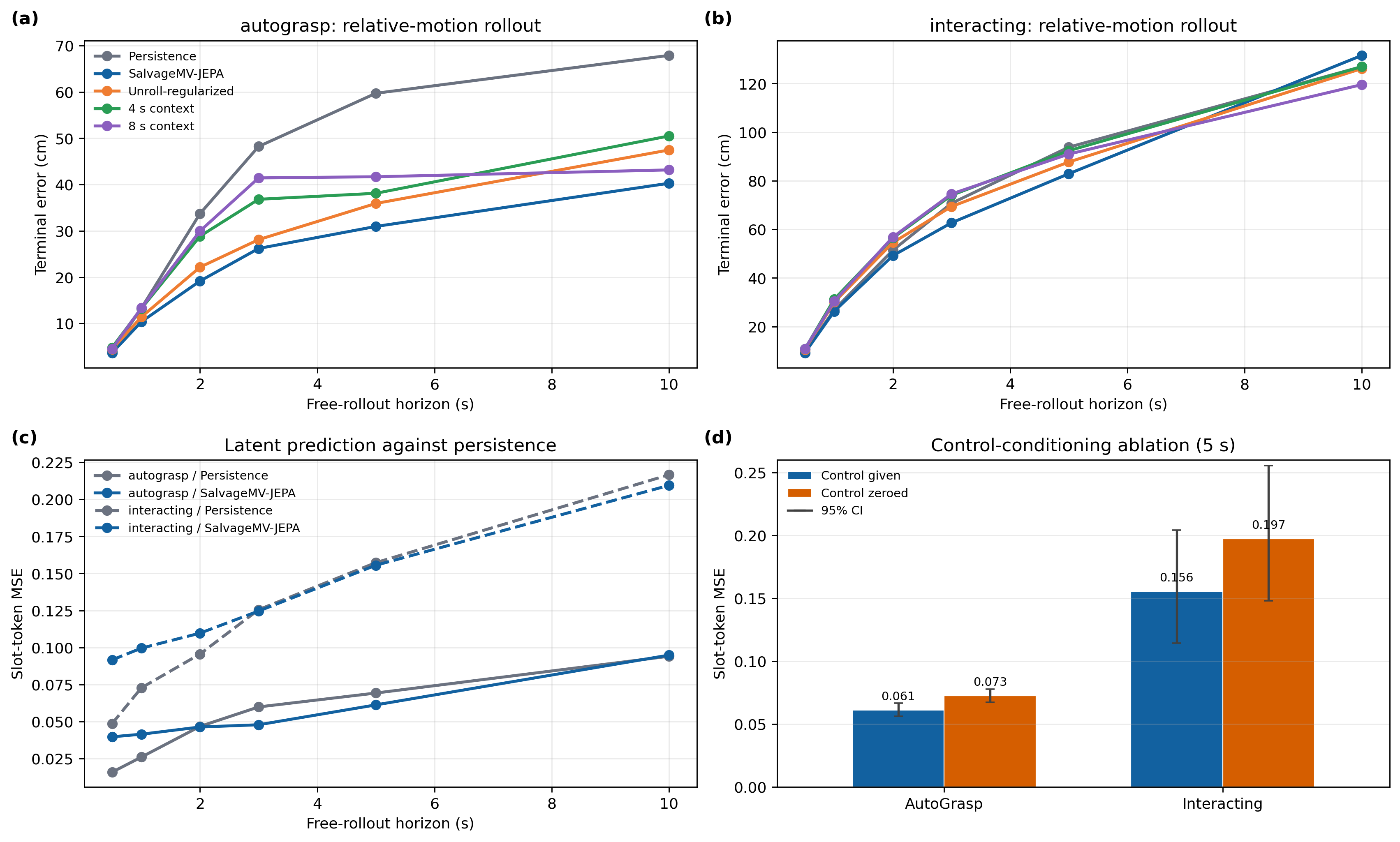
- Experiments show that the learned representation transfers substantially more task-relevant information to downstream probes than a reconstruction-free latent baseline, while keeping the predictor lightweight.
Method
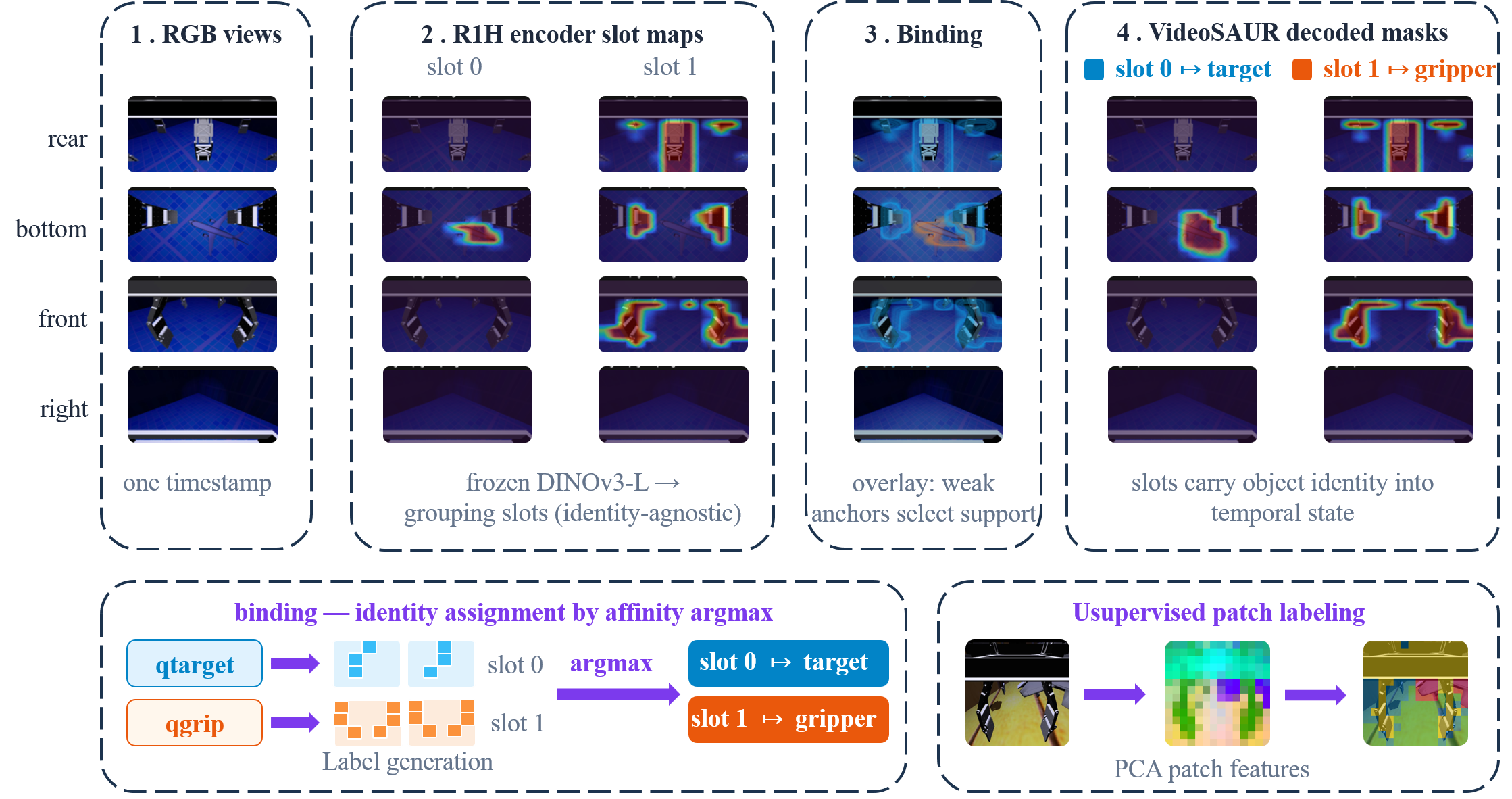
Fig. 2 summarizes the pipeline. At time $t$, synchronized camera observations are $I_{t}^{1:V}$. A frozen DINOv3-L feature extractor [ 50 ] maps each view to patch features $X_{t}^{v}\in\mathbb{R}^{P\times d_{p}}$, and a temporal slot encoder returns $K$ slots $S_{t}^{v}\in\mathbb{R}^{K\times d_{s}}$. In simulation $V=4$; the architecture itself accepts the subset of views available on a platform.
Three binding slots represent the target UUV, the gripper, and the fixed ROV frame.
Experimental Setup and Evaluation
Table I lists the training configuration of the visual encoder and the control-conditioned predictor, shared by all experiments below. Data are collected in the ROS–Gazebo UUV Simulator environment [ 52 ] , which implements Fossen’s equations of motion for the vehicle dynamics [ 24 ] ; each recording provides synchronized cameras, vehicle state, gripper signals, poses, and event annotations. The caveat of Sec.
Results
The evidence below follows the evaluation ladder of Sec. IV . The learned representation preserves task-object semantics while reconstructing frozen visual features (Table II ). Across the recording-disjoint split, binding-guided training maintains high task-group Dice for the target UUV and gripper while held-out-view fusion lowers feature reconstruction error.
Binding guidance trades reconstruction for downstream utility.
Field Validation on Real Underwater Video
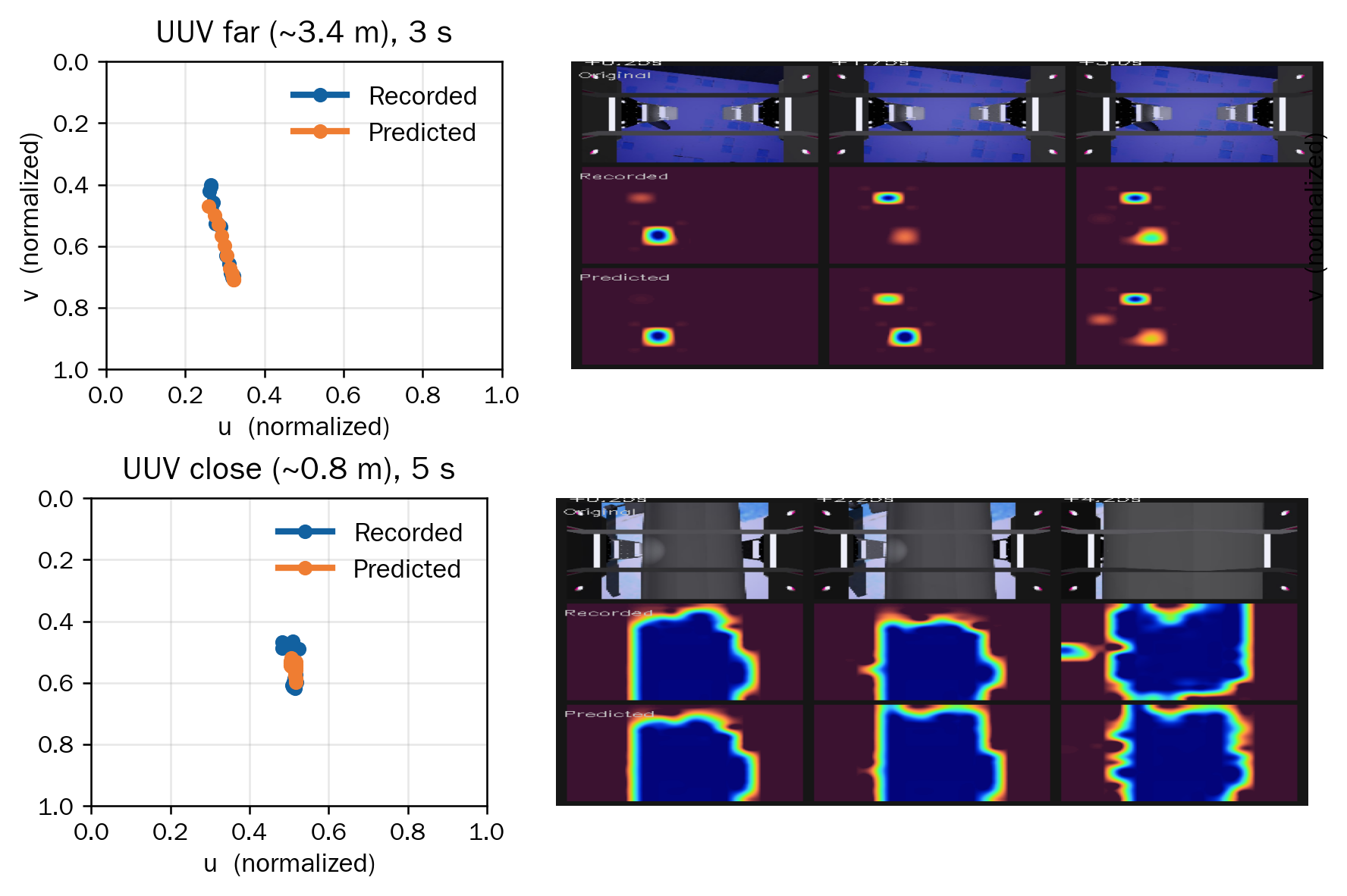
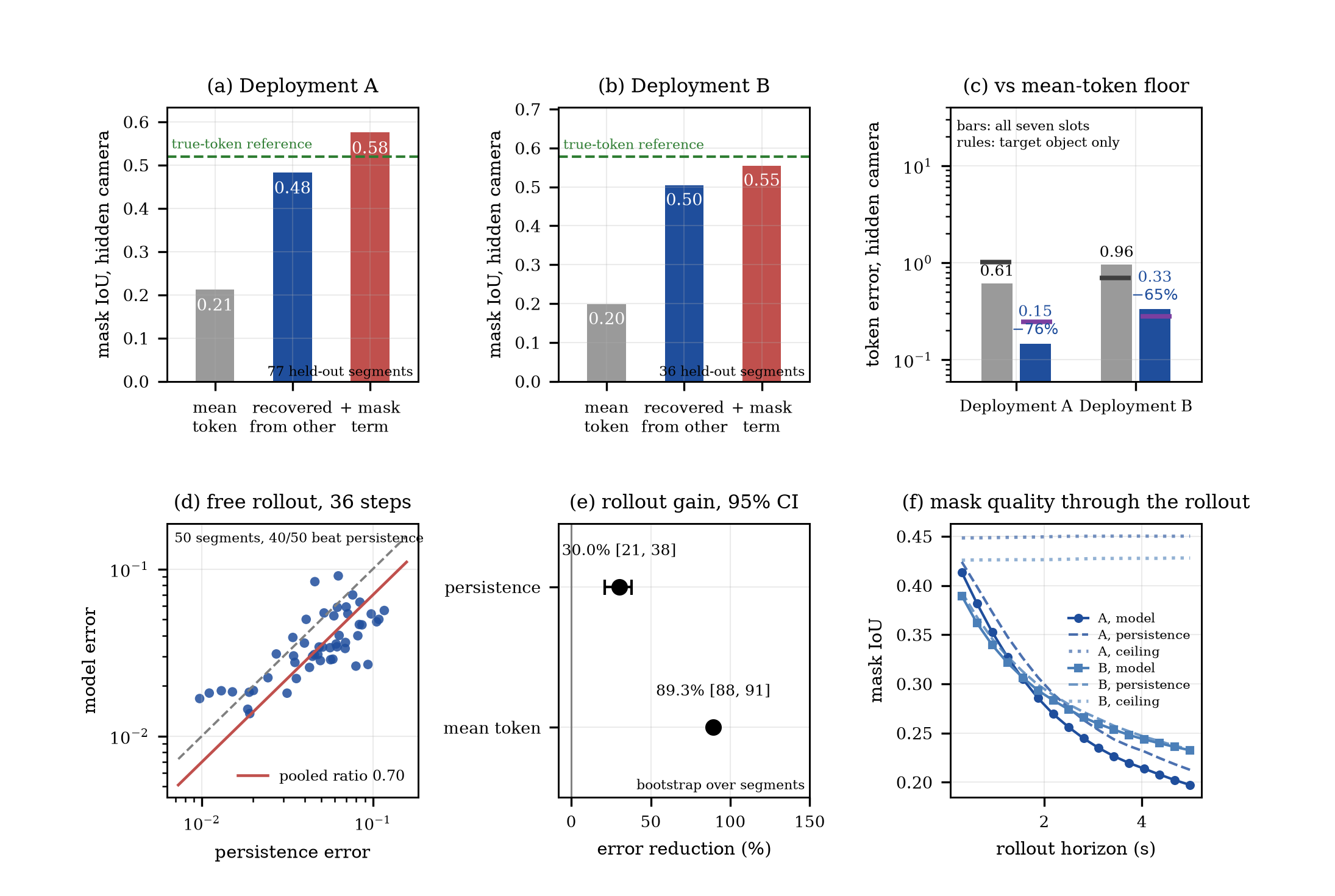
All results above are trained and measured on simulated salvage scenes. The question here: does the same predictive state, with the same recipe, hold up on real underwater video? Everything here is trained from the raw field recordings alone; the simulator does not participate. Open-loop replay of recorded actions is a recognized evaluation protocol when closed-loop deployment is unavailable [ 58 ] .
Both recordings were collected in a test pool measuring 60 m by 20 m with a water depth of 10 m, under two operation modes (Fig.
Sources and Demonstrations
Figures are reproduced from Yang et al. See the full paper for experimental details and the project page, when the paper links one, for demonstrations and videos.
Related Papers

A Sim-to-Real Integration Pipeline for Training and Deployment of Chunk-Based VLA Manipulation Policies
Mathilde Kappel, Clémence Grislain, Mohamed Chetouani et al.
Vision-Language-Action (VLA) models have become a prominent paradigm for mapping multimodal inputs, including semantic instructions, visual observations of the scene, and proprioceptive observations, to robot actions.
Aim Short to Reach Far: Your Frozen World Model Can Plan Better Than You Think
Xvyuan Liu, Jianjie Fang, Chen Gao et al.
Planners built on visual world models commonly score each predicted outcome by its distance to the encoded goal image. We show that this target can limit control even with exact dynamics and globally optimal short-horizon search: reaching a goal may require actions that initially move away from it.
Beyond Reconstruction: What Matters in Action Tokenization for Robot Policies?
Haoran Chen, Jingtian Ji, Samuel Wheeler et al.
Autoregressive action-token policies such as vision-language-action models require action tokenizers to translate discrete token sequences into precise control actions in continuous space. Many action tokenizers learn the mapping between tokens and actions via a reconstruction objective.

Capability-Aware Arbitration for Semantic Intent-Based Shared Control
Zhaoda Du, Michael Bowman, Xiaoli Zhang
Shared control often allocates robot authority based on confidence in inferred human intent, assuming reliable autonomous execution. When this assumption fails, high intent confidence can cause over-helping.