
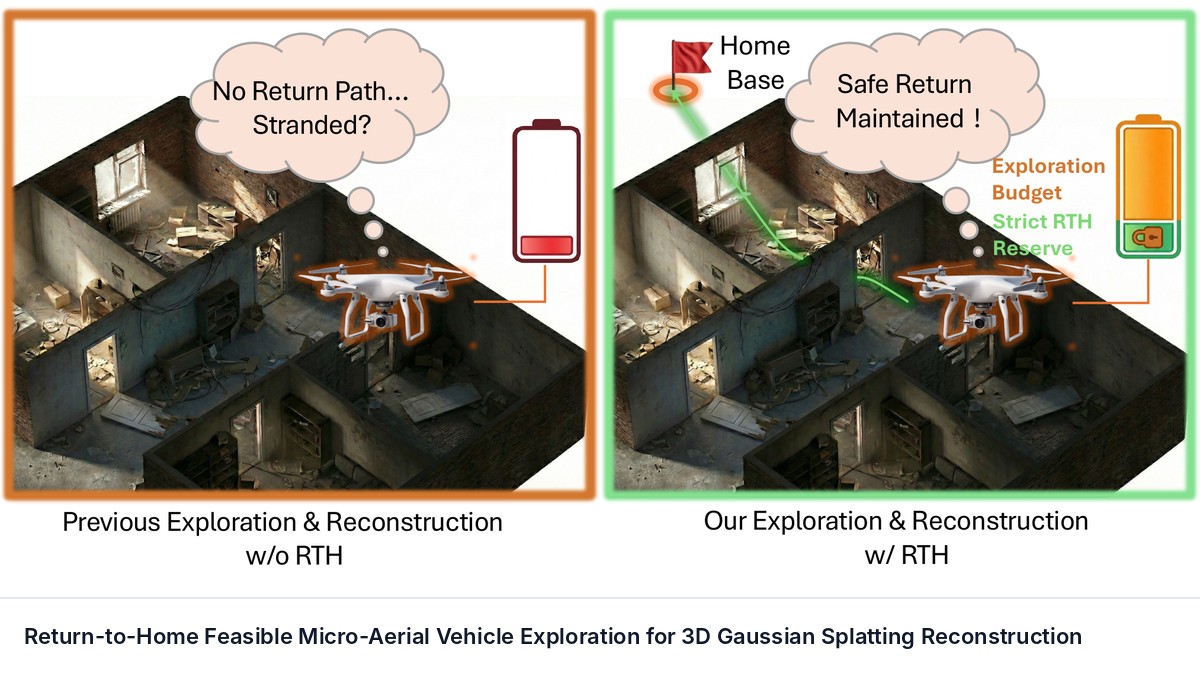
Return-to-Home Feasible Micro-Aerial Vehicle Exploration for 3D Gaussian Splatting Reconstruction
Prajit Krisshnakumar, Fan Yang, Koichiro Niinuma · N/A · 2026
Framework
N/A
License
N/A
Stars
N/A
Summary
Micro aerial vehicles (MAVs) enable rapid indoor 3D reconstruction for inspection and time-critical situational awareness, but must operate under strict flight-time budgets and safety constraints that require explicit return-to-home (RTH) feasibility with a conservative margin.
Abstract Summary
Key Points
- Micro aerial vehicles (MAVs) enable rapid indoor 3D reconstruction for inspection and time-critical situational awareness, but must operate under strict flight-time budgets and safety constraints that require explicit return-to-home (RTH) feasibility with a conservative margin.
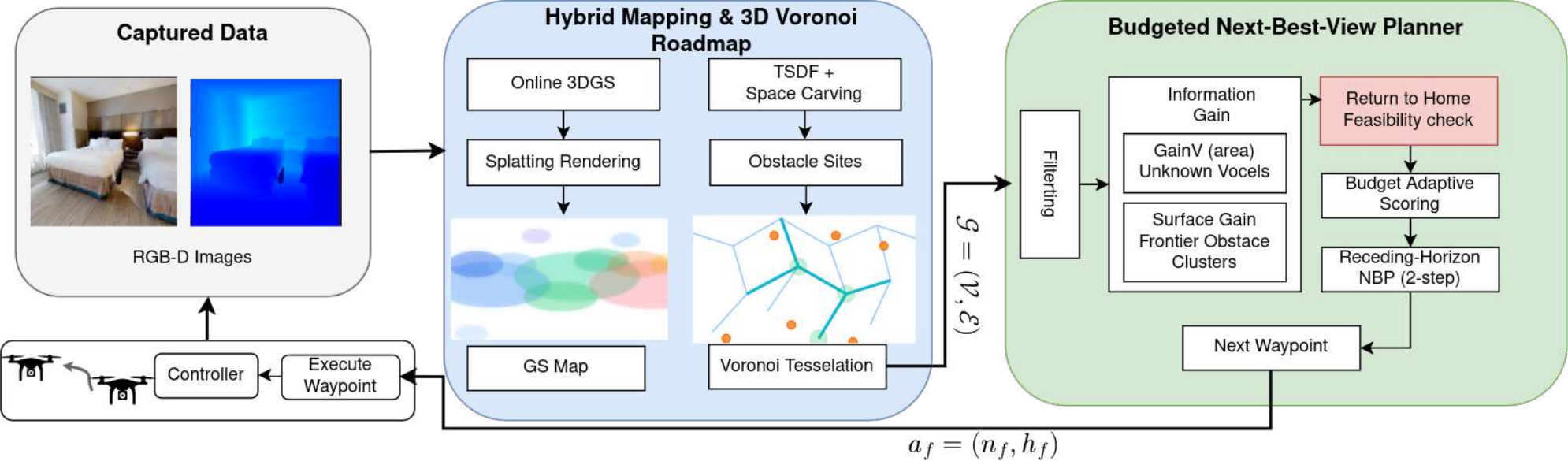
- We present a topology-first active reconstruction framework that decouples high-fidelity rendering from navigation.
- A dense 3D Gaussian Splatting (3DGS) map is optimized as the reconstruction target, while a lightweight Truncated Signed Distance Field (TSDF)/occupancy scaffold supports conservative collision checking and online construction of a sparse 3D Voronoi skeleton roadmap.
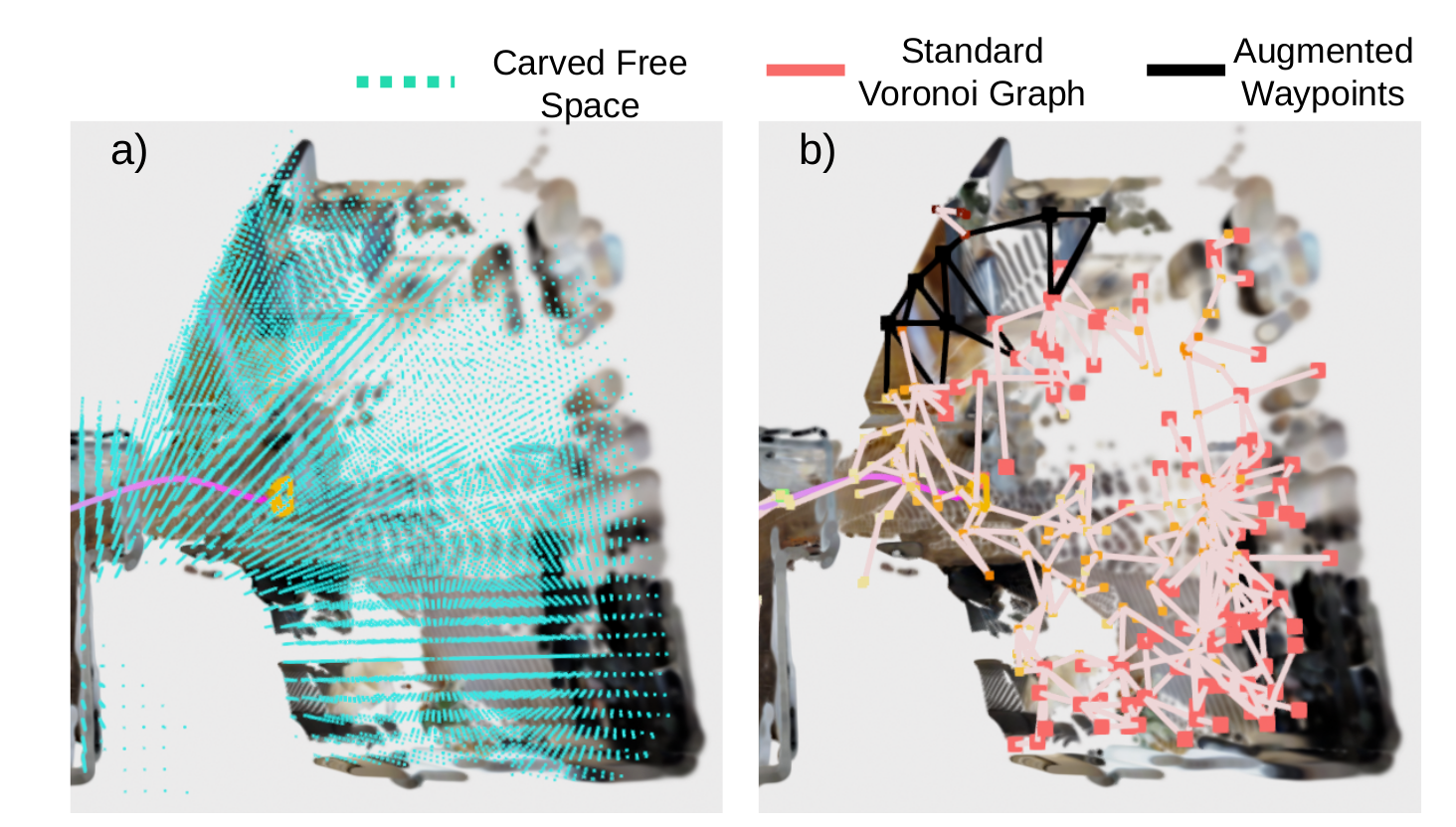
- Since directly extracting roadmaps from TSDF geometry can be unstable under noisy and incomplete online fusion, we validate nodes and edges using carved free-space consistency and dense visibility checks, which suppress behind-wall phantom structure and stabilize planning.
- Viewpoints are selected on the roadmap using a flight-time-budget-aware objective and a lightweight receding-horizon lookahead to improve non-myopic exploration behavior.
Methodology
We address edge-assisted budgeted autonomous exploration for high-fidelity indoor reconstruction using an RGB-D equipped micro aerial vehicle. A fundamental challenge in active radiance-field mapping is that representations optimized for photorealistic rendering (e.g., 3DGS) lack the explicit, conservative free-space semantics required for safe navigation. To resolve this, our framework (Fig.
Experiments and Results
To validate the proposed exploration framework, we evaluate our MAV-based active reconstruction system in photorealistic indoor simulation to quantify reconstruction quality, safety (return-to-home feasibility), and computational cost. All experiments are conducted in the Habitat simulator, which provides photorealistic indoor environments, synchronized RGB-D observations, and a simulation clock.
Sources and Demonstrations
Figures are reproduced from Krisshnakumar et al. See the full paper for experimental details and the project page, when the paper links one, for demonstrations and videos.
Related Papers
A Browser-Native Digital Test Range for Benchmarking 4D Ocean-Glider Planning Algorithms
Edward Holmberg, Elias Ioup, Mahdi Abdelguerfi
Repeated in-situ evaluation of ocean-glider planners requires scarce vehicles, operators, deployment and recovery resources, and ocean conditions that cannot be reset for competing algorithms.

Aim Short to Reach Far: Your Frozen World Model Can Plan Better Than You Think
Xvyuan Liu, Jianjie Fang, Chen Gao et al.
Planners built on visual world models commonly score each predicted outcome by its distance to the encoded goal image. We show that this target can limit control even with exact dynamics and globally optimal short-horizon search: reaching a goal may require actions that initially move away from it.
Compact Latent Coordination for Autonomous Vehicles at Unsignalized Intersections
Gil Lifshits, Igal Bilik, Gilad Katz
Coordinating autonomous vehicles at unsignalized intersections remains a critical challenge for multi-agent reinforcement learning (MARL) systems, which typically struggle with combinatorial action spaces, reliance on privileged information, or rigid agent designs.
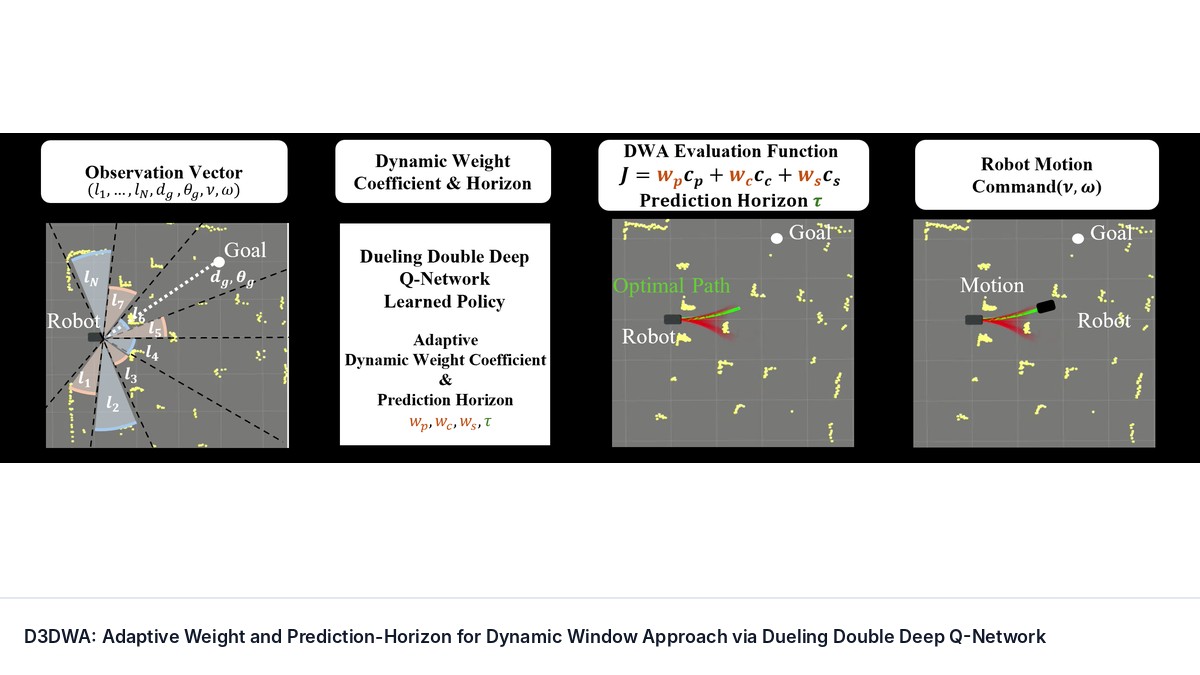
D3DWA: Adaptive Weight and Prediction-Horizon for Dynamic Window Approach via Dueling Double Deep Q-Network
Zahra Jooyandeh, Masato Kobayashi, Yuki Uranishi
The Dynamic Window Approach (DWA) is widely used for local navigation, but its performance depends strongly on parameters that are typically fixed before navigation.