
Teaching a Robot Dog New Tricks: Diverse Quadruped Skills via Combined Reinforcement and Imitation Learning with Adversarial Task Selection
Lemon Foxmere, Anthony Furman, Yizheng Du, Oliver Chang, Leilani Gilpin, Steve McGuire · N/A · 2026
Framework
N/A
License
N/A
Stars
N/A
Summary
Reinforcement Learning (RL) has enabled legged robots to perform a range of skills in single-task settings. However, applications such as farm robotics or space exploration require diverse skills such as locomotion, digging, or close-range surveying.
Abstract Summary
Key Points
- Reinforcement Learning (RL) has enabled legged robots to perform a range of skills in single-task settings.
- However, applications such as farm robotics or space exploration require diverse skills such as locomotion, digging, or close-range surveying.
- Training an end-to-end policy to address this problem remains difficult due to challenges such as sample inefficiency and gradient conflict between tasks in multi-task learning.
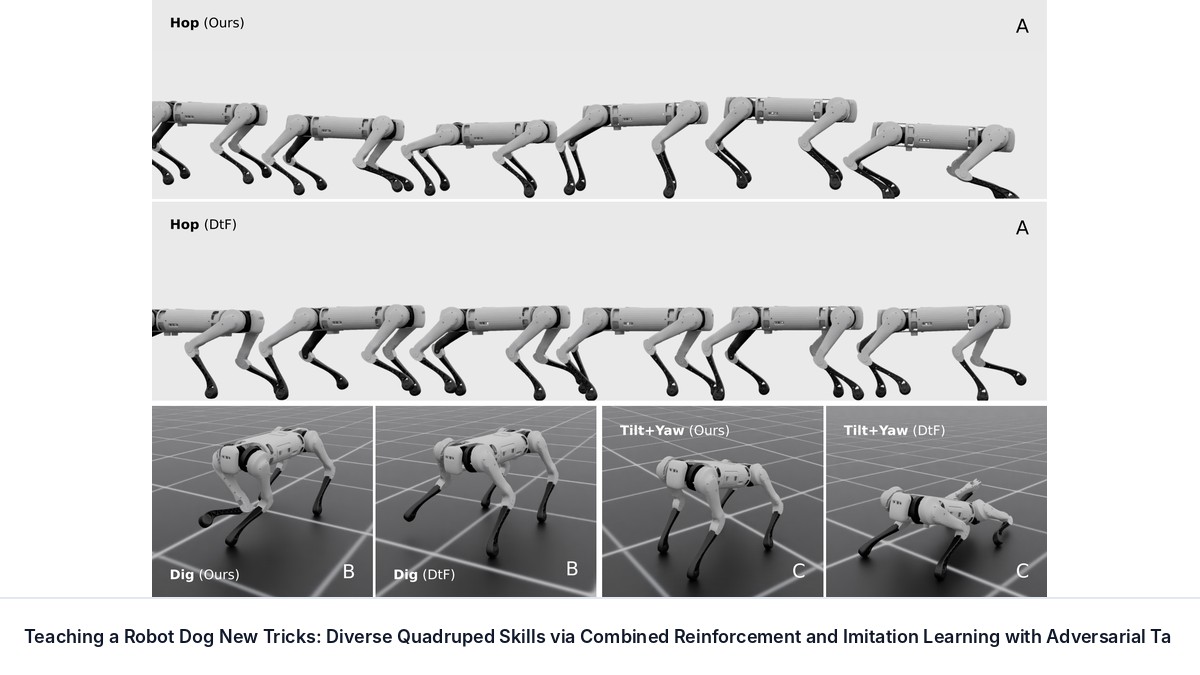
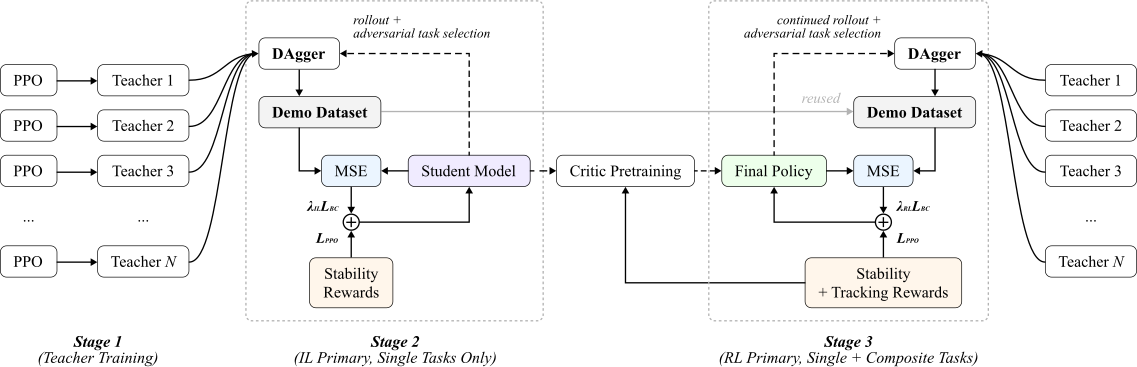
- We propose a three-stage method that trains a single policy to perform distinct tasks such as walking, digging, and hopping, and compose them into novel behaviors such as crawling.
- First, multiple teacher policies are trained using RL on narrowly defined tasks
Methodology
We model the multi-task problem as a Markov Decision Process (MDP) defined by the tuple $(\mathcal{S},\mathcal{A},\mathcal{T},\mathcal{R},\gamma)$, where $\mathcal{S}$ is the state space, $\mathcal{A}$ is the action space, $\mathcal{T}$ is the transition function, $\mathcal{R}$ is the reward function, and $\gamma$ is the discount factor.
Experiments and Evaluations
We evaluate the performance of our method on 8 single tasks and 14 non-trivial and dynamically feasible composite tasks. Each policy is trained on all 22 tasks, listed and described in Table II . For composite tasks, we only train on 2-task compositions. All compositions of three or more tasks are reserved for generalization evaluation.
We compare our method against three baselines: Distill-then-Finetune (DtF) as used by Rudin et al. [ 15 ] , single-stage PPO, and a teacher router that selects the corresponding teacher policy for a given task.
Real-World Deployment
To achieve robust real-world deployment, we apply standard domain randomization techniques during training, including observation noise and delays. Each observation channel’s noise is modeled as a Gaussian with a bias and variance, where the bias is sampled uniformly from a fixed range at the start of each episode.
We additionally model external force disturbances as forces applied to the robot’s center of mass over a randomized time duration.
Sources and Demonstrations
Figures are reproduced from Foxmere et al. See the full paper for experimental details and the project page, when the paper links one, for demonstrations and videos.
Related Papers
Has GPT-6-Astra Achieved Embodied Intelligence?
SenseNova, Joint Research Team, : et al.
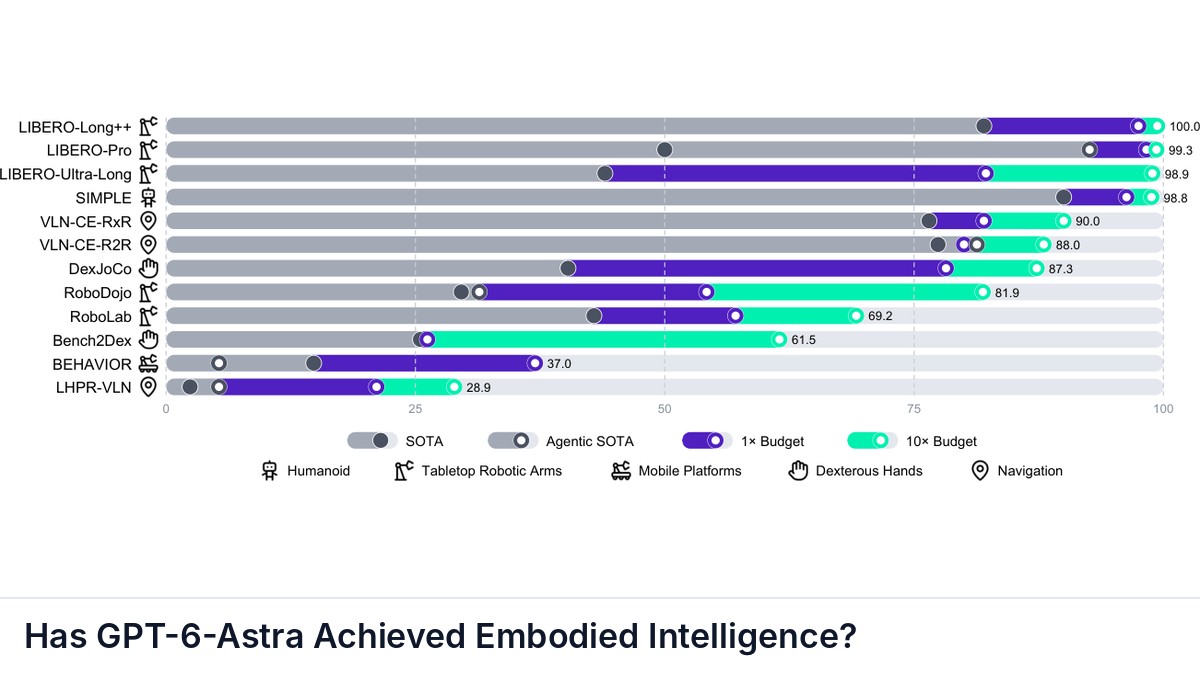
GPT-6-Astra demonstrates a level of competence in robotic manipulation and navigation that challenges the conventional paradigm of building specialized models for individual tasks and embodiments.
SynIL: Leveraging Synergy for Offline Imitation Learning from Imperfect Demonstration Datasets
Yuto Tanaka, Kyo Kutsuzawa, Martina Doku et al.
Imitation learning enables robots to acquire complex skills directly from massive demonstration datasets, but its performance degrades severely when datasets are contaminated with suboptimal or noisy demonstrations.

$ω$-0: A Latent Predictive World Action Model for Concurrent Humanoid Loco-Manipulation
Zhe Li, Zhenzhe Zhang, Yangyang Wei et al.
Humanoid household tasks often require concurrent loco-manipulation, where the robot must move, adjust posture, maintain balance, and manipulate objects as a single coordinated behavior.
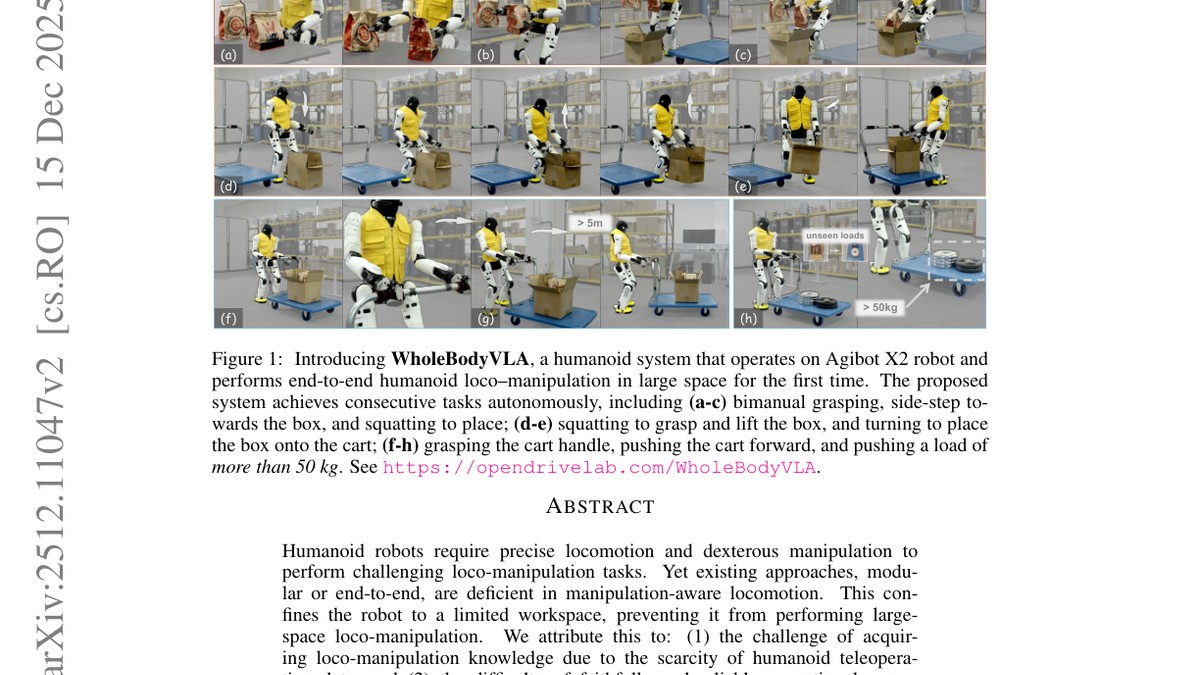
WholeBodyVLA: Towards Unified Latent VLA for Whole-Body Loco-Manipulation Control
Haoran Jiang, Jin Chen, Qingwen Bu et al.
Humanoid robots require precise locomotion and dexterous manipulation to perform challenging loco-manipulation tasks. Yet existing approaches, modular or end-to-end, are deficient in manipulation-aware locomotion.