
Asking Smarter Questions: Targeted Active Preference Learning for Underspecified Rewards
Helena Merker, Nick Walker, Andreea Bobu · N/A · 2026
Framework
N/A
License
N/A
Stars
N/A
Summary
Reward learning typically assumes the human's input covers everything that matters for the task. In practice, humans can only attend to so much at once, so their teaching naturally captures some features---or aspects of the task---better than others.
Abstract Summary
Key Points
- Reward learning typically assumes the human's input covers everything that matters for the task
- In practice, humans can only attend to so much at once, so their teaching naturally captures some features---or aspects of the task---better than others.
- Prior work has shown how the robot can identify which features were poorly supervised directly from its teaching data.
- But the current solution is to ask the human to try again, putting the burden on someone who already struggled to convey those features.
- We propose shifting this burden to the robot
Problem Setup
We address the problem of learning a reward function from human input when the teaching signal leaves some features underspecified. Recent work shows that robots can detect underspecified features from statistical patterns in the teaching data [ 3 ] . We use this detection and ask: how should the robot resolve underspecified features?
We propose using that knowledge in two ways: to correct the imperfect posterior into an informed prior, and to direct human attention during preference queries.
Method
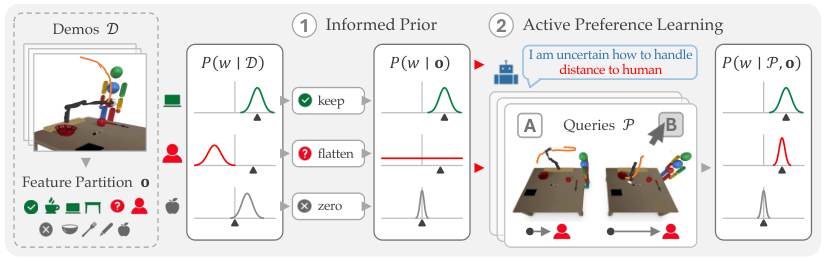
Our approach reuses the robot’s diagnosis of which features past teaching left underspecified to elicit targeted preference feedback. First, we construct an informed prior $P(w\mid\mathbf{o})$ that corrects $P(w\mid\mathcal{D})$ block-wise, concentrating uncertainty on $\phi^{u}$.
Second, we pair each query with an explanation that focuses the human’s attention on $\phi^{u}$ when answering, so their responses inform those features.
Simulated Experiments
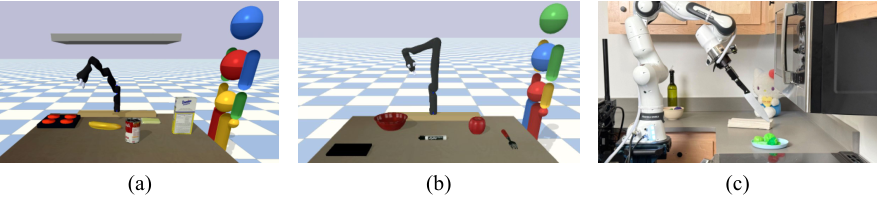
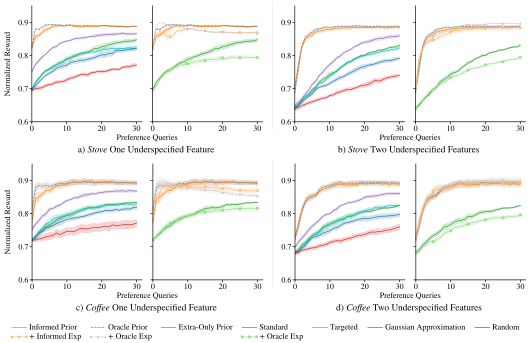
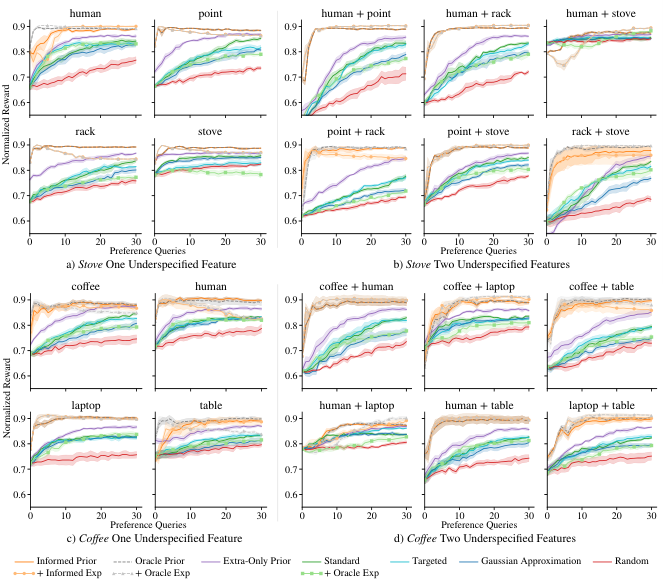
We evaluate our method in simulation, comparing the informed prior against four alternative priors, a targeted query objective, random querying, and three attention-directing explanation variants. We use two scenes wherein a 7-DoF Jaco arm carries an object above a cluttered surface ( Fig. 2 a–b).
In Stove , the robot carries a utensil across a workspace with a stove, a human, an overhead rack, and four distractors (sponge, banana, soup can, sugar box).
User Study
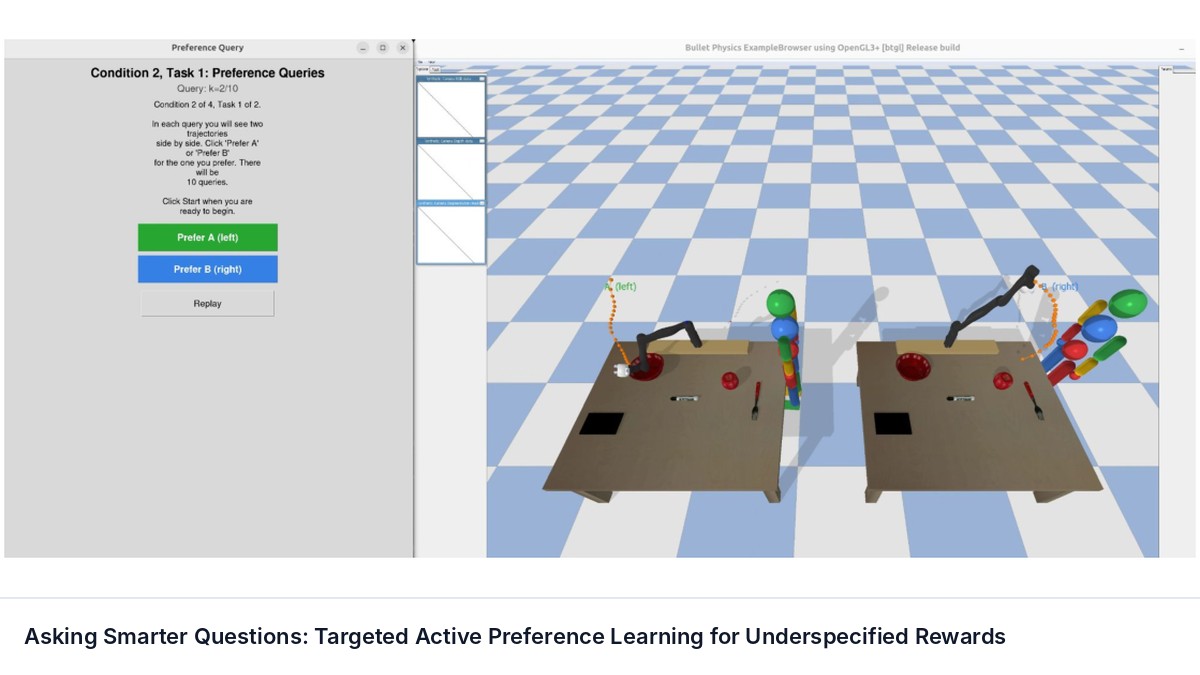
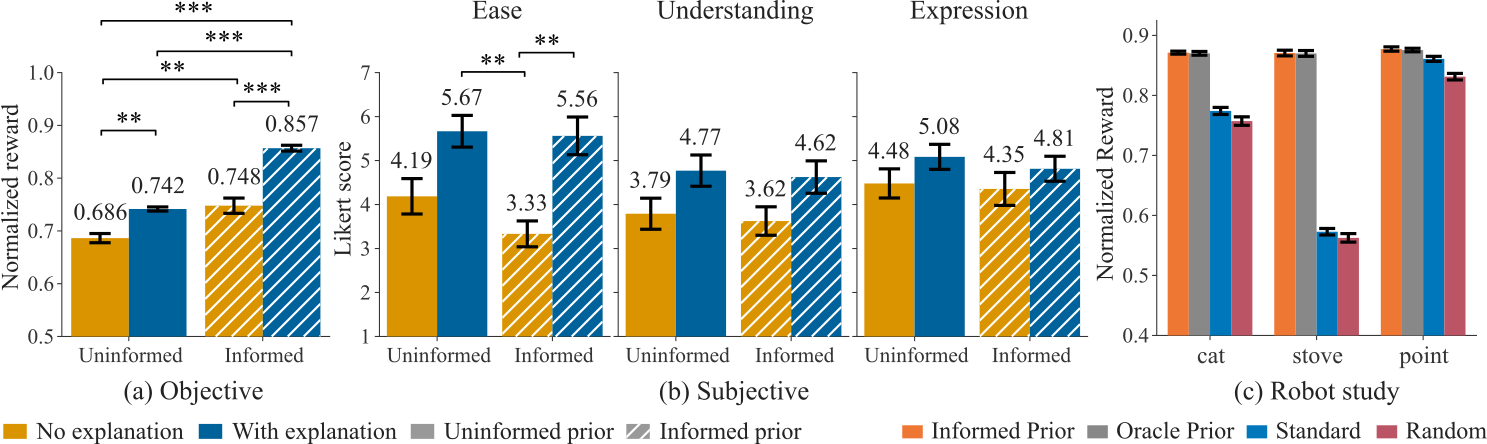
We conducted a user study to evaluate whether generating queries under the informed prior and providing explanations to guide responses improves reward learning. We also examine whether the explanations improve participants’ subjective experience along three dimensions: ease of answering queries, understanding of their purpose, and expression of what the robot needs to learn.
We conducted an IRB-approved study using the Coffee environment. The 2$\times$2 within-subjects design crossed the prior (uninformed vs.
Real Robot Examples
We use a Franka Emika FR3 arm carrying a knife in a kitchen ( Fig. 2 c). We model the kitchen in PyBullet to generate the trajectory bank and run reward learning offline. The task-relevant features are stove ($xy$-distance to cooktop), cat ($xy$-distance to cat), and point (how directly the knife’s extension axis points at the cat), alongside three distractors: $xy$-distances to a mug , lego , and rubik’s cube .
The ground-truth reward keeps the knife clear of both the stove and the cat and avoids pointing the blade at the cat.
Sources and Demonstrations
Figures are reproduced from Merker et al. See the full paper for experimental details and the project page, when the paper links one, for demonstrations and videos.
Related Papers
3DThinkVLA: Endowing Vision-Language-Action Models with Latent 3D Priors via 3D-Thinking-Guided Co-training
Jiaxin Shi, Xidong Zhang, Fucai Zhu et al.
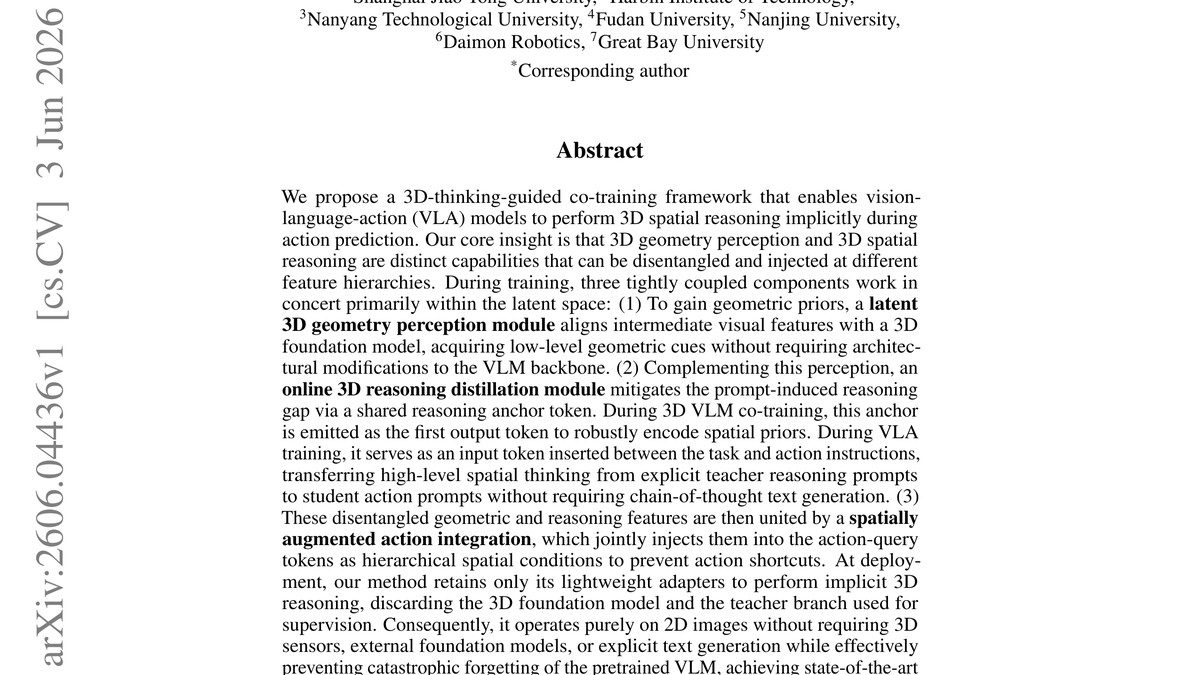
We propose a 3D-thinking-guided co-training framework that enables vision-language-action (VLA) models to perform 3D spatial reasoning implicitly during action prediction.
4D Radar Perception Algorithms for Autonomous Driving: A Review
Xumin Wu, Jun Zhou, Jilin Mei et al.
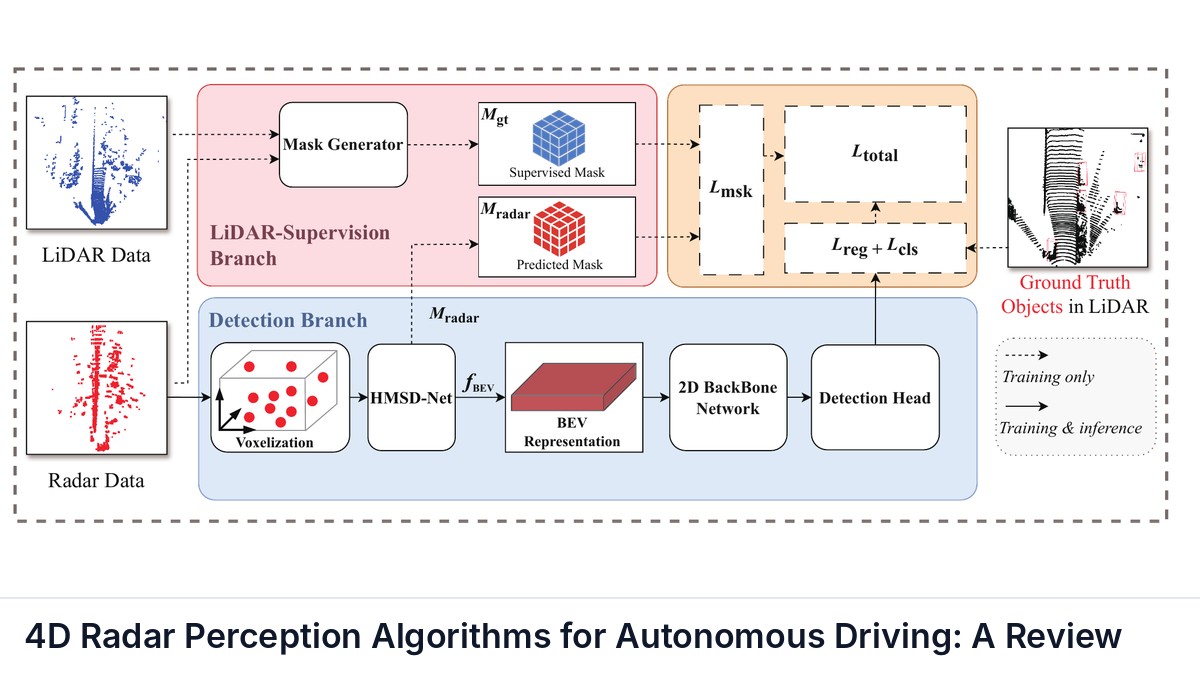
Research on 4D millimeter-wave radar perception algorithms has flourished in recent years, extending from signal processing and object detection to semantic segmentation, motion estimation, occupancy prediction, and dynamic scene reconstruction.
A Balanced Data Diet: Addressing the Exploration Bottleneck in Mega-Scale RL for Robot Control
Octi Zhang, Mateo Guaman Castro, Patrick Yin et al.
General-purpose robots must perform a wide range of tasks from agile locomotion to dexterous manipulation.
A Browser-Native Digital Test Range for Benchmarking 4D Ocean-Glider Planning Algorithms
Edward Holmberg, Elias Ioup, Mahdi Abdelguerfi
Repeated in-situ evaluation of ocean-glider planners requires scarce vehicles, operators, deployment and recovery resources, and ocean conditions that cannot be reset for competing algorithms.