
PopNavShift: Stress-Testing Social Navigation under Behavioral Population Shift
Kaizhen Tan, Diyu Zheng, Tim Guangyu Wu, ChengHe Guan · N/A · 2026
Framework
N/A
License
N/A
Stars
N/A
Summary
Social-navigation algorithms are often evaluated under a fixed pedestrian-behavior distribution, despite substantial variation in pedestrian responses to robots across individuals and social contexts.
Abstract Summary
Key Points
- Social-navigation algorithms are often evaluated under a fixed pedestrian-behavior distribution, despite substantial variation in pedestrian responses to robots across individuals and social contexts.
- We introduce PopNavShift, a matched simulation framework for stress-testing social-navigation strategies under pedestrian population shifts.
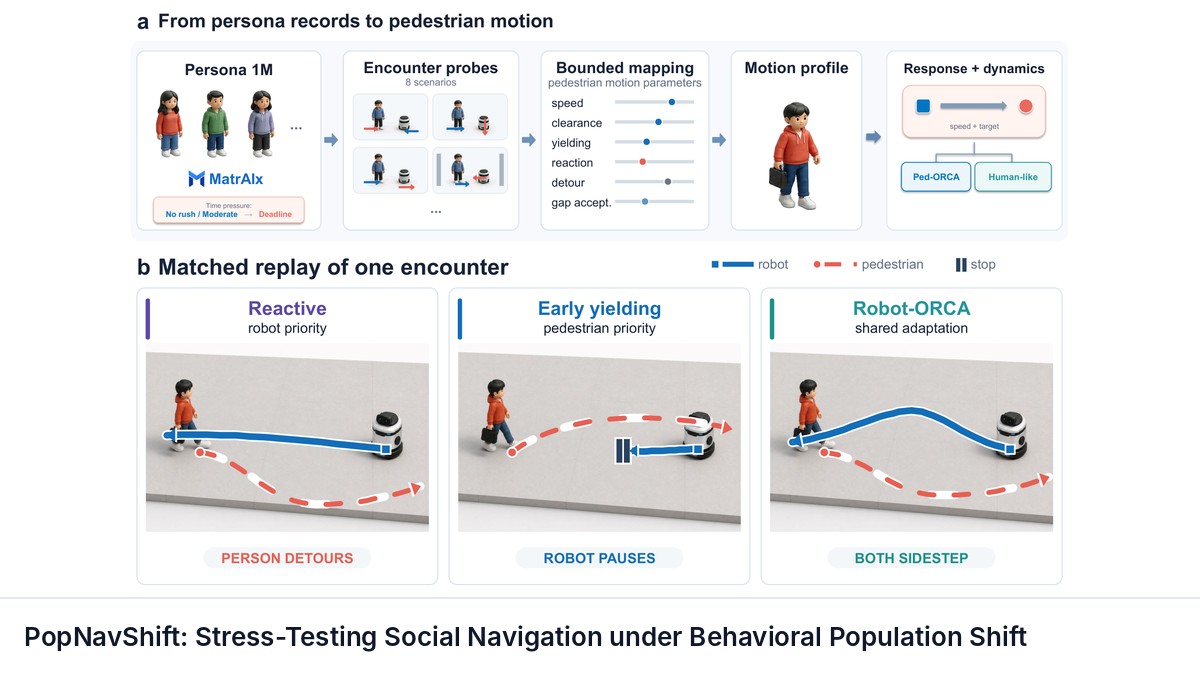
- PopNavShift constructs population-conditioned pedestrian motion profiles by prompting Gemini 3.7 Flash with 600 synthetic persona records from MatrAIx Persona 1M and deterministically mapping the responses into bounded motion parameters.
- It then compares three representative navigation strategies, reactive avoidance, early yielding, and reciprocal collision avoidance, across eight population conditions and 7,488 matched robot runs.
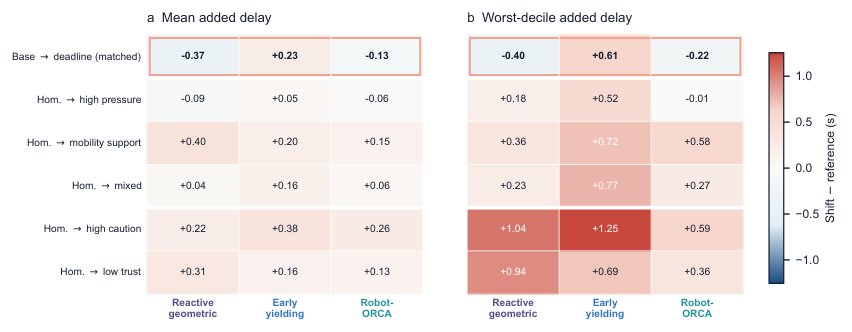
- In a matched intervention on the same 202 personas, changing only time pressure reverses 8.6% of controller rankings based on robot travel time, but 22.4% based on mean pedestrian delay and 23.9% based on worst-decile delay.
Method
To operationalize the matched population-replay design, PopNavShift separates the construction of behavioral populations from pedestrian dynamics and robot control (Fig. 1 ). Eight fixed robot-encounter probes, each describing a standardized navigation situation, elicit structured responses from each persona, which a deterministic mapping converts into seven bounded motion controls.
Experimental Design
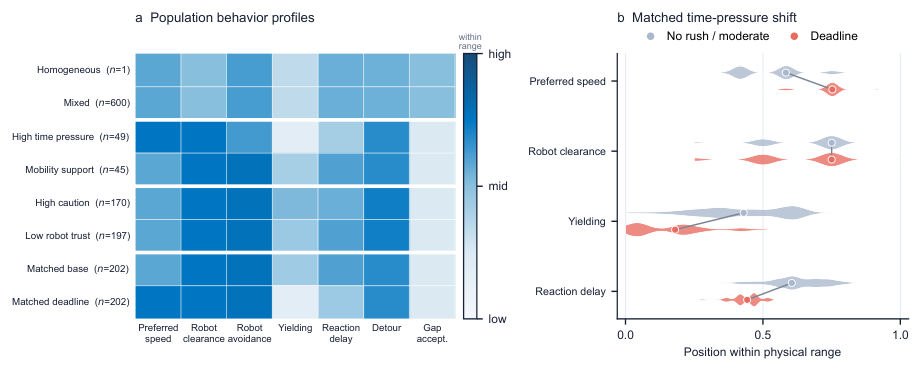
We evaluate PopNavShift on five types of physical encounters: a bidirectional sidewalk, a head-on encounter, a crossing, a bottleneck, and a static obstruction. The scenario grid varies available width (1.8, 2.4, 3.0, and 4.2 m), pedestrian density (0.06, 0.12, and 0.20 persons/m 2 ), and robot speed (0.60 and 1.00 m/s).
Head-on encounters contain one pedestrian and use the lowest density, yielding 104 valid physical cells rather than a full Cartesian product.
Results
The main experiment contains 7,488 robot runs and 2,496 matched runs without a robot, with paired pedestrian delay available for nearly all records. Changing time pressure from No rush / Moderate to Deadline alters at least one categorical response for 201 of the 202 matched personas. This shift changes controller comparisons more often for pedestrian burden than for robot travel time.
Mean-delay orderings reverse in 22.4% of comparable cells and worst-decile-delay orderings in 23.9%, compared with 8.6% for robot travel time.
Sources and Demonstrations
Figures are reproduced from Tan et al. See the full paper for experimental details and the project page, when the paper links one, for demonstrations and videos.
Related Papers
A Browser-Native Digital Test Range for Benchmarking 4D Ocean-Glider Planning Algorithms
Edward Holmberg, Elias Ioup, Mahdi Abdelguerfi
Repeated in-situ evaluation of ocean-glider planners requires scarce vehicles, operators, deployment and recovery resources, and ocean conditions that cannot be reset for competing algorithms.
A Low-Cost, Open Platform for End-to-End Autonomous Driving on a Miniature Ackermann Vehicle
Gustavo Claudio Karl Couto, Eric Aislan Antonelo, Gabriel George Zipperer
This paper presents a low-cost, open experimental platform for research in end-to-end autonomous driving with miniature Ackermann vehicles.
AD-WM: Action-Discriminative World Models for Counterfactual Model Predictive Control
Jiabin Qiu, Zixuan Chen, Hongye Cao et al.
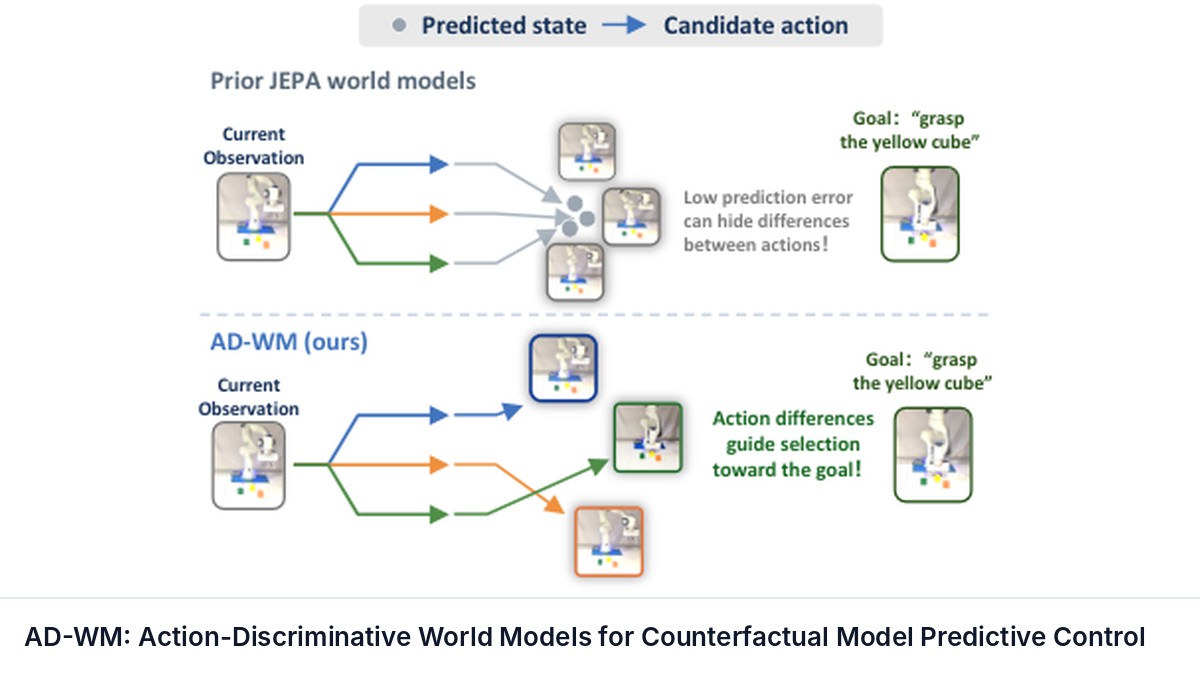
Latent world models are typically trained to predict factual transitions, whereas model predictive control (MPC) must compare alternative actions from the same state. A model can therefore achieve low factual prediction error yet poorly distinguish candidate actions.
AHEAD: Anticipatory Hand-Driven Teleoperation via Human Intent Prediction
Seok Joon Kim, Junho Lee, Federica Spinola et al.
Direct hand-driven teleoperation maps an operator's hand motion to robot end-effector commands at every frame, enabling precise control, but it requires constant monitoring and correction during approach, grasp, and placement, which can be slow and fatiguing.