
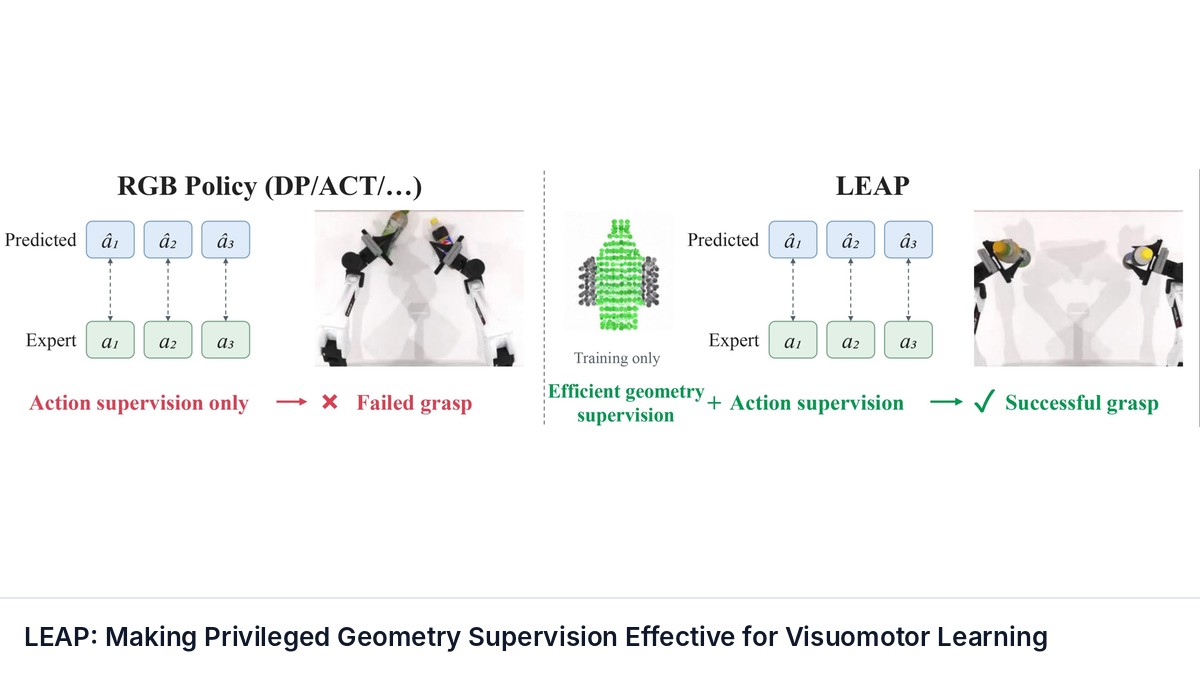
LEAP: Making Privileged Geometry Supervision Effective for Visuomotor Learning
Han Fang, Yunpeng Jiang, Jianshu Hu, Zhiyuan Guan, Ruiguo Sun, Shujia Li, Paul Weng, Xiao Li, Yutong Ban · N/A · 2026
Framework
N/A
License
N/A
Stars
N/A
Summary
Privileged 3D supervision uses additional geometric information during training to guide RGB-based visuomotor policy learning, without requiring geometric inputs at deployment. However, low reconstruction error does not ensure that visual representations capture geometry useful for control.
Abstract Summary
Key Points
- Privileged 3D supervision uses additional geometric information during training to guide RGB-based visuomotor policy learning, without requiring geometric inputs at deployment.
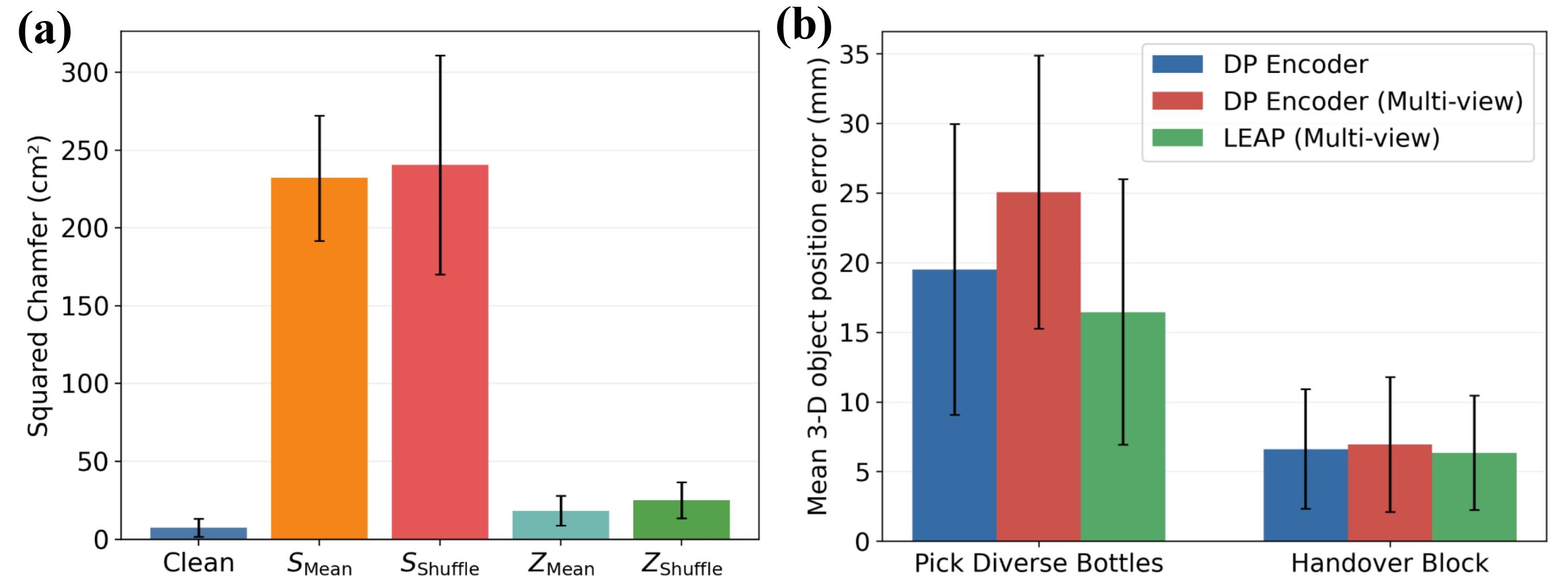
- However, low reconstruction error does not ensure that visual representations capture geometry useful for control.
- We identify three limitations that weaken this supervision: proprioceptive shortcuts, dominant-view reliance, and reconstruction objectives dominated by task-irrelevant geometry.
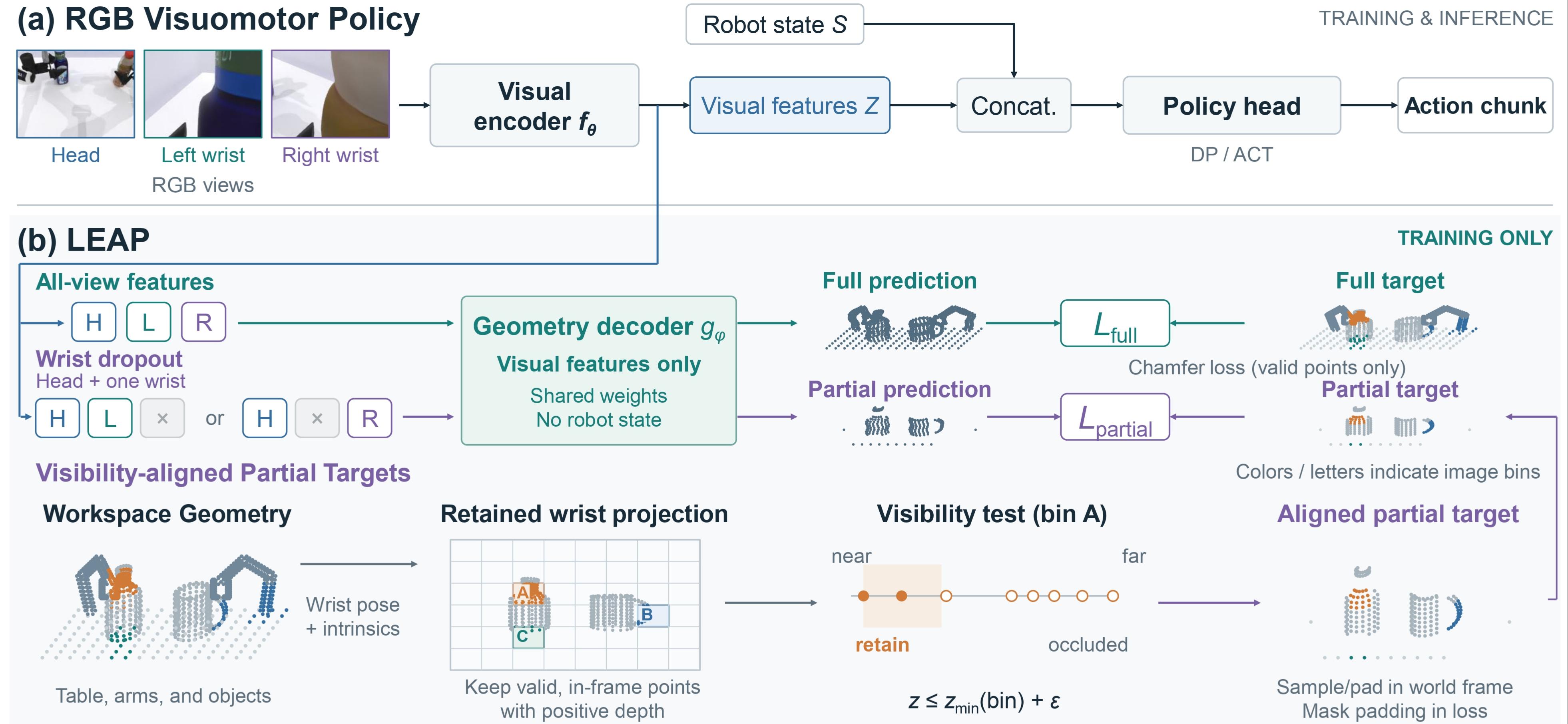
- To address these limitations, we propose Latent Encoding with Aligned Privileged Geometry (LEAP)
- Our framework uses an auxiliary decoder to reconstruct point clouds within the manipulation workspace from visual features alone, while retaining proprioception for action prediction.
Method
We first identify three limitations of privileged geometric supervision: proprioceptive shortcuts, dominant-view reliance, and reconstruction objectives dominated by task-irrelevant geometry. These issues can allow low reconstruction error without ensuring that visual features capture the geometry needed for control.
Guided by this analysis, we introduce LEAP, which aims to make geometric supervision an observation-aligned and policy-relevant constraint on visual representations.
Experimental Results
We evaluate LEAP on 50 RoboTwin tasks, six ManiSkill tasks, and three real-world manipulation tasks. To examine performance across different geometric requirements, we group the RoboTwin tasks into four categories: Object Spatial (14), Multi-object (14), Interaction (14), and Less-geometry (8). We report success rates for each category and the overall average across all 50 tasks.
The ManiSkill and real-world experiments provide complementary evaluations across simulation environments and physical manipulation settings.
Sources and Demonstrations
Figures are reproduced from Fang et al. See the full paper for experimental details and the project page, when the paper links one, for demonstrations and videos.
Related Papers
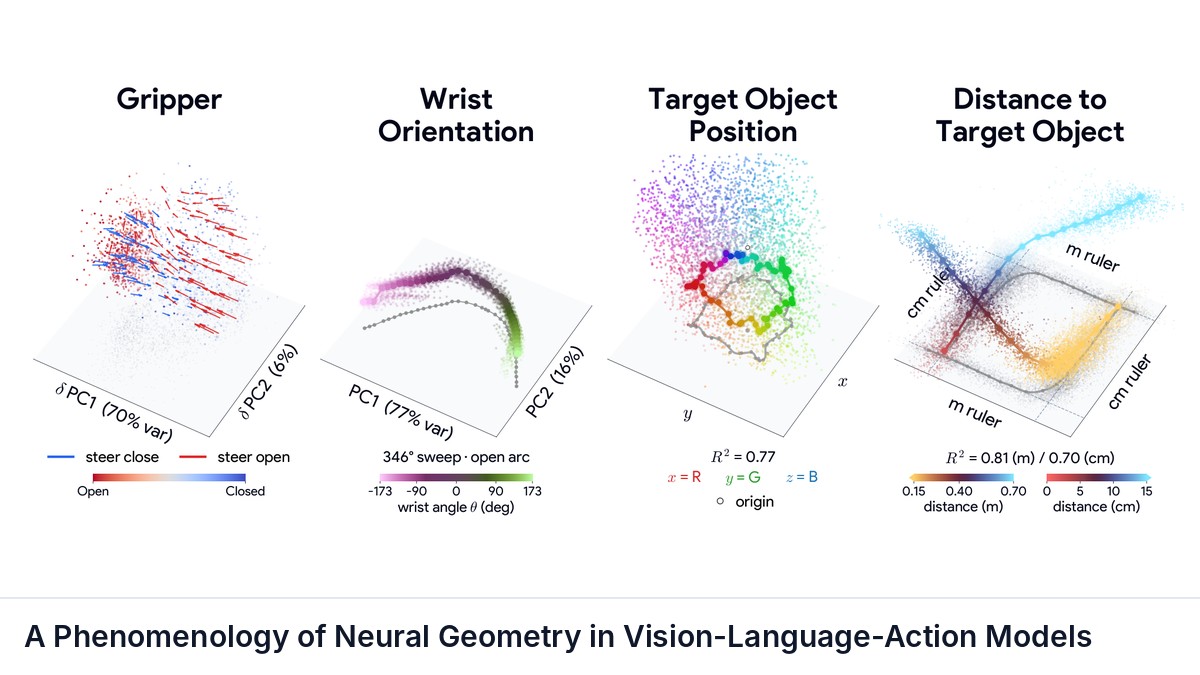
A Phenomenology of Neural Geometry in Vision-Language-Action Models
Mozes Jacobs, Aiden Swann, Mathilde Papillon et al.
Robotic manipulation is inherently geometric, but what shape does the world take inside the policy that performs it?

A Sim-to-Real Integration Pipeline for Training and Deployment of Chunk-Based VLA Manipulation Policies
Mathilde Kappel, Clémence Grislain, Mohamed Chetouani et al.
Vision-Language-Action (VLA) models have become a prominent paradigm for mapping multimodal inputs, including semantic instructions, visual observations of the scene, and proprioceptive observations, to robot actions.
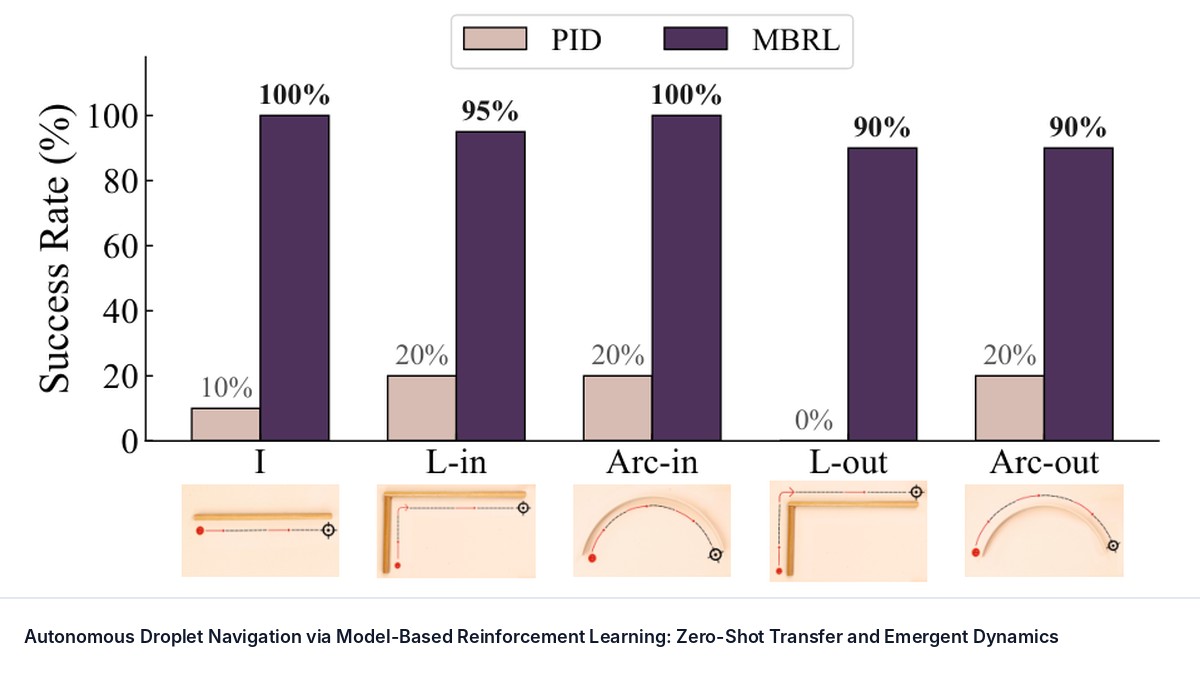
Autonomous Droplet Navigation via Model-Based Reinforcement Learning: Zero-Shot Transfer and Emergent Dynamics
Rajneesh Anand, Mayuresh V. Kothare
Self-driving laboratories (SDLs) are transforming chemical and materials discovery through closed-loop automation, yet automated infrastructure for physical manipulation of soft, deformable matter remains beyond current robotic platforms.
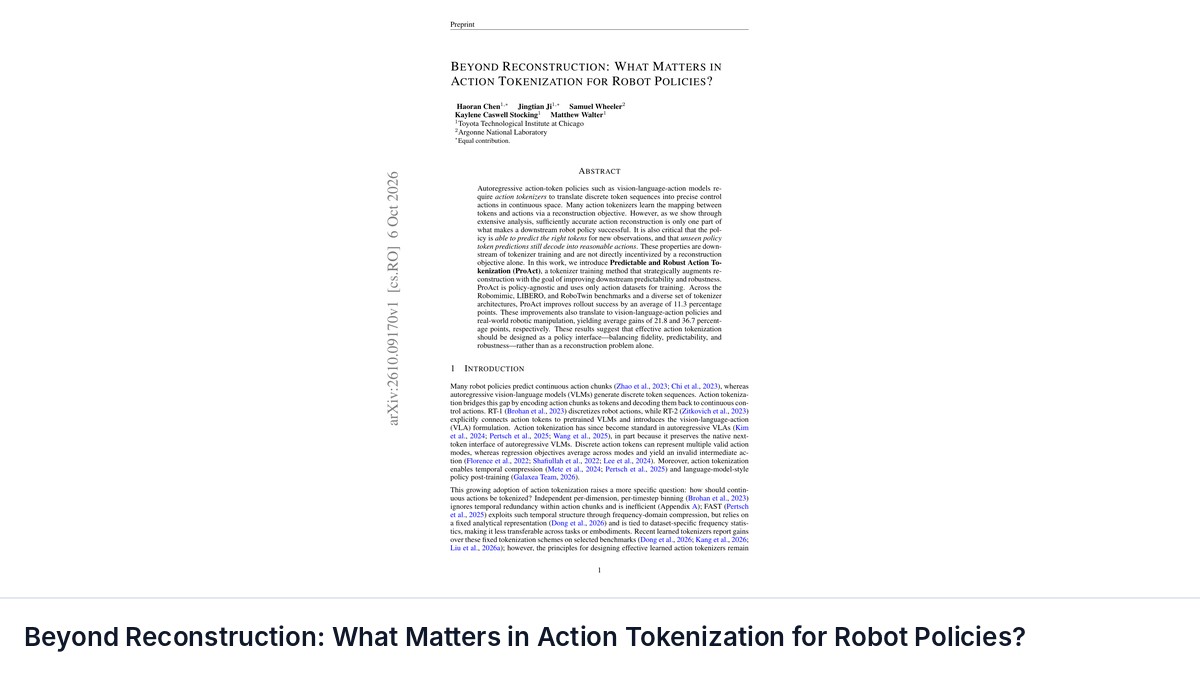
Beyond Reconstruction: What Matters in Action Tokenization for Robot Policies?
Haoran Chen, Jingtian Ji, Samuel Wheeler et al.
Autoregressive action-token policies such as vision-language-action models require action tokenizers to translate discrete token sequences into precise control actions in continuous space. Many action tokenizers learn the mapping between tokens and actions via a reconstruction objective.