
Persistent Profile-Guided Reset-Free Recovery Improves Final Gait Selection after Irreversible Leg Damage
Minjoong Kim · N/A · 2026
Framework
N/A
License
N/A
Stars
N/A
Summary
Damage-recovery algorithms often rank gaits from short trials, yet a gait that performs well briefly may not remain effective during continued execution. In reset-free recovery, each trial also changes the physical state inherited by the next.
Abstract Summary
Key Points
- Damage-recovery algorithms often rank gaits from short trials, yet a gait that performs well briefly may not remain effective during continued execution.
- In reset-free recovery, each trial also changes the physical state inherited by the next
- We introduce persistent profile-guided reset-free recovery (PGRR), which predicts multiple outcomes over repeated gait execution and uses conservative uncertainty-aware estimates to guide short online probes without resetting the robot.
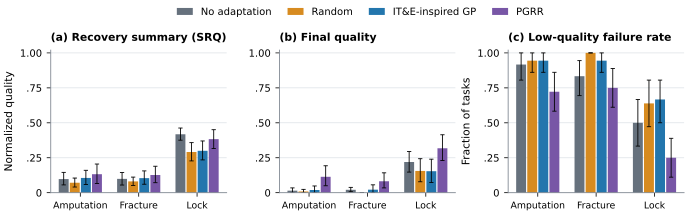
- Across 108 matched MuJoCo tasks spanning leg amputation, distal fracture, and joint lock, PGRR improves final quality by 0.106 and slot-averaged recovery quality (SRQ) by 0.044 relative to an IT&E-inspired Gaussian-process baseline, while reducing low-quality failures by 27.8 percentage points.
- Final-quality gains occur in all three damage classes
Problem and Evaluation
Figure 1 shows the structural conditions. We simulate a hexapod with two actuated joints per leg in MuJoCo, using a 5-ms time step [ 16 ] . Its gait lifts, advances, and lowers each foot before stance. Damage is applied at a prescribed time without resetting pose, velocity, or contacts. Amputation detaches a whole leg and disables its two actuators. Fracture detaches the distal segment and disables one actuator.
Joint lock fixes both joints at their damage-time positions and disables their actuators. Detached segments remain as dynamic debris.

Profile-Guided Recovery
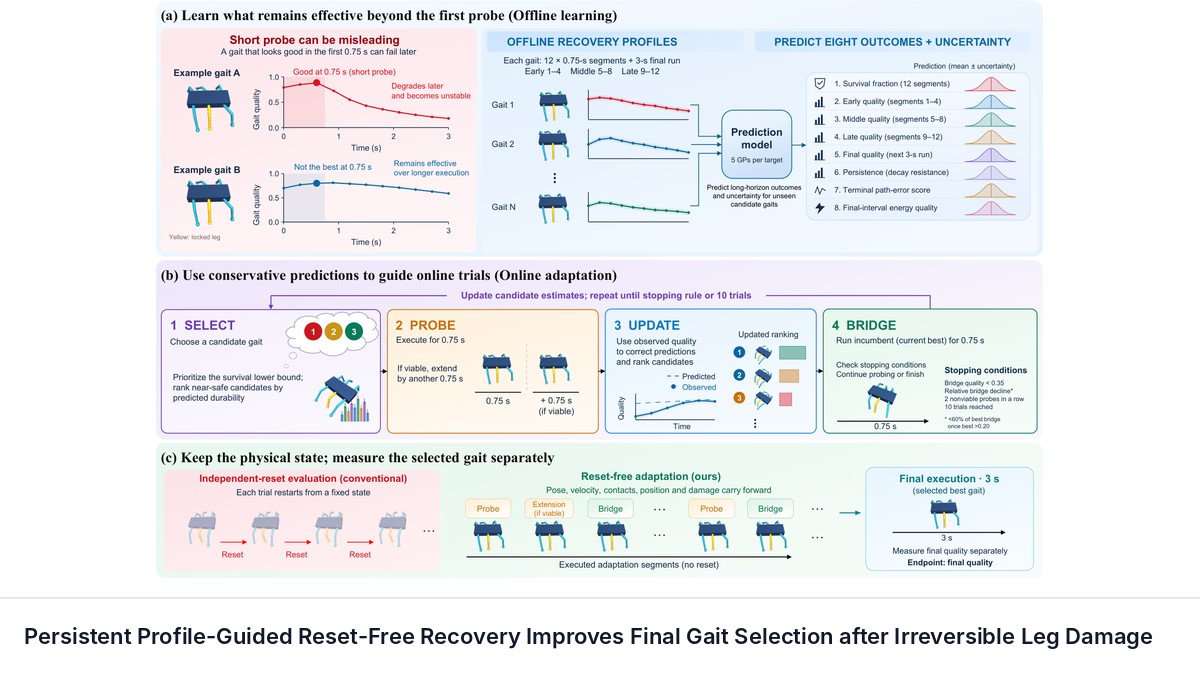
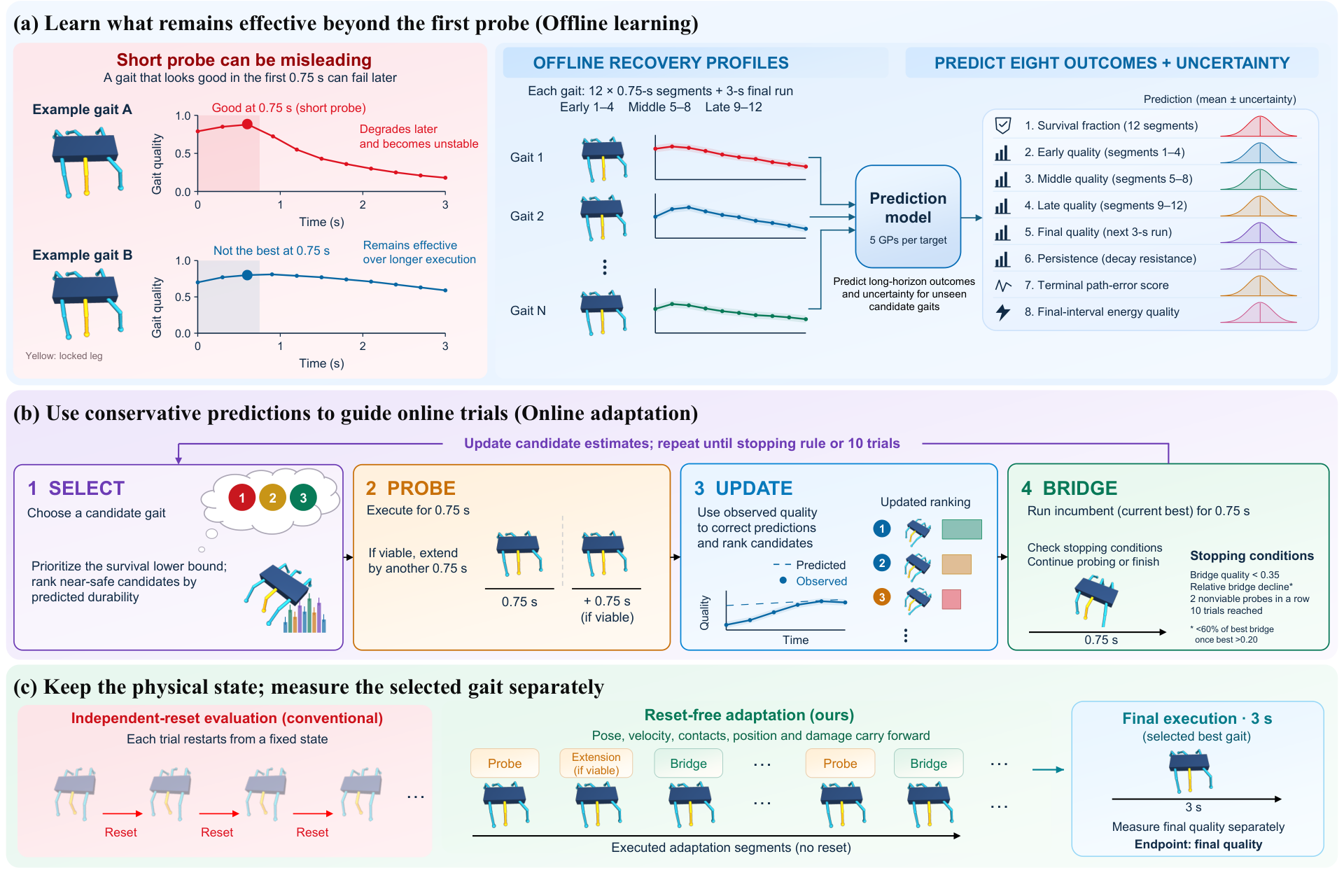
Figure 2 presents the method in execution order. Panel A describes the offline stage. Each candidate gait is executed repeatedly to form a long-horizon profile, and five GP models per target predict eight outcomes and their uncertainty for candidate gaits. Panel B describes online adaptation after damage.
The policy selects a candidate conservatively, executes a 0.75-s probe, extends viable probes by another 0.75 s, uses the observation to correct its predictions, and runs the current incumbent for 0.75 s as a bridge.
Experimental Protocol
The holdout crosses three damage types, previously unused legs 3–5, friction $\{0.865,1.135\}$, onset $\{1.73,2.37\}$ s, and three candidate seeds. This gives 36 physical conditions and 108 condition–seed tasks. The algorithm, surrogate, metrics, and evaluation procedure were fixed before opening this set. The reported holdout is now consumed and cannot serve as fresh validation after further tuning.
The three adaptive methods share the candidate pool and maximum trial budget.
Results
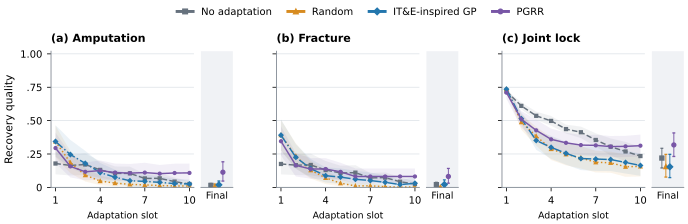
Across the 108 tasks, PGRR improves SRQ by 0.044 and final quality by 0.106 relative to the IT&E-inspired GP; the low-quality failure rate decreases by 0.278. All three paired intervals exclude zero (Table I ). Final quality improves within amputation, fracture, and joint lock, with joint lock showing the largest paired gain.
Figure 3 shows that PGRR also has higher mean SRQ than the GP comparator in every damage class, although the amputation- and fracture-specific SRQ intervals include zero (Table I ).
Sources and Demonstrations
Figures are reproduced from Kim See the full paper for experimental details and the project page, when the paper links one, for demonstrations and videos.
Related Papers
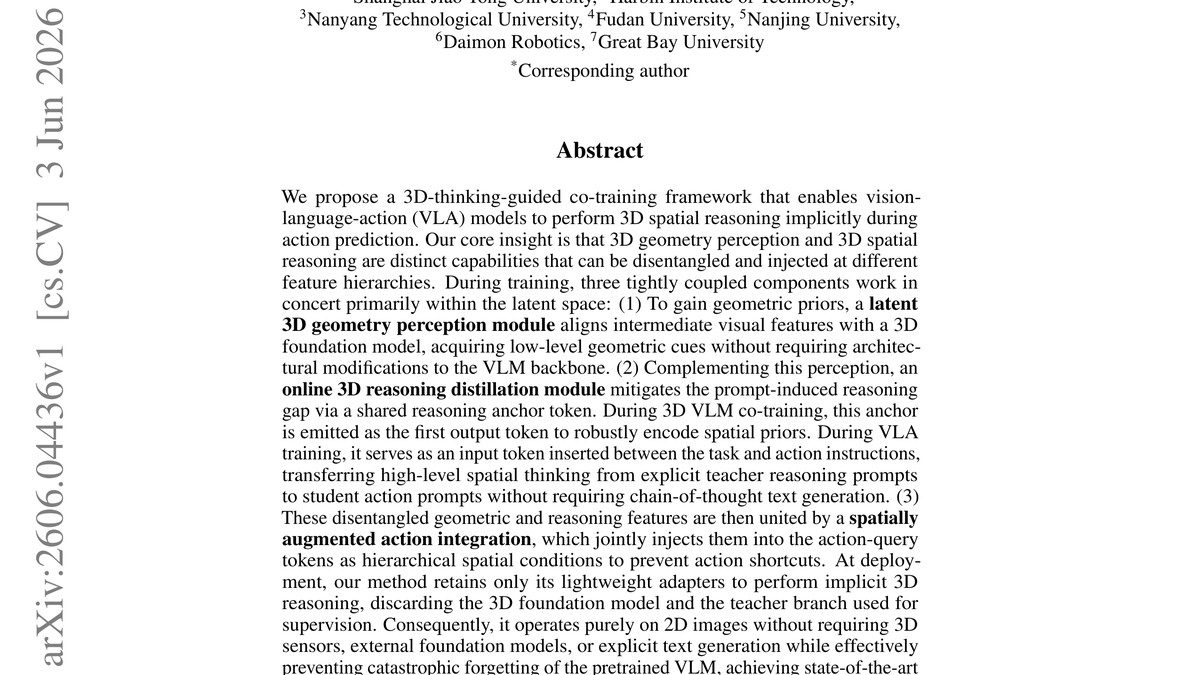
3DThinkVLA: Endowing Vision-Language-Action Models with Latent 3D Priors via 3D-Thinking-Guided Co-training
Jiaxin Shi, Xidong Zhang, Fucai Zhu et al.
We propose a 3D-thinking-guided co-training framework that enables vision-language-action (VLA) models to perform 3D spatial reasoning implicitly during action prediction.
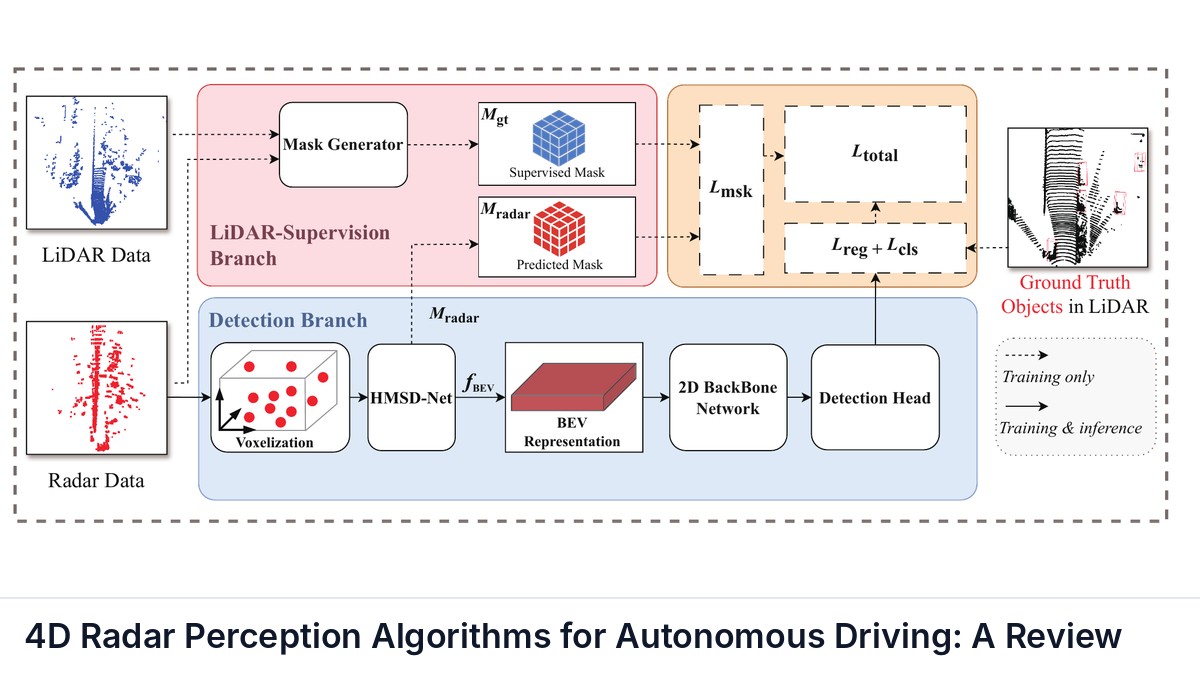
4D Radar Perception Algorithms for Autonomous Driving: A Review
Xumin Wu, Jun Zhou, Jilin Mei et al.
Research on 4D millimeter-wave radar perception algorithms has flourished in recent years, extending from signal processing and object detection to semantic segmentation, motion estimation, occupancy prediction, and dynamic scene reconstruction.
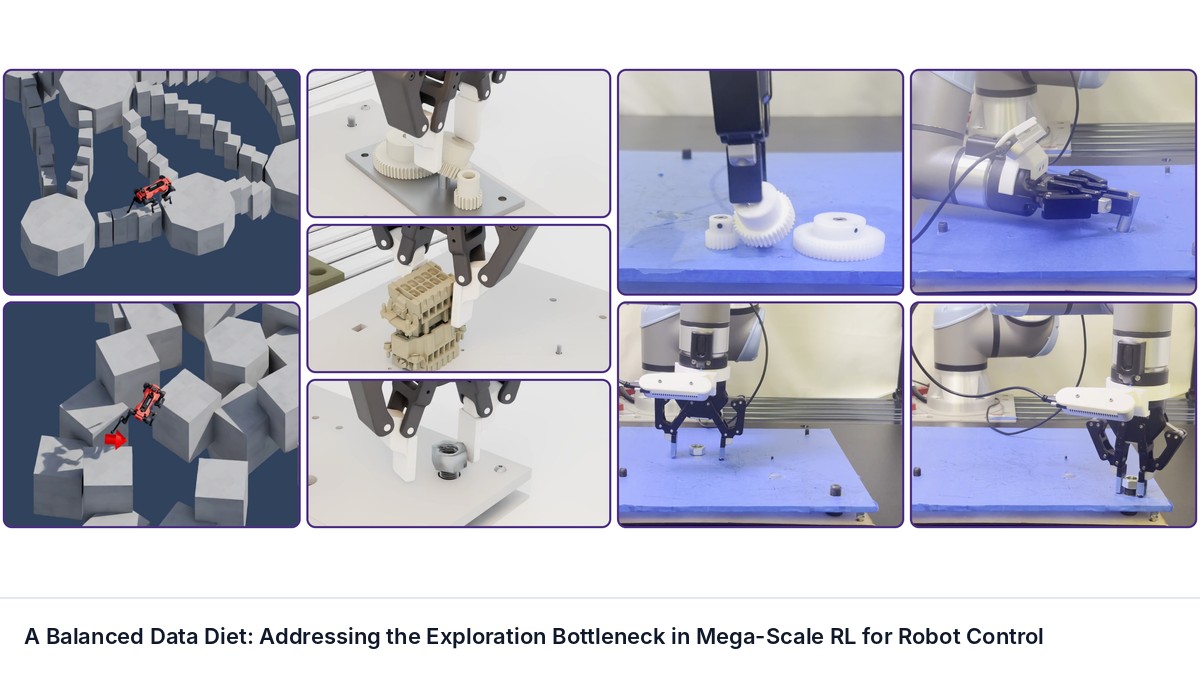
A Balanced Data Diet: Addressing the Exploration Bottleneck in Mega-Scale RL for Robot Control
Octi Zhang, Mateo Guaman Castro, Patrick Yin et al.
General-purpose robots must perform a wide range of tasks from agile locomotion to dexterous manipulation.
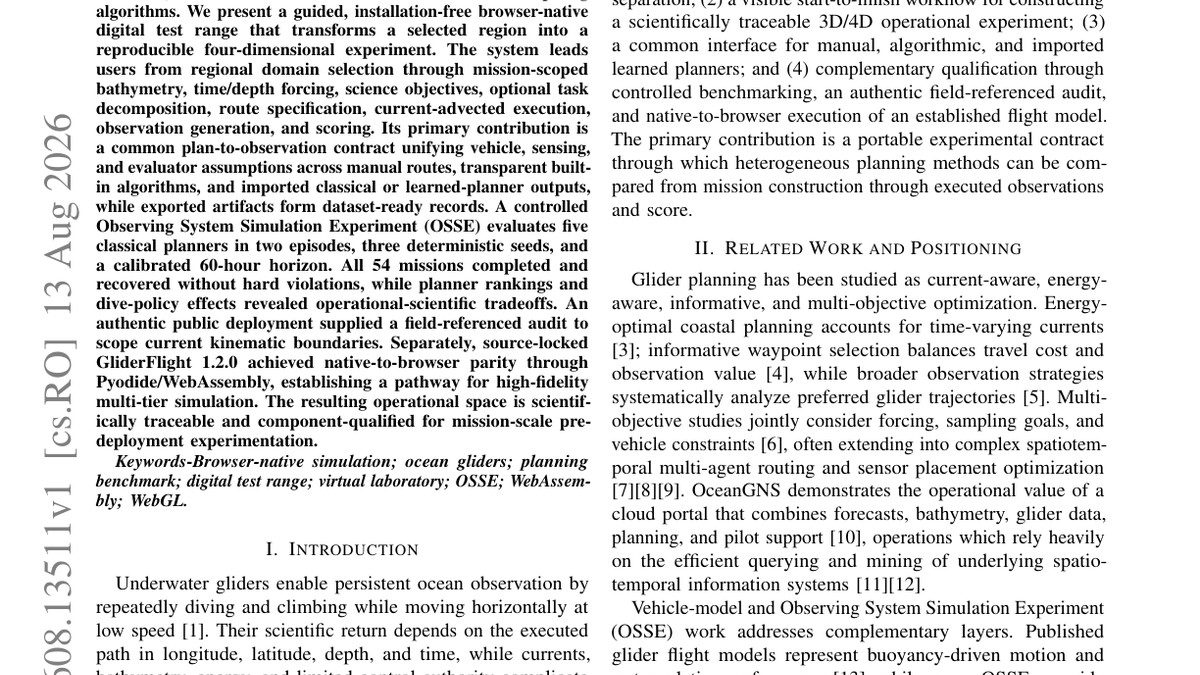
A Browser-Native Digital Test Range for Benchmarking 4D Ocean-Glider Planning Algorithms
Edward Holmberg, Elias Ioup, Mahdi Abdelguerfi
Repeated in-situ evaluation of ocean-glider planners requires scarce vehicles, operators, deployment and recovery resources, and ocean conditions that cannot be reset for competing algorithms.