
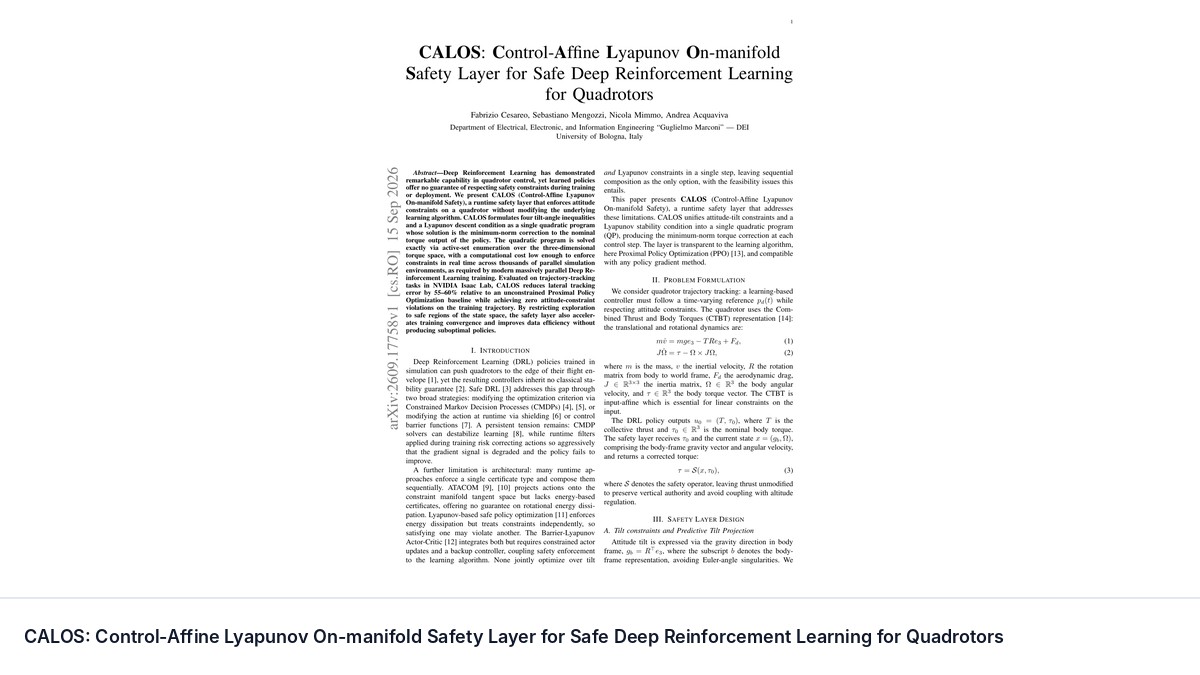
CALOS: Control-Affine Lyapunov On-manifold Safety Layer for Safe Deep Reinforcement Learning for Quadrotors
Fabrizio Cesareo, Sebastiano Mengozzi, Nicola Mimmo, Andrea Acquaviva · N/A · 2026
Framework
N/A
License
N/A
Stars
N/A
Summary
Deep Reinforcement Learning has demonstrated remarkable capability in quadrotor control, yet learned policies offer no guarantee of respecting safety constraints during training or deployment.
Abstract Summary
Key Points
- Deep Reinforcement Learning has demonstrated remarkable capability in quadrotor control, yet learned policies offer no guarantee of respecting safety constraints during training or deployment.
- We present CALOS (Control-Affine Lyapunov On-manifold Safety), a runtime safety layer that enforces attitude constraints on a quadrotor without modifying the underlying learning algorithm.
- CALOS formulates four tilt-angle inequalities and a Lyapunov descent condition as a single quadratic program whose solution is the minimum-norm correction to the nominal torque output of the policy.
- The quadratic program is solved exactly via active-set enumeration over the three-dimensional torque space, with a computational cost low enough to enforce constraints in real time across thousands of parallel simulation environments, as required by modern massively parallel Deep Reinforcement Learning training.
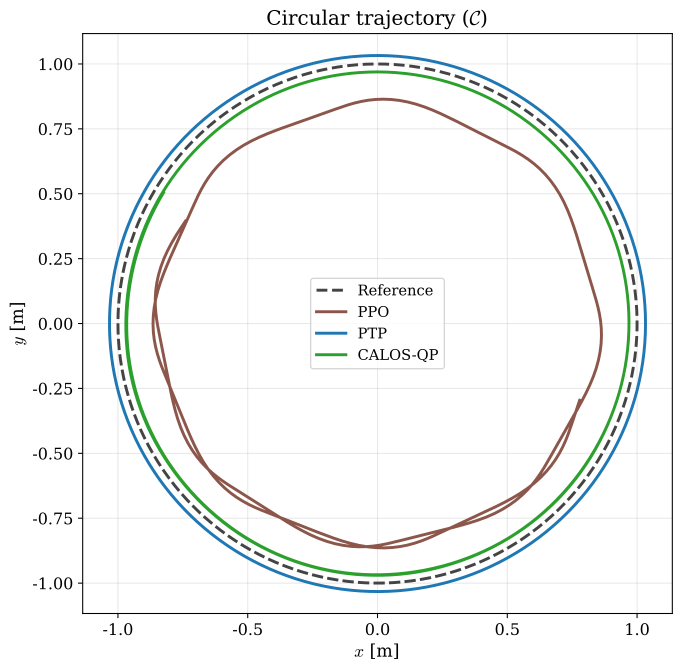
- Evaluated on trajectory-tracking tasks in NVIDIA Isaac Lab, CALOS reduces lateral tracking error by 55-60% relative to an unconstrained Proximal Policy Optimization baseline while achieving zero attitude-constraint violations on the training trajectory.
Problem Formulation
We consider quadrotor trajectory tracking: a learning-based controller must follow a time-varying reference $p_{d}(t)$ while respecting attitude constraints.
The quadrotor uses the Combined Thrust and Body Torques (CTBT) representation [ 14 ] : the translational and rotational dynamics are: where $m$ is the mass, $v$ the inertial velocity, $R$ the rotation matrix from body to world frame, $F_{d}$ the aerodynamic drag, $J\in\mathbb{R}^{3\times 3}$ the inertia matrix, $\Omega\in\mathbb{R}^{3}$ the body angular velocity, and $\tau\in\mathbb{R}^{3}...
Safety Layer Design
Attitude tilt is expressed via the gravity direction in body frame, $g_{b}=R^{\top}e_{3}$, where the subscript $b$ denotes the body-frame representation, avoiding Euler-angle singularities. We impose roll and pitch limits $\phi_{\max}=\theta_{\max}=60^{\circ}$.
Experiments
All agents are trained with PPO [ 13 ] using the DRL library SKRL on 4096 parallel environments in NVIDIA Isaac Lab for ${\sim}10^{9}$ timesteps. The policy is a two-layer MLP 64 units each, with ELU activation and Gaussian output.
The observation $o_{t}\in\mathbb{R}^{15}$ comprises body-frame velocity $v_{b}$, angular velocity $\Omega_{b}$, projected gravity $g_{b}$, desired position $p_{d,b}$, and desired velocity $v_{d,b}$, all in $\mathbb{R}^{3}$.
Sources and Demonstrations
Figures are reproduced from Cesareo et al. See the full paper for experimental details and the project page, when the paper links one, for demonstrations and videos.
Related Papers
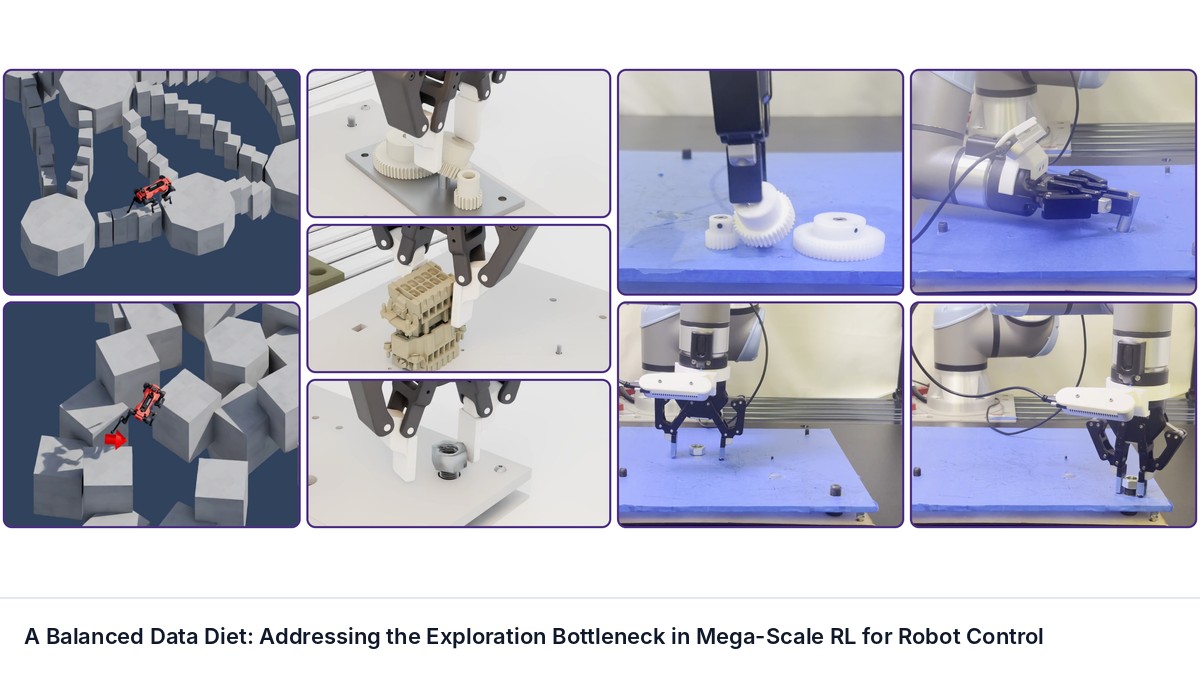
A Balanced Data Diet: Addressing the Exploration Bottleneck in Mega-Scale RL for Robot Control
Octi Zhang, Mateo Guaman Castro, Patrick Yin et al.
General-purpose robots must perform a wide range of tasks from agile locomotion to dexterous manipulation.
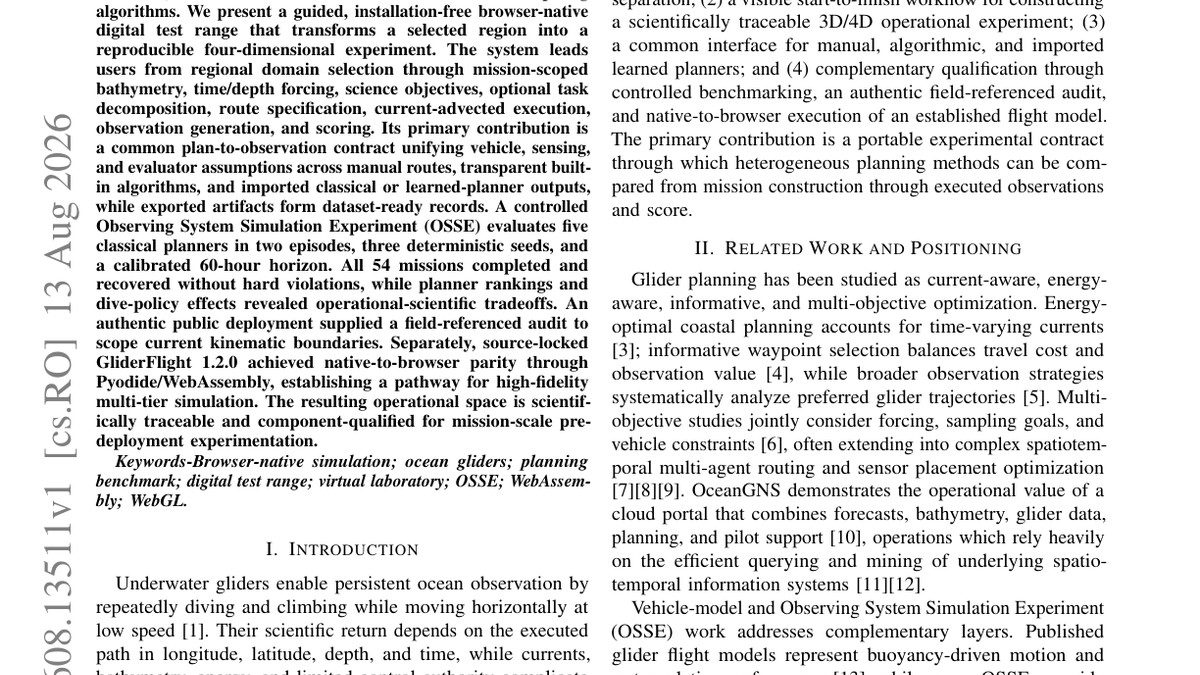
A Browser-Native Digital Test Range for Benchmarking 4D Ocean-Glider Planning Algorithms
Edward Holmberg, Elias Ioup, Mahdi Abdelguerfi
Repeated in-situ evaluation of ocean-glider planners requires scarce vehicles, operators, deployment and recovery resources, and ocean conditions that cannot be reset for competing algorithms.
A Low-Cost, Open Platform for End-to-End Autonomous Driving on a Miniature Ackermann Vehicle
Gustavo Claudio Karl Couto, Eric Aislan Antonelo, Gabriel George Zipperer
This paper presents a low-cost, open experimental platform for research in end-to-end autonomous driving with miniature Ackermann vehicles.
A Mode-Unified, Continuous, and Biomimetic Control Strategy of a Robotic Lower Limb Prosthesis
Hanjun Kim, Sixu Zhou, John Shim et al.
Existing biomimetic lower-limb prosthesis controllers are commonly designed for discrete locomotion modes, requiring separate parameterizations for level walking, ramps, and stairs.