
Attention from Action, for Action: Emergent Visual Bottlenecks for Policy Learning
Zheyu Zhuang, Ruiyu Wang, Nick Heppert, Johannes Fabian Hahn, Abhinav Valada, Florian T. Pokorny, Danica Kragic · N/A · 2026
Framework
N/A
License
N/A
Stars
N/A
Summary
Visual bottlenecks that focus policy inputs on regions of interest (ROIs) can improve data-efficient visuomotor learning by separating where to look from how to act. Many ROI interfaces rely on external spatial labels, such as gaze, object classes, or affordance annotations.
Abstract Summary
Key Points
- Visual bottlenecks that focus policy inputs on regions of interest (ROIs) can improve data-efficient visuomotor learning by separating where to look from how to act.
- Many ROI interfaces rely on external spatial labels, such as gaze, object classes, or affordance annotations.
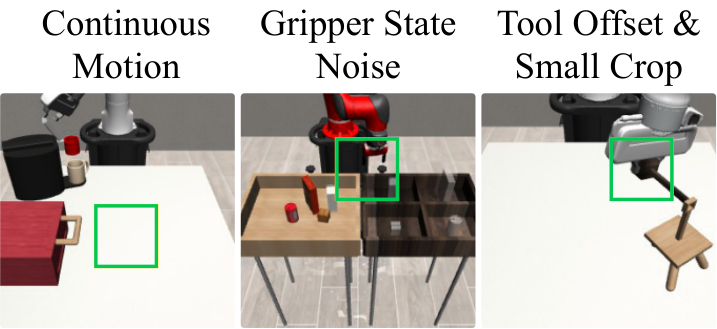
- Label-free alternatives often derive crops from trajectories by detecting gripper or motion events and centering a fixed crop at the projected end-effector.
- Such action-derived crops are useful spatial priors that require no additional labels, but they encode fixed choices about event timing, proxy points, and crop scale.
- When the visual evidence needed for control lies away from the end-effector or changes continuously with task progress, these crops can become misaligned.
Methodology
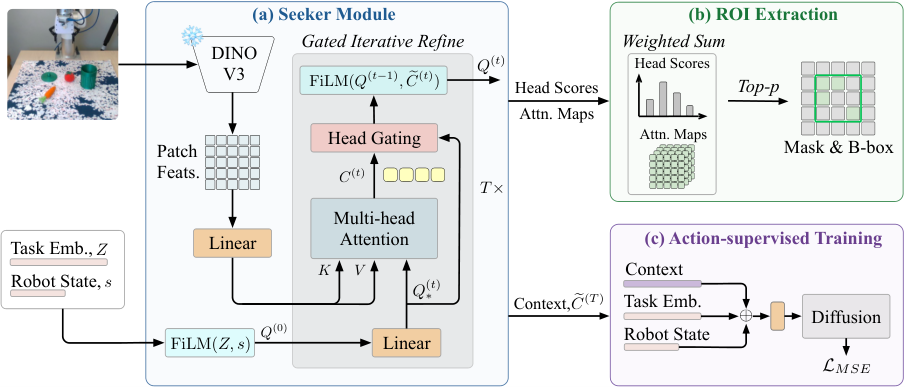
Fig. 1 (a) illustrates Seeker, a lightweight readout over frozen DINOv3 [ 22 ] patch tokens. Its design is related to attention-probing readouts over pretrained visual features [ 1 , 5 , 25 ] , but is adapted for action-grounded ROI discovery.
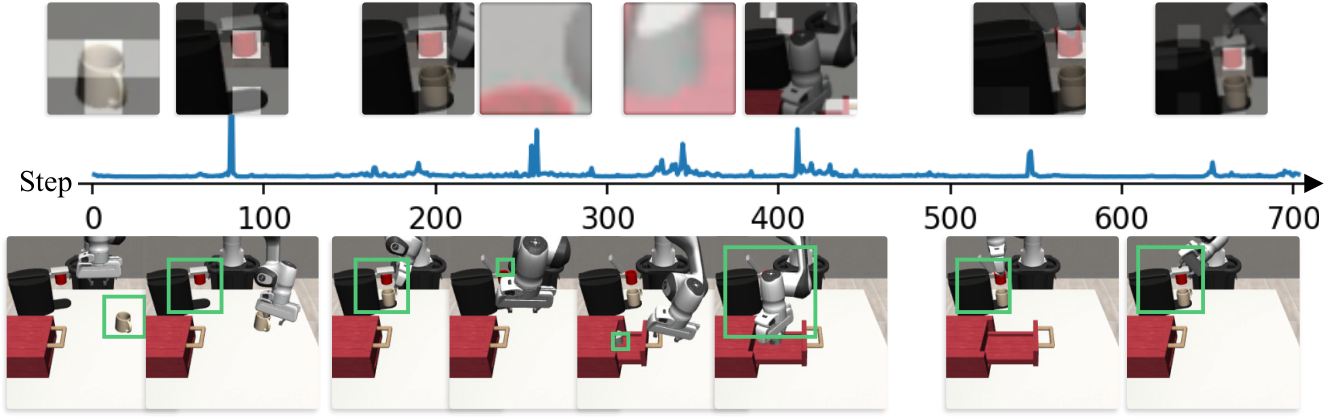
Rather than performing a single visual lookup, Seeker treats readout as an iterative search process: a task- and state-conditioned query repeatedly attends to DINO patches, gathers visual context, and updates itself before the next lookup.
Simulation Evaluations
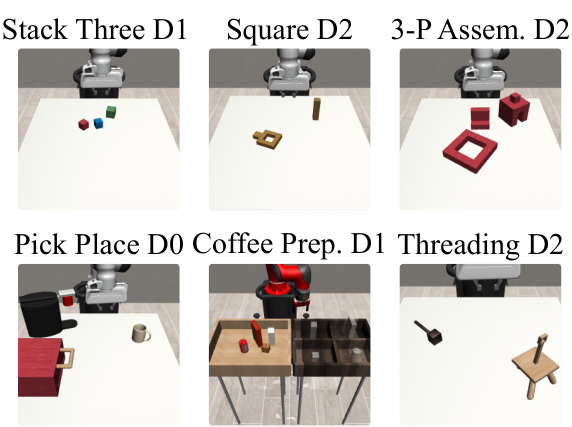
Fig. 2a illustrates the six MimicGen [ 15 ] tasks used in our simulation study: Stack Three D1, Square D2, Three-Piece Assembly D2, Coffee Preparation D1, Pick & Place D0, and Threading D2. These tasks cover high spatial variance and long-horizon manipulation; detailed task descriptions are provided in App. B . We omit D0/D1/D2 suffixes where clear.
We train a single multi-task Seeker once, using 100 demonstrations per task from the original-background RGB data, and keep it frozen for all simulation experiments.
Real-world Evaluations
We evaluate Seeker and two representative baselines on a real-world multi-view RGB setup with a UFactory xArm7, using a fixed third-person camera and an eye-in-hand camera. The three tasks are performed on visually distracting table textures and require different forms of spatial attention (Fig.
Ablations
We compare direct regression, flow matching [ 13 , 2 ] , and IMLE [ 20 ] for training Seeker from action supervision. Direct regression yields noisy attention, while generative objectives produce more stable ROIs: IMLE is cleaner but diffuse, and flow matching gives tighter masks closest to diffusion.
Across 300 trajectories from Square, Stack Three, and Three-Piece Assembly, the average ROI box IoU to the diffusion-trained Seeker is $0.50$ for IMLE and $0.67$ for flow matching. Additional qualitative comparisons in App. A.2 .
Sources and Demonstrations
Figures are reproduced from Zhuang et al. See the full paper for experimental details and the project page, when the paper links one, for demonstrations and videos.
Related Papers
A Low-Cost, Open Platform for End-to-End Autonomous Driving on a Miniature Ackermann Vehicle
Gustavo Claudio Karl Couto, Eric Aislan Antonelo, Gabriel George Zipperer
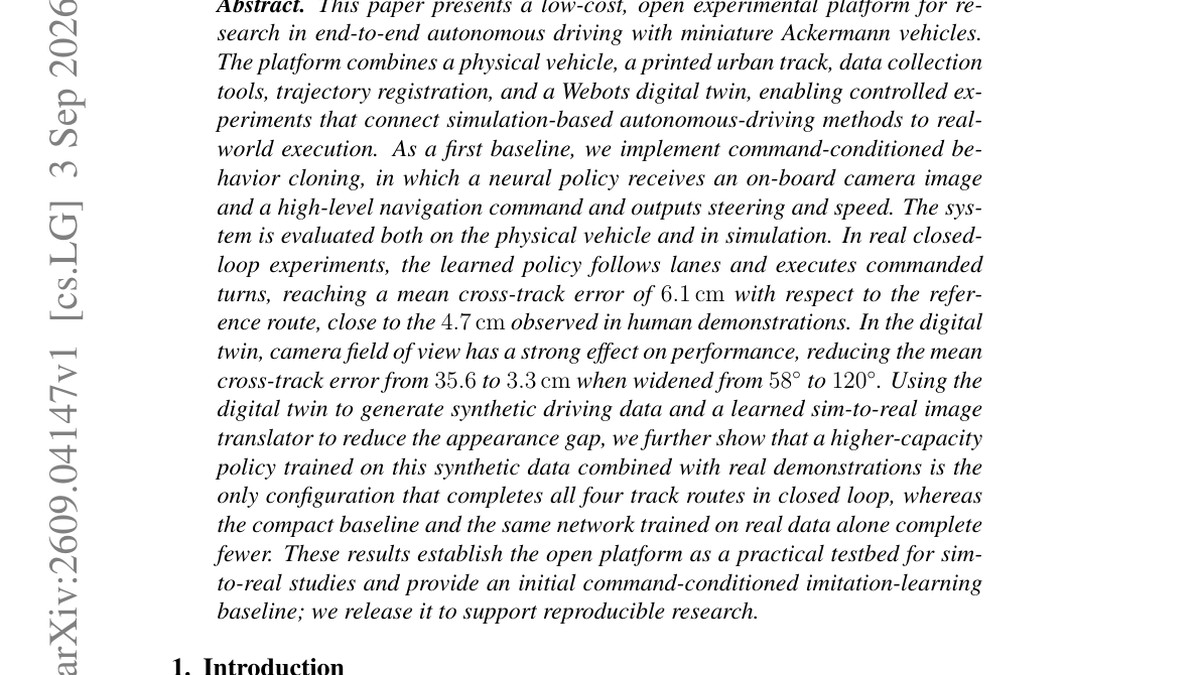
This paper presents a low-cost, open experimental platform for research in end-to-end autonomous driving with miniature Ackermann vehicles.
A Phenomenology of Neural Geometry in Vision-Language-Action Models
Mozes Jacobs, Aiden Swann, Mathilde Papillon et al.
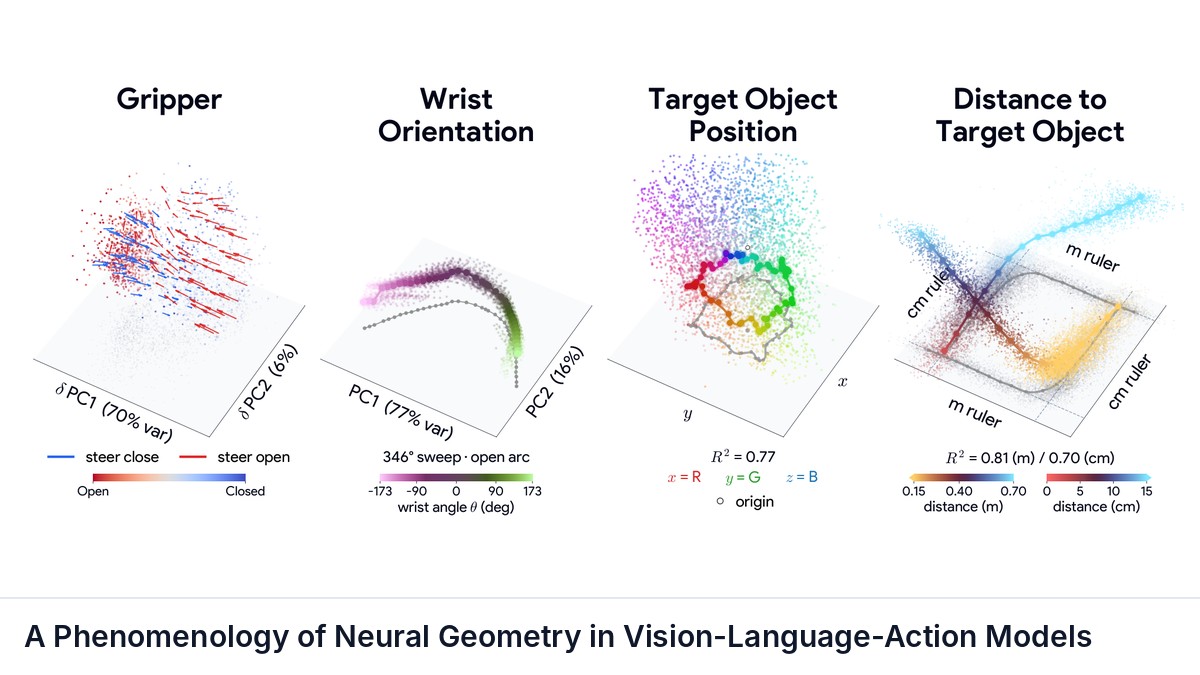
Robotic manipulation is inherently geometric, but what shape does the world take inside the policy that performs it?

A Sim-to-Real Integration Pipeline for Training and Deployment of Chunk-Based VLA Manipulation Policies
Mathilde Kappel, Clémence Grislain, Mohamed Chetouani et al.
Vision-Language-Action (VLA) models have become a prominent paradigm for mapping multimodal inputs, including semantic instructions, visual observations of the scene, and proprioceptive observations, to robot actions.
Aim Short to Reach Far: Your Frozen World Model Can Plan Better Than You Think
Xvyuan Liu, Jianjie Fang, Chen Gao et al.
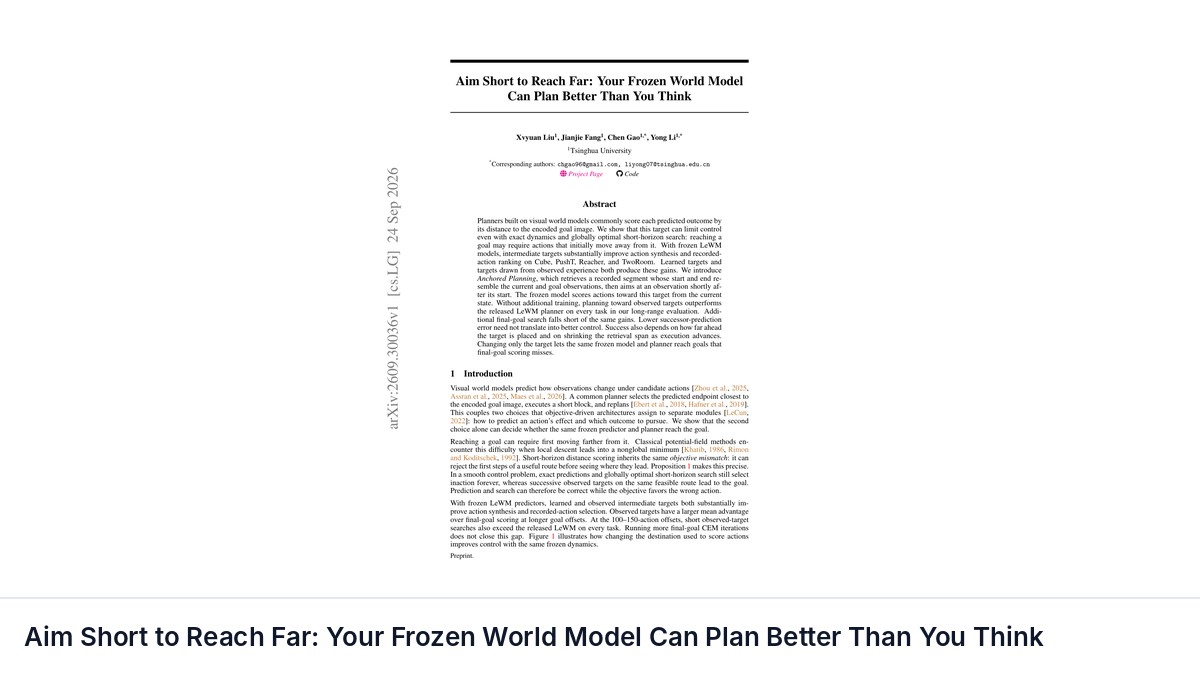
Planners built on visual world models commonly score each predicted outcome by its distance to the encoded goal image. We show that this target can limit control even with exact dynamics and globally optimal short-horizon search: reaching a goal may require actions that initially move away from it.