
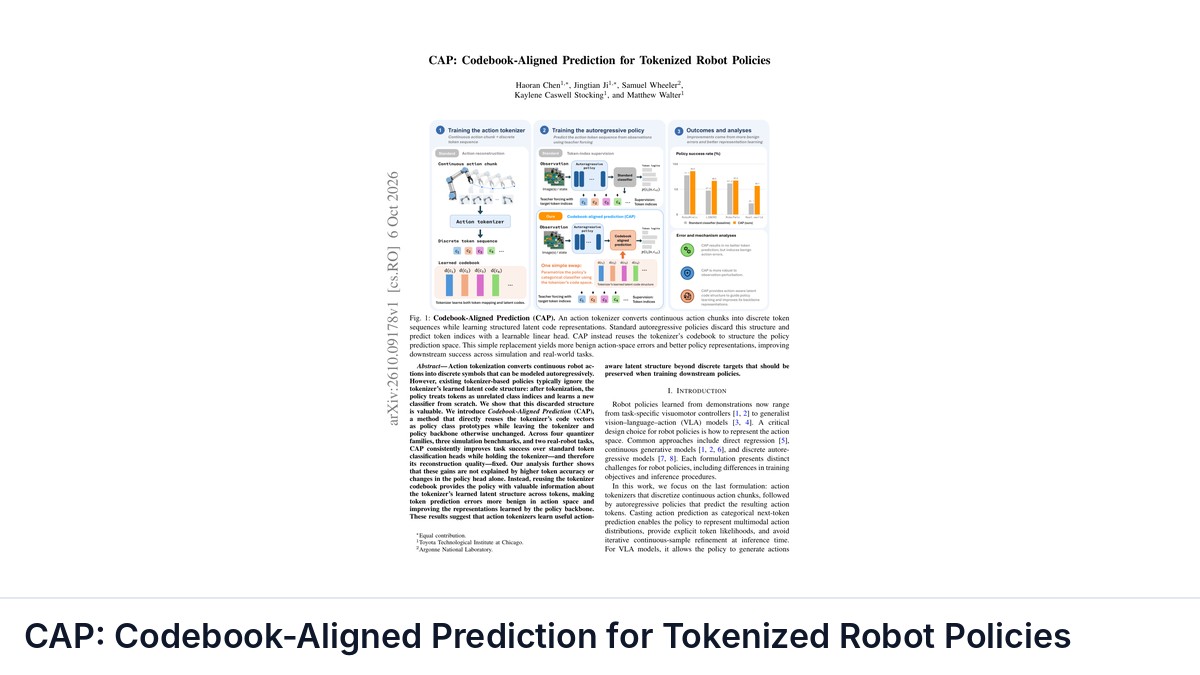
CAP: Codebook-Aligned Prediction for Tokenized Robot Policies
Haoran Chen, Jingtian Ji, Samuel Wheeler, Kaylene Caswell Stocking, Matthew Walter · N/A · 2026
Framework
N/A
License
N/A
Stars
N/A
Summary
Action tokenization converts continuous robot actions into discrete symbols that can be modeled autoregressively.
Abstract Summary
Key Points
- Action tokenization converts continuous robot actions into discrete symbols that can be modeled autoregressively.
- However, existing tokenizer-based policies typically ignore the tokenizer's learned latent code structure: after tokenization, the policy treats tokens as unrelated class indices and learns a new classifier from scratch.
- We show that this discarded structure is valuable
- We introduce Codebook-Aligned Prediction (CAP), a method that directly reuses the tokenizer's code vectors as policy class prototypes while leaving the tokenizer and policy backbone otherwise unchanged.
- Across four quantizer families, three simulation benchmarks, and two real-robot tasks, CAP consistently improves task success over standard token classification heads while holding the tokenizer (and therefore its reconstruction quality) fixed.
CAP: Codebook-Aligned Prediction for Tokenized Robot Policies
|Authors: Haoran Chen, Jingtian Ji, Samuel Wheeler, Kaylene Caswell Stocking, Matthew Walter
|Venue: arXiv preprint | Year: 2026
|arXiv: 2610.09178
Abstract
Action tokenization converts continuous robot actions into discrete symbols that can be modeled autoregressively. However, existing tokenizer-based policies typically ignore the tokenizer’s learned latent code structure: after tokenization, the policy treats tokens as unrelated class indices and learns a new classifier from scratch. We show that this discarded structure is valuable. We introduce Codebook-Aligned Prediction (CAP), a method that directly reuses the tokenizer’s code vectors as policy class prototypes while leaving the tokenizer and policy backbone otherwise unchanged. Across four quantizer families, three simulation benchmarks, and two real-robot tasks, CAP consistently improves task success over standard token classification heads while holding the tokenizer (and therefore its reconstruction quality) fixed. Our analysis further shows that these gains are not explained by higher token accuracy or changes in the policy head alone. Instead, reusing the tokenizer codebook provides the policy with valuable information about the tokenizer’s learned latent structure across tokens, making token prediction errors more benign in action space and improving the representations learned by the policy backbone. These results suggest that action tokenizers learn useful action-aware latent structure beyond discrete targets that should be preserved when training downstream policies.
Key Contributions
- Action tokenization converts continuous robot actions into discrete symbols that can be modeled a…
- However, existing tokenizer-based policies typically ignore the tokenizer’s learned latent code s…
- We show that this discarded structure is valuable
- We introduce Codebook-Aligned Prediction (CAP), a method that directly reuses the tokenizer’s cod…
- Across four quantizer families, three simulation benchmarks, and two real-robot tasks, CAP consis…
Topics
- reinforcement-learning
- benchmark
Code & Data
No code repository linked in paper metadata.
BibTeX
@article{Chen2026_261009178,
  title     = {CAP: Codebook-Aligned Prediction for Tokenized Robot Policies},
  author    = {Haoran Chen and Jingtian Ji and Samuel Wheeler and Kaylene Caswell Stocking and Matthew Walter},
  year      = {2026},
  eprint    = {2610.09178},
  archivePrefix = {arXiv},
  primaryClass  = {cs.RO},
  url       = {https://arxiv.org/abs/2610.09178}
}
Related Papers
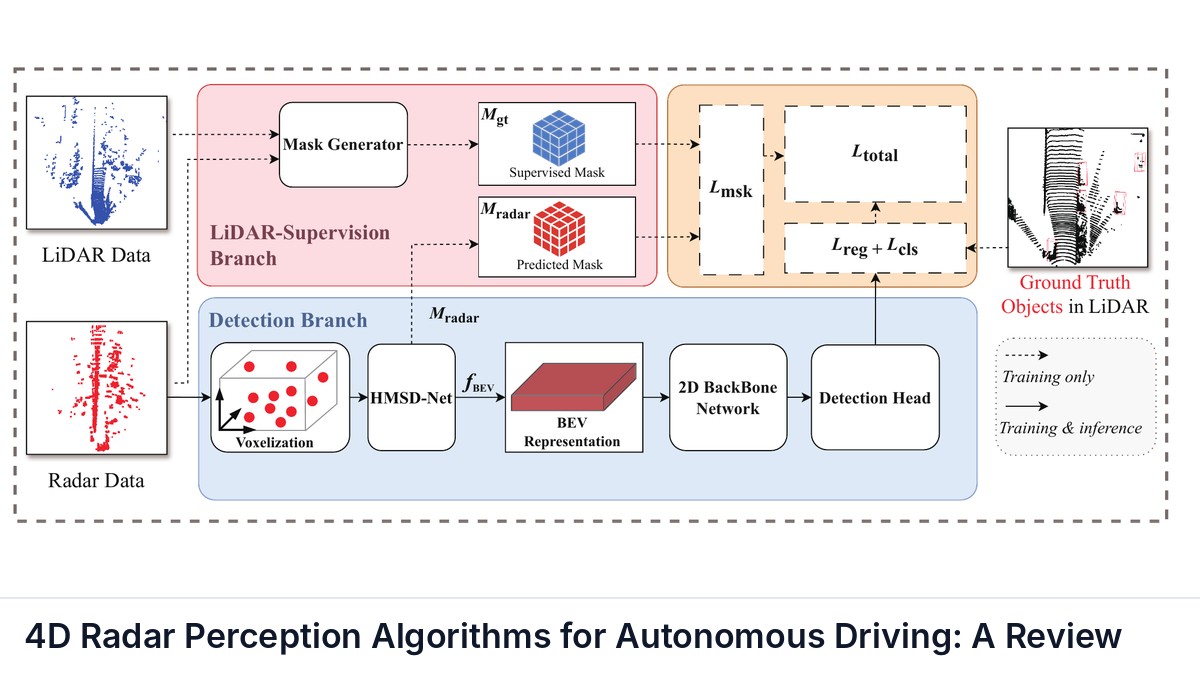
4D Radar Perception Algorithms for Autonomous Driving: A Review
Xumin Wu, Jun Zhou, Jilin Mei et al.
Research on 4D millimeter-wave radar perception algorithms has flourished in recent years, extending from signal processing and object detection to semantic segmentation, motion estimation, occupancy prediction, and dynamic scene reconstruction.
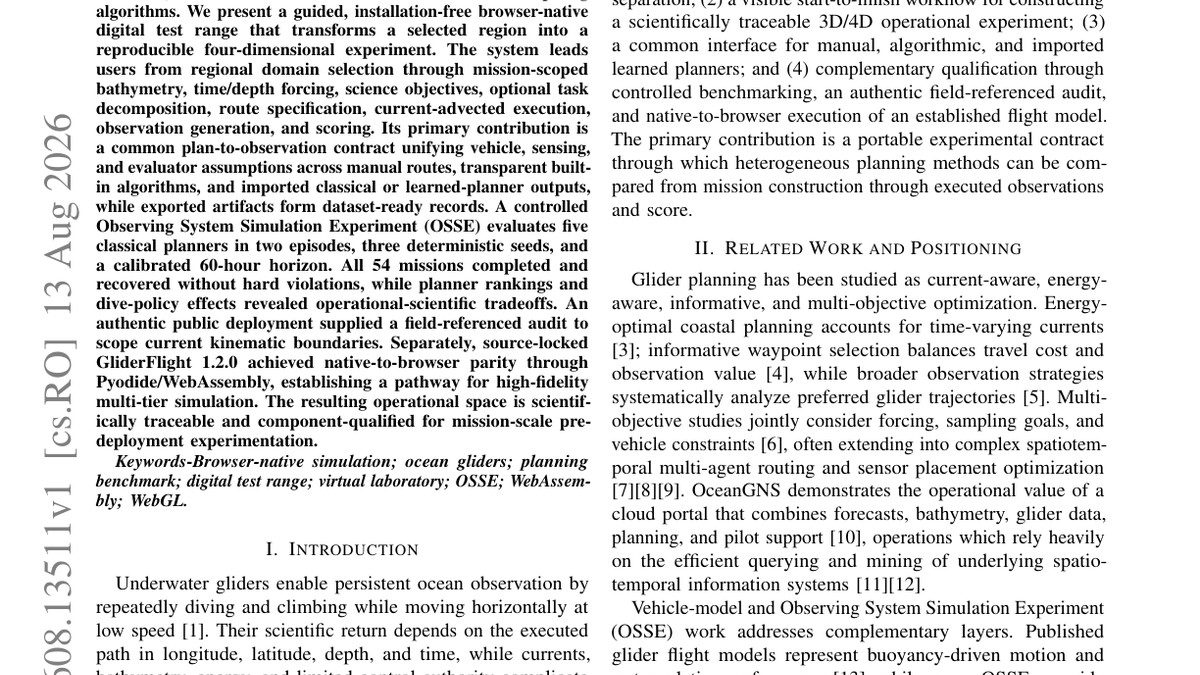
A Browser-Native Digital Test Range for Benchmarking 4D Ocean-Glider Planning Algorithms
Edward Holmberg, Elias Ioup, Mahdi Abdelguerfi
Repeated in-situ evaluation of ocean-glider planners requires scarce vehicles, operators, deployment and recovery resources, and ocean conditions that cannot be reset for competing algorithms.
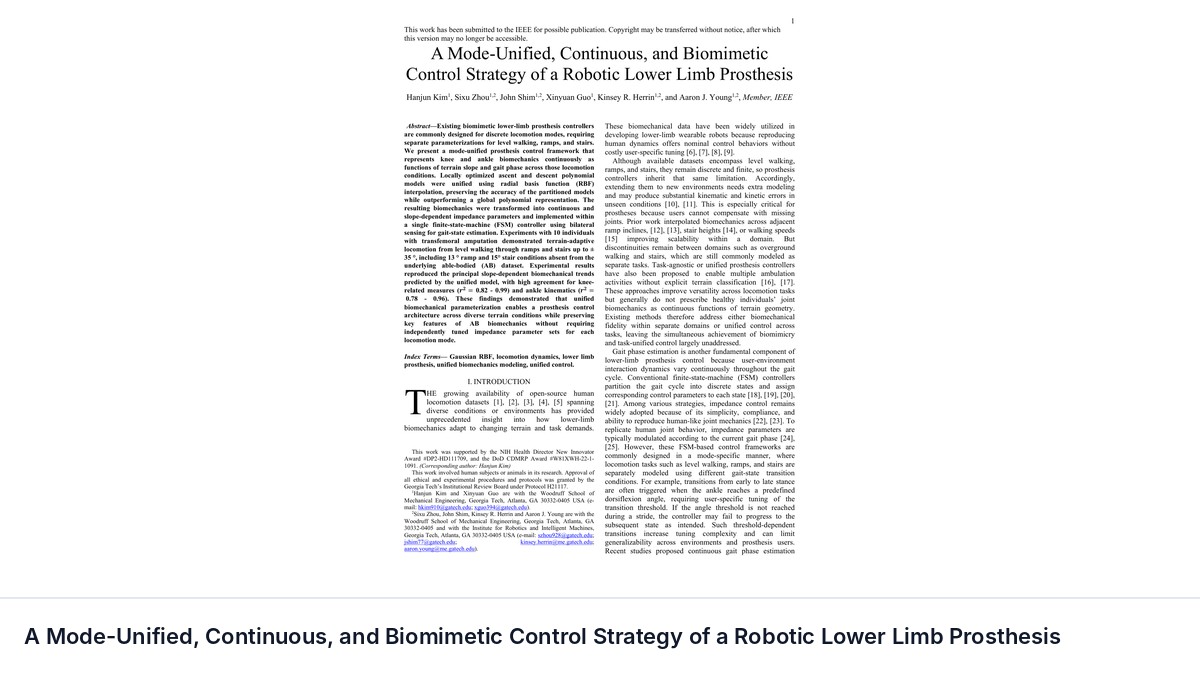
A Mode-Unified, Continuous, and Biomimetic Control Strategy of a Robotic Lower Limb Prosthesis
Hanjun Kim, Sixu Zhou, John Shim et al.
Existing biomimetic lower-limb prosthesis controllers are commonly designed for discrete locomotion modes, requiring separate parameterizations for level walking, ramps, and stairs.
A Review Of Robotic World Models For Dynamic Environments Based On Factor And Scene Graphs
Marco Giberna, Miguel Fernandez-Cortizas, Jose Luis Sanchez Lopez et al.
Models based on graphs have emerged in robotics as a powerful foundation for internal world representations, where factor and scene graphs are among the most prominent model types found in the related literature and in successful robotic solutions.