
WALT: Learning World-Model-Aligned Latent Trajectories for Autonomous Driving
Mingkai Jia, Jiaxin Guo, Zhijian Shu, Jiawei Xu, Mingxiao Li, Jintao Cheng, Ping Tan, Wei Yin · N/A · 2026
Framework
N/A
License
N/A
Stars
N/A
Summary
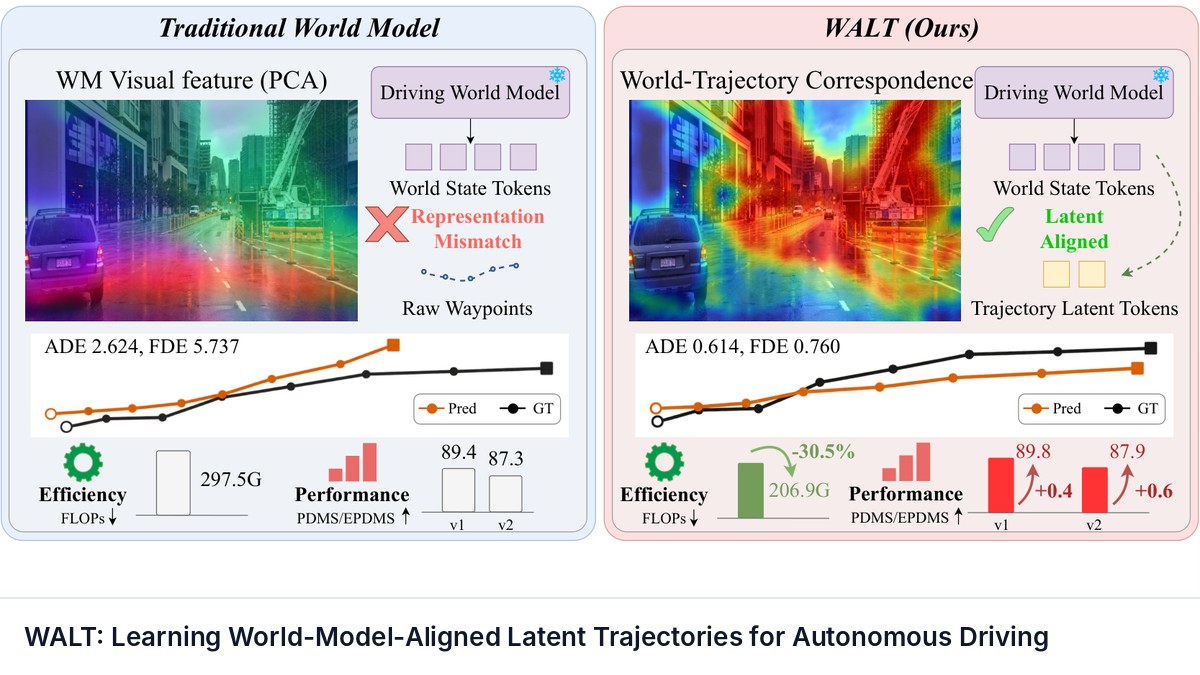
Driving world models learn rich predictive representations of the surrounding environment from visual observations, yet accurate visual prediction does not necessarily translate into effective trajectory planning.
Abstract Summary
Key Points
- Driving world models learn rich predictive representations of the surrounding environment from visual observations, yet accurate visual prediction does not necessarily translate into effective trajectory planning.
- We argue that a key bottleneck lies in the mismatch between visual world states and raw geometric trajectories, which may limit the planner's ability to exploit action-relevant semantics encoded by the world model.
- To address this issue, we propose World-Model Alignment for Latent Trajectories (WALT), which learns a compact generative trajectory latent space by transferring information from a frozen pretrained driving world model without modifying the world model itself.
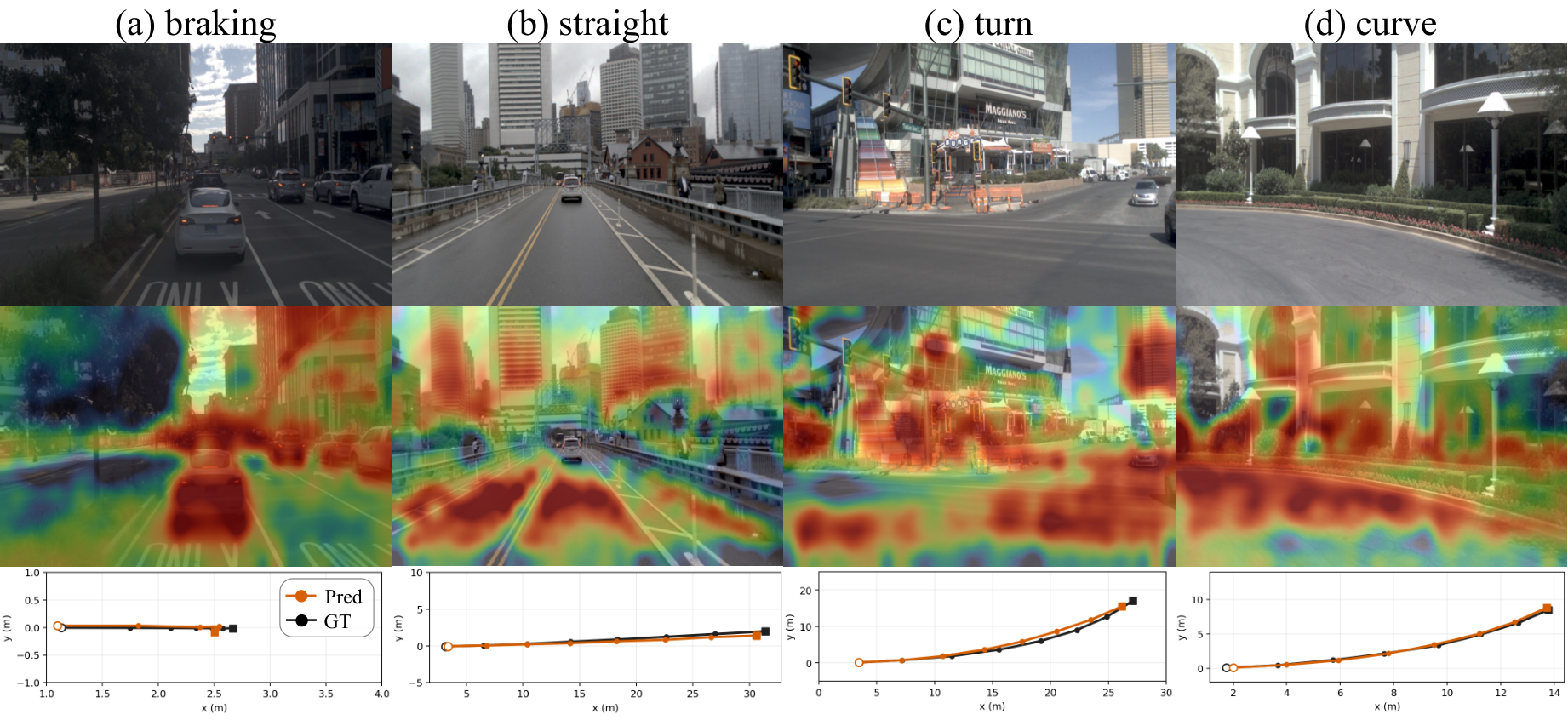
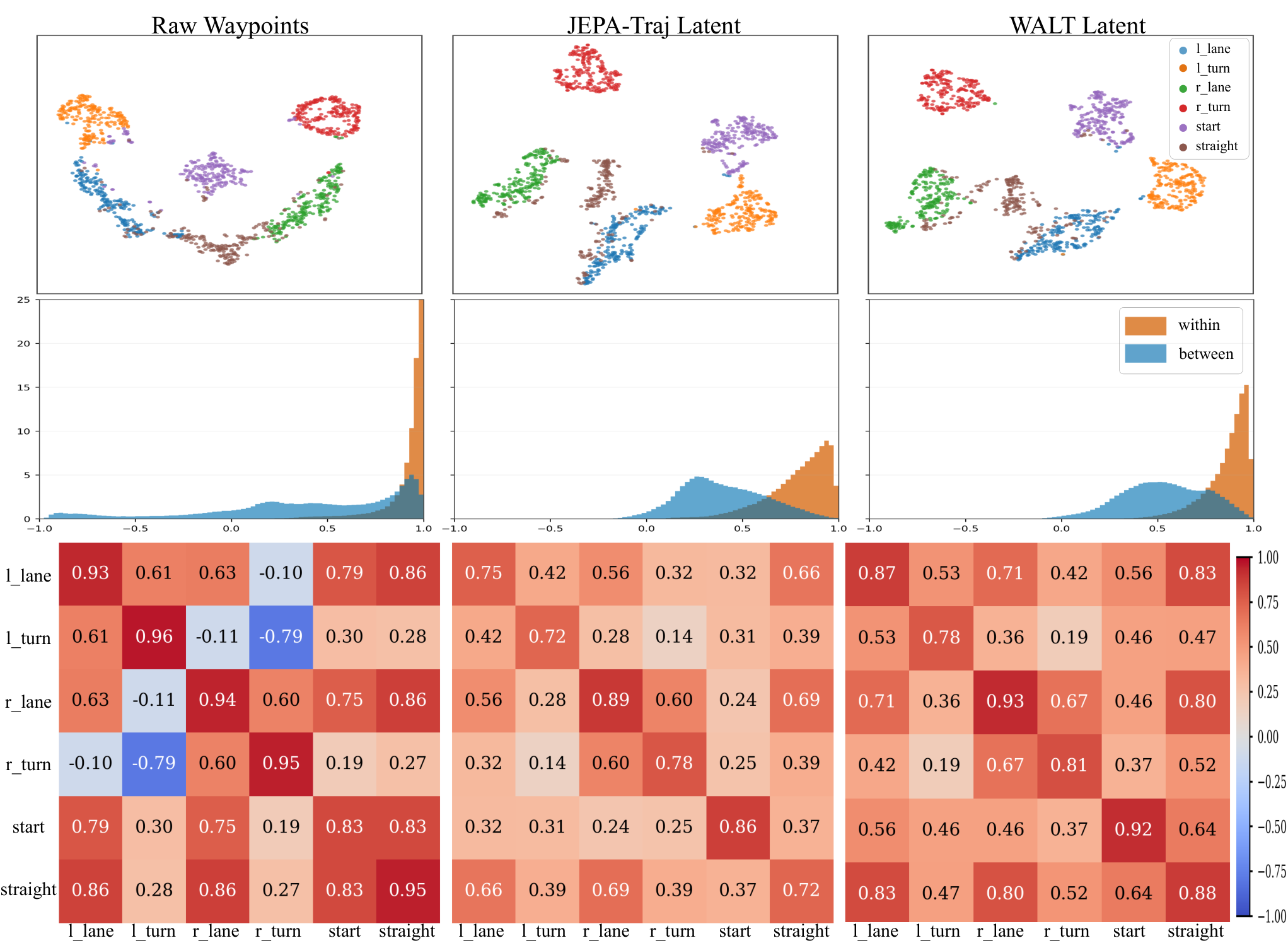
- Rather than directly generating raw waypoints, WALT maps them into compact representations through a dual-branch trajectory autoencoder and transfers semantic knowledge from the frozen visual world model into this trajectory space, encouraging the learned action representation to capture scene-level cues relevant to future motion and planning.
- Beyond our proposed formulation, we systematically study latent learning based on Joint-Embedding Predictive Architectures (JEPA) and feature alignment following Representation Alignment (REPA) to investigate how trajectory-only representation learning affects downstream planning.
Method
The WALT pipeline is illustrated in Fig. 2 . In Stage 1, we train a dual-branch trajectory autoencoder to compress raw waypoints into a compact latent representation (Sec. III-B ). The training objective includes a reconstruction loss and a world-model alignment loss that transfers information from the frozen world model into the trajectory latent space (Sec. III-C ).
In Stage 2, we employ the aligned trajectory latent as the generation space for the action head of the frozen world model (Sec. III-D ).
Experiments
Benchmarks and metrics. We evaluate on NAVSIMv1 navtest using the official planning protocol [ 23 ] . We report PDMS together with no-at-fault collision (NC), drivable-area compliance (DAC), ego progress (EP), time-to-collision (TTC), and comfort (C).
We additionally evaluate on NAVSIMv2 [ 24 ] , reporting EPDMS and its associated component metrics, including traffic light compliance (TLC) and lane keeping (LK), while expanding comfort (C) into history comfort (HC) and extended comfort (EC).
Sources and Demonstrations
Figures are reproduced from Jia et al. See the full paper for experimental details and the project page, when the paper links one, for demonstrations and videos.
Related Papers
Aim Short to Reach Far: Your Frozen World Model Can Plan Better Than You Think
Xvyuan Liu, Jianjie Fang, Chen Gao et al.
Planners built on visual world models commonly score each predicted outcome by its distance to the encoded goal image. We show that this target can limit control even with exact dynamics and globally optimal short-horizon search: reaching a goal may require actions that initially move away from it.
Beyond Episodic Evaluation: Memory Architectural Bottlenecks in Sequential Embodied Question Answering
Zikui Cai, Kaushal Janga, Tan Dat Dao et al.
Embodied question answering (EQA) is traditionally evaluated under an episodic formulation, where agents solve each task independently and reset internal state between episodes.
EditWM: Event-Decomposed World Modeling with Incremental Correction for End-to-End Autonomous Driving
Junjie Yang, Qingwei Zeng, Youyou Li et al.
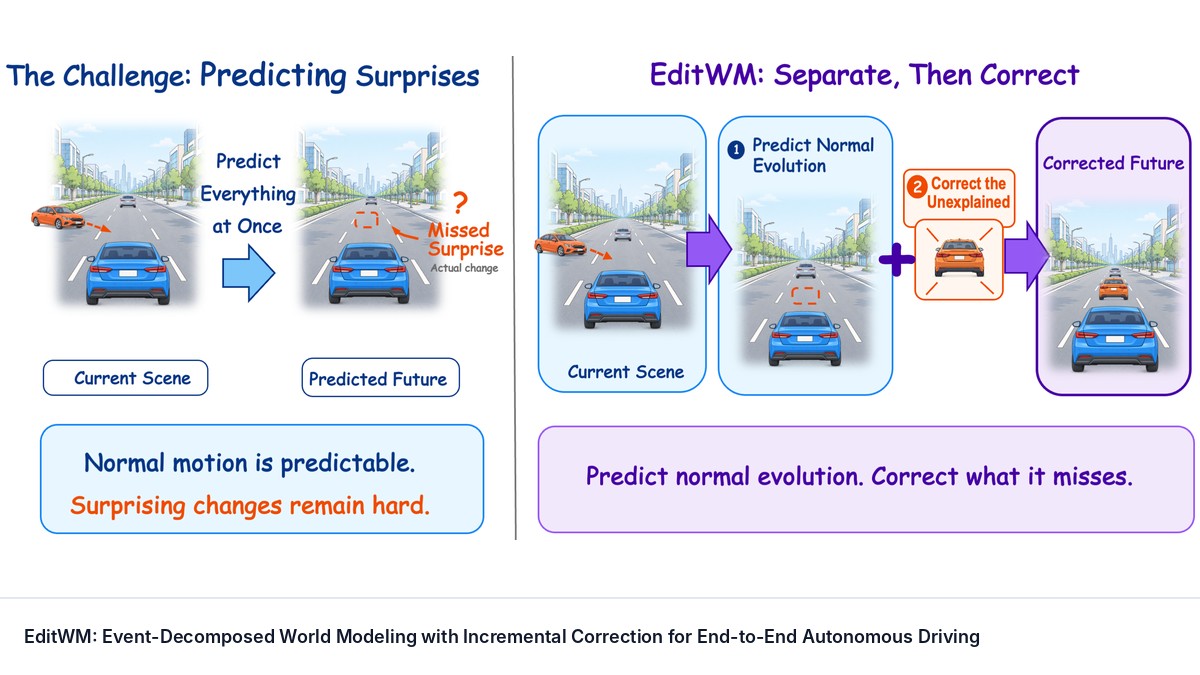
World models support autonomous driving by predicting the scene evolution associated with candidate trajectories. Driving dynamics differ in predictability, motivating a distinction between regular evolution and event-induced deviations that call for selective correction.
Embodied Scene Rearrangement Planning
Canzhi Chen, Zan Wang, Siqi Zhu et al.
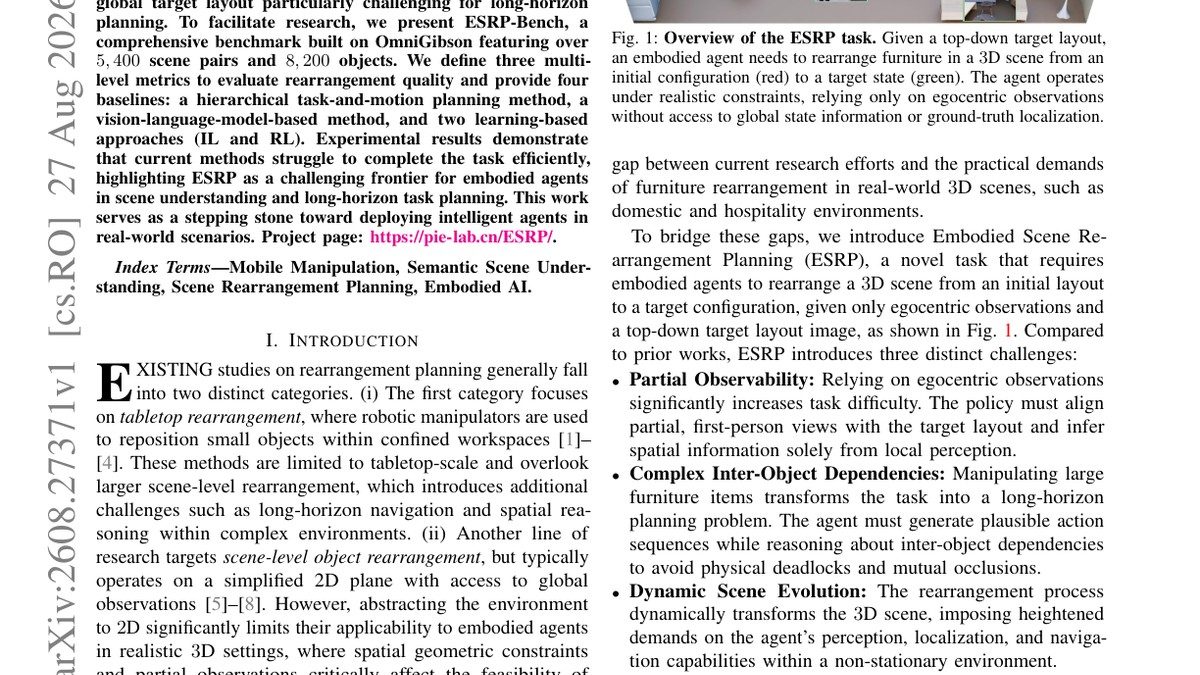
This paper introduces Embodied Scene Rearrangement Planning (ESRP), a novel task requiring embodied agents to rearrange furniture in 3D scenes to match a target configuration using only egocentric observations and a top-down target layout.