
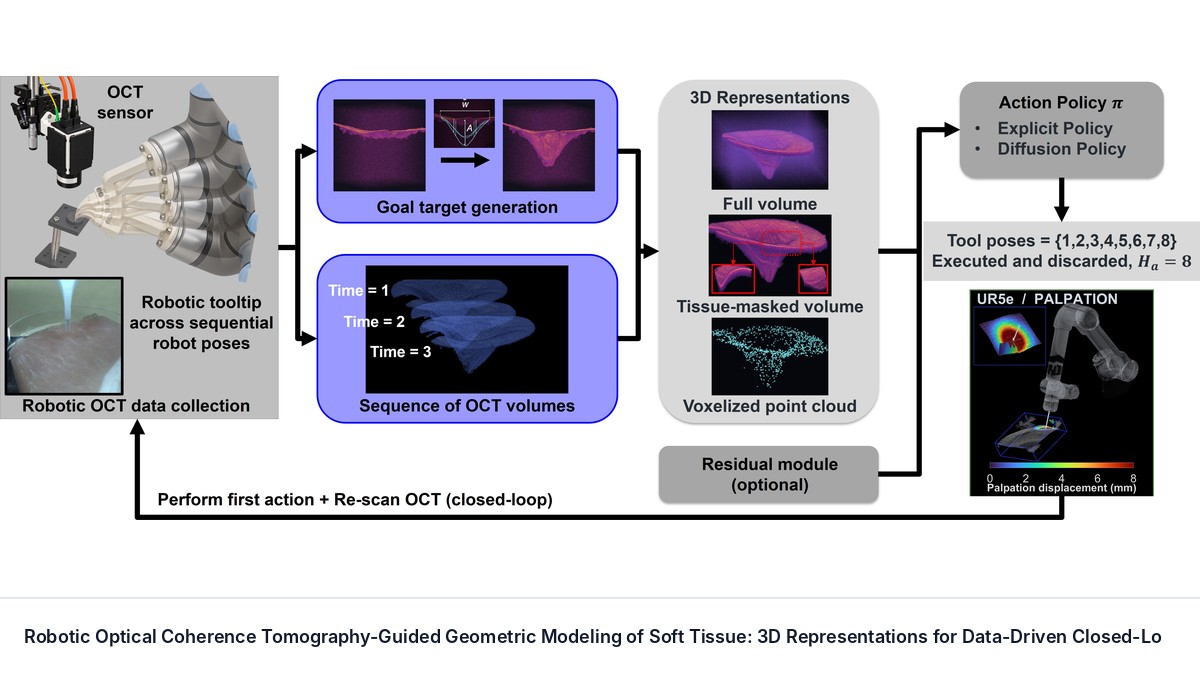
Robotic Optical Coherence Tomography-Guided Geometric Modeling of Soft Tissue: 3D Representations for Data-Driven Closed-Loop Shape Control
Chaoyu Zhang, Guangshen Ma, Mark Draelos · N/A · 2026
Framework
N/A
License
N/A
Stars
N/A
Summary
In medical robotics, data-driven soft-tissue shape control requires deforming tissue toward desired morphologies through sequential physical interactions.
Abstract Summary
Key Points
- In medical robotics, data-driven soft-tissue shape control requires deforming tissue toward desired morphologies through sequential physical interactions.
- This challenge is particularly important in microscale manipulation, where localized deformation is difficult to observe, represent, and control, while physics-based models can be computationally expensive and difficult to adapt to realistic environments.
- Optical coherence tomography (OCT) provides high-resolution volumetric perception of tissue deformation, but target-conditioned control requires effective representations of both observed and desired tissue states.
- In this work, we introduce an OCT-guided data-driven framework for tissue shape control, learned from user-guided demonstrations and executed with closed-loop OCT feedback.
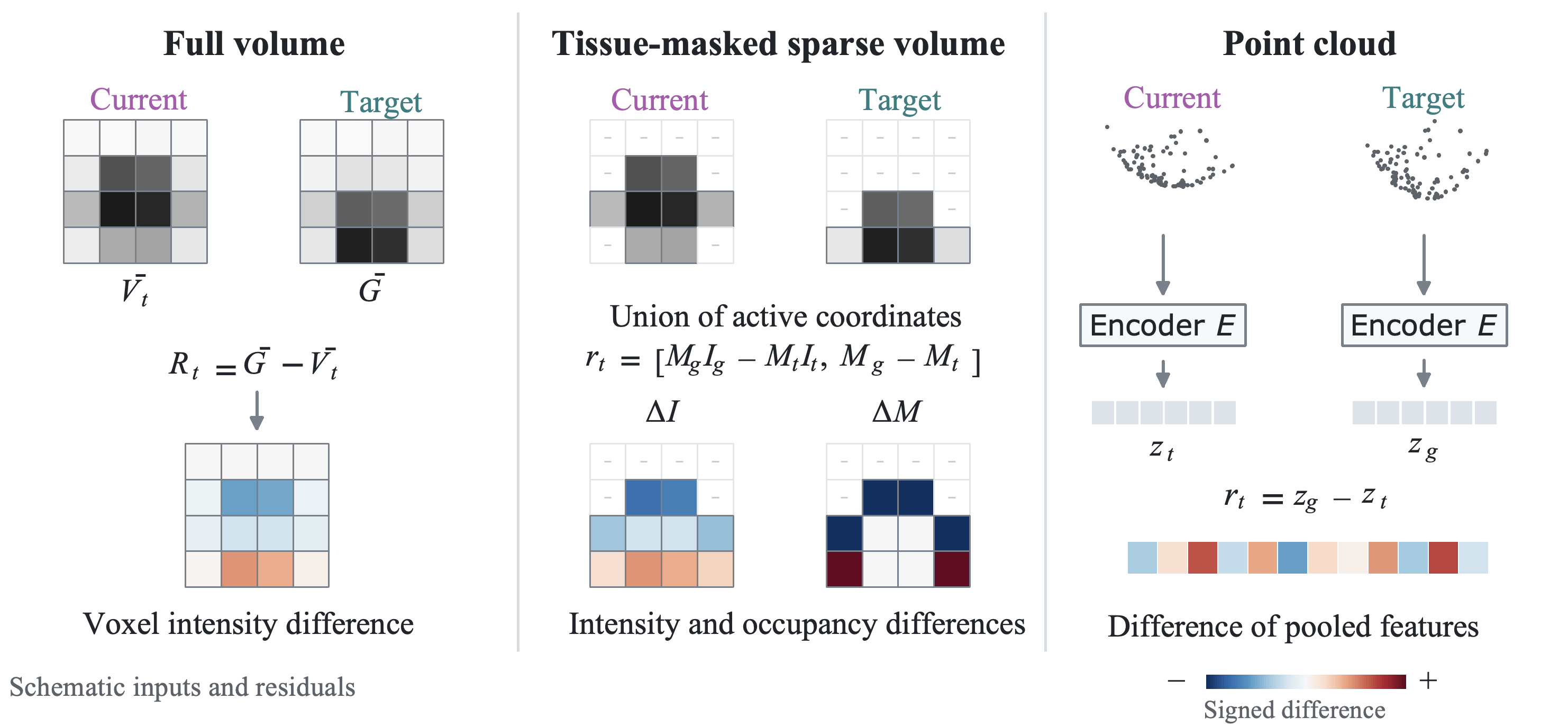
- We study full-volume, tissue-masked sparse-volume, and voxelized point-cloud representations, with or without residual conditioning, using deterministic (Explicit) and generative diffusion (Diffusion) policies.
OCT-Guided Tissue Shape Control Framework
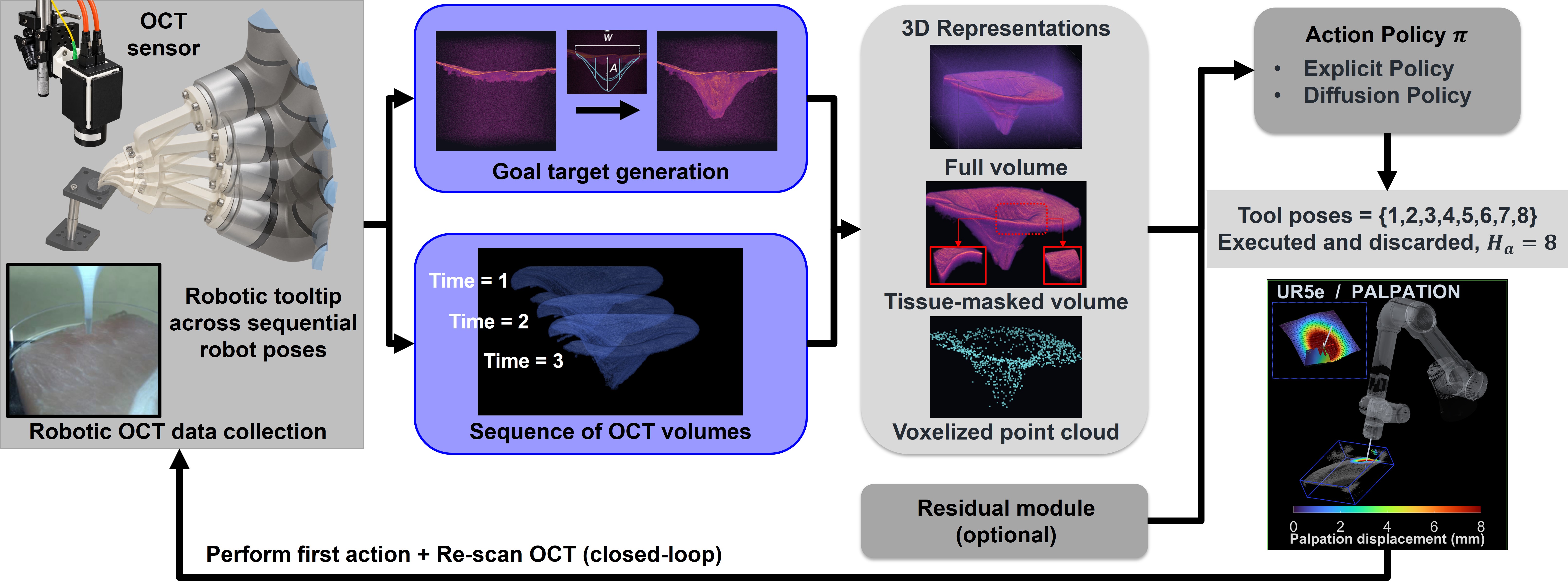
We formulate soft-tissue shape control as a goal-conditioned robot learning problem with closed-loop volumetric OCT feedback. A policy learned from user-guided demonstrations predicts tooltip motions conditioned on current OCT observations and a target tissue morphology.
The framework integrates parameterized target generation (Appendix A.2 ), 3D OCT representations, goal-conditioning schemes, and Explicit and Diffusion policies within a unified closed-loop formulation.
Real-Robot Evaluation
We evaluated the proposed framework on physical tissue phantoms and ex vivo porcine tissue to determine whether learned policies (i) achieve desired tissue morphologies, (ii) adapt actions to different targets, and (iii) generalize to intermediate targets unseen during training.
The platform combines a 6-DoF UR5e robot, a printed palpation tooltip, a 1064-nm swept-source OCT system operating at 400 kHz, and an RGB camera (Fig. 1 ). Experiments use a soft silicone 40A phantom with an internal empty layer, together with ex vivo porcine tissue.
Sources and Demonstrations
Figures are reproduced from Zhang et al. See the full paper for experimental details and the project page, when the paper links one, for demonstrations and videos.
Related Papers

A Sim-to-Real Integration Pipeline for Training and Deployment of Chunk-Based VLA Manipulation Policies
Mathilde Kappel, Clémence Grislain, Mohamed Chetouani et al.
Vision-Language-Action (VLA) models have become a prominent paradigm for mapping multimodal inputs, including semantic instructions, visual observations of the scene, and proprioceptive observations, to robot actions.

Capability-Aware Arbitration for Semantic Intent-Based Shared Control
Zhaoda Du, Michael Bowman, Xiaoli Zhang
Shared control often allocates robot authority based on confidence in inferred human intent, assuming reliable autonomous execution. When this assumption fails, high intent confidence can cause over-helping.
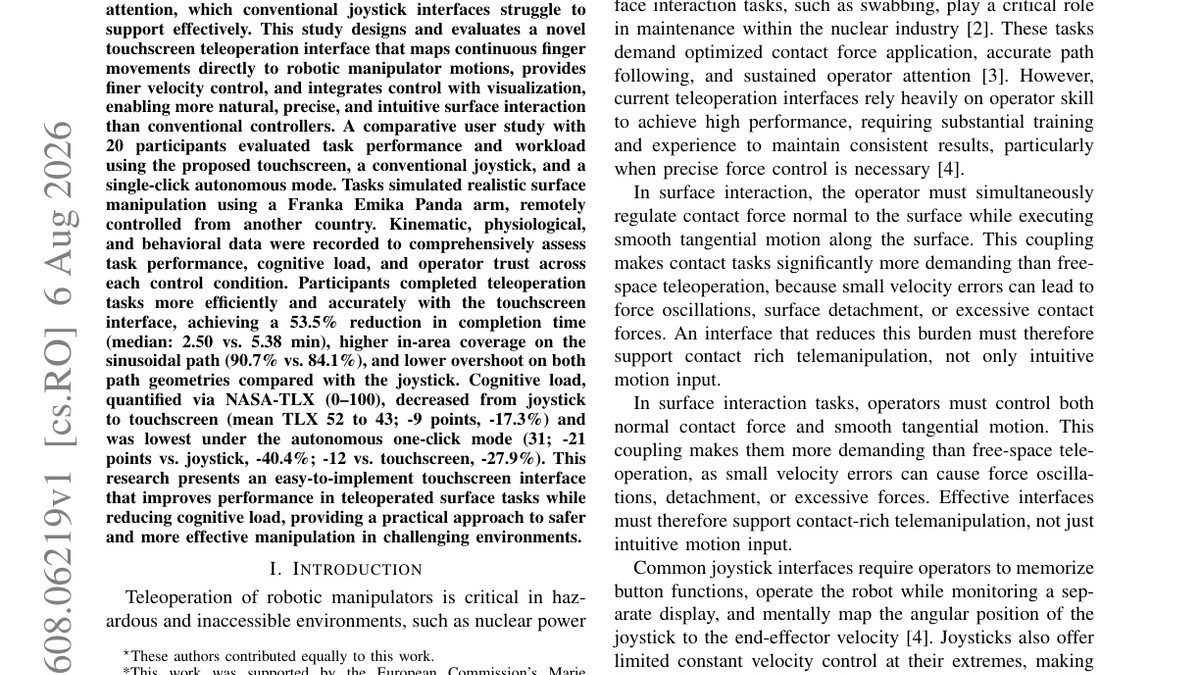
Design and Evaluation of a Touchscreen-Based Teleoperation Interface for Robotic Manipulators
Juan José García Cárdenas, Alperen Kenan, Hamidreza Raei et al.
Intuitive teleoperation interfaces are crucial for the safe and effective operation of robotic manipulators in challenging environments.
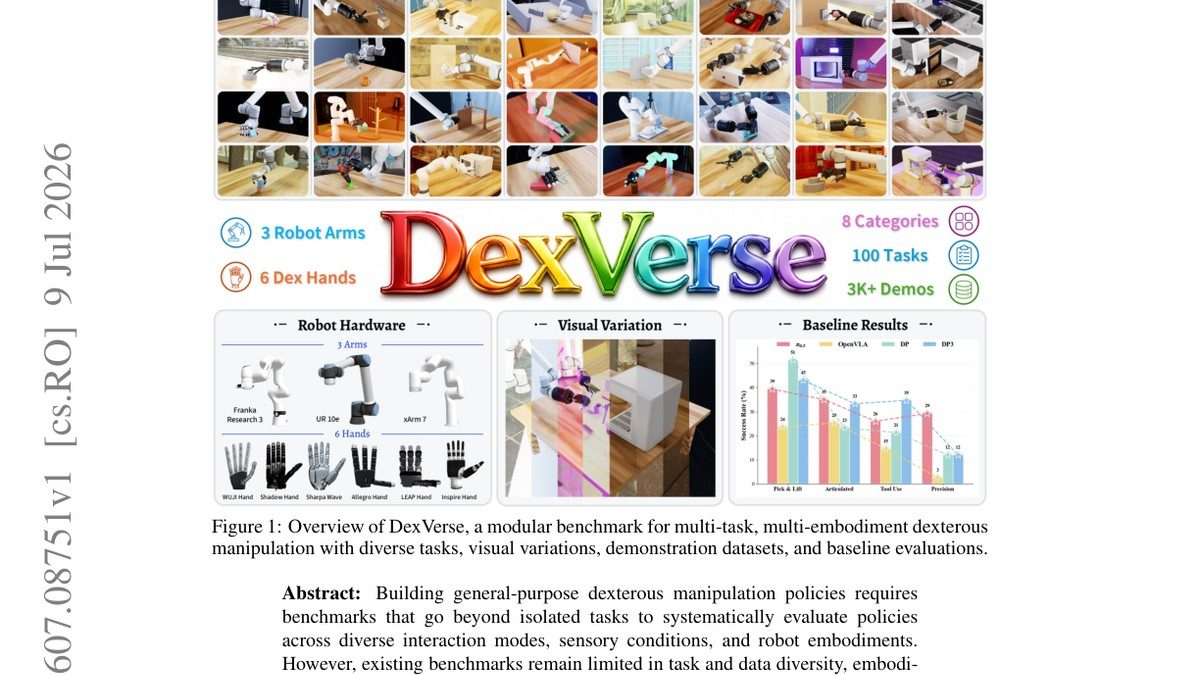
DexVerse: A Modular Benchmark for Multi-Task, Multi-Embodiment Dexterous Manipulation
Yunchao Yao, Zhuxiu Xu, Tianqi Zhang et al.
Building general-purpose dexterous manipulation policies requires benchmarks that go beyond isolated tasks to systematically evaluate policies across diverse interaction modes, sensory conditions, and robot embodiments.