
Modality-Autoregressive World-Action Models
Adam Hung, Bardienus P. Duisterhof, Deva Ramanan, Jeffrey Ichnowski · N/A · 2026
Framework
N/A
License
N/A
Stars
N/A
Summary
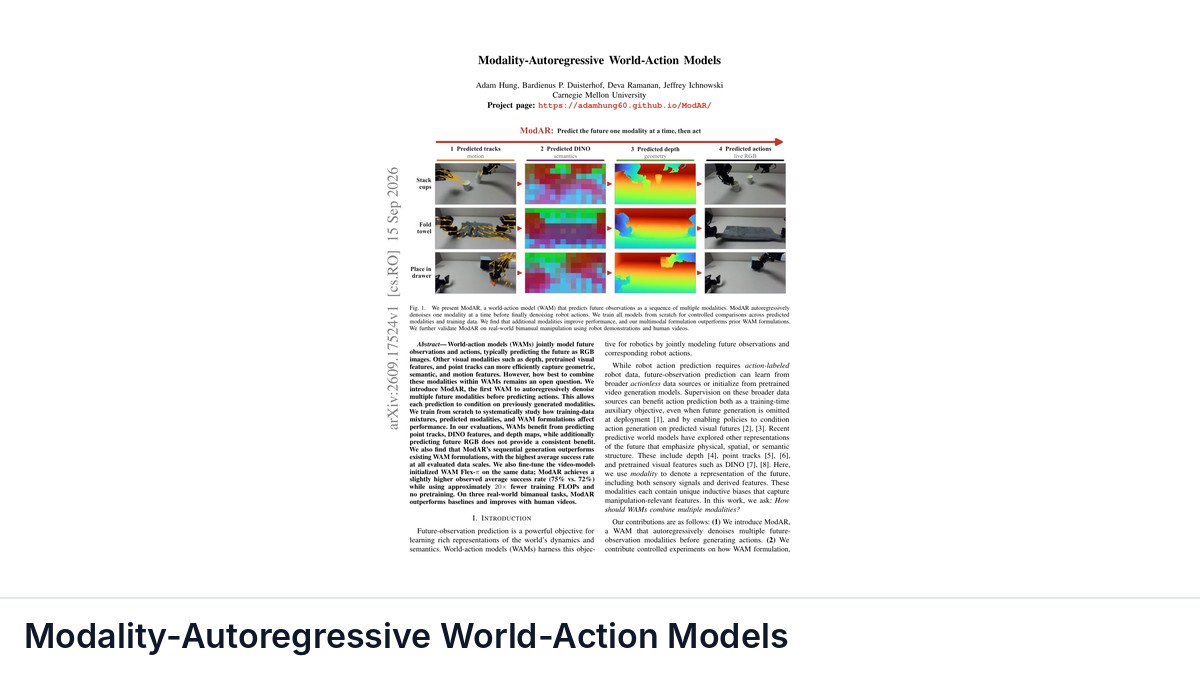
World-action models (WAMs) jointly model future observations and actions, typically predicting the future as RGB images. Other visual modalities such as depth, pretrained visual features, and point tracks can more efficiently capture geometric, semantic, and motion features.
Abstract Summary
Key Points
- World-action models (WAMs) jointly model future observations and actions, typically predicting the future as RGB images.
- Other visual modalities such as depth, pretrained visual features, and point tracks can more efficiently capture geometric, semantic, and motion features.
- However, how best to combine these modalities within WAMs remains an open question
- We introduce ModAR, the first WAM to autoregressively denoise multiple future modalities before predicting actions.
- This allows each prediction to condition on previously generated modalities
Method
Given demonstrations spanning multiple manipulation tasks, our objective is to jointly model future multimodal observations and robot actions conditioned on the current observation, robot configuration, and task label. We consider the set of predicted future modalities $\mathcal{M}=\{\mathrm{rgb},\mathrm{depth},\mathrm{dino},\mathrm{tracks}\}$.
At decision time $t$, let $\mathbf{o}_{t}$ denote the multimodal observation.
Experiments
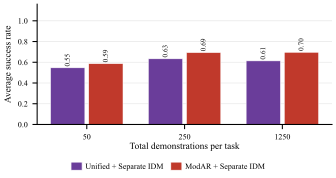
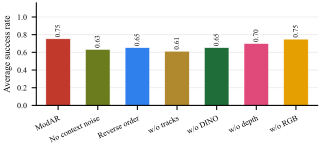
In simulation, we evaluate WAM formulations (Figure 3 ), actionless-data scaling, and predicted modality sets. We also compare with a large video-model-initialized WAM, Flex-$\pi$ [ 9 ] . We then evaluate ModAR on real-world bimanual manipulation and learning from human demonstrations. Simulation.
We evaluate on six representative RoboTwin [ 32 ] tasks: “dump bin”, “pick bottles”, “place bread”, “put bottles”, “stack bowls”, and “turn switch.” Each task uses $D\in\{50,250,1250\}$ total training demonstrations.
Sources and Demonstrations
Figures are reproduced from Hung et al. See the full paper for experimental details and the project page, when the paper links one, for demonstrations and videos.
Related Papers
4D Radar Perception Algorithms for Autonomous Driving: A Review
Xumin Wu, Jun Zhou, Jilin Mei et al.
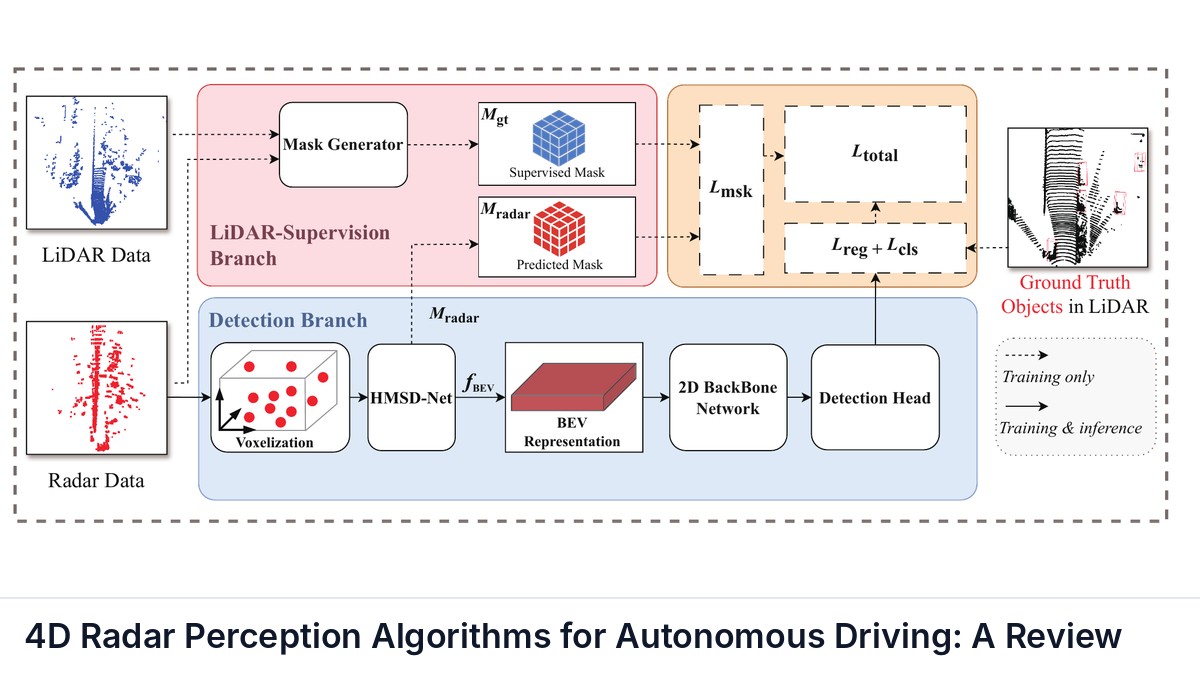
Research on 4D millimeter-wave radar perception algorithms has flourished in recent years, extending from signal processing and object detection to semantic segmentation, motion estimation, occupancy prediction, and dynamic scene reconstruction.
A Review Of Robotic World Models For Dynamic Environments Based On Factor And Scene Graphs
Marco Giberna, Miguel Fernandez-Cortizas, Jose Luis Sanchez Lopez et al.
Models based on graphs have emerged in robotics as a powerful foundation for internal world representations, where factor and scene graphs are among the most prominent model types found in the related literature and in successful robotic solutions.

A Sim-to-Real Integration Pipeline for Training and Deployment of Chunk-Based VLA Manipulation Policies
Mathilde Kappel, Clémence Grislain, Mohamed Chetouani et al.
Vision-Language-Action (VLA) models have become a prominent paradigm for mapping multimodal inputs, including semantic instructions, visual observations of the scene, and proprioceptive observations, to robot actions.
Aim Short to Reach Far: Your Frozen World Model Can Plan Better Than You Think
Xvyuan Liu, Jianjie Fang, Chen Gao et al.
Planners built on visual world models commonly score each predicted outcome by its distance to the encoded goal image. We show that this target can limit control even with exact dynamics and globally optimal short-horizon search: reaching a goal may require actions that initially move away from it.