TAPESIM: Efficient Simulation of Adhesive Tape Dispensing for Robotic Manipulation

TAPESIM: Efficient Simulation of Adhesive Tape Dispensing for Robotic Manipulation

Zhaofeng Luo, Xinyu Lu, jaehoon Choi, Zhehuan Chen, Trinity Chung, Xiaowen Qiu, Hugh Nicholas Perkins, Gianna Calderon, Alexis Duburcq, Sanghyun Son, Tsun-Hsuan Wang, Yi-Ling Qiao, Minchen Li · N/A · 2026

manipulation vision control benchmark

Framework

N/A

License

N/A

Stars

N/A

Summary

Applying adhesive tape to secure wire harnesses or seal packages requires robots to coordinate a flexible strip, a moving roll, and surfaces that attach and detach.

Abstract Summary

Applying adhesive tape to secure wire harnesses or seal packages requires robots to coordinate a flexible strip, a moving roll, and surfaces that attach and detach. Simulation could make these interactions repeatable for robot development and evaluation, but resolving every adhesive layer is expensive and can suppress roll motion at practical solver tolerances, while a permanently rigid roll cannot release material. We present TapeSim, a tape simulator that concentrates deformation near the unwinding region and along the released strip. We will release the source code. A rigid cluster represents most wound material, while an advancing deformable collar enables payout and leaves released tape flexible and reattachable. Optional releasable bonds simplify adhesive interfaces and reduce mean step times for smaller rolls. Controlled swing tests show improved roll rotation. At 32 turns, clustering gives 3.2-3.4x mean physics-step speedups at a fixed Newton tolerance and 4.5-8.4x for comparable roll motion. Across five real-motion Stick replays, the clustered variants reduce mean image-plane core-landmark error by 23-29% relative to the full-shell cohesive baseline. On 100 paired Peel cases, they improve balanced accuracy from 50% to 72.9-76.3%, with interface rankings varying across tasks. A teleoperated box-sealing sequence demonstrates attachment, dispensing, cutting, and sealing in a continuous workflow.

Key Points

  • Applying adhesive tape to secure wire harnesses or seal packages requires robots to coordinate a flexible strip, a moving roll, and surfaces that attach and detach.
  • Simulation could make these interactions repeatable for robot development and evaluation, but resolving every adhesive layer is expensive and can suppress roll motion at practical solver tolerances, while a permanently rigid roll cannot release material.
  • We present TapeSim, a tape simulator that concentrates deformation near the unwinding region and along the released strip.
  • We will release the source code
  • A rigid cluster represents most wound material, while an advancing deformable collar enables payout and leaves released tape flexible and reattachable.

Method

We model the tape backing with a triangular thin shell using StVK membrane elasticity and discrete-shell bending. Both use the flat rest mesh, so winding stores elastic strain rather than defining a new stress-free configuration. We first describe the nonadhesive strip, then add adhesion in Section III-B . At each time step with size $\Delta t$, we solve jointly for the tape and body coordinates $\mathbf{q}$.
Method — TAPESIM: Efficient Simulation of Adhesive Tape Dispensing for Robotic Manipulation
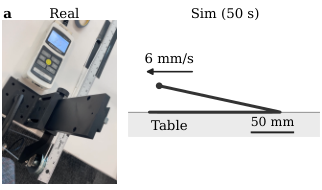
Fig. 2: Peel-force calibration and tape-handling feasibility. (a) Force-gauge measurement and simulated peel shape at 50 s; the simulated fixture gives a median reaction of 2.54 N at $C_{n}=C_{t}=0.675$. The arrow indicates pulling direction; the simulated profile uses equal horizontal and vertical scales. (b) A 32-turn Bond-R roll dispenses tape as the collar advances. Orange/magenta/blue indicate cluster/collar/free end, and gray the hub. State bars span the same rest-material interval; black markers track one material row. Roll views share a common scale. (c) Blade indentation and separation of a fixed-end strip. Black edges are fixed and gray denotes the blade. Color denotes positive maximum principal membrane tension (N/m), showing tension release after contact-pressure-triggered cutting.

Evaluation

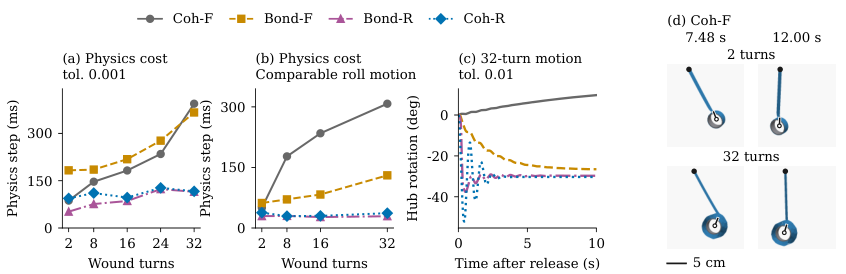
We evaluate tape handling, computational cost, and real/sim agreement through motion replay and paired policy rollouts. We also test adhesion sensitivity and demonstrate continuous teleoperated packaging. Models and shared settings. We compare Coh-F, Bond-F, Bond-R, and Coh-R. Coh/Bond selects cohesive or bond tape–tape and tape–hub interfaces; F/R selects full shells or rigid clusters.

Within each comparison, all four models share tape geometry and nonadhesive material parameters, including membrane and bending stiffness.
Evaluation — TAPESIM: Efficient Simulation of Adhesive Tape Dispensing for Robotic Manipulation
Fig. 3: Roll motion and computational cost. (a) Mean physics-step time over 1750 steps at Newton tolerance $10^{-3}$ m/s, excluding cluster updates and rendering. (b) Mean physics-step time for comparable roll motion, using tolerances selected by matching hub-rotation ranges. (c) Hub rotation after release for a 32-turn roll at $10^{-2}$ m/s, relative to the first post-release state. (d) Coh-F at 7.48 and 12 s, before and after hub release at 7.5 s. Views share time and scale; dots mark the held tip, circles the hub center, and spokes the hub orientation.

Sources and Demonstrations

Figures are reproduced from Luo et al. See the full paper for experimental details and the project page, when the paper links one, for demonstrations and videos.

Share

Related Papers

A Sim-to-Real Integration Pipeline for Training and Deployment of Chunk-Based VLA Manipulation Policies
arXiv preprint

A Sim-to-Real Integration Pipeline for Training and Deployment of Chunk-Based VLA Manipulation Policies

Mathilde Kappel, Clémence Grislain, Mohamed Chetouani et al.

Vision-Language-Action (VLA) models have become a prominent paradigm for mapping multimodal inputs, including semantic instructions, visual observations of the scene, and proprioceptive observations, to robot actions.
manipulation vision vla reinforcement-learning sim-to-real control learning-from-demonstration benchmark
PDF Advanced
Beyond Reconstruction: What Matters in Action Tokenization for Robot Policies?
arXiv preprint

Beyond Reconstruction: What Matters in Action Tokenization for Robot Policies?

Haoran Chen, Jingtian Ji, Samuel Wheeler et al.

Autoregressive action-token policies such as vision-language-action models require action tokenizers to translate discrete token sequences into precise control actions in continuous space. Many action tokenizers learn the mapping between tokens and actions via a reconstruction objective.

manipulation vision vla reinforcement-learning control benchmark
PDF Intermediate
Capability-Aware Arbitration for Semantic Intent-Based Shared Control
arXiv preprint

Capability-Aware Arbitration for Semantic Intent-Based Shared Control

Zhaoda Du, Michael Bowman, Xiaoli Zhang

Shared control often allocates robot authority based on confidence in inferred human intent, assuming reliable autonomous execution. When this assumption fails, high intent confidence can cause over-helping.
manipulation vision vla reinforcement-learning control learning-from-demonstration benchmark
Code PDF Intermediate
GitHub ★ —
DECOWAM: Decoupled Whole-Body World-Action Model for Legged Mobile Manipulation
arXiv preprint

DECOWAM: Decoupled Whole-Body World-Action Model for Legged Mobile Manipulation

Siyuan Ma, Boshi Zhang, Yutian Zhang et al.

Mobile manipulation requires a robot to predict how locomotion and arm motion jointly alter future observations and control. Existing world-action models, developed largely for fixed-base platforms, do not explicitly distinguish camera ego-motion from base and arm actions.

manipulation locomotion vision reinforcement-learning control benchmark
PDF Intermediate
