
Masked Generative Motion Planning with Geometry-Guided Token Search
Lipeng Zhuang, Yingdong Ru, Shiyu Fan, Edmond S. L. Ho, Gerardo Aragon Camarasa, Paul Henderson · N/A · 2026
Framework
N/A
License
N/A
Stars
N/A
Summary
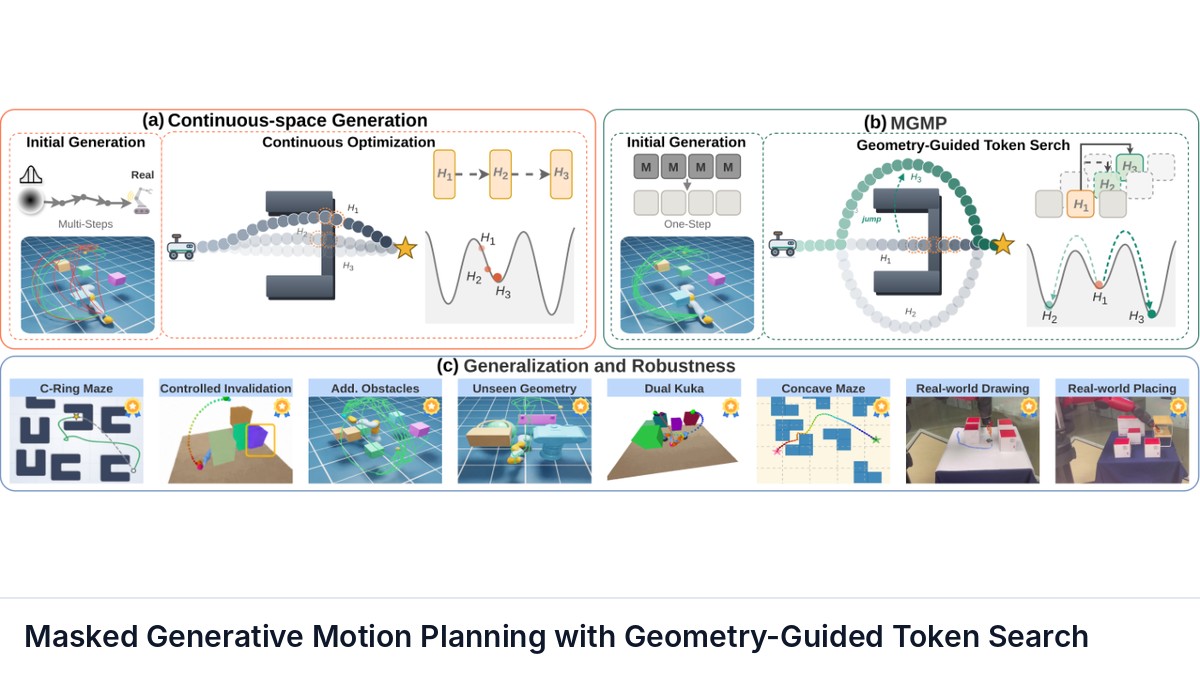
Generative motion planners typically use learned trajectory priors for initial generation, while leaving test-time repair to local continuous refinement. We introduce Masked Generative Motion Planning (MGMP), which extends the learned prior from efficient parallel generation to structural repair.
Abstract Summary
Key Points
- Generative motion planners typically use learned trajectory priors for initial generation, while leaving test-time repair to local continuous refinement.
- We introduce Masked Generative Motion Planning (MGMP), which extends the learned prior from efficient parallel generation to structural repair.
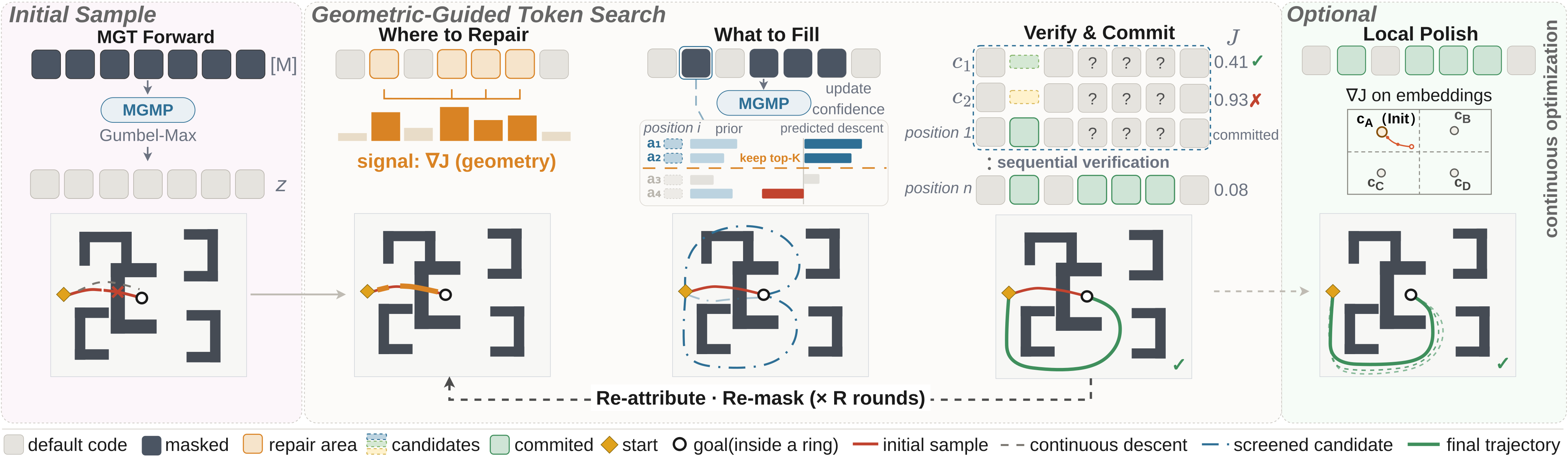
- A masked generative transformer generates discrete trajectory candidates in parallel, and Geometry-Guided Token Search (GGTS) uses scene geometry to target where to edit and which prior-supported alternatives to evaluate.
- This turns refinement into an efficient search over discrete motion alternatives, enabling route-level restructuring beyond local trajectory deformation.
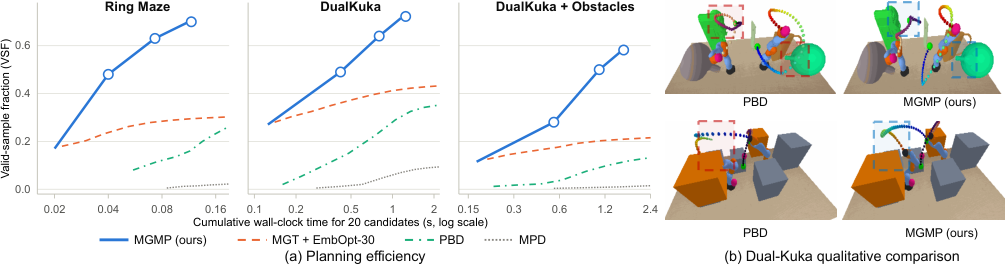
- MGMP achieves 96% success on Ring Maze and 82% repair success on Controlled Route Invalidation on Kuka, exceeding the strongest external baselines by 23 and 25 percentage points, respectively.
Methodology
We formulate motion planning as conditional trajectory generation. Given a start state $c_{s}\in\mathbb{R}^{d}$, a goal state $c_{g}\in\mathbb{R}^{d}$, and environment constraints $w$, the planner is required to generate feasible motion trajectories $\left\{x_{t}\right\}_{t=0}^{T-1}$.
Here $d$ is the dimensionality of the robot’s state space, $x_{t}$ is its configuration at frame $t$, and $T$ is the horizon of the full trajectory.
Experiments
We organize the evaluation from controlled analysis of structural repair to broader generalization and real-world execution. Ring Maze tests whether MGMP can escape local planning basins that require substantial route changes (Sec. 4.1.1 ), while Controlled Route Invalidation on Kuka isolates GGTS-based repair from initial-generation quality by initializing all methods from the same invalidated trajectory (Sec.
Sources and Demonstrations
Figures are reproduced from Zhuang et al. See the full paper for experimental details and the project page, when the paper links one, for demonstrations and videos.
Related Papers
A Browser-Native Digital Test Range for Benchmarking 4D Ocean-Glider Planning Algorithms
Edward Holmberg, Elias Ioup, Mahdi Abdelguerfi
Repeated in-situ evaluation of ocean-glider planners requires scarce vehicles, operators, deployment and recovery resources, and ocean conditions that cannot be reset for competing algorithms.
A Low-Cost, Open Platform for End-to-End Autonomous Driving on a Miniature Ackermann Vehicle
Gustavo Claudio Karl Couto, Eric Aislan Antonelo, Gabriel George Zipperer
This paper presents a low-cost, open experimental platform for research in end-to-end autonomous driving with miniature Ackermann vehicles.
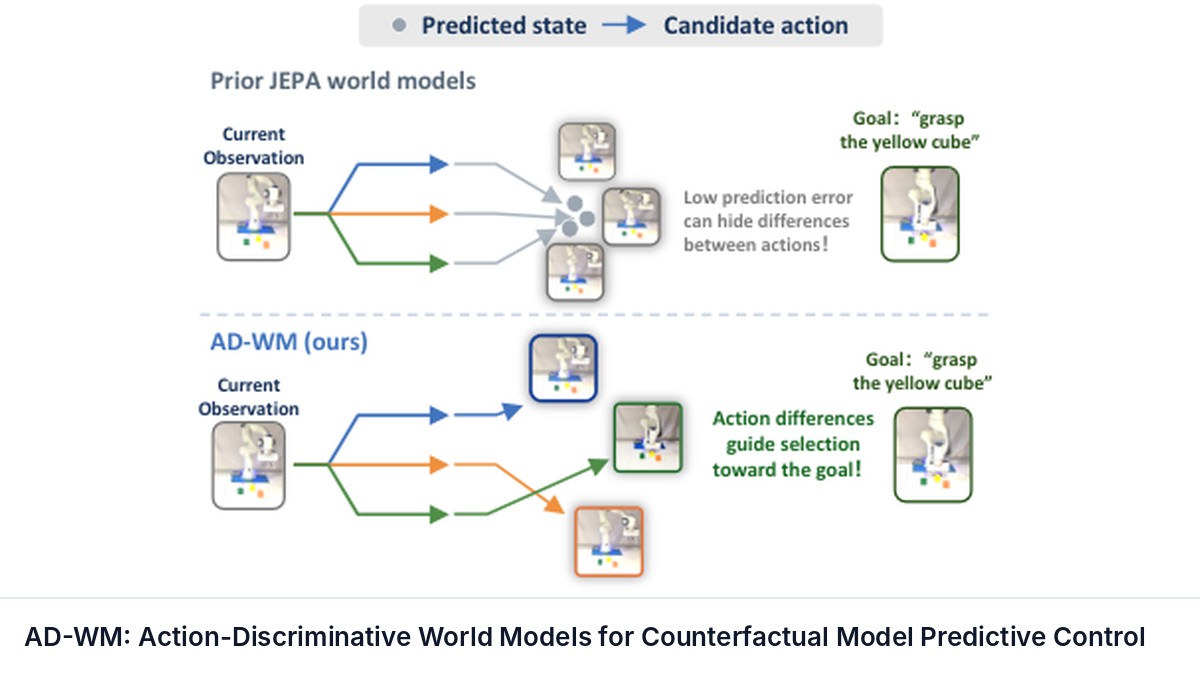
AD-WM: Action-Discriminative World Models for Counterfactual Model Predictive Control
Jiabin Qiu, Zixuan Chen, Hongye Cao et al.
Latent world models are typically trained to predict factual transitions, whereas model predictive control (MPC) must compare alternative actions from the same state. A model can therefore achieve low factual prediction error yet poorly distinguish candidate actions.
AHEAD: Anticipatory Hand-Driven Teleoperation via Human Intent Prediction
Seok Joon Kim, Junho Lee, Federica Spinola et al.
Direct hand-driven teleoperation maps an operator's hand motion to robot end-effector commands at every frame, enabling precise control, but it requires constant monitoring and correction during approach, grasp, and placement, which can be slow and fatiguing.