
FA-RDP: A Frequency-Adaptive Reactive Diffusion Policy for Contact-Rich Manipulation
Lifeng Zhuo, Wendi Chen, Han Xue, Shirun Tang, Jun Lv, Cewu Lu, Chuan Wen · N/A · 2026
Framework
N/A
License
N/A
Stars
N/A
Summary
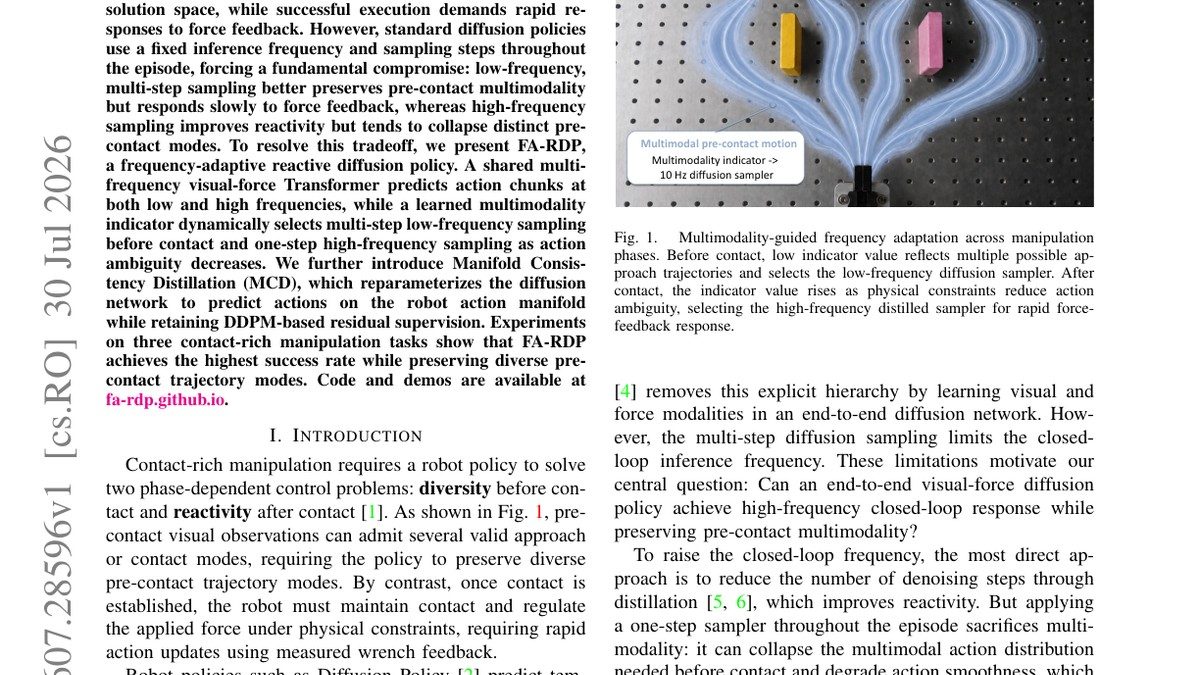
In contact-rich manipulation, action multimodality and reactivity dominate different stages of a single episode. Before contact, multiple trajectories might be equally valid, making it important to preserve diverse action modes.
Abstract Summary
Key Points
- In contact-rich manipulation, action multimodality and reactivity dominate different stages of a single episode.
- Before contact, multiple trajectories might be equally valid, making it important to preserve diverse action modes.
- After contact, geometric constraints and force limits narrow the solution space, while successful execution demands rapid responses to force feedback.
- However, standard diffusion policies use a fixed inference frequency and sampling steps throughout the episode, forcing a fundamental compromise: low-frequency, multi-step sampling better preserves pre-contact multimodality but responds slowly to force feedback, whereas high-frequency sampling improves reactivity but tends to collapse distinct pre-contact modes.
- To resolve this tradeoff, we present FA-RDP, a frequency-adaptive reactive diffusion policy
Preliminary
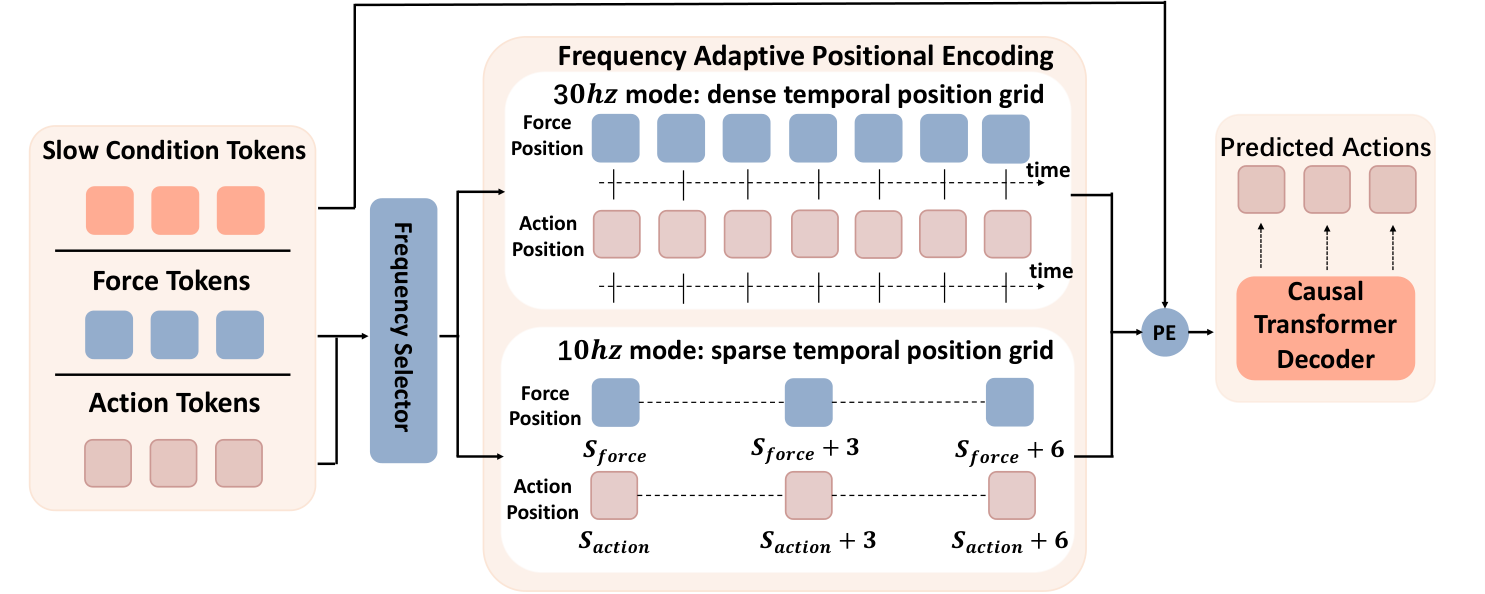
We adopt the consistent reactive diffusion inference mechanism from prior end-to-end visual-force diffusion policies [ 4 ] . This mechanism combines slow visual-proprioceptive tokens and fast force tokens in one Transformer. Its structural slow-fast learning separates observations into a slow part for visual context and a fast part for dense force feedback.
Method
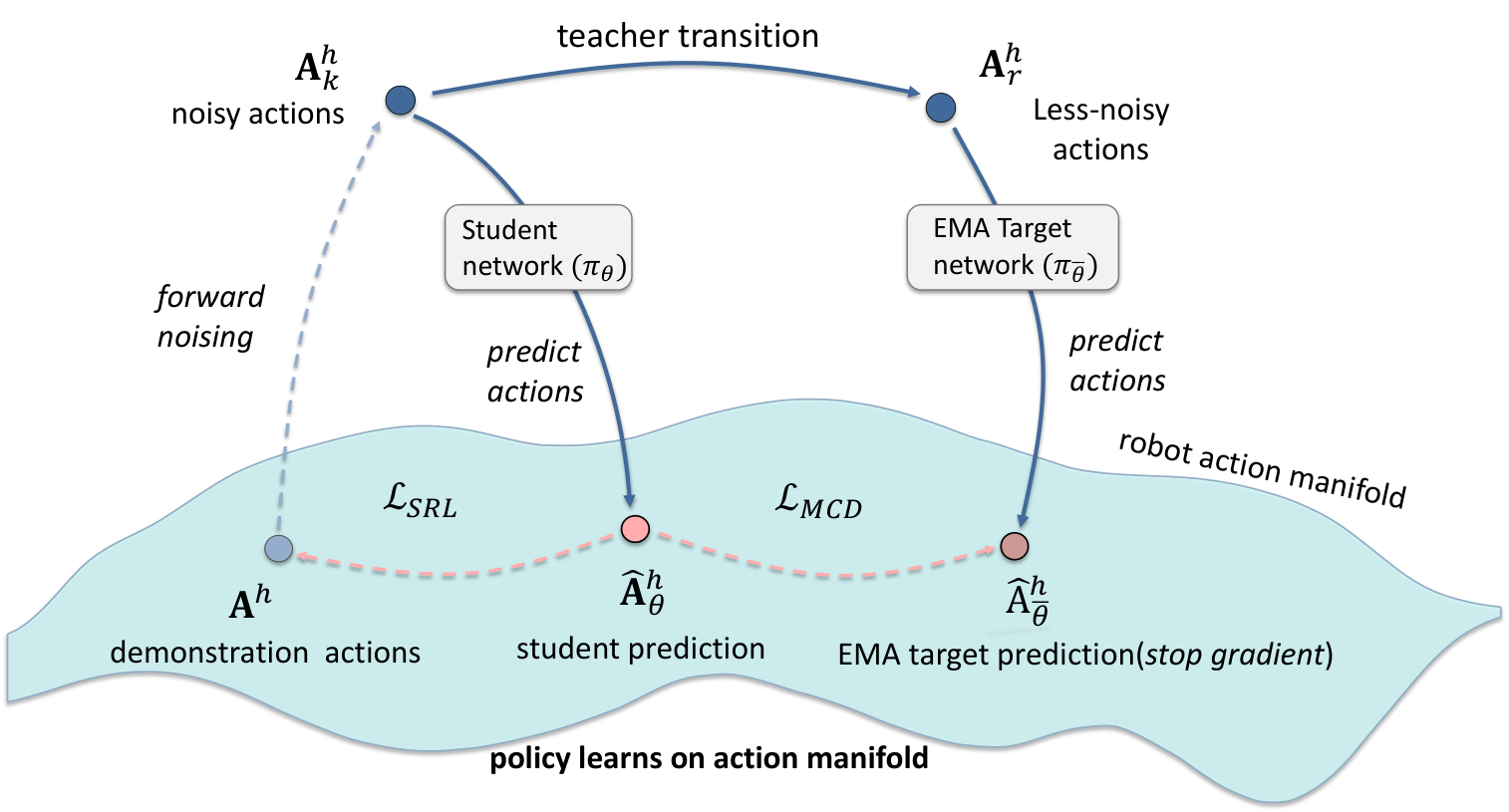
FA-RDP addresses the low force-feedback frequency of prior end-to-end policies with a multi-frequency visual-force diffusion backbone. It preserves multimodal pre-contact behavior while enabling high-frequency control through three components: a multi-frequency visual-force Transformer that supports multi-frequency action prediction (Sec.
IV-A ), multimodality-based frequency selection that chooses the appropriate sampling mode (Sec.
Experiments
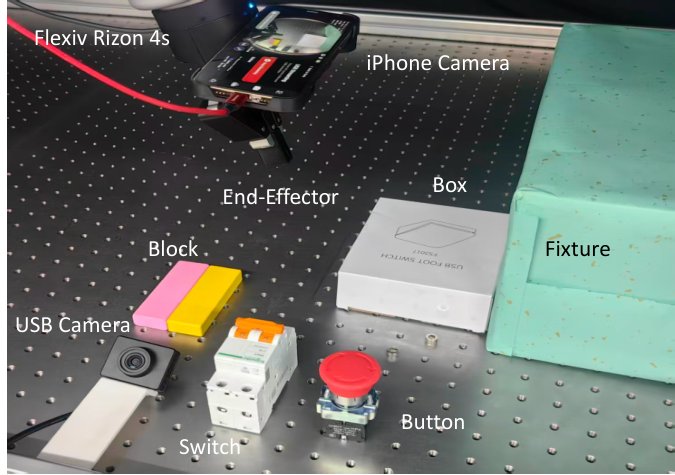
We evaluate FA-RDP on three real-world contact-rich manipulation tasks to answer four key questions: Q1: How does FA-RDP compare against visual-only diffusion policy, hierarchical visual-force policy, fixed-frequency end-to-end visual-force policy, and a non-diffusion regression baseline? Q2: Does FA-RDP preserve multimodal ability?
Q3: Does the multimodality indicator improve performance by switching between frequency modes? Q4: Does our distillation perform better than other distillation methods? Our hardware setup uses a Flexiv Rizon 4R lead...
Sources and Demonstrations
Figures are reproduced from Zhuo et al. See the full paper for experimental details and the project page, when the paper links one, for demonstrations and videos.
Related Papers
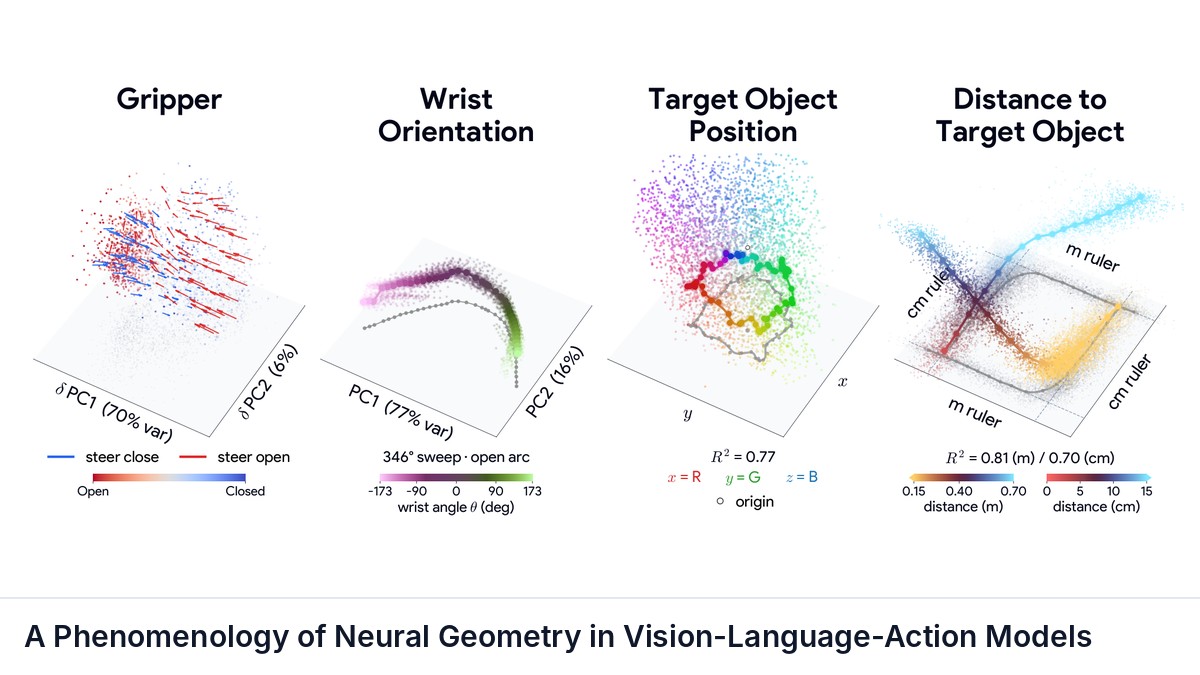
A Phenomenology of Neural Geometry in Vision-Language-Action Models
Mozes Jacobs, Aiden Swann, Mathilde Papillon et al.
Robotic manipulation is inherently geometric, but what shape does the world take inside the policy that performs it?

A Sim-to-Real Integration Pipeline for Training and Deployment of Chunk-Based VLA Manipulation Policies
Mathilde Kappel, Clémence Grislain, Mohamed Chetouani et al.
Vision-Language-Action (VLA) models have become a prominent paradigm for mapping multimodal inputs, including semantic instructions, visual observations of the scene, and proprioceptive observations, to robot actions.
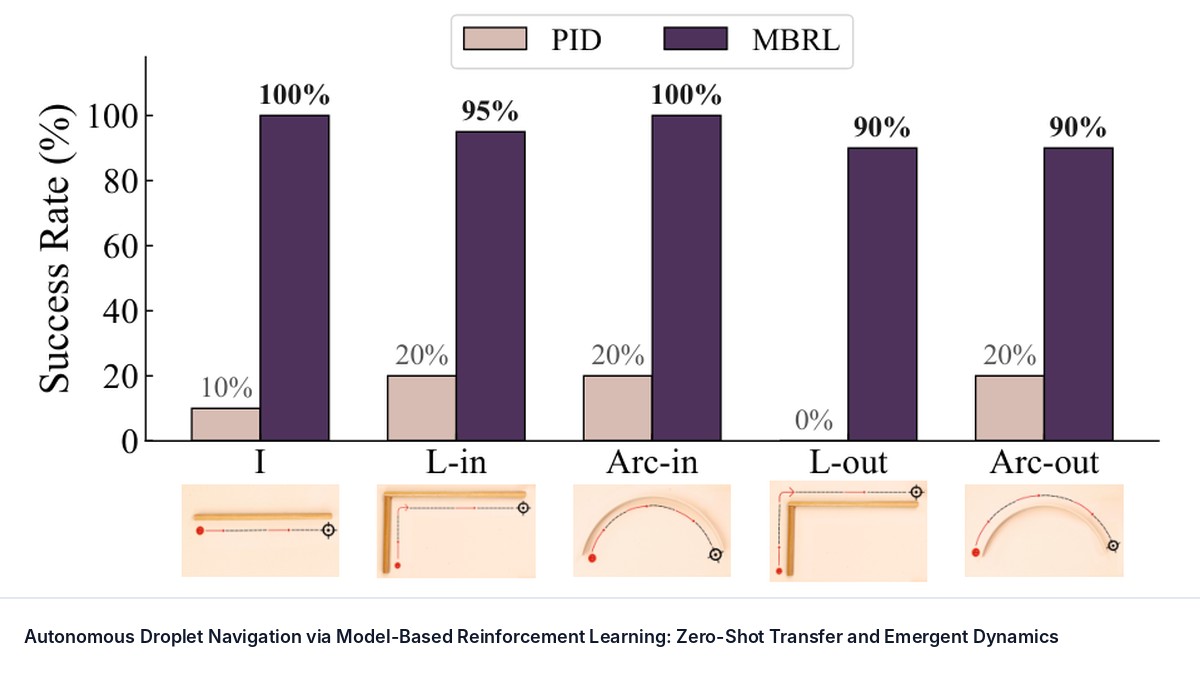
Autonomous Droplet Navigation via Model-Based Reinforcement Learning: Zero-Shot Transfer and Emergent Dynamics
Rajneesh Anand, Mayuresh V. Kothare
Self-driving laboratories (SDLs) are transforming chemical and materials discovery through closed-loop automation, yet automated infrastructure for physical manipulation of soft, deformable matter remains beyond current robotic platforms.
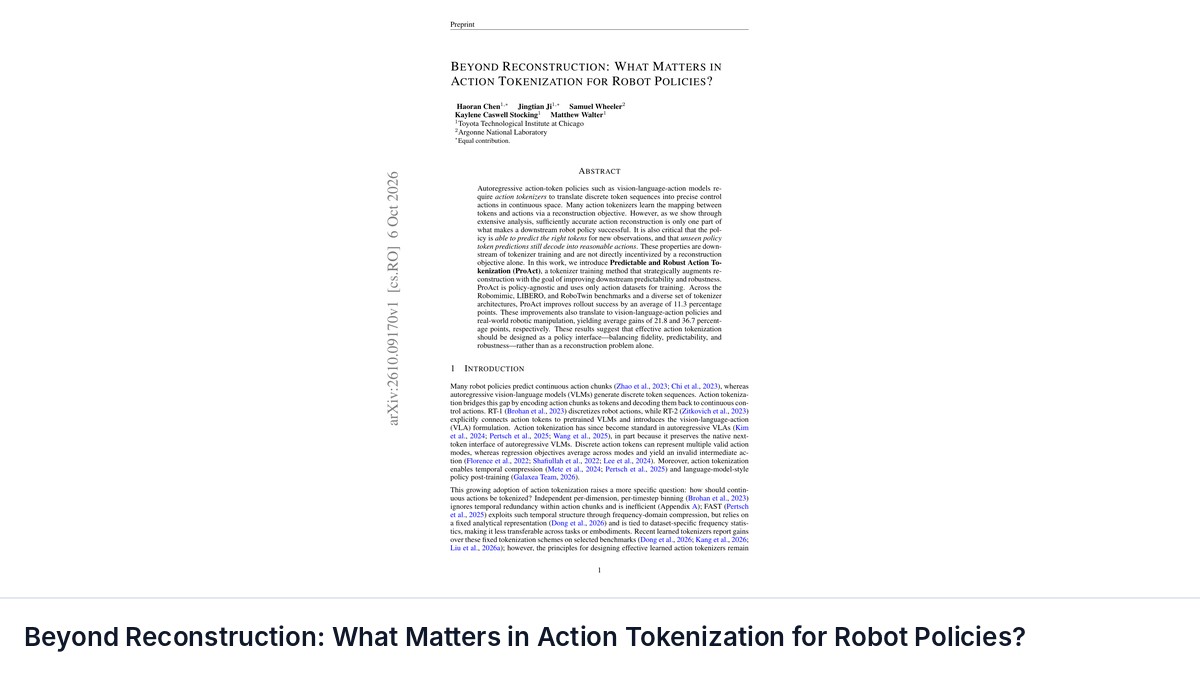
Beyond Reconstruction: What Matters in Action Tokenization for Robot Policies?
Haoran Chen, Jingtian Ji, Samuel Wheeler et al.
Autoregressive action-token policies such as vision-language-action models require action tokenizers to translate discrete token sequences into precise control actions in continuous space. Many action tokenizers learn the mapping between tokens and actions via a reconstruction objective.