
Mothership: A Two Tier Autonomous Refuse Collection System for Pedestrian Campuses
Wei Wang (Robostreet research team. Cambridge, MA, USA), Yiru Veronika Wang (Robostreet research team. Cambridge, MA, USA), Yihan Wang (Robostreet research team. Cambridge, MA, USA), Zihao Li (Robostreet research team. Cambridge, MA, USA), Xiaohui Liang (Robostreet research team. Cambridge, MA, USA) · N/A · 2026
Framework
N/A
License
N/A
Stars
N/A
Summary
Refuse collection in pedestrian campuses, parks and mixed-use districts remains manual because compaction trucks cannot reach bins located on walkways, courtyards and building service doors.
Abstract Summary
Key Points
- Refuse collection in pedestrian campuses, parks and mixed-use districts remains manual because compaction trucks cannot reach bins located on walkways, courtyards and building service doors.
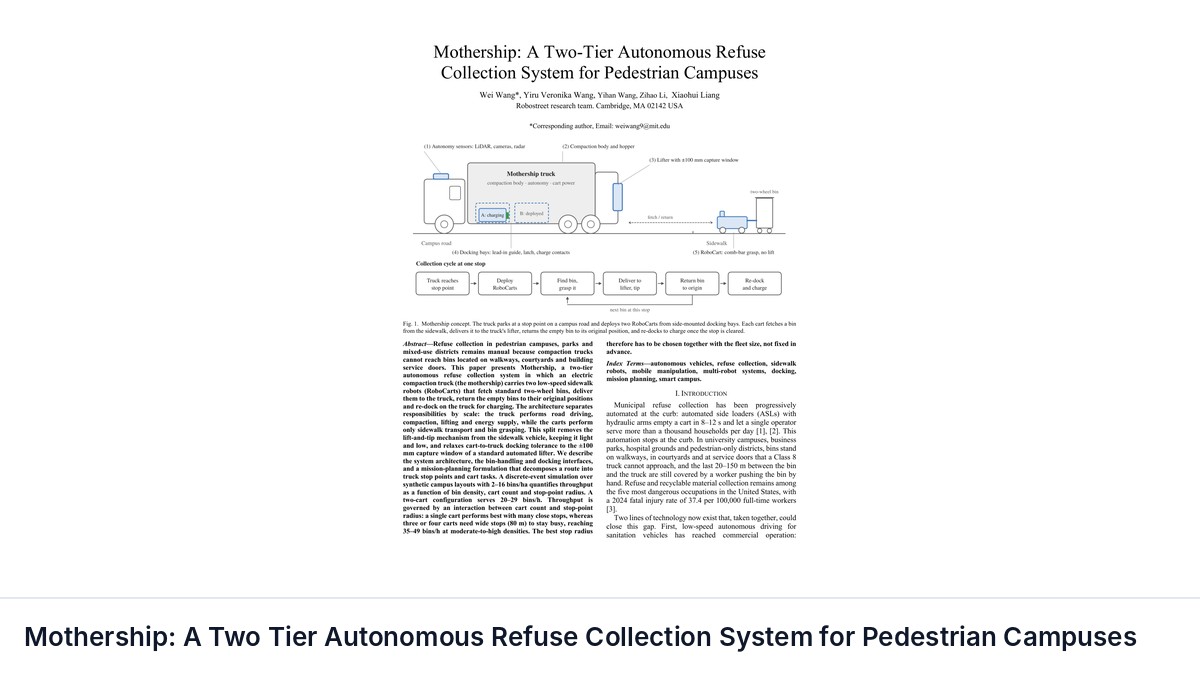
- This paper presents Mothership, a two-tier autonomous refuse collection system in which an electric compaction truck (the mothership) carries two low-speed sidewalk robots (RoboCarts) that fetch standard two-wheel bins, deliver them to the truck, return the empty bins to their original positions and re-dock on the truck for charging.
- The architecture separates responsibilities by scale: the truck performs road driving, compaction, lifting and energy supply, while the carts perform only sidewalk transport and bin grasping.
- This split removes the lift-and-tip mechanism from the sidewalk vehicle, keeping it light and low, and relaxes cart-to-truck docking tolerance to the +/-100 mm capture window of a standard automated lifter.
- We describe the system architecture, the bin-handling and docking interfaces, and a mission-planning formulation that decomposes a route into truck stop points and cart tasks.
Mothership: A Two Tier Autonomous Refuse Collection System for Pedestrian Campuses
|Authors: Wei Wang (Robostreet research team. Cambridge, MA, USA), Yiru Veronika Wang (Robostreet research team. Cambridge, MA, USA), Yihan Wang (Robostreet research team. Cambridge, MA, USA), Zihao Li (Robostreet research team. Cambridge, MA, USA), Xiaohui Liang (Robostreet research team. Cambridge, MA, USA)
|Venue: arXiv preprint | Year: 2026
|arXiv: 2610.22461
Abstract
Refuse collection in pedestrian campuses, parks and mixed-use districts remains manual because compaction trucks cannot reach bins located on walkways, courtyards and building service doors. This paper presents Mothership, a two-tier autonomous refuse collection system in which an electric compaction truck (the mothership) carries two low-speed sidewalk robots (RoboCarts) that fetch standard two-wheel bins, deliver them to the truck, return the empty bins to their original positions and re-dock on the truck for charging. The architecture separates responsibilities by scale: the truck performs road driving, compaction, lifting and energy supply, while the carts perform only sidewalk transport and bin grasping. This split removes the lift-and-tip mechanism from the sidewalk vehicle, keeping it light and low, and relaxes cart-to-truck docking tolerance to the +/-100 mm capture window of a standard automated lifter. We describe the system architecture, the bin-handling and docking interfaces, and a mission-planning formulation that decomposes a route into truck stop points and cart tasks. A discrete-event simulation over synthetic campus layouts with 2-16 bins/ha quantifies throughput as a function of bin density, cart count and stop-point radius. A two-cart configuration serves 20-29 bins/h. Throughput is governed by an interaction between cart count and stop-point radius: a single cart performs best with many close stops, whereas three or four carts need wide stops (80 m) to stay busy, reaching 35-49 bins/h at moderate-to-high densities. The best stop radius therefore has to be chosen together with the fleet size, not fixed in advance.
Key Contributions
- Refuse collection in pedestrian campuses, parks and mixed-use districts remains manual because co…
- This paper presents Mothership, a two-tier autonomous refuse collection system in which an electr…
- The architecture separates responsibilities by scale: the truck performs road driving, compaction…
- This split removes the lift-and-tip mechanism from the sidewalk vehicle, keeping it light and low…
- We describe the system architecture, the bin-handling and docking interfaces, and a mission-plann…
Topics
- manipulation
- planning
Code & Data
No code repository linked in paper metadata.
BibTeX
@article{Cambridge2026_261022461,
  title     = {Mothership: A Two Tier Autonomous Refuse Collection System for Pedestrian Campuses},
  author    = {Wei Wang (Robostreet research team. Cambridge and MA and USA) and Yiru Veronika Wang (Robostreet research team. Cambridge and MA and USA) and Yihan Wang (Robostreet research team. Cambridge and MA and USA) and Zihao Li (Robostreet research team. Cambridge and MA and USA) and Xiaohui Liang (Robostreet research team. Cambridge and MA and USA)},
  year      = {2026},
  eprint    = {2610.22461},
  archivePrefix = {arXiv},
  primaryClass  = {cs.RO},
  url       = {https://arxiv.org/abs/2610.22461}
}
Related Papers
A Physics-Informed Collision Learning Framework for Collaborative Robot Motion Generation
Chen Cai, Steven Liu
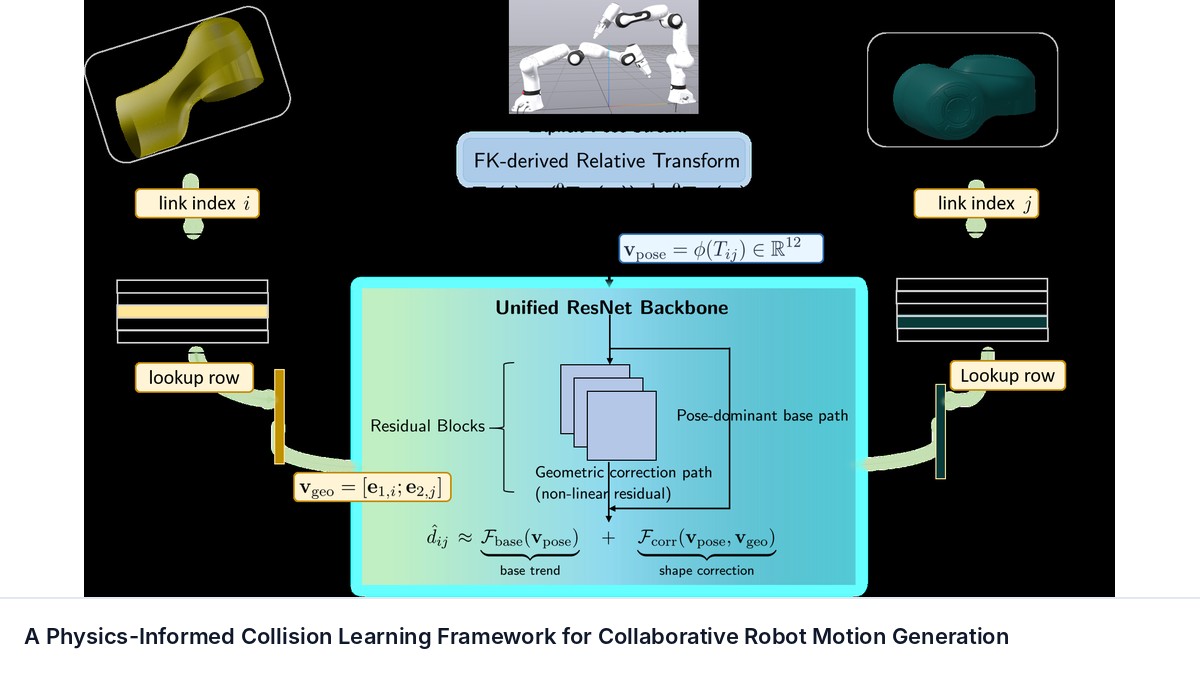
Close-proximity multi-arm manipulation requires collision models that are both geometrically accurate and differentiable enough for real-time optimization.
AD-WM: Action-Discriminative World Models for Counterfactual Model Predictive Control
Jiabin Qiu, Zixuan Chen, Hongye Cao et al.
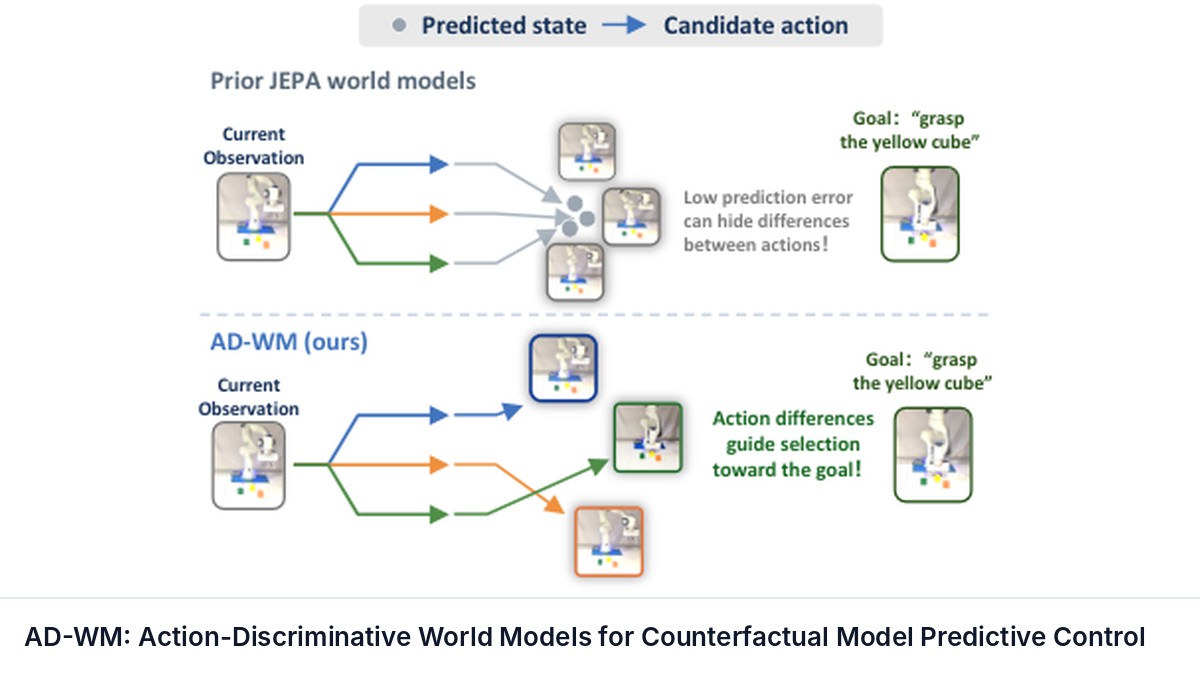
Latent world models are typically trained to predict factual transitions, whereas model predictive control (MPC) must compare alternative actions from the same state. A model can therefore achieve low factual prediction error yet poorly distinguish candidate actions.
AHEAD: Anticipatory Hand-Driven Teleoperation via Human Intent Prediction
Seok Joon Kim, Junho Lee, Federica Spinola et al.
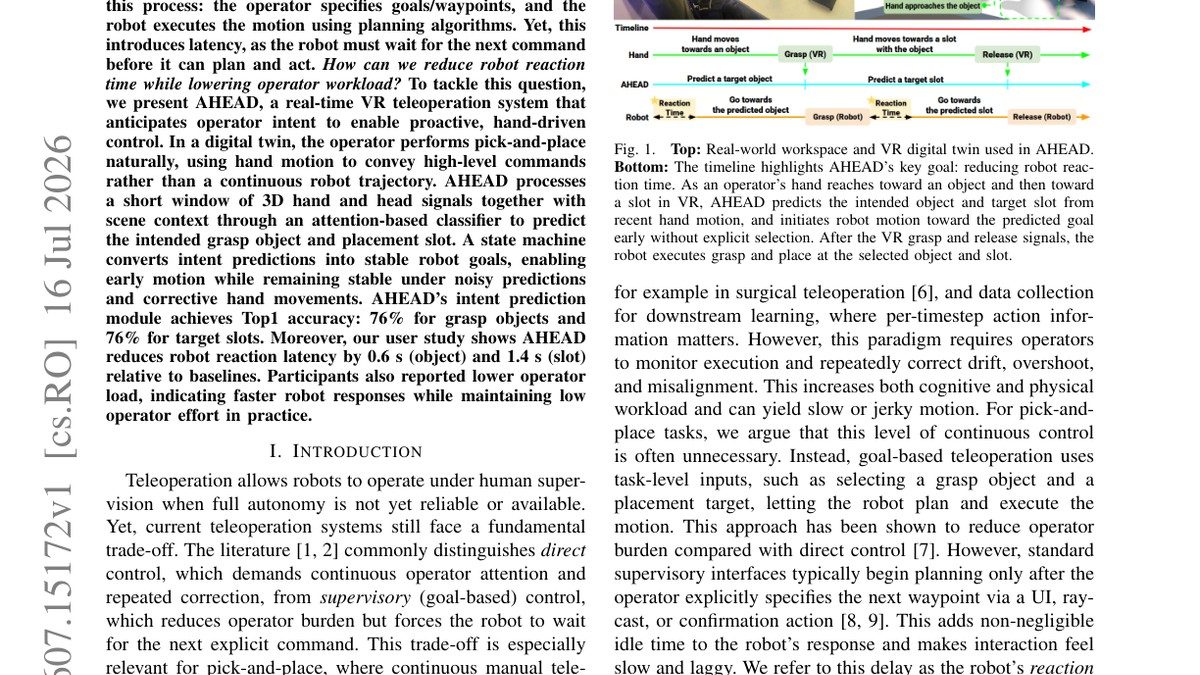
Direct hand-driven teleoperation maps an operator's hand motion to robot end-effector commands at every frame, enabling precise control, but it requires constant monitoring and correction during approach, grasp, and placement, which can be slow and fatiguing.
Autonomous Droplet Navigation via Model-Based Reinforcement Learning: Zero-Shot Transfer and Emergent Dynamics
Rajneesh Anand, Mayuresh V. Kothare
Self-driving laboratories (SDLs) are transforming chemical and materials discovery through closed-loop automation, yet automated infrastructure for physical manipulation of soft, deformable matter remains beyond current robotic platforms.