
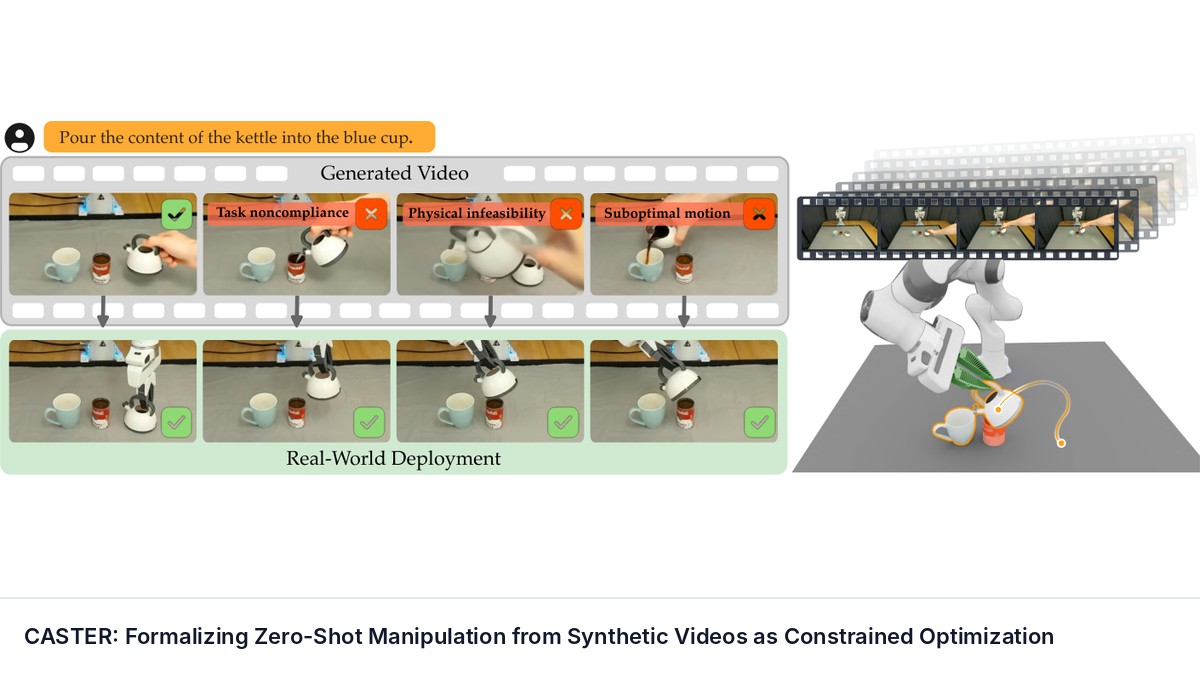
CASTER: Formalizing Zero-Shot Manipulation from Synthetic Videos as Constrained Optimization
Yinlong Dai, Homanga Bharadhwaj, Dylan P. Losey · N/A · 2026
Framework
N/A
License
N/A
Stars
N/A
Summary
Prior research on learning from humans often requires real human demonstrations. But advances in video generation models offer a new paradigm: we can now prompt these generators to make synthetic videos of the task.
Abstract Summary
Key Points
- Prior research on learning from humans often requires real human demonstrations
- But advances in video generation models offer a new paradigm: we can now prompt these generators to make synthetic videos of the task.
- On the plus side, these synthetic videos take place in the robot's current environment, and do not require actual human teaching.
- However, while the generated videos appear to show plausible motions, they lack both physical consistency and robot grounding, and thus the robot cannot directly roll out the trajectory shown by the video.
- In this paper we seek to formalize the process of going from synthetic video generation to real-world robot trajectories for zero-shot manipulation tasks.
Problem Statement
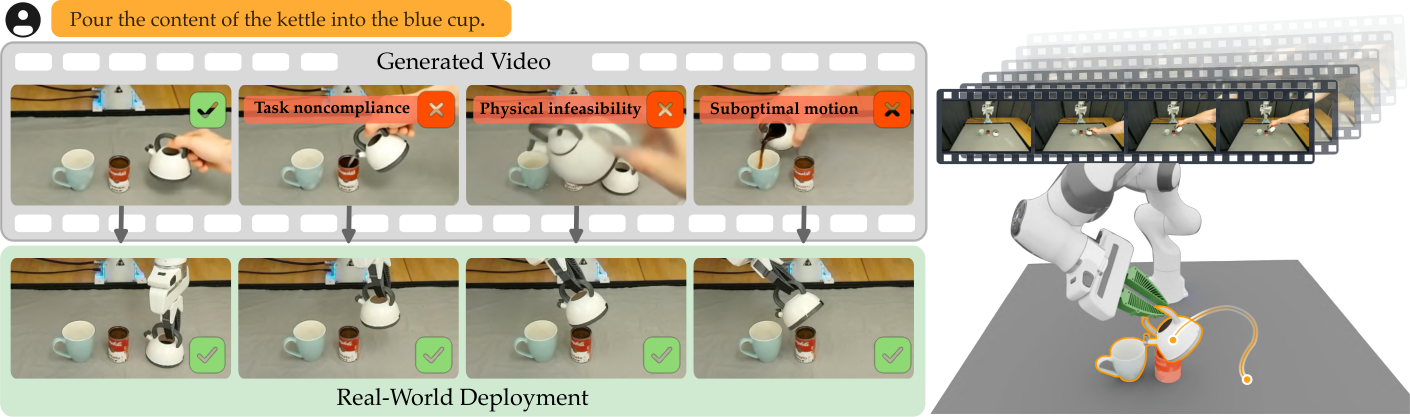
We consider the setting of zero-shot tabletop robot manipulation. An example of this setting is shown in Figure 1 . The robot is given a natural-language task description $\tau$ and an initial visual observation $o$ of a scene containing $M$ objects.
The setting is zero-shot in the sense that the robot must execute the task within a finite horizon without access to task-specific robot demonstrations (i.e., teleoperation) or any additional real-world interaction. Trajectories.
Introducing a Unified Formalism
Generated videos provide insights into the correct behavior through their visual content, but these videos do not directly provide executable robot actions. Prior work has explored several approaches for zero-shot robot manipulation based on synthetic video generation. Rather than starting with another solution, we begin by focusing on the underlying problem .
More specifically, we formulate leveraging synthetic videos as constrained optimization.
Approximating the Underlying Solution
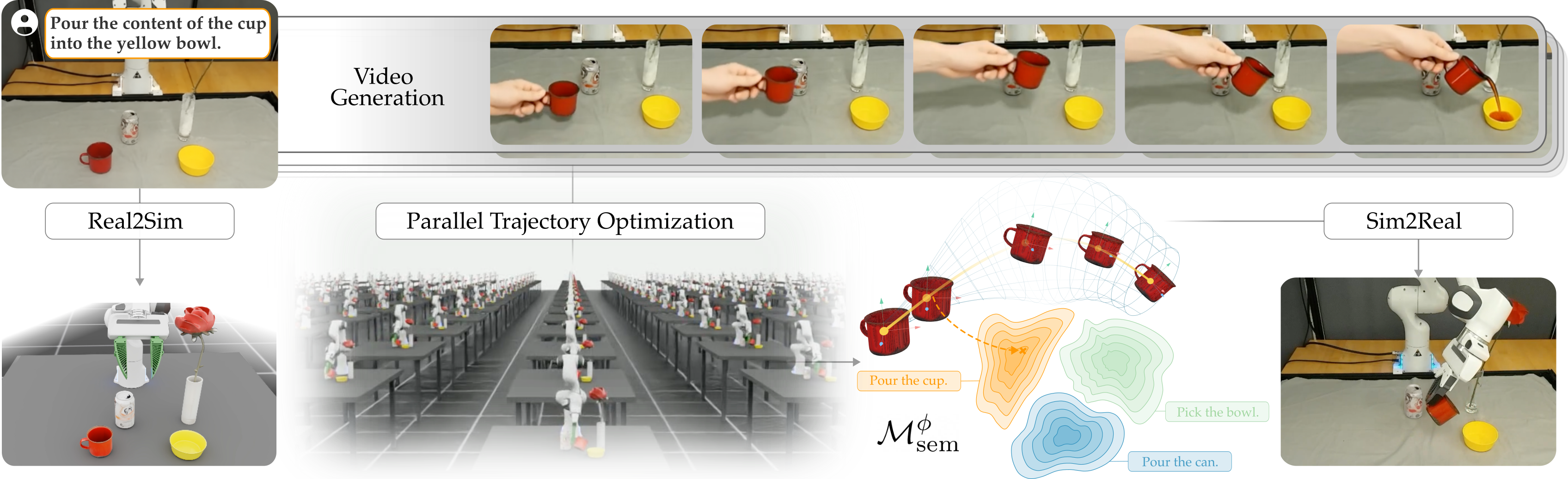
In Section IV we present zero-shot manipulation from synthetic videos as a constrained optimization problem. While current methods introduce simplifications, in this section we present CASTER (Figure 2 ), an approach that more closely follows Equation ( 4 ). Practically, this leads to two distinctions from previous work.
First, instead of optimizing to exactly follow the object’s video trajectory, we preserve task features $\phi$.
Experiments
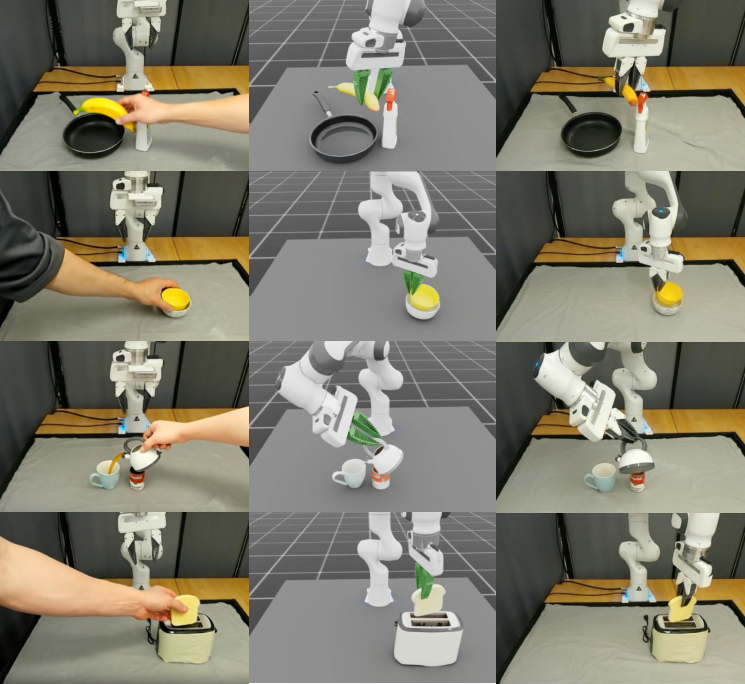
We conduct real-world experiments to evaluate the effectiveness of our unified framework. Within these experiments the robot is expected to perform the 12 tasks from Table I on its first attempt, without any real-world demonstrations or additional interactions. To find the correct trajectory the robot uses synthetically generated videos of the human performing the task. Examples of these videos are shown in Figure 3 .
Sources and Demonstrations
Figures are reproduced from Dai et al. See the full paper for experimental details and the project page, when the paper links one, for demonstrations and videos.
Related Papers
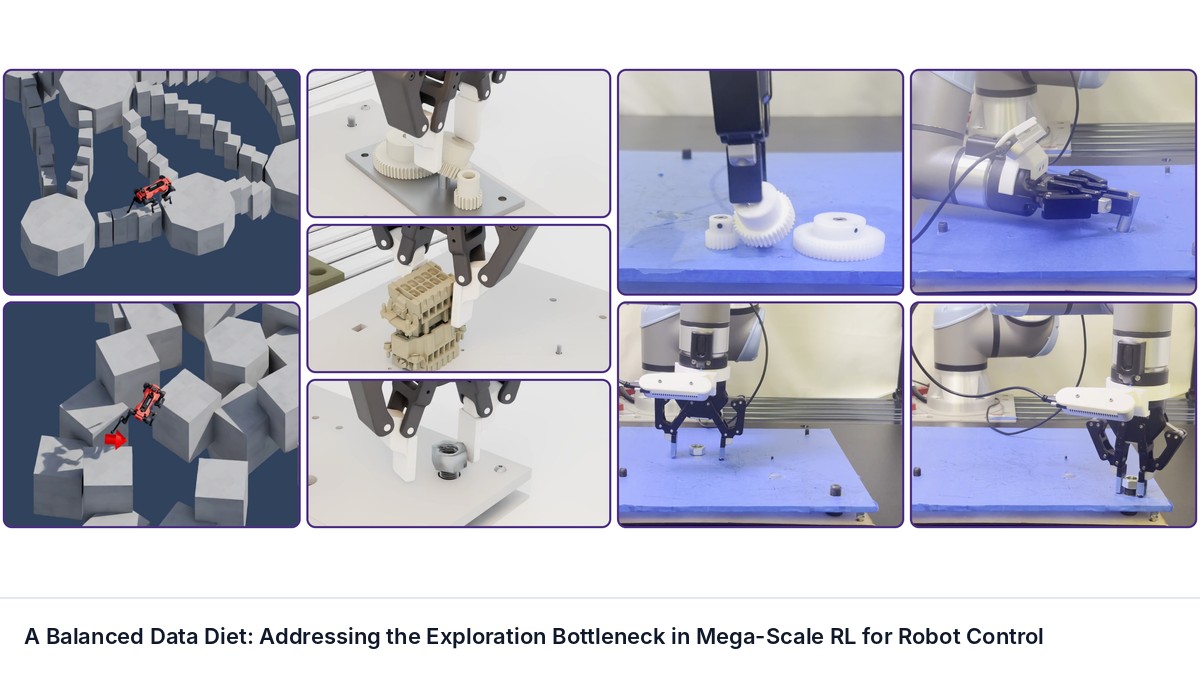
A Balanced Data Diet: Addressing the Exploration Bottleneck in Mega-Scale RL for Robot Control
Octi Zhang, Mateo Guaman Castro, Patrick Yin et al.
General-purpose robots must perform a wide range of tasks from agile locomotion to dexterous manipulation.

A Sim-to-Real Integration Pipeline for Training and Deployment of Chunk-Based VLA Manipulation Policies
Mathilde Kappel, Clémence Grislain, Mohamed Chetouani et al.
Vision-Language-Action (VLA) models have become a prominent paradigm for mapping multimodal inputs, including semantic instructions, visual observations of the scene, and proprioceptive observations, to robot actions.
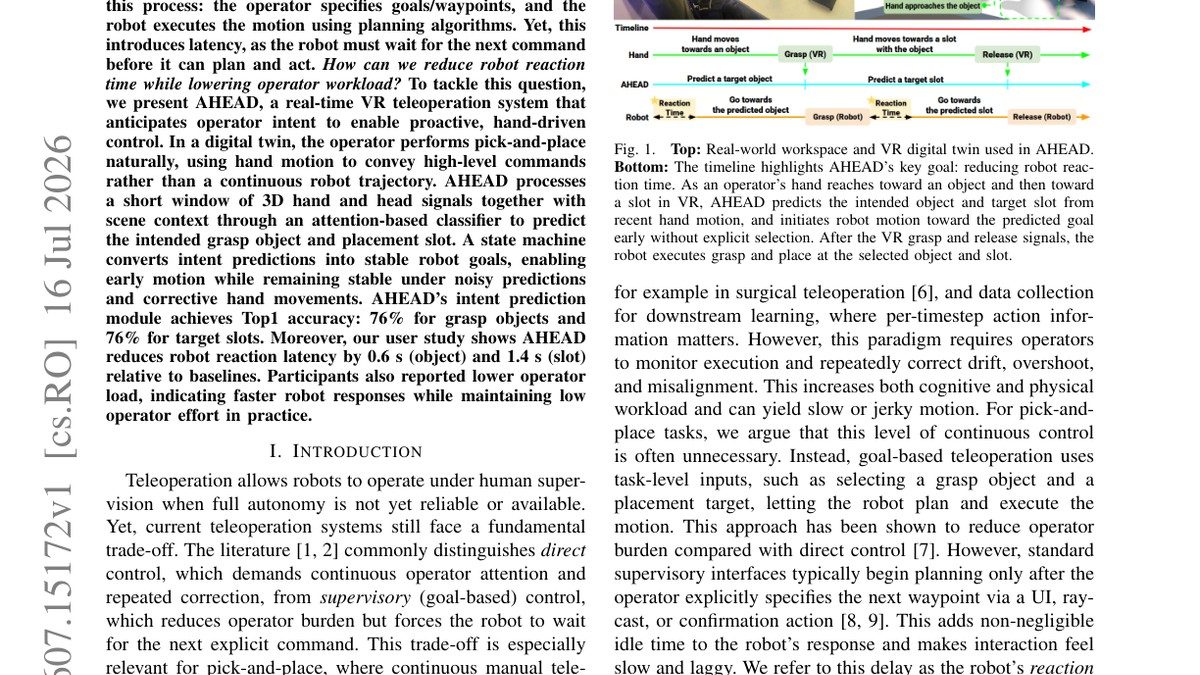
AHEAD: Anticipatory Hand-Driven Teleoperation via Human Intent Prediction
Seok Joon Kim, Junho Lee, Federica Spinola et al.
Direct hand-driven teleoperation maps an operator's hand motion to robot end-effector commands at every frame, enabling precise control, but it requires constant monitoring and correction during approach, grasp, and placement, which can be slow and fatiguing.
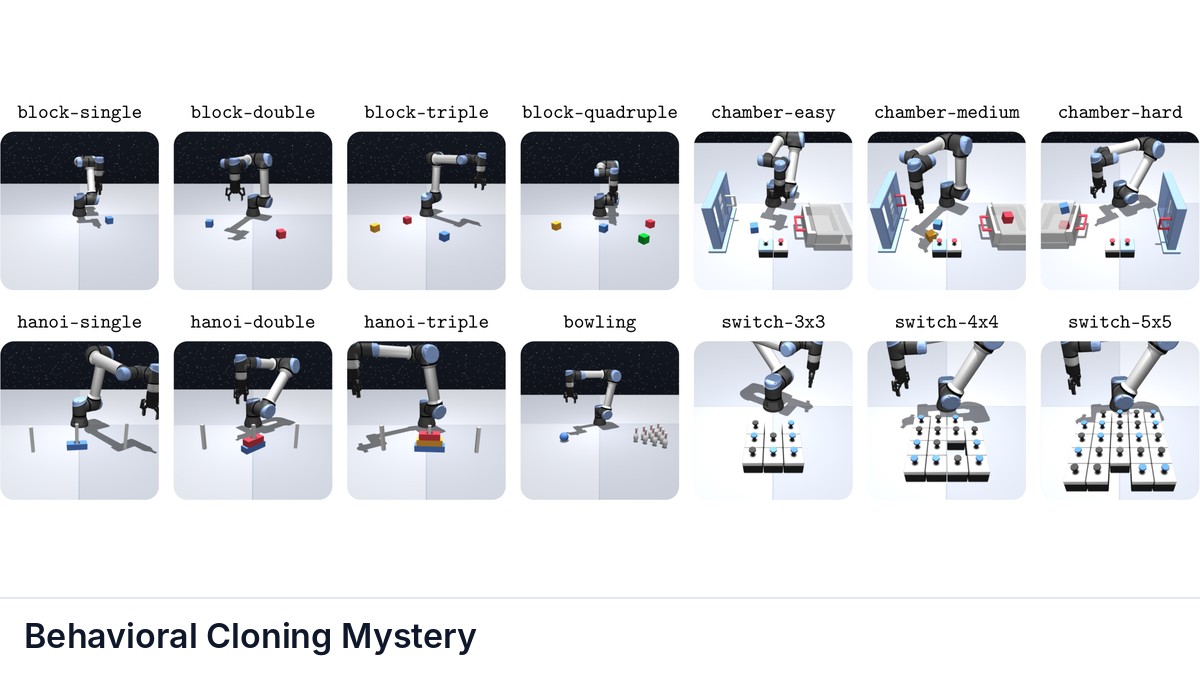
Behavioral Cloning Mystery
Seohong Park, Sergey Levine
Behavioral cloning (BC), despite its simplicity, exhibits many counterintuitive phenomena in the real world. For example, the performance of BC often keeps increasing as the model overfits more to the dataset, and fully closed-loop policies often completely fail without action chunking.