
Informationally Decoupled Trajectory Design for Sim-to-Real System Identification
Sangwoo Shin, Ashvin Anilkumar, Ryan Gao, Josiah P. Hanna · N/A · 2026
Framework
N/A
License
N/A
Stars
N/A
Summary
Sampling-based system identification estimates physically meaningful parameters by tuning a simulator to reproduce the target system dynamics, providing an interpretable approach to improving sim-to-real transfer.
Abstract Summary
Key Points
- Sampling-based system identification estimates physically meaningful parameters by tuning a simulator to reproduce the target system dynamics, providing an interpretable approach to improving sim-to-real transfer.
- Yet when the collected trajectories do not distinguish the effects of different parameters, multiple parameter combinations can reproduce those trajectories, leading to unreliable parameter estimates.
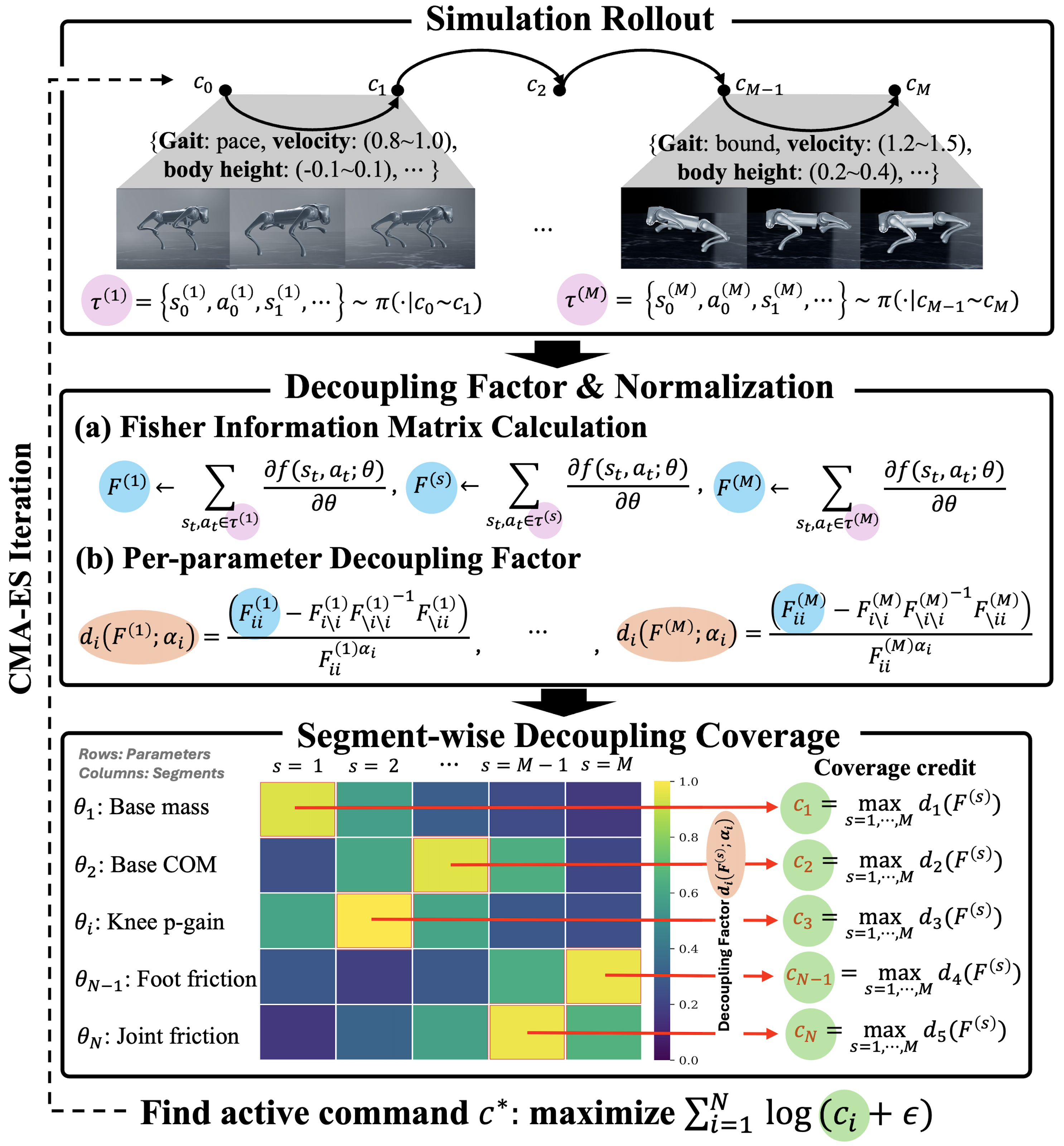
- To address this challenge, we introduce an Informationally Decoupled Trajectory Design framework (IDTD), which formulates the objective for the exploration policy built on the Schur complement score derived from the Fisher information matrix.
- To faithfully reflect parameter separability in the exploration objective, IDTD normalizes the score against the per-parameter information, selects the most favorable trajectory segment for each parameter, and aggregates the resulting scores logarithmically.
- The optimized trajectory is therefore composed of complementary intervals, each exposing a distinct subset of parameters whose contribution to the motion over that interval can be attributed unambiguously.
Preliminaries
Let $\theta\in\mathbb{R}^{N}$ denote the vector of parameters to identify (e.g., base inertial properties, per-joint PD gains, and friction coefficients), and let $\pi$ be a policy pretrained in simulation, conditioned on a command $c_{t}$ (e.g., base velocity and gait parameters).
A dataset $\mathcal{D}=\{\tau=(s_{0},a_{0},s_{1},\cdots)\}$ of trajectories is collected on the target system by rolling out $\pi$ under a command sequence $\mathbf{c}=(c_{1},\ldots,c_{T})$, recording states and executed actions.
Methods
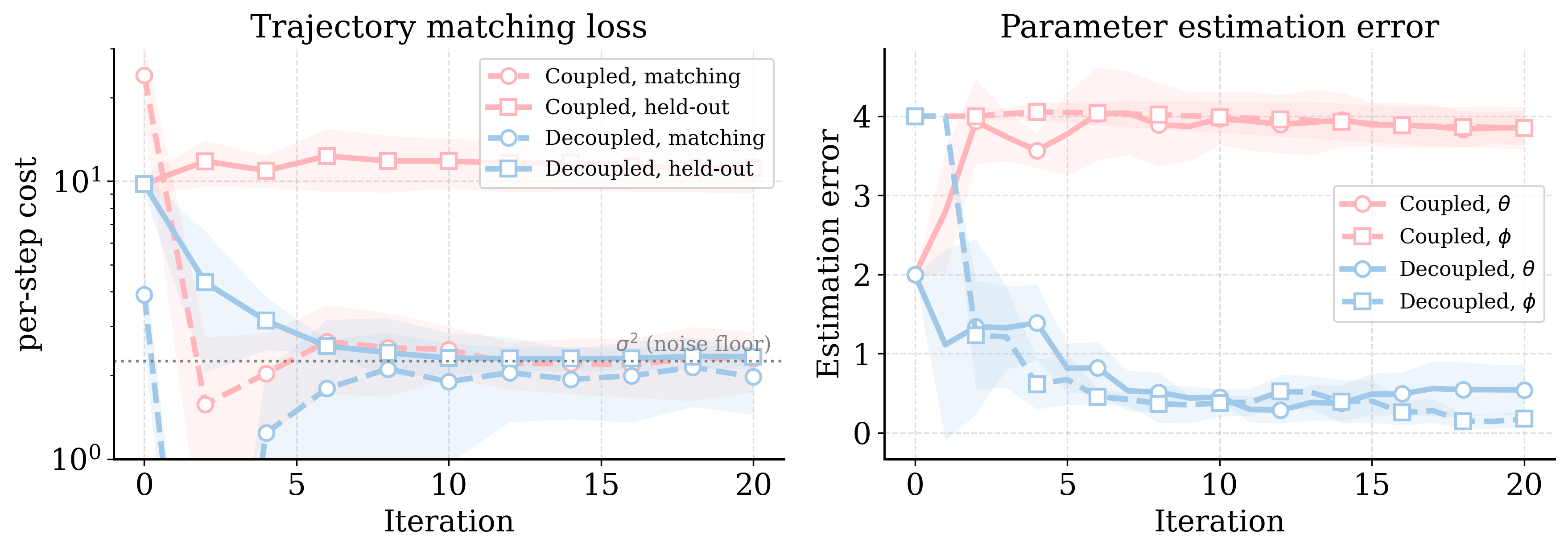
We analyze a two-parameter linear system to illustrate how parameter coupling allows estimation errors in one parameter to be absorbed by another, motivating an explicit characterization of parameter separability.
Consider a scalar state governed by a discrete-time mass-damper system, in which the control input $u_{t}$ drives the state through a compliance $\theta^{\star}$ and the velocity $\dot{x}_{t}$ resists it through a damping $\phi^{\star}$, where $w_{t}$ is i.i.d. Gaussian noise. By Eq.
Experiments
We evaluate IDTD on the linear-dynamics system, in physics-based simulation, and on a real Booster K1 robot. To validate the analysis of Sec. IV-A , we manually construct two excitation trajectories on the mass-damper system that differ in how strongly the two parameters are coupled. Specifically, we collect sequences of states $x_{t}$ and inputs $u_{t}$ following the dynamics in Eq. ( 5 ).
Sources and Demonstrations
Figures are reproduced from Shin et al. See the full paper for experimental details and the project page, when the paper links one, for demonstrations and videos.
Related Papers
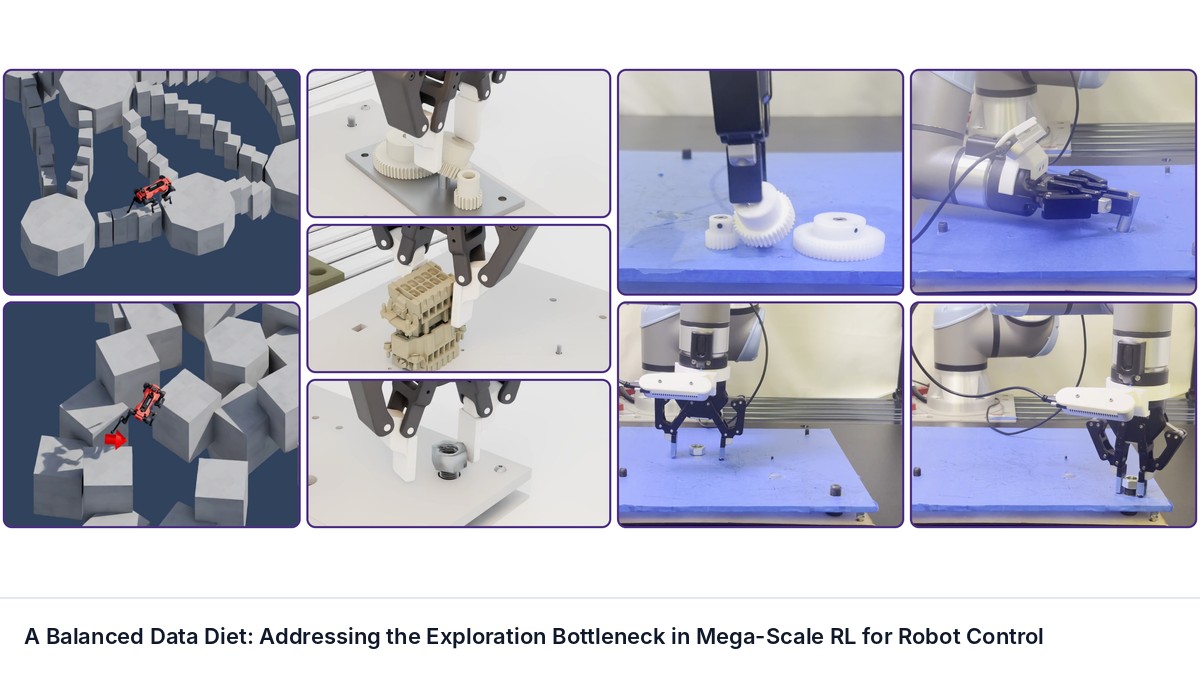
A Balanced Data Diet: Addressing the Exploration Bottleneck in Mega-Scale RL for Robot Control
Octi Zhang, Mateo Guaman Castro, Patrick Yin et al.
General-purpose robots must perform a wide range of tasks from agile locomotion to dexterous manipulation.
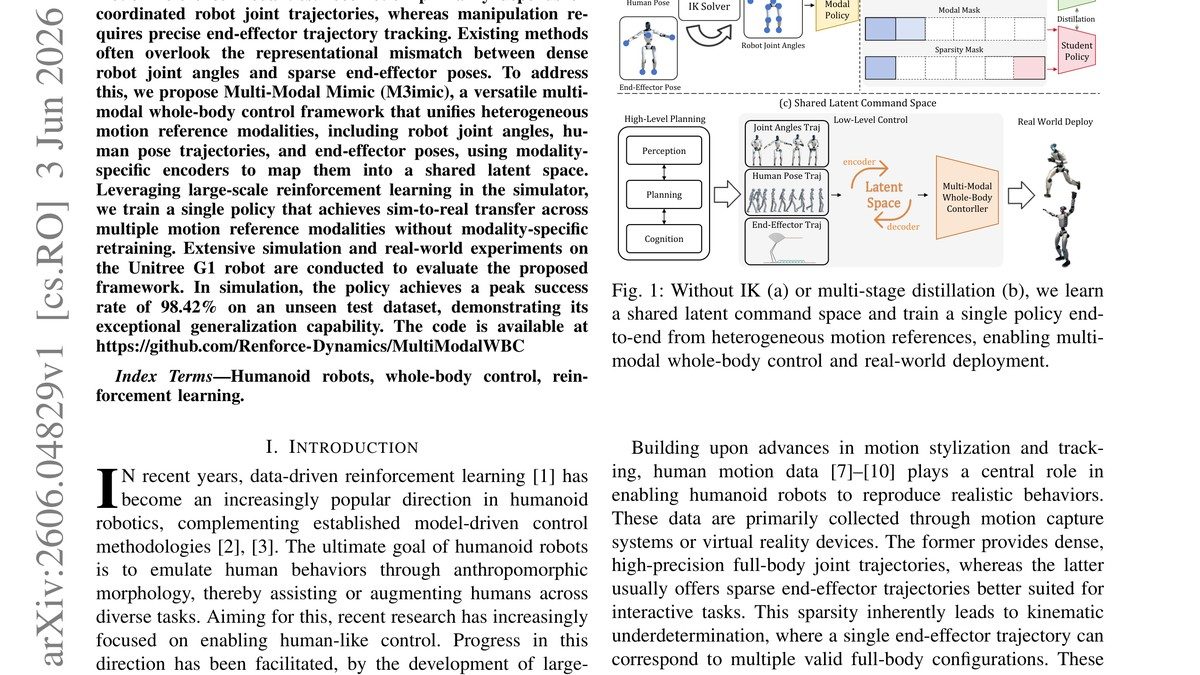
M3imic: Learning a Versatile Whole-Body Controller for Multimodal Motion Mimicking
Zuxing Lu, Ziang Zheng, Yao Lyu et al.
Building a general-purpose whole-body controller is essential for enabling diverse motion capabilities in humanoid robots across a wide range of downstream tasks, including locomotion and loco-manipulation.
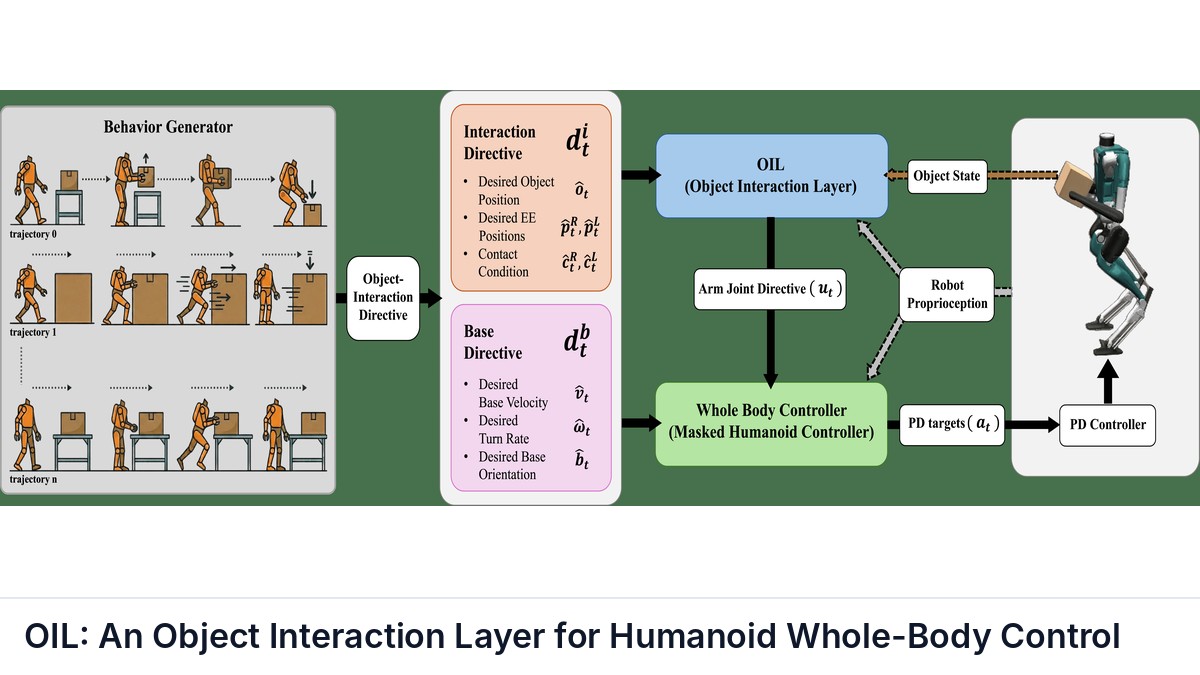
OIL: An Object Interaction Layer for Humanoid Whole-Body Control
Pranay Dugar, Mohitvishnu S. Gadde, Rajesh Mangannavar et al.
Recent progress in learned whole-body controllers for humanoid robots has enabled robust free-space motion by tracking kinematic targets such as joint or end-effector trajectories.
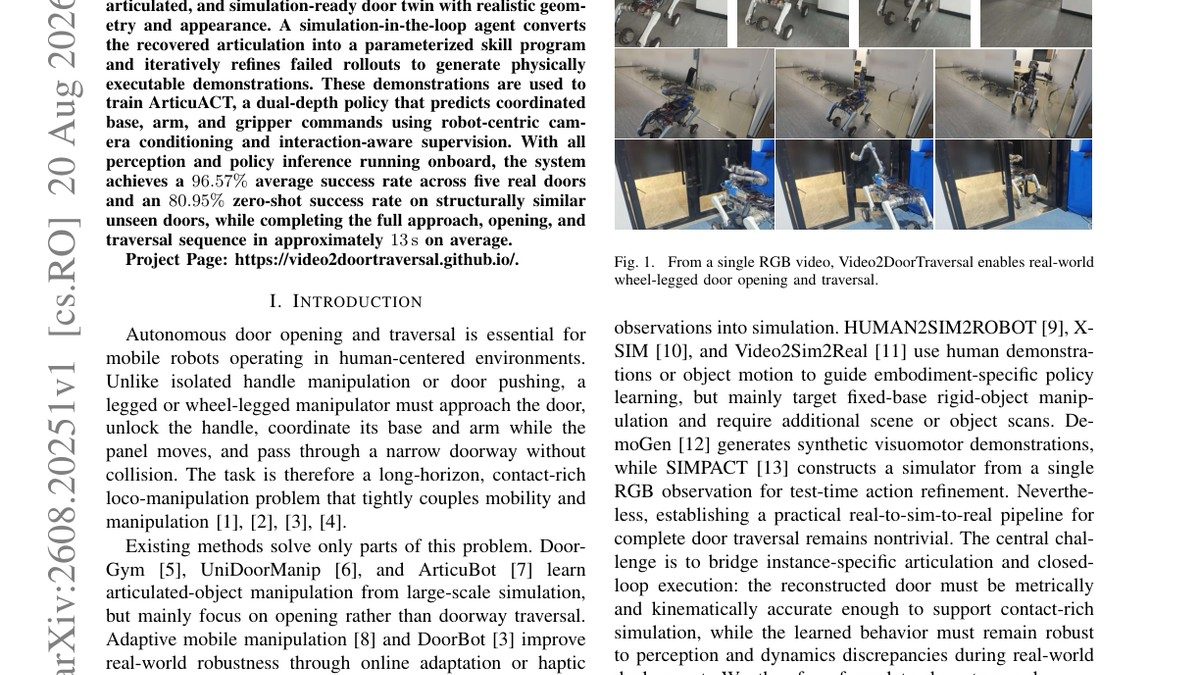
Video2DoorTraversal: Push Door Traversal via Simulated Door Twins
Xincheng Tang, Yiji Chen, Youhan Xie et al.
Door opening and traversal is a long-horizon loco-manipulation task that requires precise handle interaction and coordinated base-arm control. We present Video2DoorTraversal, a single-video real-to-sim-to-real framework for wheel-legged mobile manipulators.