

Slot-MPC: Goal-Conditioned Model Predictive Control with Object-Centric Representations
FeaturedJonathan Spieler, Angel Villar-Corrales, Sven Behnke · · 2026
Framework
N/A
License
N/A
Stars
0
Summary
Predictive world models enable agents to model scene dynamics and reason about the consequences of their actions.
Abstract Summary
Key Points
- Proposes Goal-Conditioned Model Predictive Control with Object-Centric Representations
- Uses reinforcement learning for policy optimization
- Provides open-source code or data
Slot-MPC
We propose Slot-MPC, a novel method that combines gradient-based MPC with a slot-based object-centric latent dynamics model. Figure 1 illustrates the main components of our approach, as well as its training ( Figure 1(a) ) and inference ( Figure 1(b) ).
Experiments
To evaluate the effectiveness of our object-centric planning framework, we investigate the following research questions: (i) Can an object-centric world model be learned purely from pre-collected offline trajectories and subsequently be used for goal-conditioned planning? (ii) Do object-centric representations enable more efficient planning compared to holistic scene representations?
(iii) What components are required to efficiently solve long-horizon manipulation tasks? We evaluate our proposed method on four robotic manipulation environments...
Sources and Demonstrations
Figures are reproduced from Spieler et al. See the full paper for experimental details and the project page, when the paper links one, for demonstrations and videos.
Related Papers

Scalable Behavior Cloning with Open Data, Training, and Evaluation
Arthur Allshire, Himanshu Gaurav Singh, Ritvik Singh et al.
We introduce ABC, a fully open-source stack for manipulation with behavior cloning. At its core is ABC-130K: the largest open-source teleoperation dataset to date, featuring 3,500 hours of data spanning over 130K episodes across 195 diverse tasks.

E-TTS: A New Embodied Test-Time Scaling Framework for Robotic Manipulation
Wen Ye, Peiyan Li, Tingyu Yuan et al.
Recently, a few works have made early attempts to study test-time scaling for embodied tasks.
HumanoidUMI: Bridging Robot-Free Demonstrations and Humanoid Whole-Body Manipulation
Hongwu Wang, Chenhao Yu, Youhao Hu et al.
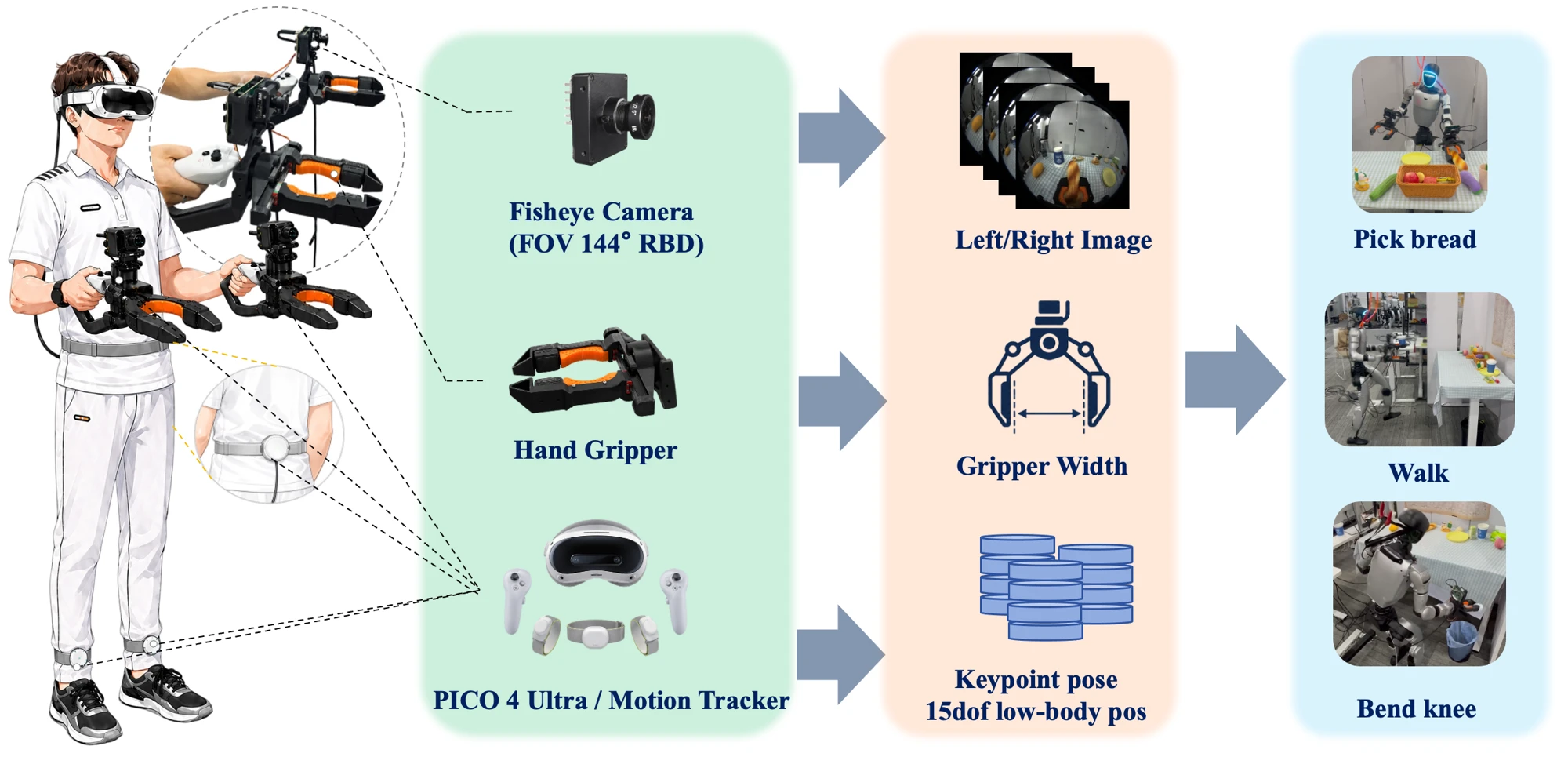
HumanoidUMI moves demonstration collection off the robot, then translates human motion into executable humanoid skills.

LA4VLA: Learning to Act without Seeing via Language-Action Pretraining
Tao Lin, Yuxin Du, Yiran Mao et al.
Vision-Language-Action (VLA) models are commonly pretrained on robot demonstrations by jointly mapping visual observations and language instructions to actions. However, dense visual-action supervision can dominate the comparatively sparse language-action signal.