
Mem4Act: Learning Effective Latent Memory for Long-Horizon Robotic Manipulation
Yun Zhang, Zhiyu Huang, Tianhui Cai, Chen Tang, Wei Wang, Jiaqi Ma · N/A · 2026
Framework
N/A
License
N/A
Stars
N/A
Summary
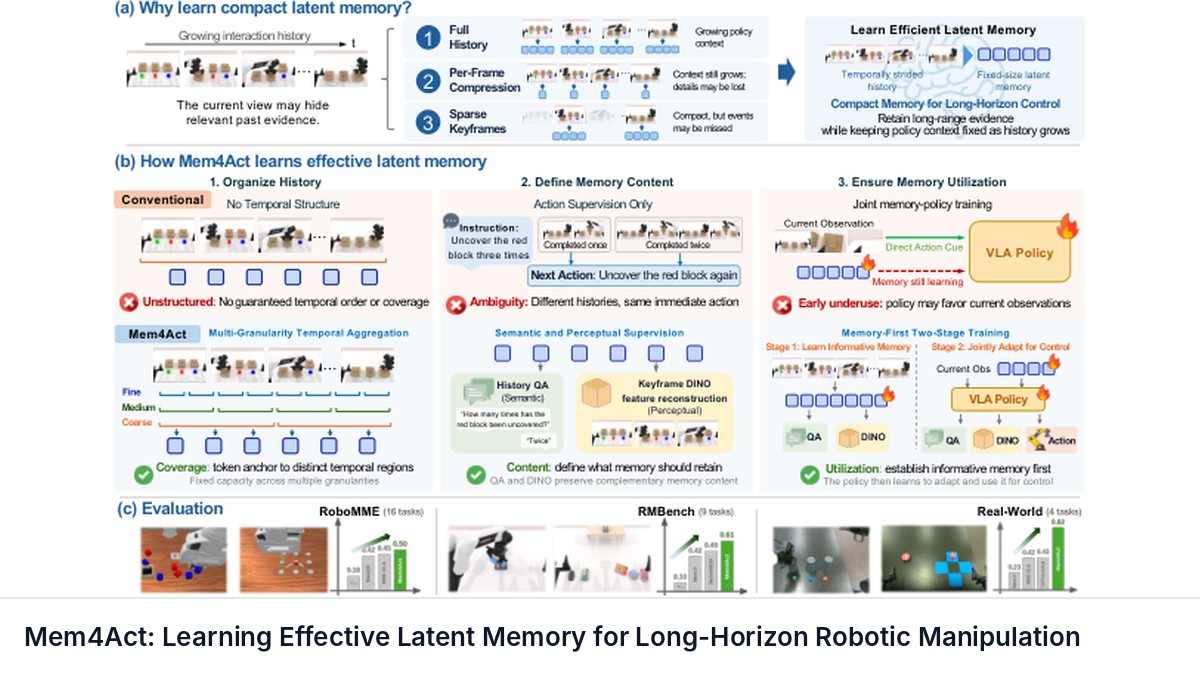
Long-horizon robotic manipulation fundamentally requires memory: agents must retain task-relevant information from past observations and interactions and use it to guide future actions.
Abstract Summary
Key Points
- Long-horizon robotic manipulation fundamentally requires memory: agents must retain task-relevant information from past observations and interactions and use it to guide future actions.
- Existing approaches typically preserve raw historical observations, compressed visual tokens, or language summaries, but these representations either expose the action policy to increasingly long histories or risk discarding task-relevant temporal, semantic, and perceptual information.
- We introduce Mem4Act, a framework for learning effective latent memory as a fixed-size representation explicitly optimized for long-horizon robotic control.
- Mem4Act addresses three coupled challenges: how to efficiently cover long histories, what information memory should retain, and how to ensure the policy actually relies on memory.
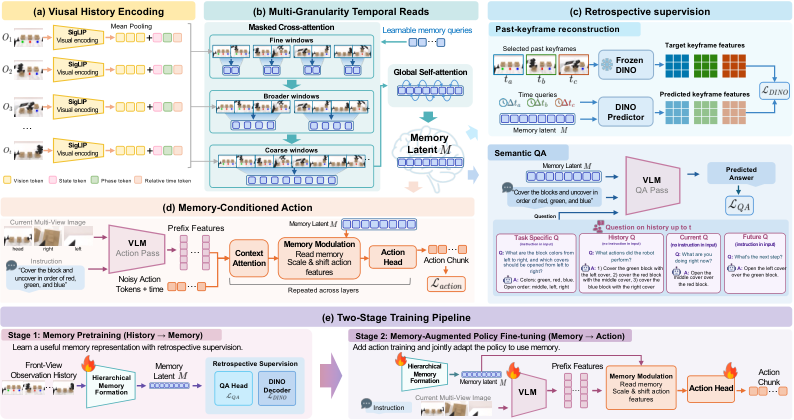
- To this end, it organizes history via multi-granularity temporal aggregation, preserves complementary semantic and perceptual information through question-answering supervision and key-frame DINO feature reconstruction, and employs memory-first two-stage training to encourage greater use of memory by the action policy.
Method
We consider partially observable, long-horizon robotic manipulation. At timestep $t$, the agent predicts a future action chunk $\mathcal{A}_{t}=(a_{t},\ldots,a_{t+T-1})$ given instruction $L$, current observation $O_{t}$, and history $\mathcal{H}_{t}=(O_{1},\ldots,O_{t})$.
Experiments
Datasets. We initialize Mem4Act from a pretrained $\pi_{0.5}$ model ( Physical Intelligence et al., 2025 ) and train it on two memory-intensive long-horizon manipulation benchmarks. RMBench ( Chen et al., 2026a ) contains 9 dual-arm tasks that require recalling either a single relevant past observation $\mathcal{M}(1)$ or multiple observations $\mathcal{M}(n)$ for successful completion.
RoboMME ( Dai et al., 2026 ) evaluates 16 single-arm tasks spanning temporal, spatial, object, and procedural memory. Baselines.
Sources and Demonstrations
Figures are reproduced from Zhang et al. See the full paper for experimental details and the project page, when the paper links one, for demonstrations and videos.
Related Papers
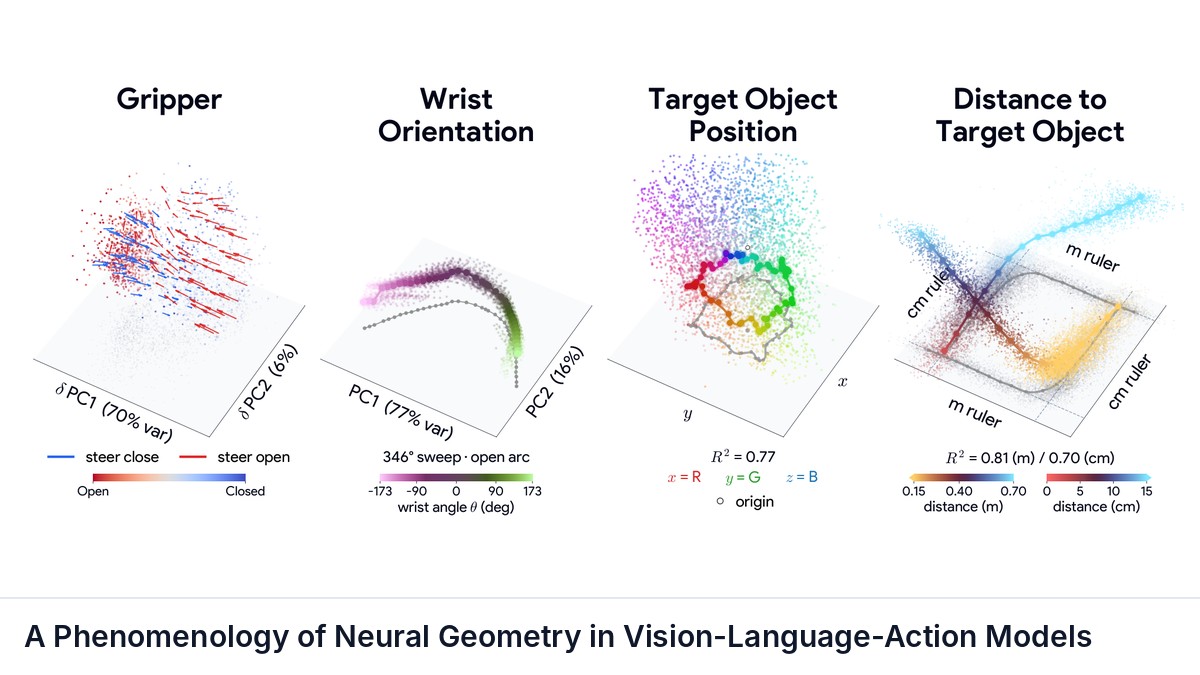
A Phenomenology of Neural Geometry in Vision-Language-Action Models
Mozes Jacobs, Aiden Swann, Mathilde Papillon et al.
Robotic manipulation is inherently geometric, but what shape does the world take inside the policy that performs it?

A Sim-to-Real Integration Pipeline for Training and Deployment of Chunk-Based VLA Manipulation Policies
Mathilde Kappel, Clémence Grislain, Mohamed Chetouani et al.
Vision-Language-Action (VLA) models have become a prominent paradigm for mapping multimodal inputs, including semantic instructions, visual observations of the scene, and proprioceptive observations, to robot actions.
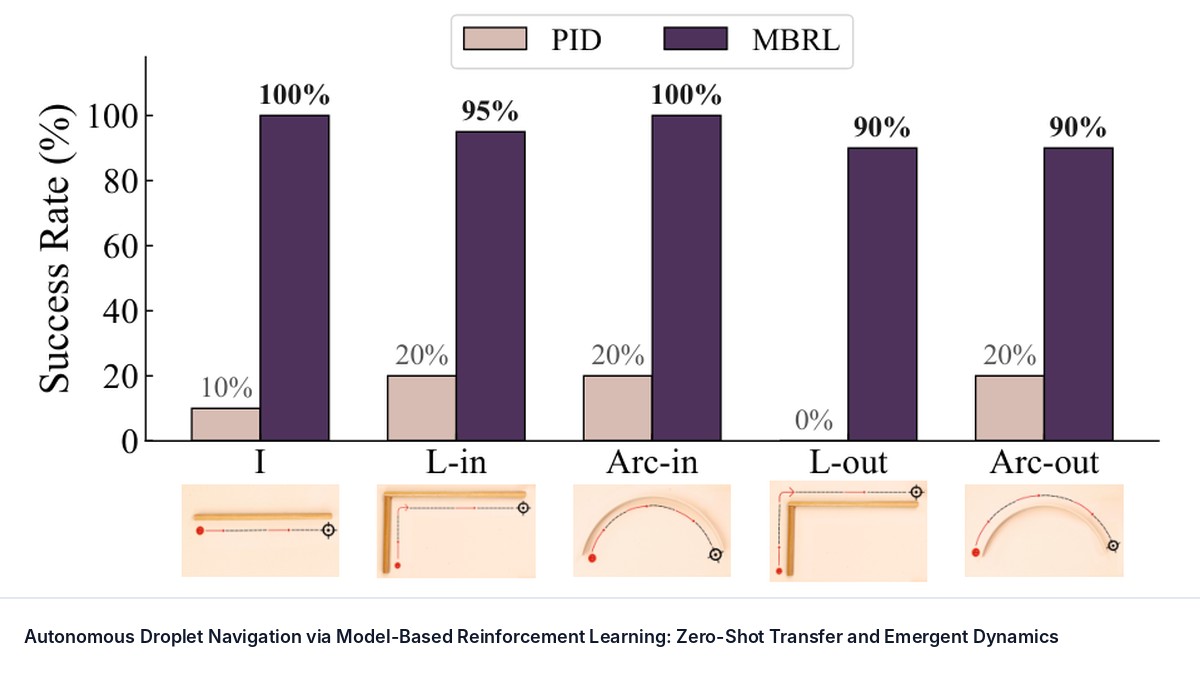
Autonomous Droplet Navigation via Model-Based Reinforcement Learning: Zero-Shot Transfer and Emergent Dynamics
Rajneesh Anand, Mayuresh V. Kothare
Self-driving laboratories (SDLs) are transforming chemical and materials discovery through closed-loop automation, yet automated infrastructure for physical manipulation of soft, deformable matter remains beyond current robotic platforms.
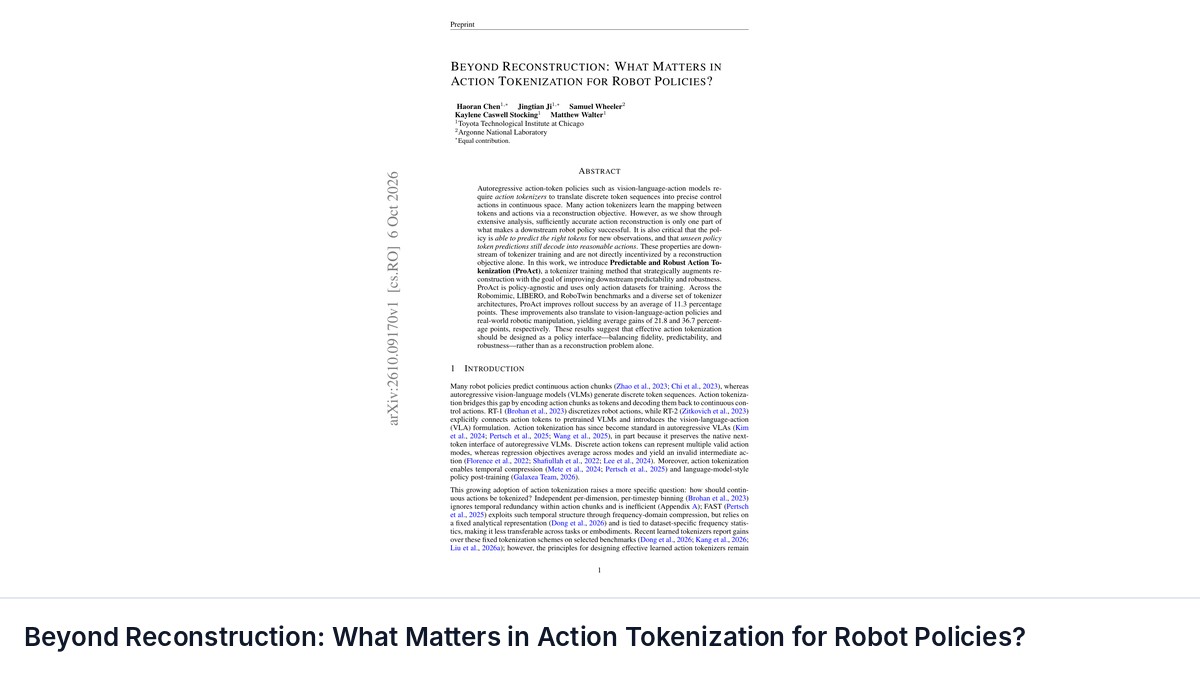
Beyond Reconstruction: What Matters in Action Tokenization for Robot Policies?
Haoran Chen, Jingtian Ji, Samuel Wheeler et al.
Autoregressive action-token policies such as vision-language-action models require action tokenizers to translate discrete token sequences into precise control actions in continuous space. Many action tokenizers learn the mapping between tokens and actions via a reconstruction objective.