
Residual Compliant Policy: Learning Compliant Policies from Few Demonstrations
Chunyu Jiang, Yichen Cai, Shuai Li, Wenbin Sun, Jo\~ao Carvalho, Kostas Daniilidis, Oleg Arenz, Cristiana de Farias, Jan Peters · N/A · 2026
Framework
N/A
License
N/A
Stars
N/A
Summary
Contact-rich manipulation requires a robot to be precise in free space to establish the intended contacts, and compliant once in contact to avoid excessive forces.
Abstract Summary
Key Points
- Contact-rich manipulation requires a robot to be precise in free space to establish the intended contacts, and compliant once in contact to avoid excessive forces.
- Imitation learning has proven effective for simpler manipulation tasks, but the compliance underlying a demonstration is not directly observable and is therefore difficult to infer from demonstration data alone.
- We present a framework that makes compliance explicit at every stage
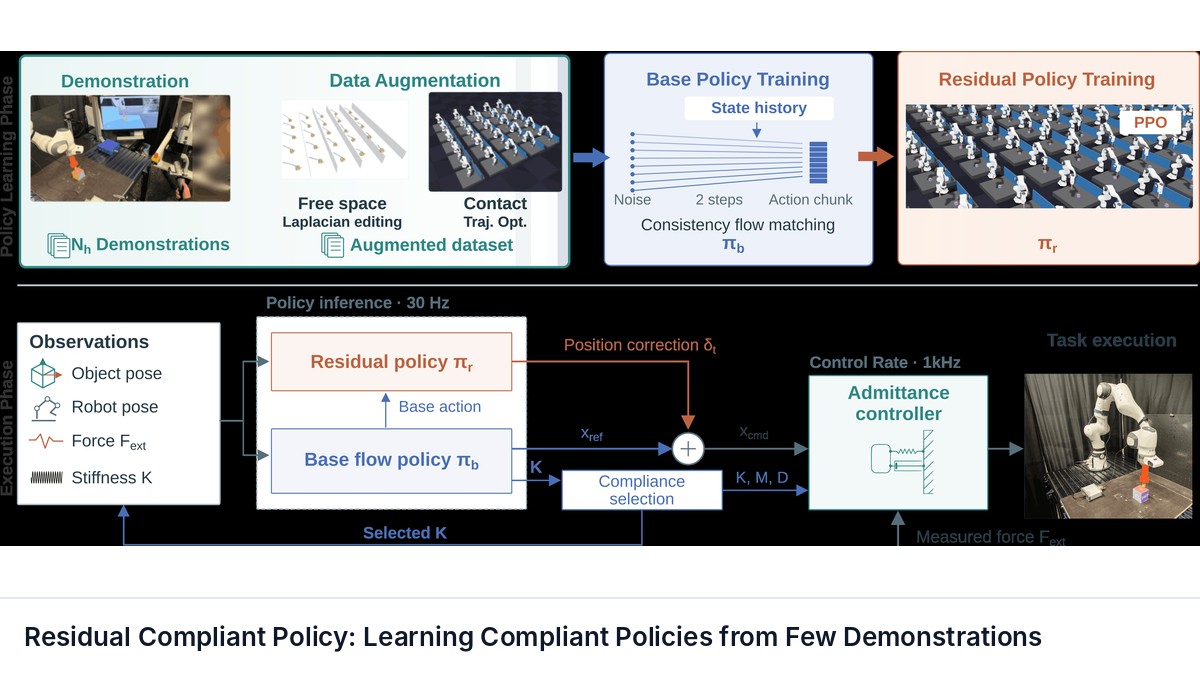
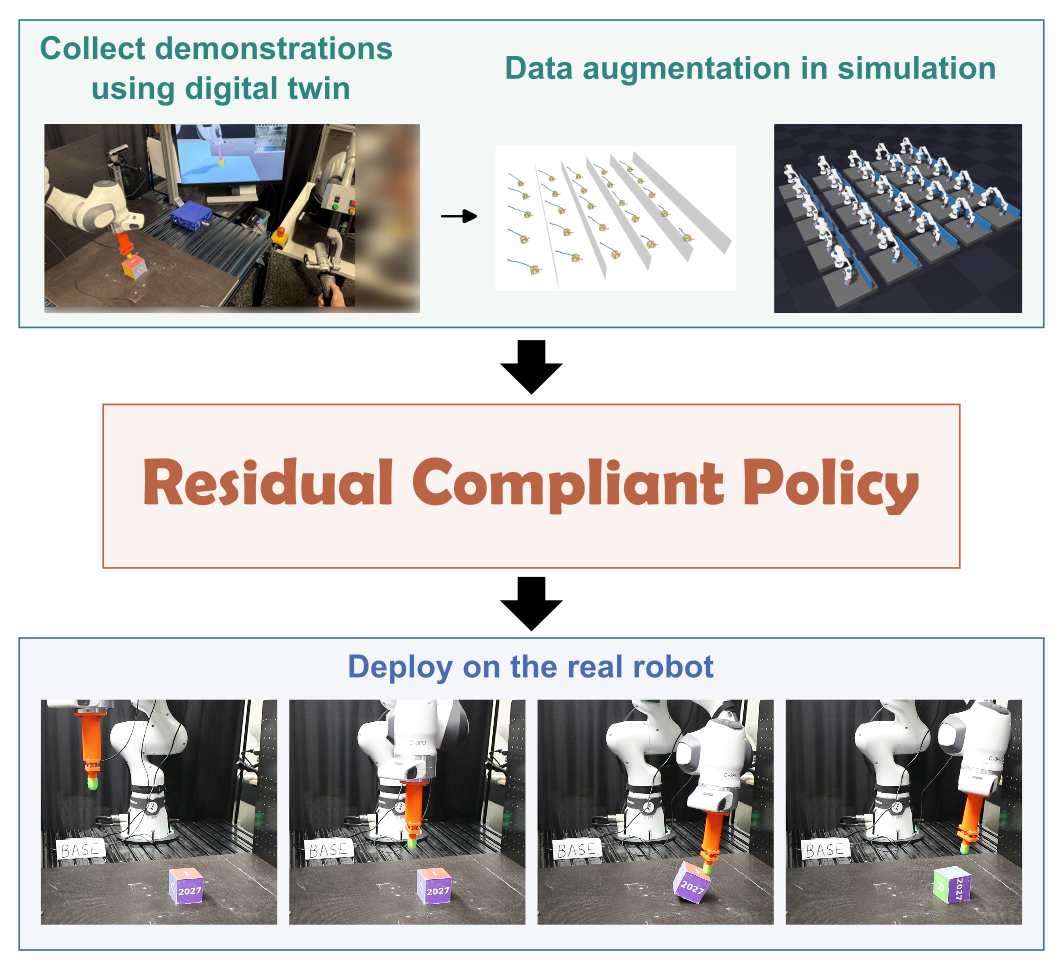
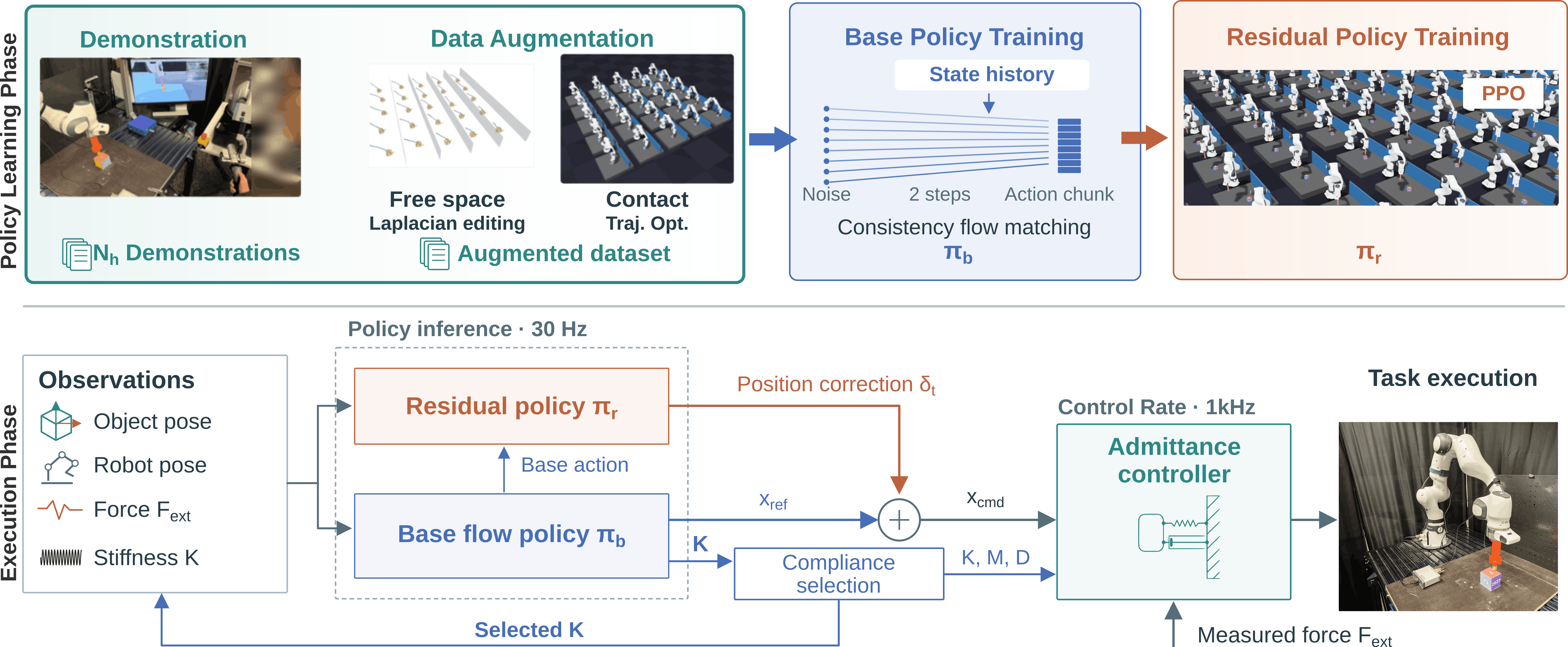
- During data collection, the operator teleoperates the real robot while a synchronized digital twin visualizes the error between the commanded reference and the achieved pose, making the current compliance visible, and selects between two discrete compliance modes.
- To generalize across object poses, we combine Laplacian editing, which retargets trajectories efficiently but is not physics-consistent during contact, with simulation-based trajectory optimization, which enforces physical plausibility but offers no manual guidance.
Method
This section covers the main components of our method. We first discuss our admittance controller design in section III-A . Next, we introduce our proposed data collection pipeline in section III-B and data augmentation method in section III-C , which generate hundreds of high-quality trajectories from a few collected demonstrations to train the base policy. We then describe our base policy in section III-D .
Finally, we present our residual RL policy in section III-E .
Experiments
In this section, we evaluate our framework through experiments designed to answer the following questions: (i) Can our data collection and augmentation pipeline provide sufficient high-quality trajectories for policy learning? (ii) Can a policy trained on the generated data successfully perform contact-rich manipulation on the real robot?
(iii) How does our compliance strategy compare with an ACP-style compliance policy? (iv) Does residual reinforcement learning improve the performance of the base policy? We evaluate our method on a Franka FR3...
Sources and Demonstrations
Figures are reproduced from Jiang et al. See the full paper for experimental details and the project page, when the paper links one, for demonstrations and videos.
Related Papers

A Sim-to-Real Integration Pipeline for Training and Deployment of Chunk-Based VLA Manipulation Policies
Mathilde Kappel, Clémence Grislain, Mohamed Chetouani et al.
Vision-Language-Action (VLA) models have become a prominent paradigm for mapping multimodal inputs, including semantic instructions, visual observations of the scene, and proprioceptive observations, to robot actions.

Capability-Aware Arbitration for Semantic Intent-Based Shared Control
Zhaoda Du, Michael Bowman, Xiaoli Zhang
Shared control often allocates robot authority based on confidence in inferred human intent, assuming reliable autonomous execution. When this assumption fails, high intent confidence can cause over-helping.
Design and Evaluation of a Touchscreen-Based Teleoperation Interface for Robotic Manipulators
Juan José García Cárdenas, Alperen Kenan, Hamidreza Raei et al.
Intuitive teleoperation interfaces are crucial for the safe and effective operation of robotic manipulators in challenging environments.
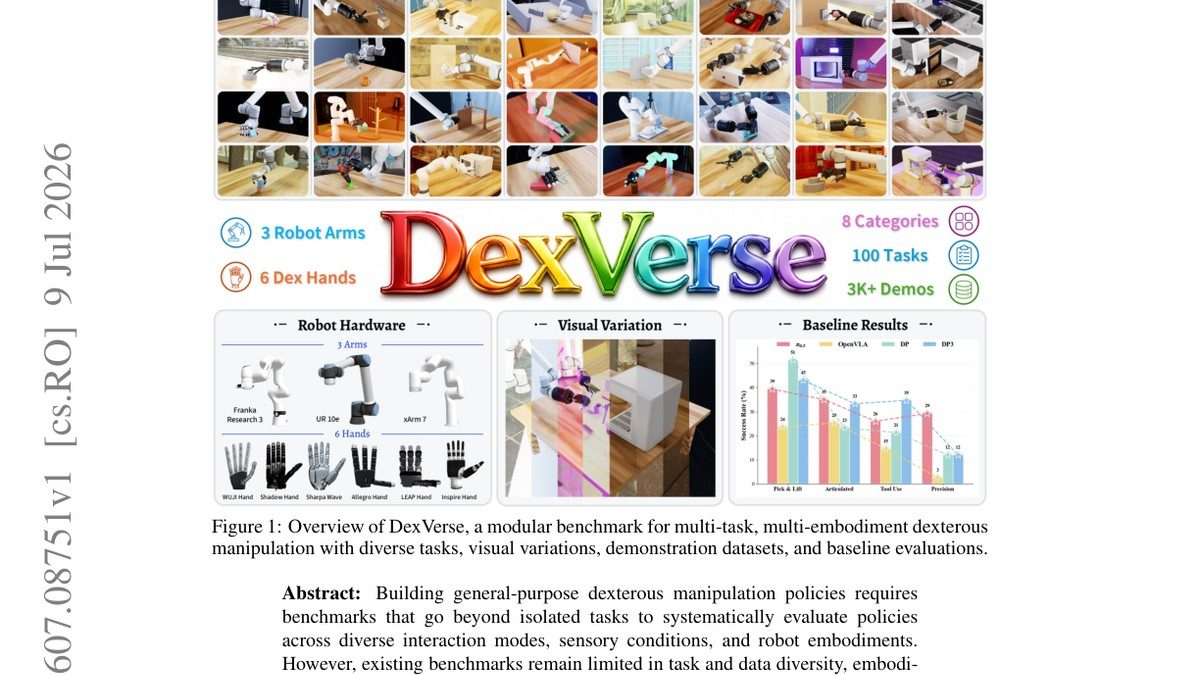
DexVerse: A Modular Benchmark for Multi-Task, Multi-Embodiment Dexterous Manipulation
Yunchao Yao, Zhuxiu Xu, Tianqi Zhang et al.
Building general-purpose dexterous manipulation policies requires benchmarks that go beyond isolated tasks to systematically evaluate policies across diverse interaction modes, sensory conditions, and robot embodiments.