
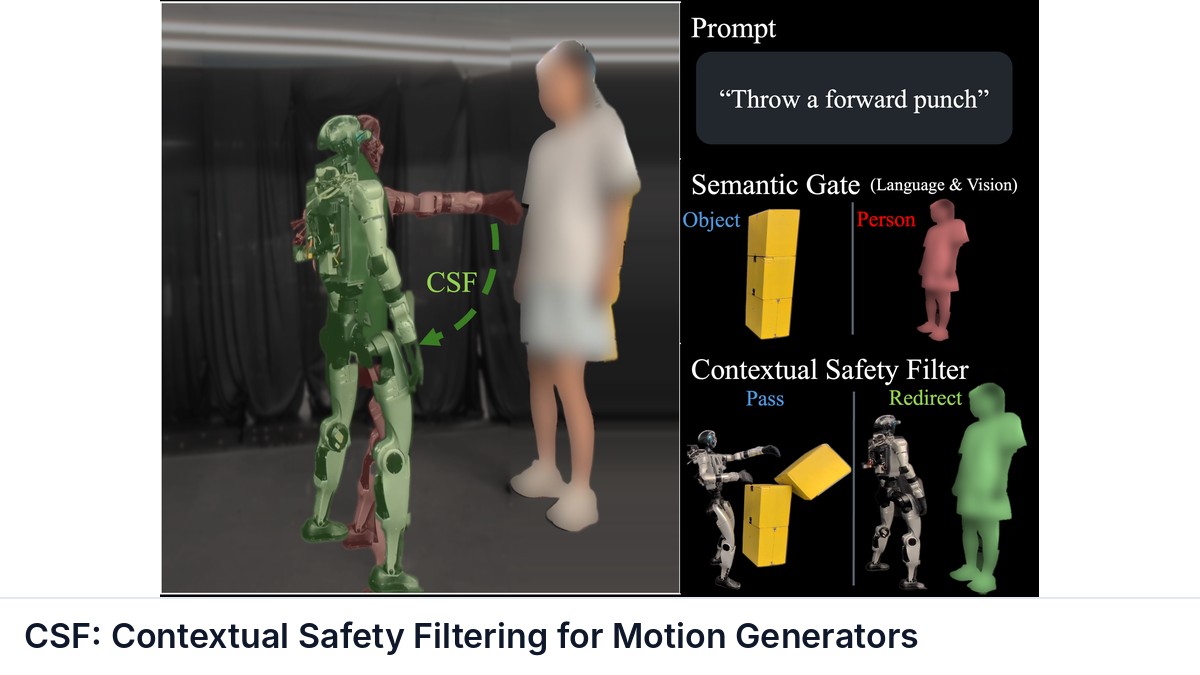
CSF: Contextual Safety Filtering for Motion Generators
Lizhi Yang, Yiling Hou, Yao Tang, Junheng Li, Daniel Weng, Blake Werner, Aaron D. Ames · N/A · 2026
Framework
N/A
License
N/A
Stars
N/A
Summary
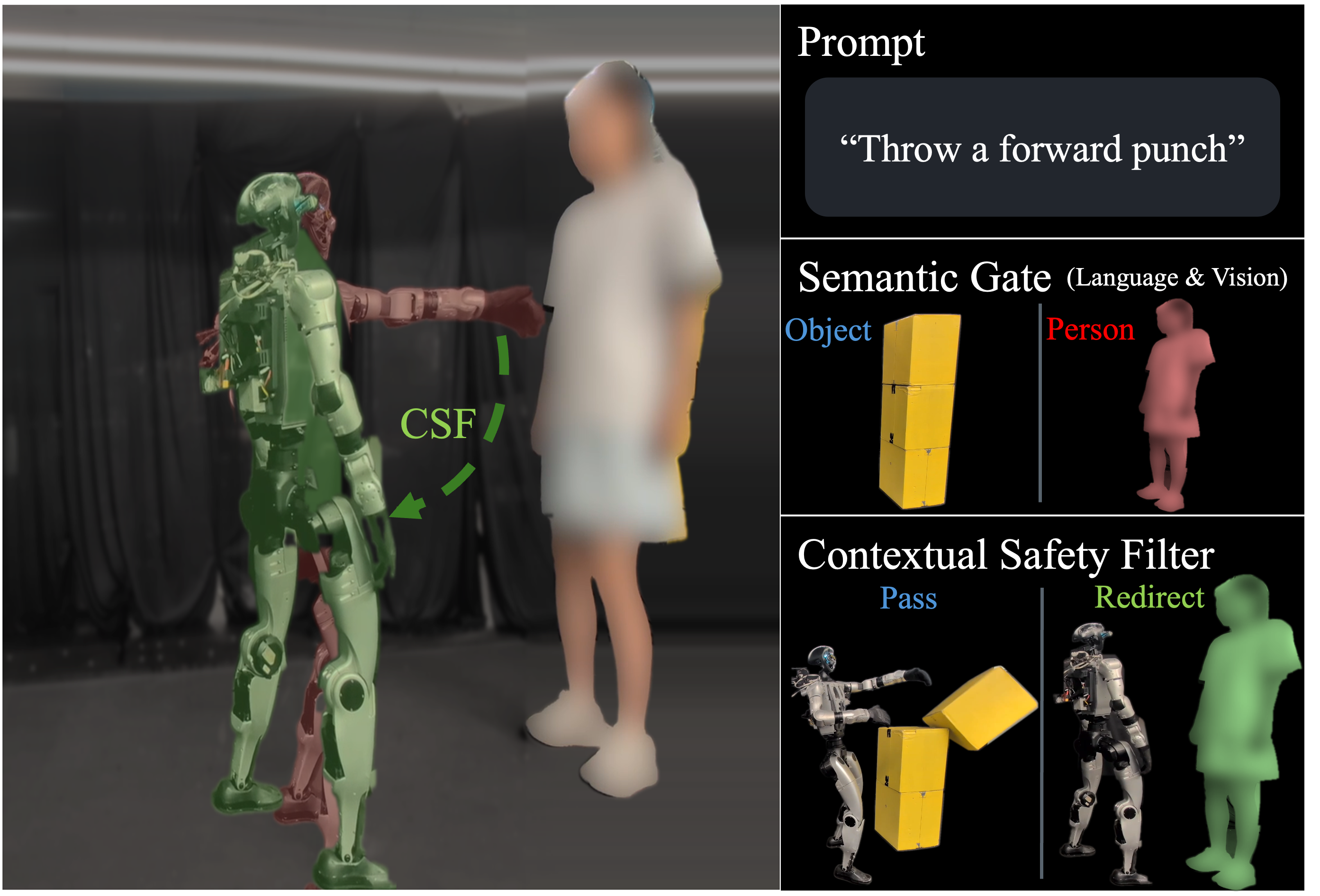
Text-conditioned motion generators produce trackable whole-body motion, but they have no notion of scene-dependent safety: the same action may target an object or a person.
Abstract Summary
Key Points
- Text-conditioned motion generators produce trackable whole-body motion, but they have no notion of scene-dependent safety: the same action may target an object or a person.
- Existing safeguards either inspect the prompt, require labeled motion data, or enforce geometric constraints; therefore, they do not directly account for how scene context changes a motion's meaning.
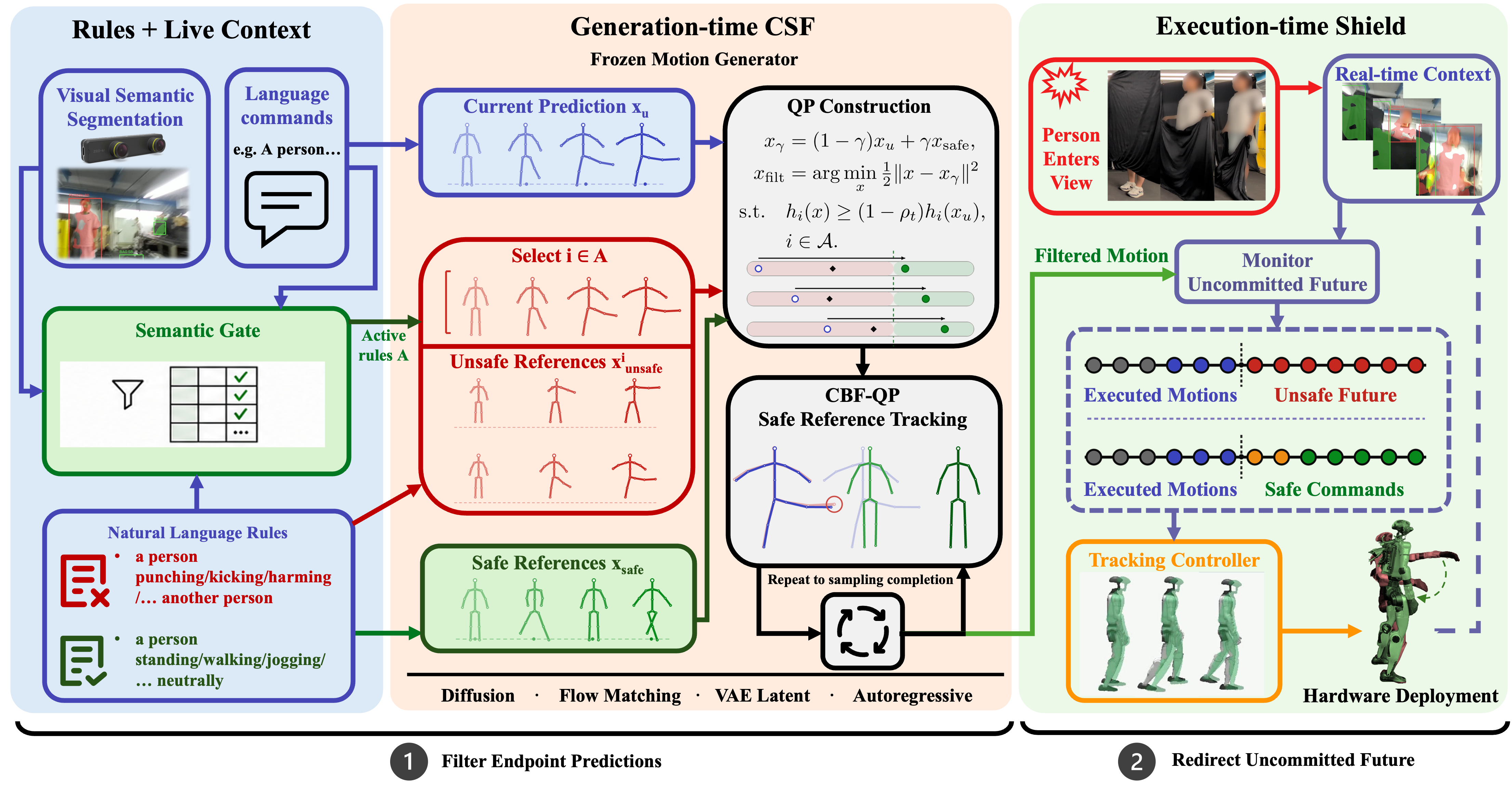
- We introduce contextual safety filtering (CSF), a training-free filter that grounds natural-language safety rules in safe and unsafe reference trajectories produced by the generator.
- For each active rule, safe and unsafe reference trajectories define an affine safety value that a safe reference tracking CBF-QP enforces.
- Across four pretrained generators with different architectures, CSF activates the intended rules in all explicit and scene-triggered unsafe cases and reduces the danger-event rate by up to 90%, while preserving 88-100% of benign motions.
Method
Consider a text-conditioned generator that samples a motion for prompt $c$ in a scene with semantically rich entities; its parameters remain frozen during filtering. We declare unsafe behaviors in natural language and, at inference time, correct only motions that violate a scene-active rule while passing all other motions through without retraining or auxiliary models.
Experiments
We apply CSF without retraining to four pretrained generators through the output-estimate interface of Definition 1 : Kimodo-G1 [ 1 ] (DDIM diffusion), ECHO [ 2 ] (diffusion with DPM-Solver sampling [ 49 ] ), MotionHiFlow [ 3 ] (flow matching in a VAE latent), and ARDY [ 4 ] (windowed autoregressive generation over hybrid tokens).
Table I lists each adapter’s output space, tracking strength $\gamma$, and root-channel handling.
Sources and Demonstrations
Figures are reproduced from Yang et al. See the full paper for experimental details and the project page, when the paper links one, for demonstrations and videos.
Related Papers
3DThinkVLA: Endowing Vision-Language-Action Models with Latent 3D Priors via 3D-Thinking-Guided Co-training
Jiaxin Shi, Xidong Zhang, Fucai Zhu et al.
We propose a 3D-thinking-guided co-training framework that enables vision-language-action (VLA) models to perform 3D spatial reasoning implicitly during action prediction.
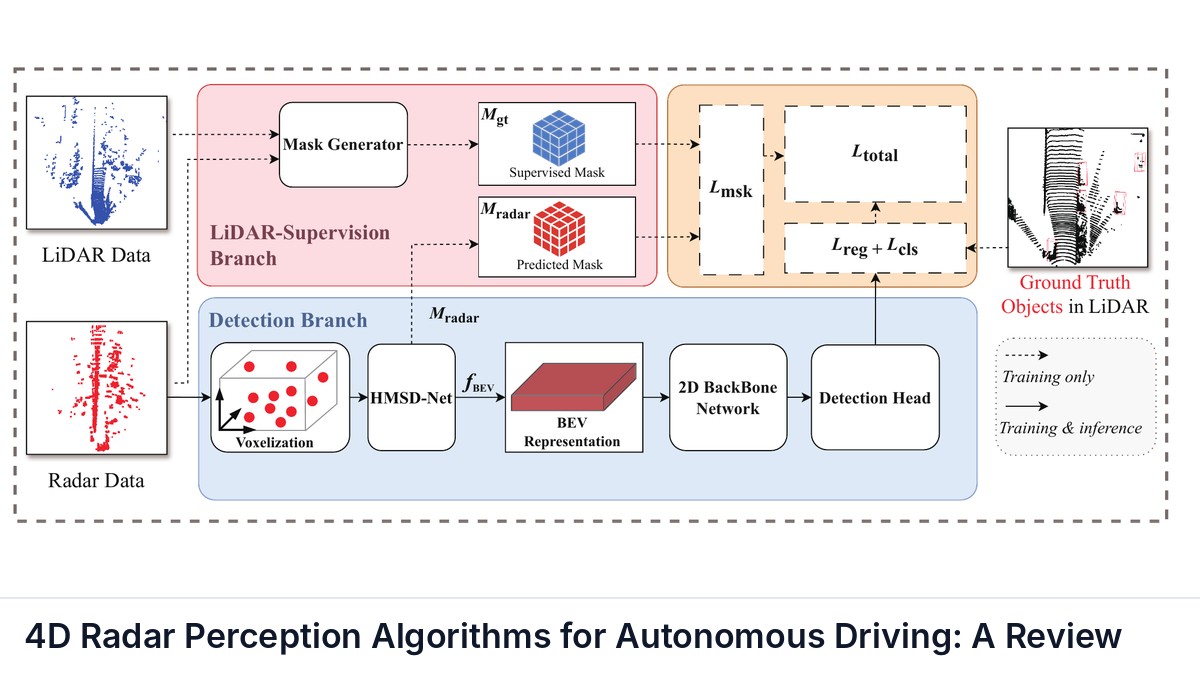
4D Radar Perception Algorithms for Autonomous Driving: A Review
Xumin Wu, Jun Zhou, Jilin Mei et al.
Research on 4D millimeter-wave radar perception algorithms has flourished in recent years, extending from signal processing and object detection to semantic segmentation, motion estimation, occupancy prediction, and dynamic scene reconstruction.
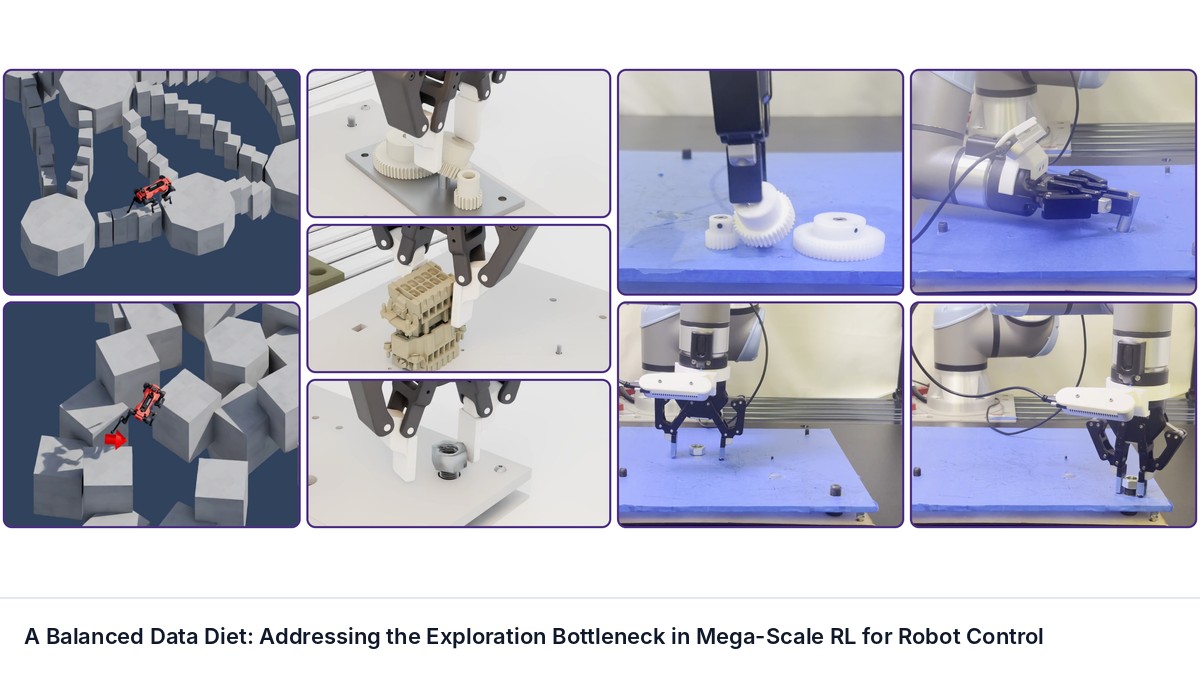
A Balanced Data Diet: Addressing the Exploration Bottleneck in Mega-Scale RL for Robot Control
Octi Zhang, Mateo Guaman Castro, Patrick Yin et al.
General-purpose robots must perform a wide range of tasks from agile locomotion to dexterous manipulation.
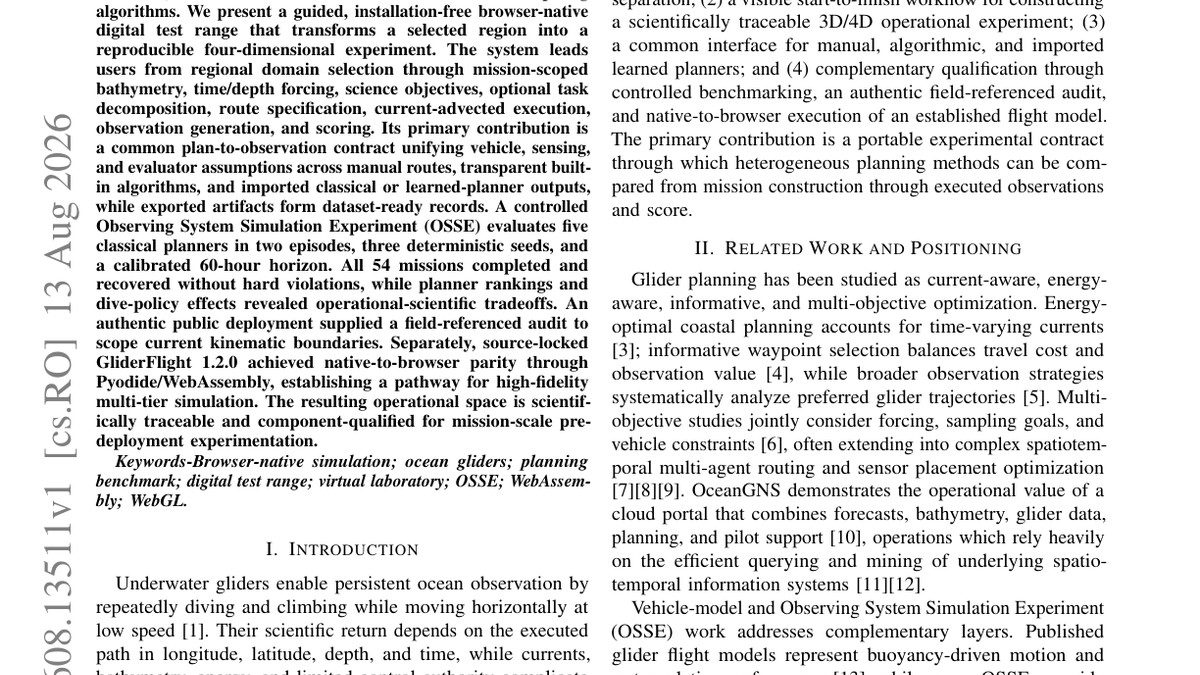
A Browser-Native Digital Test Range for Benchmarking 4D Ocean-Glider Planning Algorithms
Edward Holmberg, Elias Ioup, Mahdi Abdelguerfi
Repeated in-situ evaluation of ocean-glider planners requires scarce vehicles, operators, deployment and recovery resources, and ocean conditions that cannot be reset for competing algorithms.