
Watch, Infer, Coordinate: Inferring Robot Partner Constraints for Zero-Shot Coordination
Suyu Ye, Zheyuan Zhang, Vaishnav Tadiparthi, Hossein Nourkhiz Mahjoub, Ehsan Moradi Pari, Tianmin Shu, Homanga Bharadhwaj, Nakul Agarwal · N/A · 2026
Framework
N/A
License
N/A
Stars
N/A
Summary
Robots operating in the physical world will increasingly need to coordinate with other robots, particularly in manipulation tasks where an object may be too large or heavy for a single robot to carry alone.
Abstract Summary
Key Points
- Robots operating in the physical world will increasingly need to coordinate with other robots, particularly in manipulation tasks where an object may be too large or heavy for a single robot to carry alone.
- Physical limitations caused by hardware degradation or actuator faults can restrict the actions a robot can reliably execute, yet these limitations may be unknown to its partner.
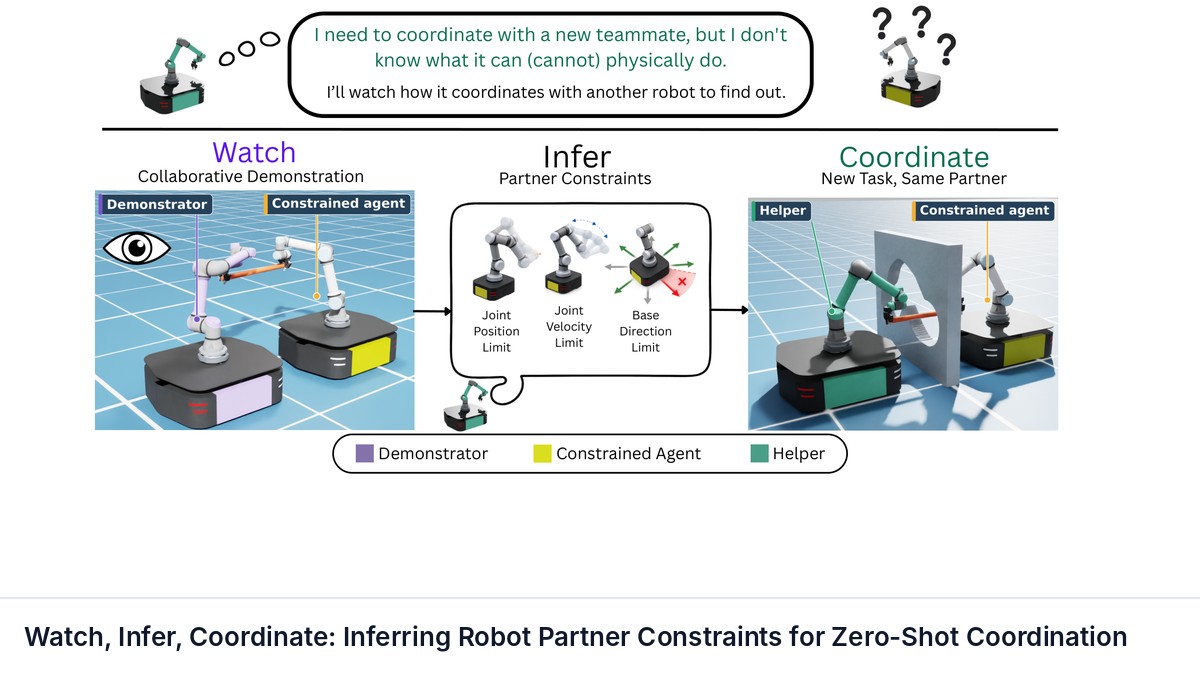
- We study whether a helper can infer a robot partner's physical constraints from observing it coordinate with another robot, then use the inferred capability to coordinate with the same partner on a new task.
- This is difficult because a demonstration shows what the constrained robot did, but not what it could have done.
- In physically coupled tasks, the other robot may also compensate for its limitations, making those limitations difficult to identify from the constrained robot's behavior alone.
Watch, Infer, Coordinate: Problem Setup and Benchmark
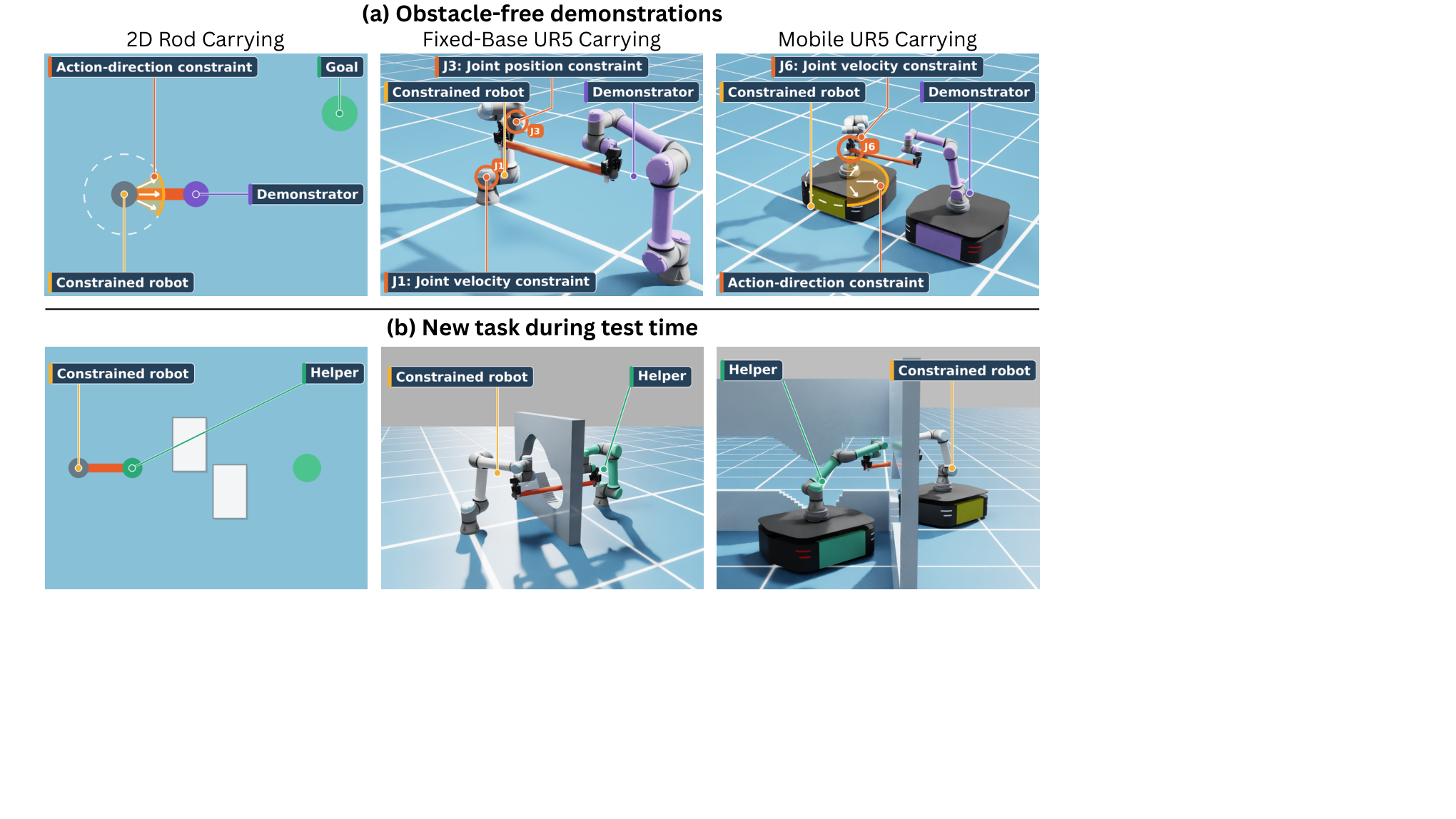
We consider a helper that must coordinate with a robot whose low-level physical capabilities are initially unknown. We refer to this robot as the constrained agent . Its physical actions are restricted by constraints, such as joint position limits, velocity limits, or allowable motion directions.
During the observation stage, the helper watches the constrained agent coordinate with another robot, which we call the demonstrator .
Method
We infer the constrained agent’s capability by treating each candidate capability as a hypothesis about which actions the agent can execute. At each observed state, a candidate changes the constrained agent’s feasible actions and, in turn, how the demonstrator is expected to respond.
Using the boundedly rational behavioral model, we predict the joint behavior of the two agents under each candidate and score how well it matches the observed actions across demonstrations.
Experiments and Results
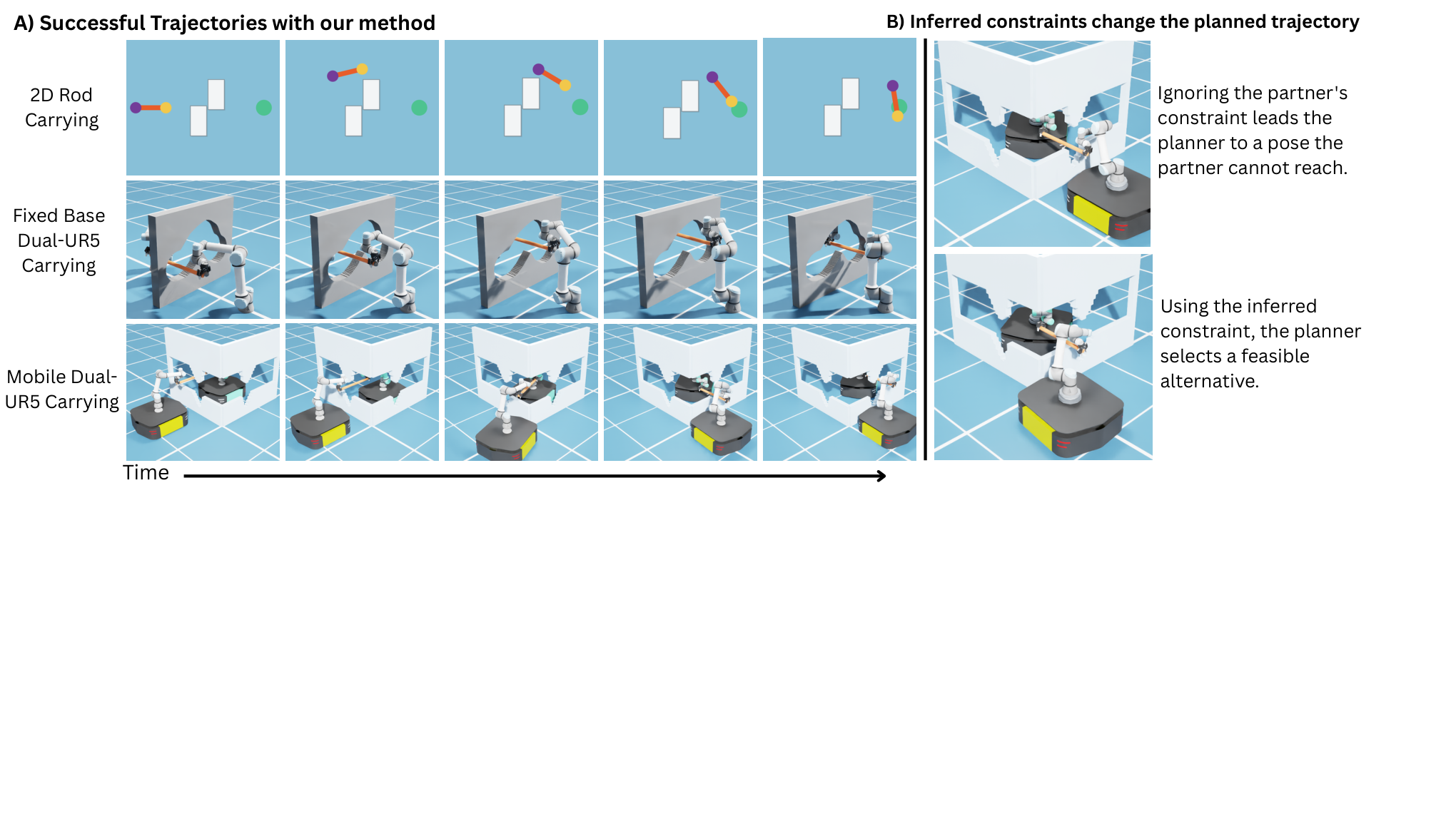
We evaluate whether our method can accurately infer the constrained agent’s physical constraints from prior coordination and whether the inferred capability supports zero-shot coordination on a new task. We study both questions across the 2D rod, fixed-base dual-UR5, and mobile dual-UR5 settings.
For capability inference, we vary the number of observed demonstrations over $N\in\{1,2,4,8\}$ and measure normalized Hamming distance between the inferred and true constraints, where lower is better.
Sources and Demonstrations
Figures are reproduced from Ye et al. See the full paper for experimental details and the project page, when the paper links one, for demonstrations and videos.
Related Papers

A Sim-to-Real Integration Pipeline for Training and Deployment of Chunk-Based VLA Manipulation Policies
Mathilde Kappel, Clémence Grislain, Mohamed Chetouani et al.
Vision-Language-Action (VLA) models have become a prominent paradigm for mapping multimodal inputs, including semantic instructions, visual observations of the scene, and proprioceptive observations, to robot actions.
Behavioral Cloning Mystery
Seohong Park, Sergey Levine
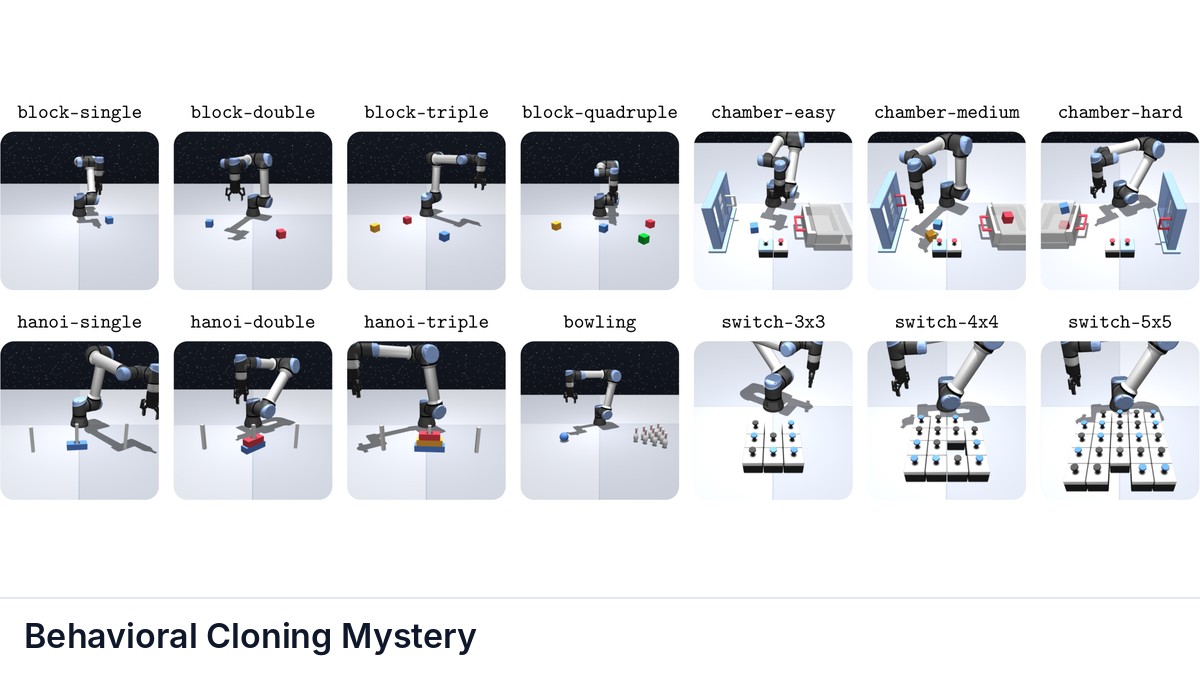
Behavioral cloning (BC), despite its simplicity, exhibits many counterintuitive phenomena in the real world. For example, the performance of BC often keeps increasing as the model overfits more to the dataset, and fully closed-loop policies often completely fail without action chunking.

Capability-Aware Arbitration for Semantic Intent-Based Shared Control
Zhaoda Du, Michael Bowman, Xiaoli Zhang
Shared control often allocates robot authority based on confidence in inferred human intent, assuming reliable autonomous execution. When this assumption fails, high intent confidence can cause over-helping.
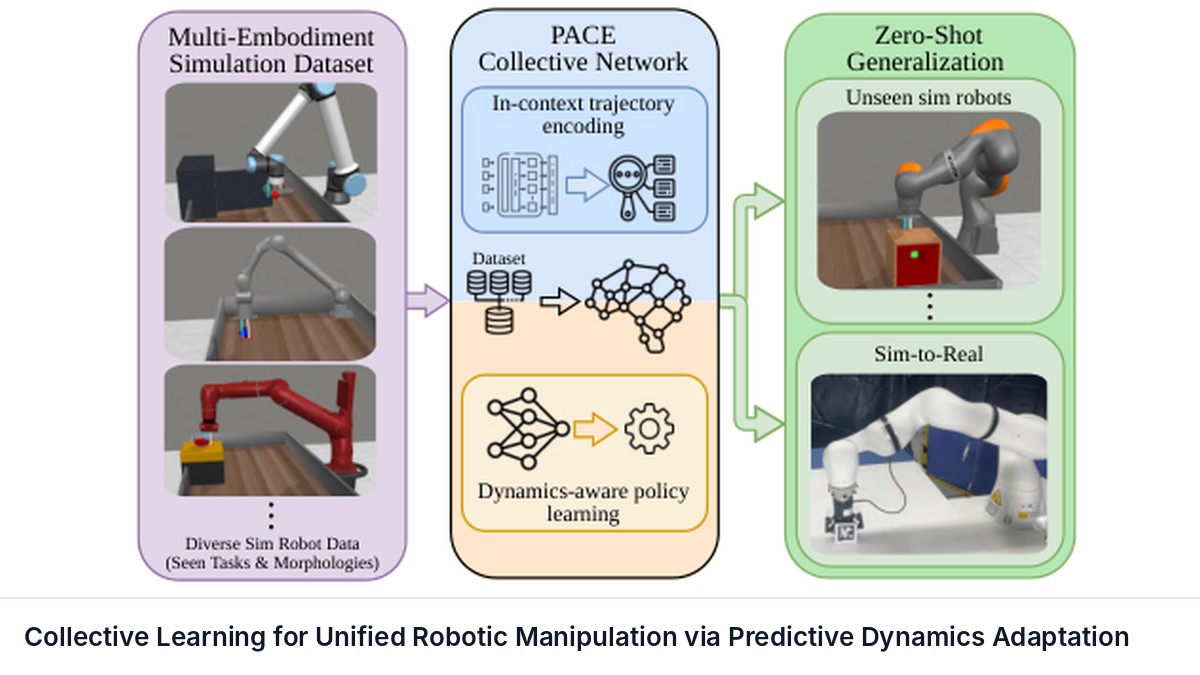
Collective Learning for Unified Robotic Manipulation via Predictive Dynamics Adaptation
Shaocheng Liu, Yuan Meng, Zhenshan Bing et al.
Learning a collective policy for state-based Cartesian manipulation across diverse robotic embodiments presents a fundamental challenge due to embodiment-dependent transition dynamics.