
MOSS: Mode-Oriented Source Shaping for Robot Flow Matching Policies
Zirun Ma, Jindou Jia, Tuo An, Jiaqi Bai, Jiahua Dong, Jianfei Yang · N/A · 2026
Framework
N/A
License
N/A
Stars
N/A
Summary
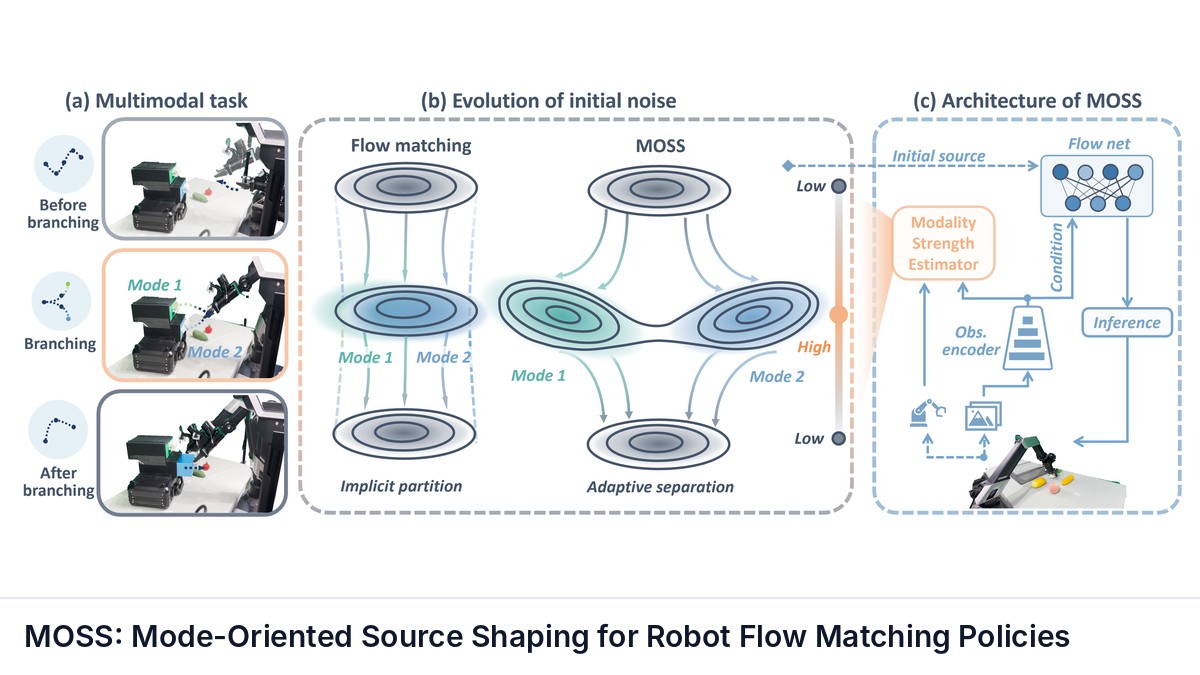
In robotic manipulation, the same observation often admits multiple feasible actions. Generative policies such as diffusion and flow matching naturally capture such multimodal behaviors, yet which mode is executed is left to random sampling and cannot be actively controlled.
Abstract Summary
Key Points
- In robotic manipulation, the same observation often admits multiple feasible actions
- Generative policies such as diffusion and flow matching naturally capture such multimodal behaviors, yet which mode is executed is left to random sampling and cannot be actively controlled.
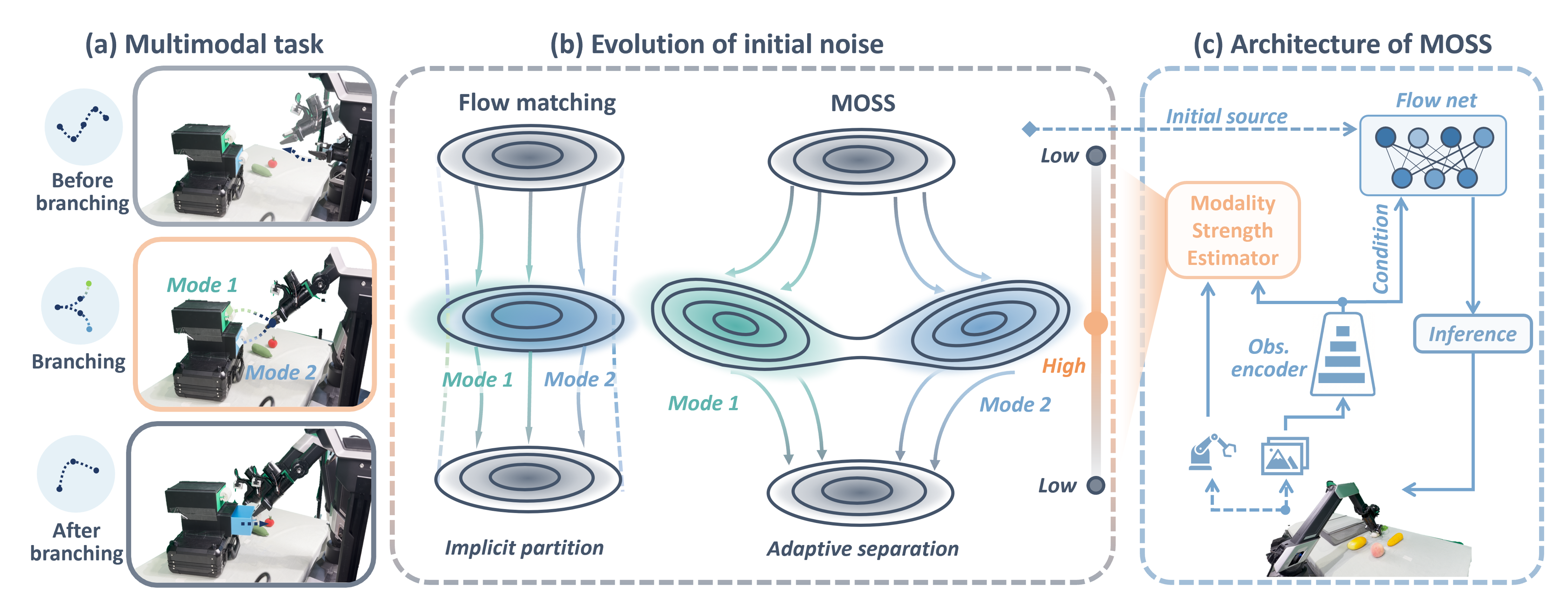
- We propose Mode-Oriented Source Shaping (MOSS), which turns mode selection into an explicit choice of where generation starts.
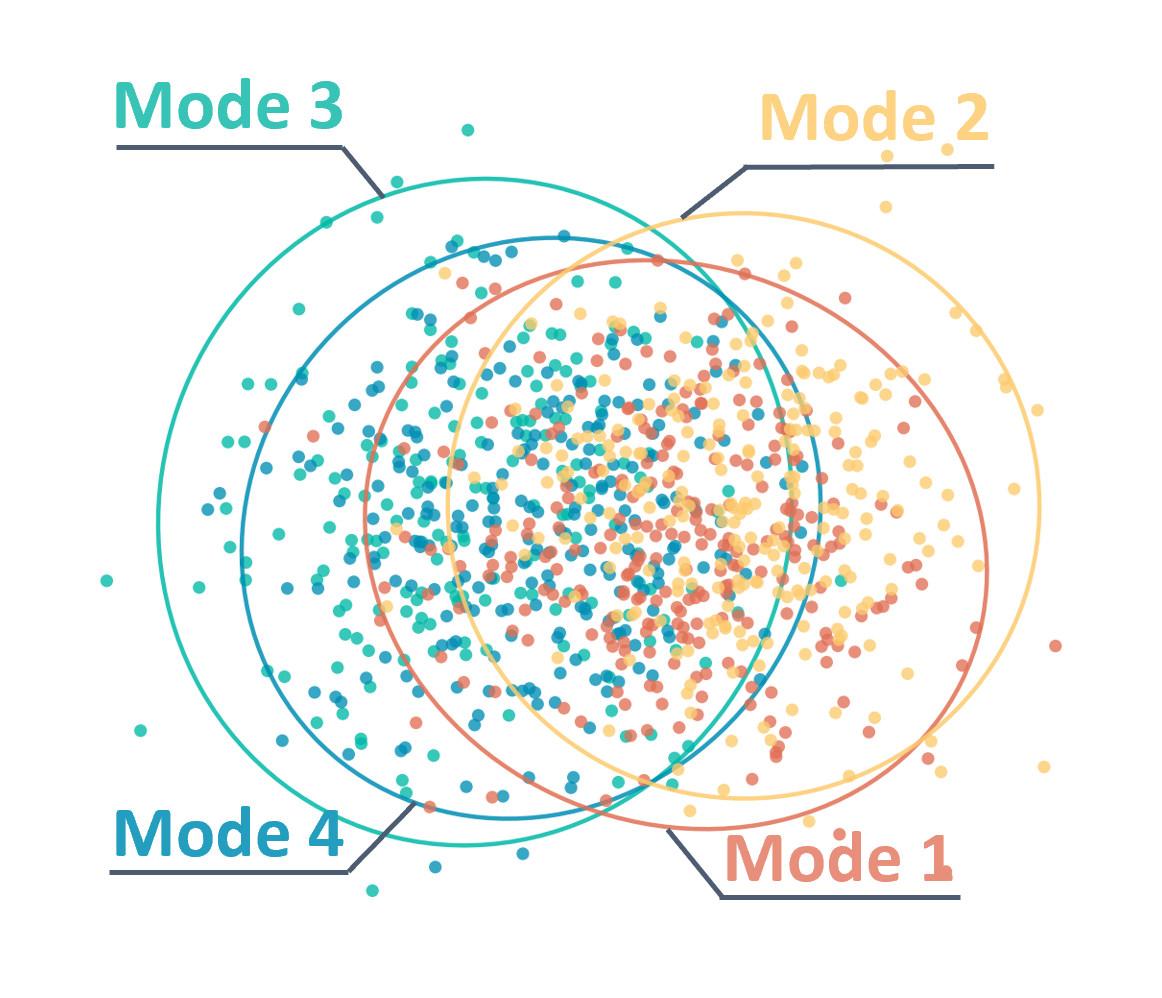
- We first reveal, both empirically and theoretically, that deterministic flow transport induces mode-dependent structure in the source space.
- Under ideal deterministic ODE transport, distinct behavioral modes have distinct source-space preimages, while practical approximation errors can blur their boundaries due to imbalanced data, limited model capacity, and few inference steps.
Multimodal Property of Flow Matching
Standard FM learns a continuous transport from a simple source to a complex action distribution conditioned on an observation $\mathbf{o}\in\mathcal{O}$ ( Lipman et al., 2023 ; Jia et al., 2026b ) .
Let $d\in\mathbb{N}$ denote the dimension of the vectorized action chunk, $\mathbf{z}\in\mathbb{R}^{d}$ with $\mathbf{z}\sim\mu_{0}=\mathcal{N}(\mathbf{0}_{d},\mathbf{I}_{d})$ be the source noise, where $\mathbf{0}_{d}\in\mathbb{R}^{d}$ and $\mathbf{I}_{d}\in\mathbb{R}^{d\times d}$, and let $\mathbf{y}\in\mathbb{R}^{d}$ with $\mathbf{y}\sim p^{\math...
Mode-Oriented Source Shaping
Section 3 shows that FM naturally induces mode-dependent regions in the source space, but this separation is implicit and can become weak or entangled in practice. Rather than recovering these implicit regions, MOSS deliberately imposes a simple, semantically aligned source geometry to make mode separation explicit and controllable.
It enlarges the source-space separation between modes when it is actually needed, and selects the mode by choosing where the transport starts .
Evaluation
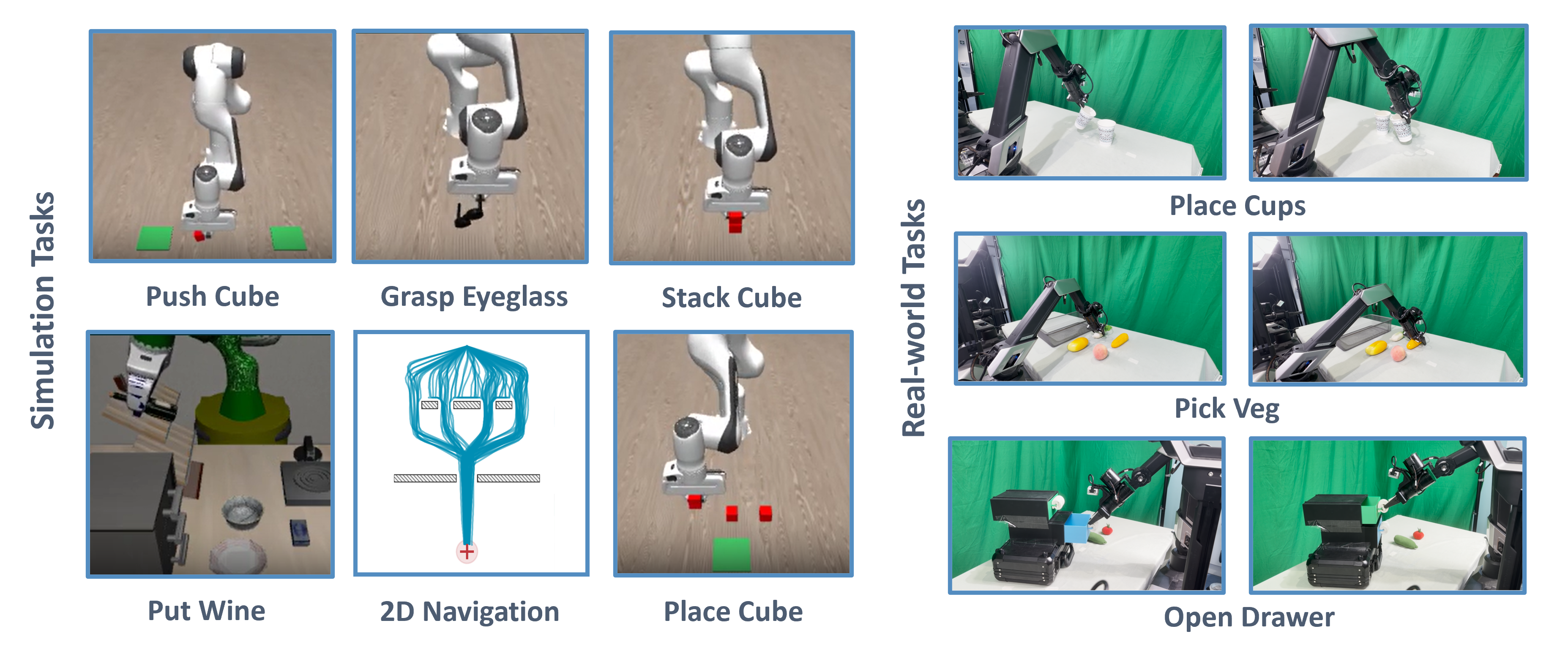
We evaluate MOSS on $6$ simulated tasks and $3$ real-world robotic tasks, as shown in Figure 3 . The simulation benchmark consists of $4$ bimodal tasks— Push Cube , Grasp Eyeglasses , Stack Cube , and Put Wine —and two multi-mode tasks, 2D Navigation and Place Cube ( Jia et al., 2026a ; Mu et al., 2021 ; Liu et al., 2023 ) . Each task admits multiple distinct yet valid strategies for successful completion.
For real-world evaluation, we consider Place Cups , Pick Veg , and Open Drawer on a Galaxea R1 Lite robotic platform.
Sources and Demonstrations
Figures are reproduced from Ma et al. See the full paper for experimental details and the project page, when the paper links one, for demonstrations and videos.
Related Papers

A Sim-to-Real Integration Pipeline for Training and Deployment of Chunk-Based VLA Manipulation Policies
Mathilde Kappel, Clémence Grislain, Mohamed Chetouani et al.
Vision-Language-Action (VLA) models have become a prominent paradigm for mapping multimodal inputs, including semantic instructions, visual observations of the scene, and proprioceptive observations, to robot actions.
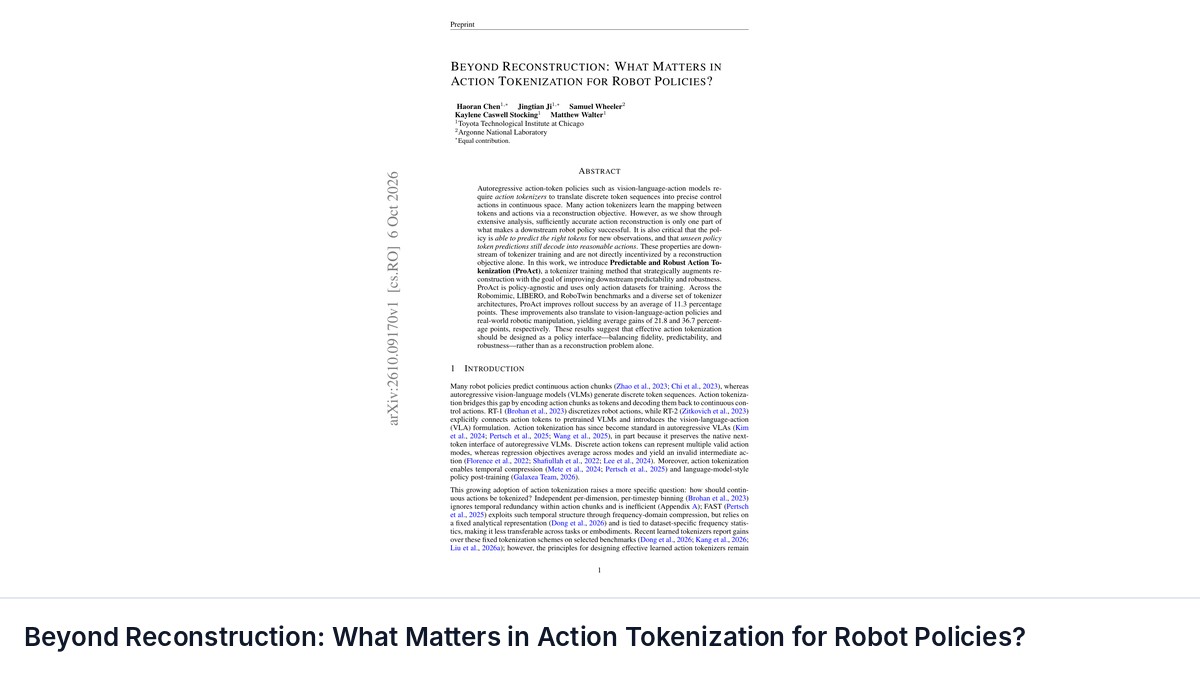
Beyond Reconstruction: What Matters in Action Tokenization for Robot Policies?
Haoran Chen, Jingtian Ji, Samuel Wheeler et al.
Autoregressive action-token policies such as vision-language-action models require action tokenizers to translate discrete token sequences into precise control actions in continuous space. Many action tokenizers learn the mapping between tokens and actions via a reconstruction objective.

Capability-Aware Arbitration for Semantic Intent-Based Shared Control
Zhaoda Du, Michael Bowman, Xiaoli Zhang
Shared control often allocates robot authority based on confidence in inferred human intent, assuming reliable autonomous execution. When this assumption fails, high intent confidence can cause over-helping.
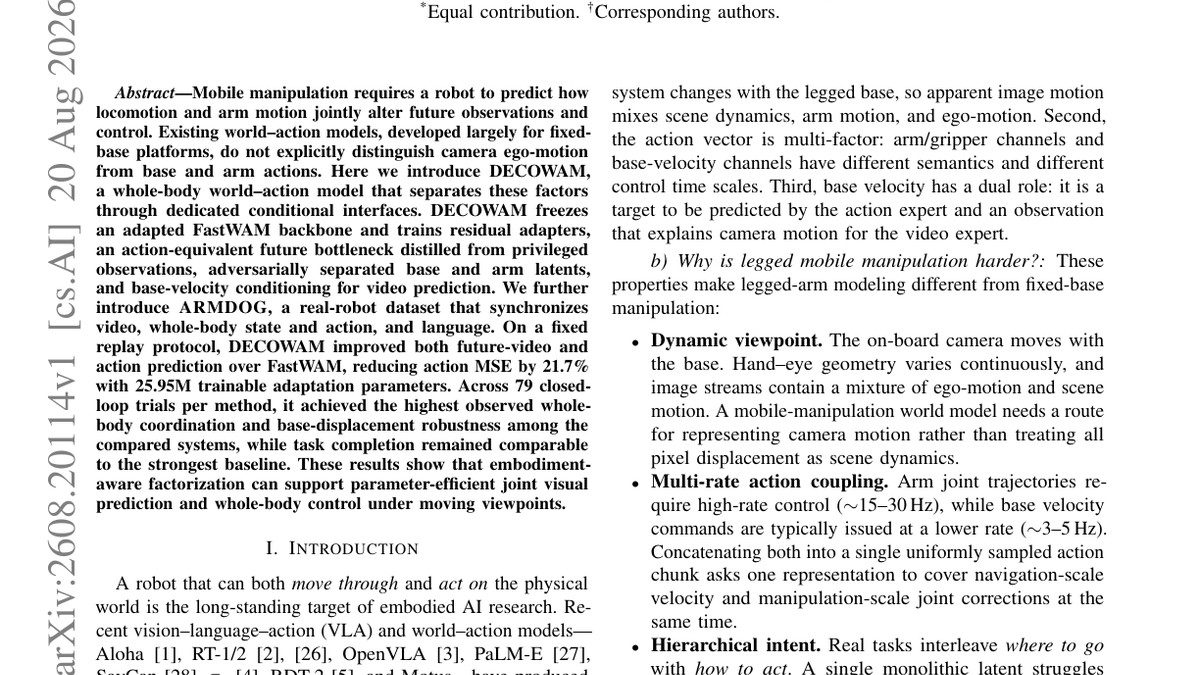
DECOWAM: Decoupled Whole-Body World-Action Model for Legged Mobile Manipulation
Siyuan Ma, Boshi Zhang, Yutian Zhang et al.
Mobile manipulation requires a robot to predict how locomotion and arm motion jointly alter future observations and control. Existing world-action models, developed largely for fixed-base platforms, do not explicitly distinguish camera ego-motion from base and arm actions.