
REDIRECT: A 1% Fix for Bad Robot Habits
Yu Zhang, Jiazhuo Li, Yancong Wei, Kangkang Dong, Xiaojun Zhu, Houde Liu · N/A · 2026
Framework
N/A
License
N/A
Stars
N/A
Summary
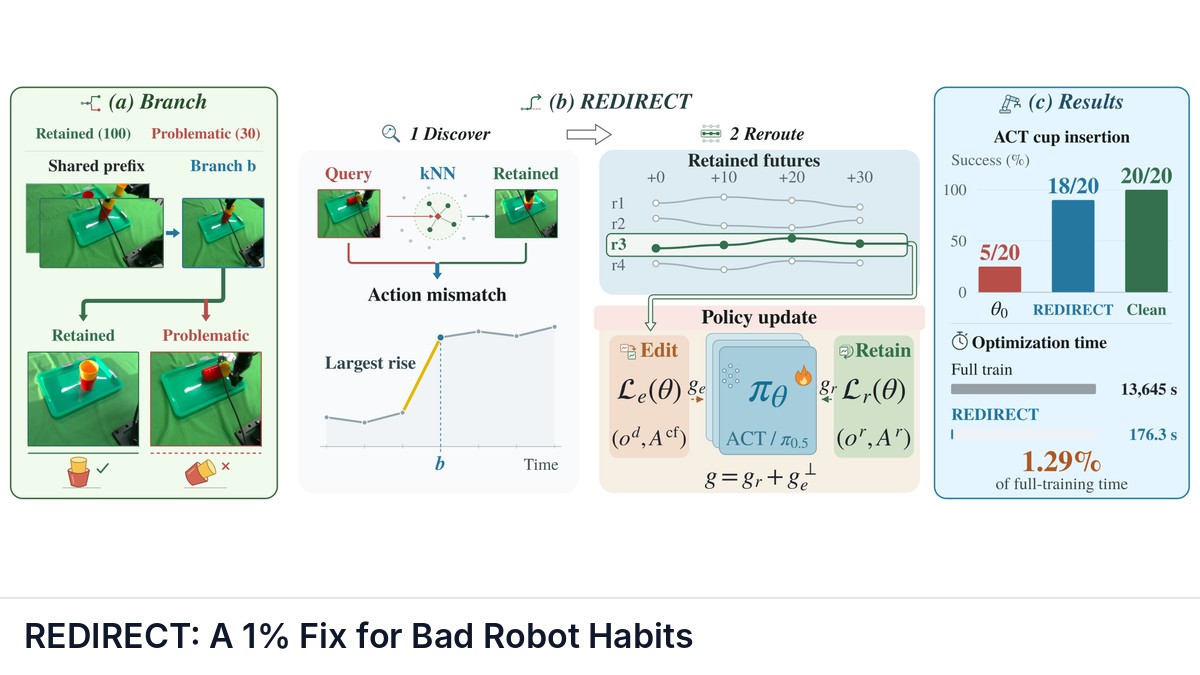
Robots can acquire bad habits from a few defective moments in otherwise useful teleoperation. In mixed-quality robot data, normal and problematic demonstrations share most task behavior and differ only at a local action continuation.
Abstract Summary
Key Points
- Robots can acquire bad habits from a few defective moments in otherwise useful teleoperation
- In mixed-quality robot data, normal and problematic demonstrations share most task behavior and differ only at a local action continuation.
- Full retraining is costly, while fine-tuning on clean data alone offers limited recovery under a small update budget.
- We ask whether the local difference can instead be fixed with only 1% of the full-training sample-backward budget.
- Using only episode-level retained/problematic labels, REDIRECT localizes the branch, assigns a coherent retained continuation to the original observations around it, and anchors shared behavior, without frame-level annotations or additional interaction.
Redirect: A One-Percent Behavioral Fix
Mixed-quality teleoperation structure. Let $\mathcal{D}_{r}=\{\tau_{i}^{r}\}$ contain ordinary demonstrations and $\mathcal{D}_{d}=\{\tau_{i}^{d}\}$ locally flawed demonstrations used to train $\pi_{\theta_{0}}$. Both execute the same task and share most behavior.
A trajectory in $\mathcal{D}_{d}$ follows ordinary behavior until a local decision departs from a continuation in $\mathcal{D}_{r}$; downstream observations can then diverge. In this setting, the local departure naturally induces a behavioral branch.
Experimental Setup
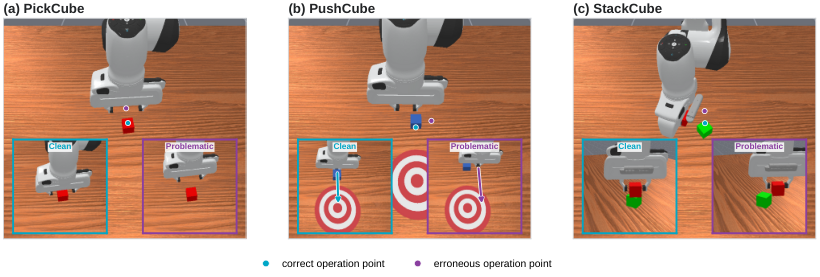
We evaluate repair performance, computational cost, and behavioral preservation across three simulation tasks and two real-robot tasks using ACT and $\pi_{0.5}$. Each setting starts from a policy $\theta_{0}$ trained on 100 clean and 30 designated problematic demonstrations. Repair receives episode membership without temporal annotations. Simulation.
We use ManiSkill PickCube, PushCube, and StackCube [ 28 ] , with local grasp, push, and placement offsets of 50/60/50 mm, respectively.
Results
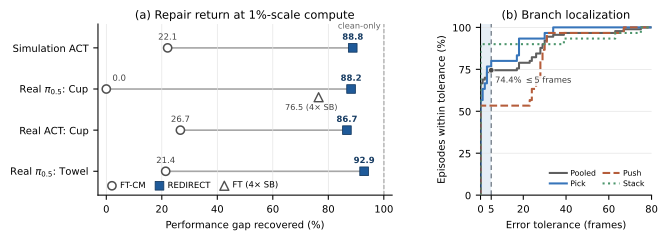
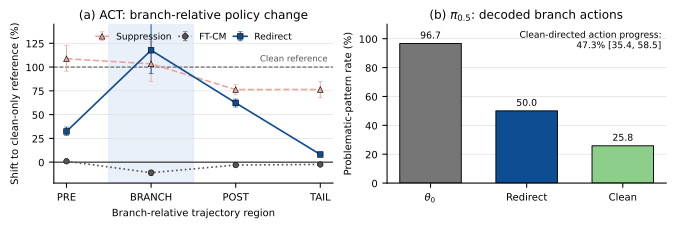
At the same 4,000-SB budget, Redirect raises mean success from 68.2% to 90.3%, recovering 88.8% of the clean-only gap; FT-CM recovers 22.1% (Table I ; Fig. 3 (a)). Redirect performs best among post-training methods on all three tasks, with a 5.0% regression rate (Table II ). The improvement also holds when different episodes contain different defect types.
On heterogeneous StackCube, Redirect reaches 81.0% success and recovers 68.6% of the clean-only gap without defect-family labels or retuning (Table V ).
Sources and Demonstrations
Figures are reproduced from Zhang et al. See the full paper for experimental details and the project page, when the paper links one, for demonstrations and videos.
Related Papers
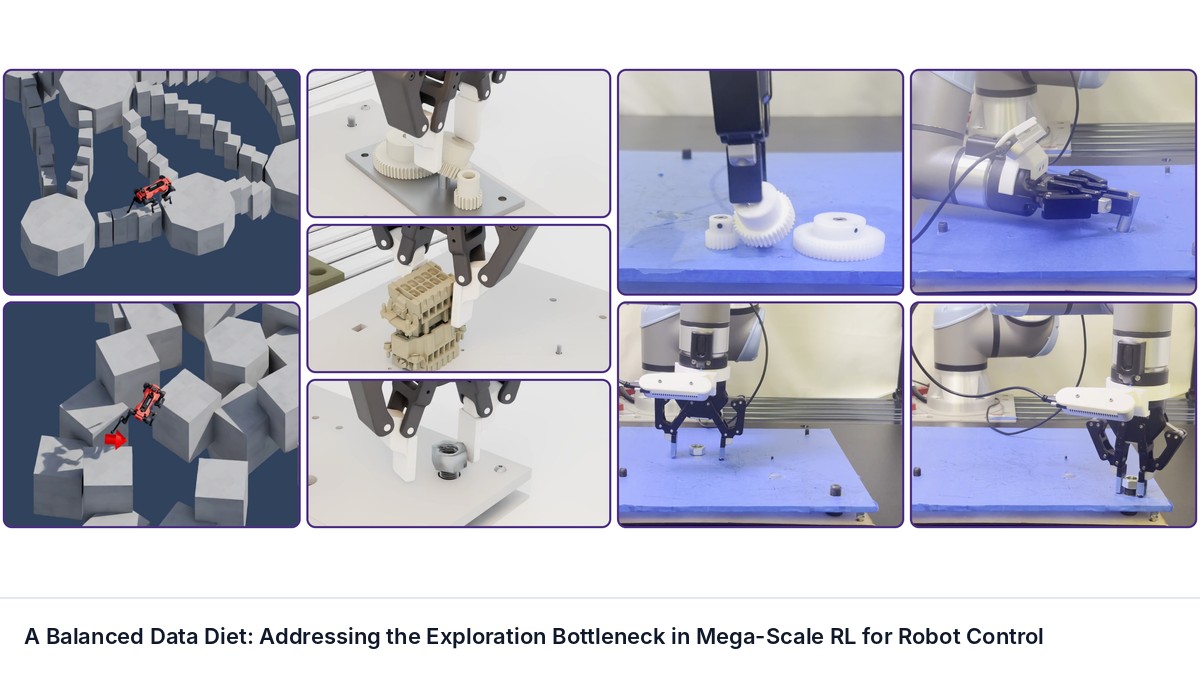
A Balanced Data Diet: Addressing the Exploration Bottleneck in Mega-Scale RL for Robot Control
Octi Zhang, Mateo Guaman Castro, Patrick Yin et al.
General-purpose robots must perform a wide range of tasks from agile locomotion to dexterous manipulation.
A Low-Cost, Open Platform for End-to-End Autonomous Driving on a Miniature Ackermann Vehicle
Gustavo Claudio Karl Couto, Eric Aislan Antonelo, Gabriel George Zipperer
This paper presents a low-cost, open experimental platform for research in end-to-end autonomous driving with miniature Ackermann vehicles.
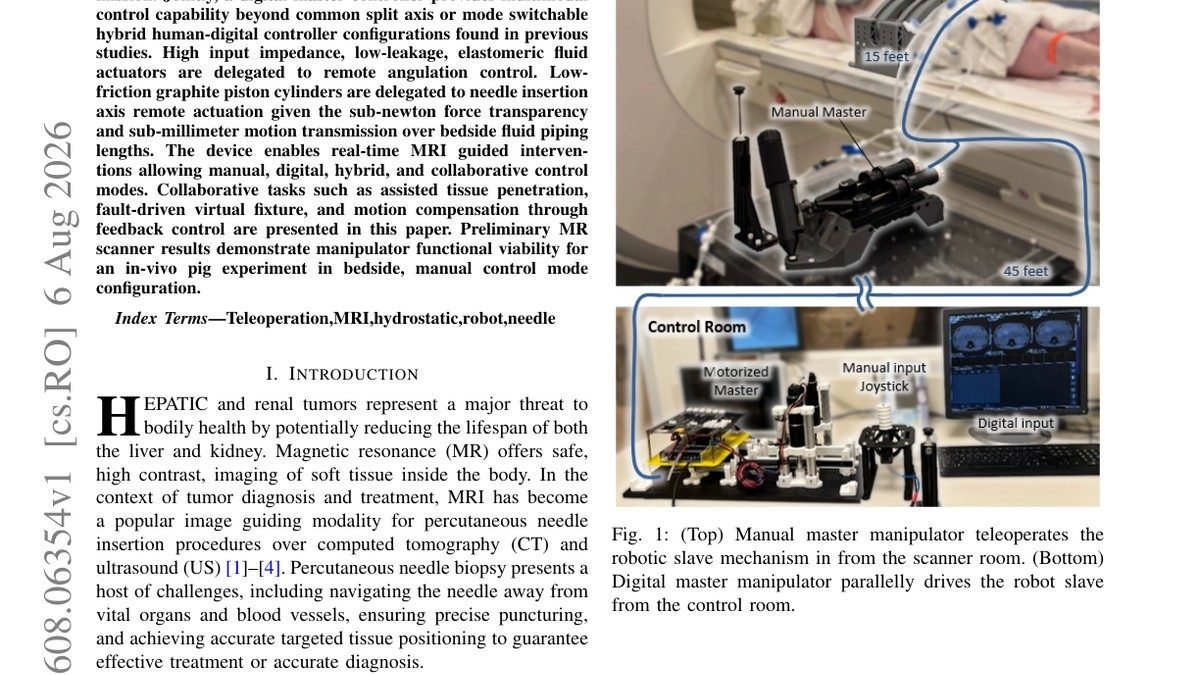
A Master-Salve Robot Manipulator for Needle-Based Teleoperation in MRI Chamber
Omar Curiel, Jing-Yuan Huang, Po-Chih Chen et al.
We present a MR safe, master-slave robot manipulator for abdominal interventions in the MRI chamber. A human operated 2+1-DoF master controller manipulator transmits motion and force to a 2+1-DoF slave manipulator via fluid transmission.

A Sim-to-Real Integration Pipeline for Training and Deployment of Chunk-Based VLA Manipulation Policies
Mathilde Kappel, Clémence Grislain, Mohamed Chetouani et al.
Vision-Language-Action (VLA) models have become a prominent paradigm for mapping multimodal inputs, including semantic instructions, visual observations of the scene, and proprioceptive observations, to robot actions.