
Humanoid Rickshaw Pulling: Whole-Body Locomotion under Coupled Wheeled Loads
Yangzhi Yang, Xiansheng Lin, Zhaoming Xie, Xiaobin Xiong · N/A · 2026
Framework
N/A
License
N/A
Stars
N/A
Summary
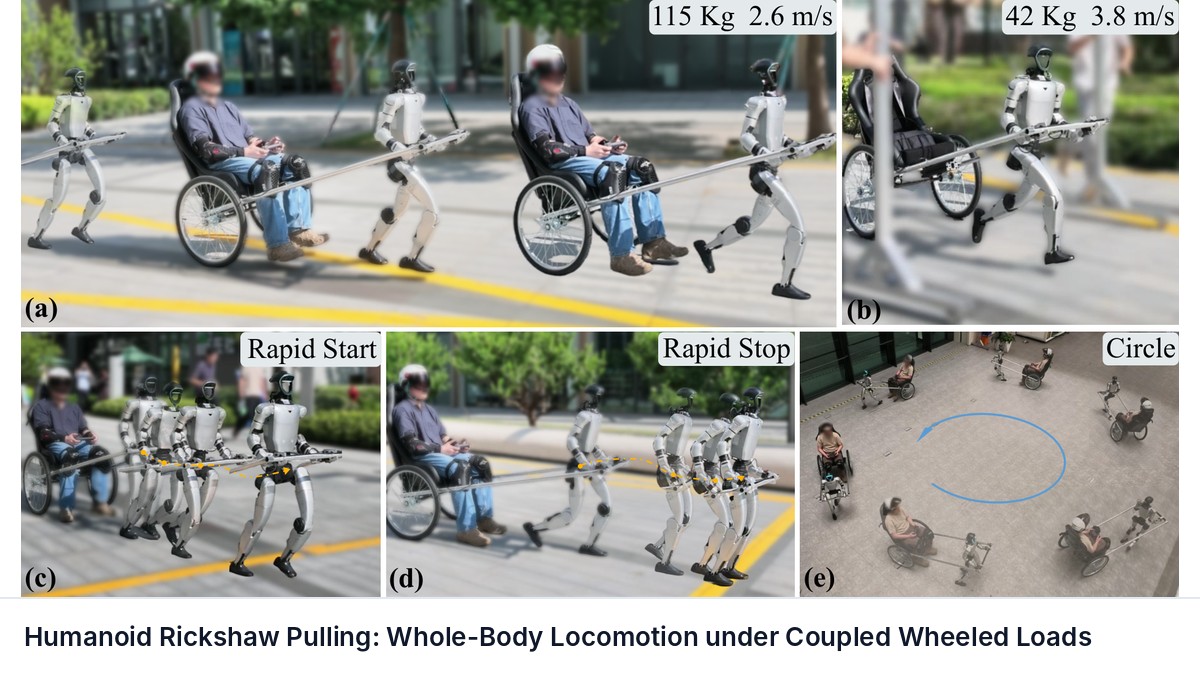
Humanoid robots could transport payloads substantially heavier than themselves by pulling passive wheeled vehicles instead of carrying the load.
Abstract Summary
Key Points
- Humanoid robots could transport payloads substantially heavier than themselves by pulling passive wheeled vehicles instead of carrying the load.
- This capability, however, creates a coupled locomotion problem: the robot must maintain persistent upper-body contact while adapting to unknown, configuration-dependent forces arising from the payload, vehicle, and terrain.
- We present a whole-body control framework for humanoid rickshaw pulling that tracks commanded vehicle motion while preserving balance and stable grasps under uncertain load dynamics.
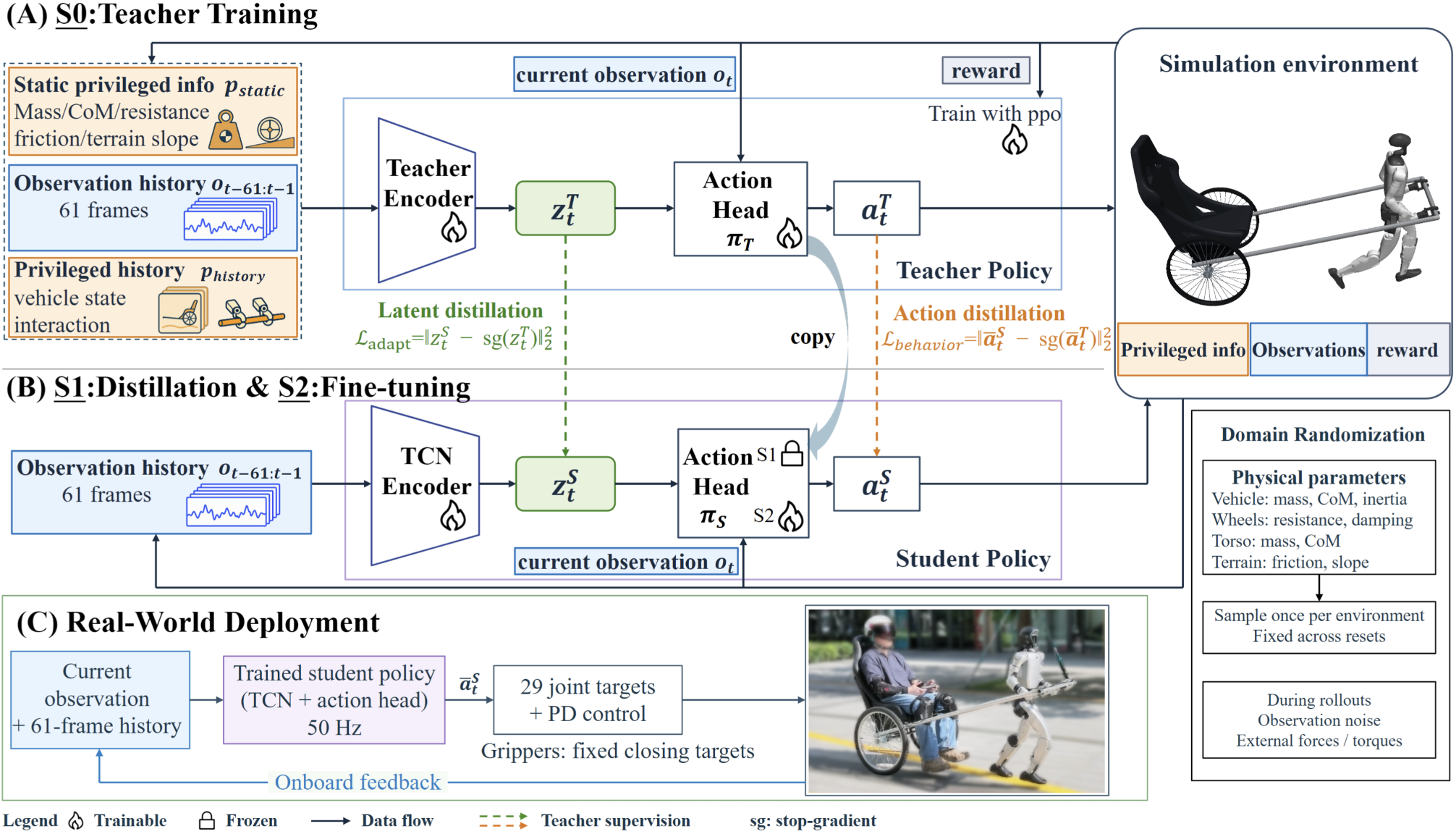
- During training, a privileged teacher exploits vehicle states, interaction forces, and load properties.
- Its actions and latent are distilled into a history-conditioned student that implicitly infers coupled dynamics from proprioceptive responses, followed by reinforcement-learning fine-tuning.
Problem Formulation
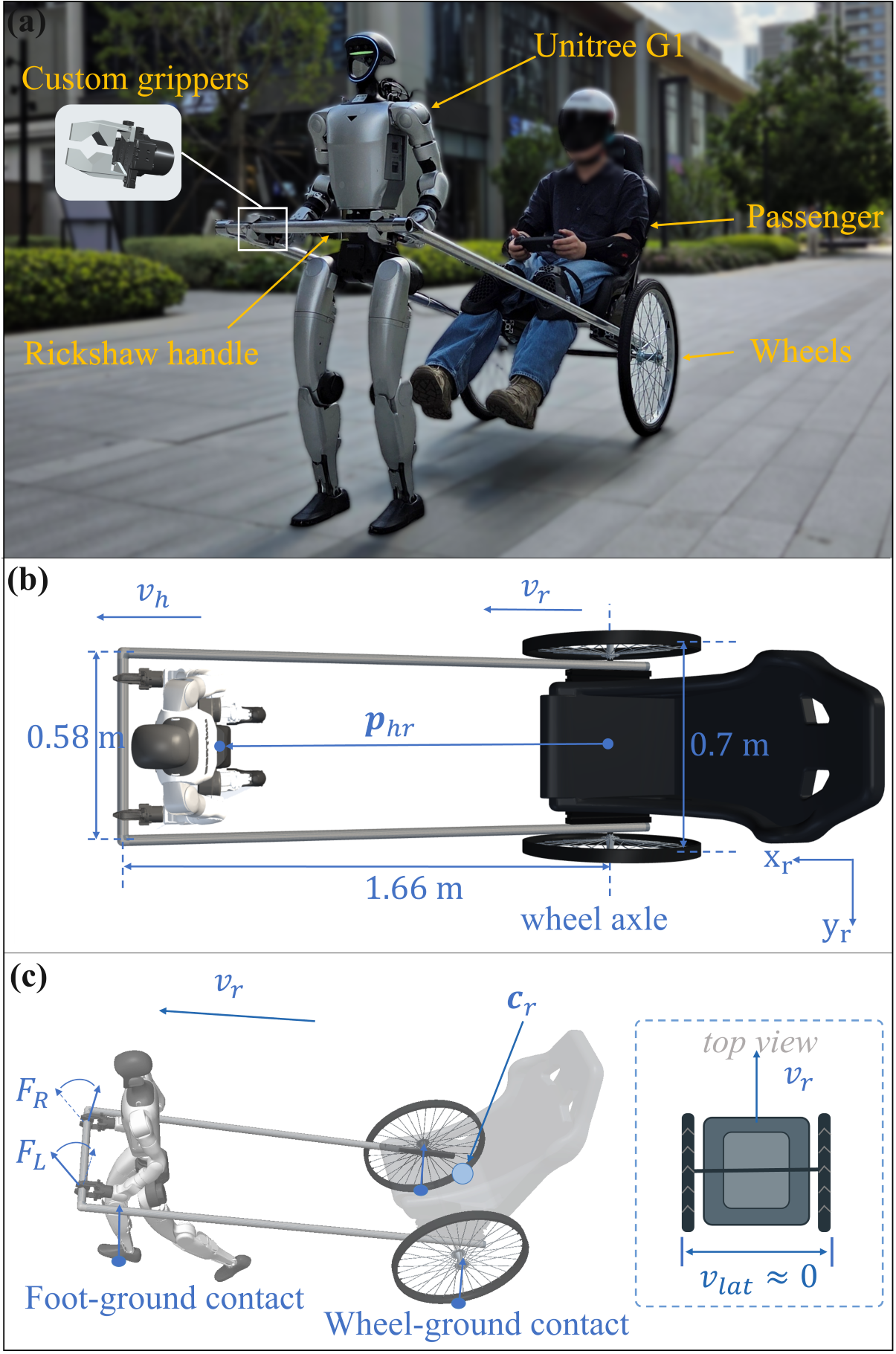
We formulate a humanoid robot’s pulling of a passive two-wheeled rickshaw through persistent bimanual grasping as a partially observed MDP. The task is to realize desired vehicle velocity while maintaining balance and grasp, without directly observing vehicle states or load parameters during deployment. Fig. 2 shows the hardware system and its kinematics.
Humanoid and Gripper : We use a Unitree G1 with $29$ actuated joints spanning the legs, waist, and arms, and two Dex1-1 grippers on its hands.
Method
Proprioceptive responses during pulling provide cues about the unobservable vehicle dynamics. To learn a control-relevant representation from these responses, we train a privileged teacher using robot and vehicle histories together with static parameters ( S0 ). Its actions and latent are distilled into a history-conditioned student ( S1 ).
We then jointly fine-tune the student encoder and action head with PPO [ 23 ] ( S2 ; Fig. 3 ). This approach shares the motivation of prior history-based adaptation methods [ 17 , 19 ] .
Experimental Results
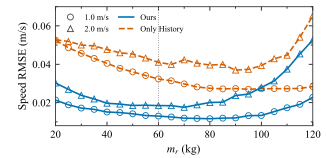
We evaluate vehicle tracking across loads and the contribution of each design choice. Beyond tracking, joint-effort and handle-interaction analyses help explain how pulling a wheeled load changes locomotion, transport costs, and balance behavior. Hardware trials evaluate different passenger configurations, revealing the remaining sim-to-real differences.
Sources and Demonstrations
Figures are reproduced from Yang et al. See the full paper for experimental details and the project page, when the paper links one, for demonstrations and videos.
Related Papers
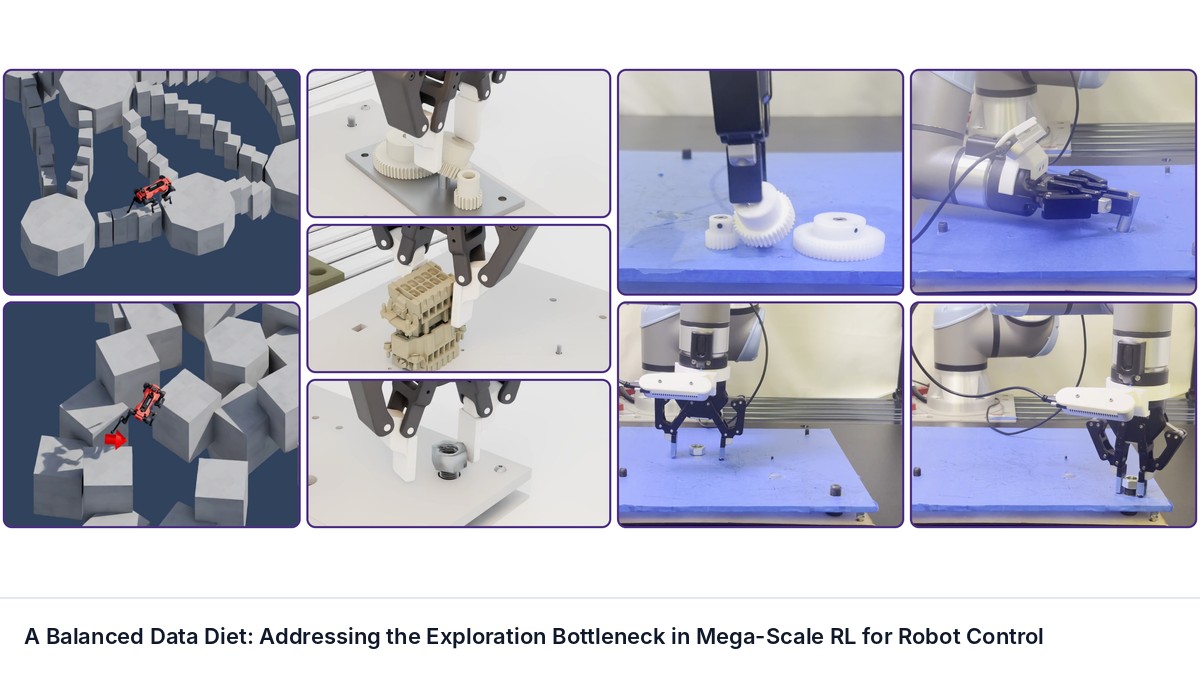
A Balanced Data Diet: Addressing the Exploration Bottleneck in Mega-Scale RL for Robot Control
Octi Zhang, Mateo Guaman Castro, Patrick Yin et al.
General-purpose robots must perform a wide range of tasks from agile locomotion to dexterous manipulation.
DECOWAM: Decoupled Whole-Body World-Action Model for Legged Mobile Manipulation
Siyuan Ma, Boshi Zhang, Yutian Zhang et al.
Mobile manipulation requires a robot to predict how locomotion and arm motion jointly alter future observations and control. Existing world-action models, developed largely for fixed-base platforms, do not explicitly distinguish camera ego-motion from base and arm actions.
DUET: Decoupled Upper- and Lower-Body Execution for Task-Agnostic Humanoid Loco-Manipulation
Kapalik Khanal, Biswash Khatiwada, Stephen Afrifa et al.
Changing a humanoid robot's manipulation policy should not require retraining the controller that maintains the robot's balance.
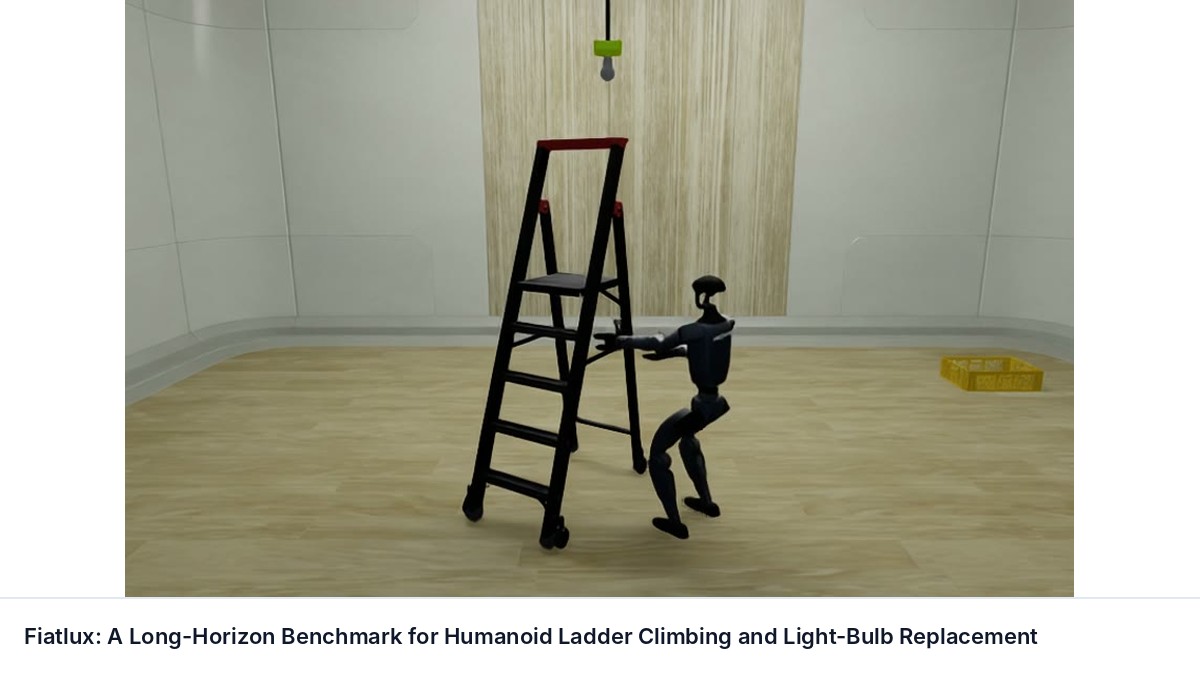
Fiatlux: A Long-Horizon Benchmark for Humanoid Ladder Climbing and Light-Bulb Replacement
Pavel Bushuyeu, Yujin Chen, Anton Nikolaev et al.
Existing benchmarks evaluate tabletop manipulation, flat-floor household activity, or humanoid locomotion and manipulation as separate task groups; none scores vertical mobility and dexterous work on a fragile payload in one long-horizon episode.