
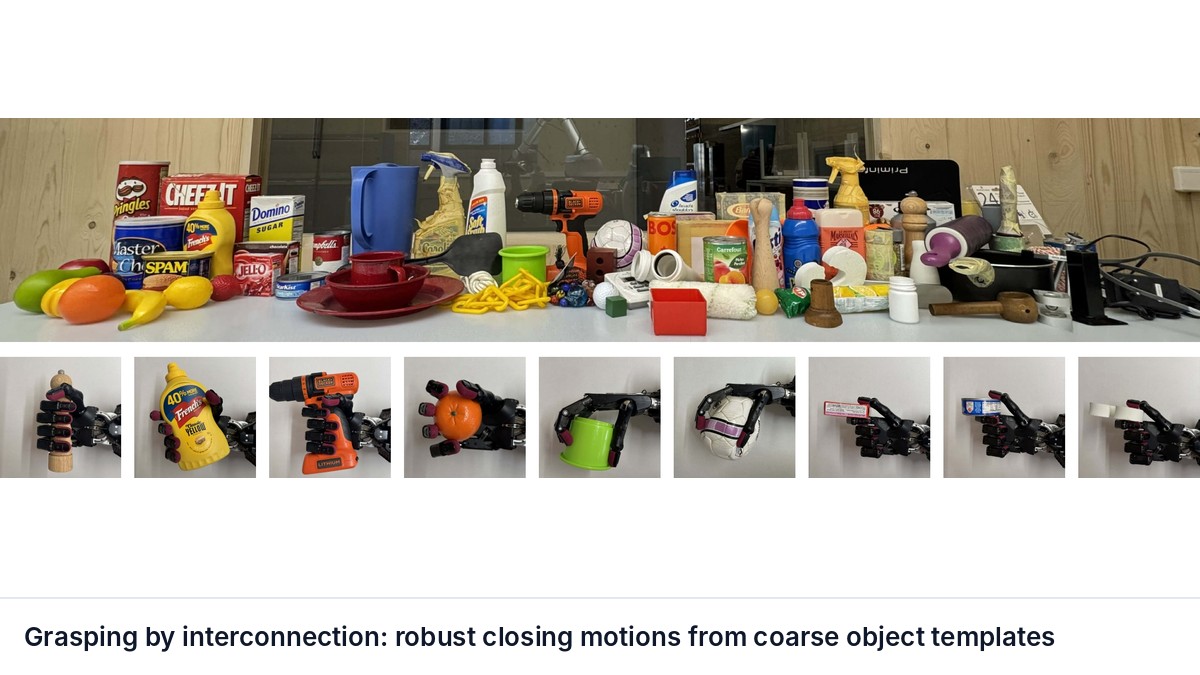
Grasping by interconnection: robust closing motions from coarse object templates
Julien Vanderheyden, Guillaume Drion, Fulvio Forni, Pierre Sacr\'e · N/A · 2026
Framework
N/A
License
N/A
Stars
N/A
Summary
Dexterous robot hands must often grasp objects whose shape, size, and pose are known only approximately. Grasp planners typically require accurate object models or correct errors with feedback, but how much inaccuracy a closing motion can tolerate on its own remains unclear.
Abstract Summary
Key Points
- Dexterous robot hands must often grasp objects whose shape, size, and pose are known only approximately.
- Grasp planners typically require accurate object models or correct errors with feedback, but how much inaccuracy a closing motion can tolerate on its own remains unclear.
- To address this question, we designed a motion planner based on four principles: a coarse template of the object, human grasp types, an object-centric interaction, and compliant, sliding contacts instead of prescribed contact points.
- This paper presents the planner, implemented through virtual model control, and its evaluation on a Shadow Dexterous Hand.
- Without feedback, the planned closing motions tolerated size errors of about 1cm and pose errors of several centimeters and tens of degrees, a wider range than a state-of-the-art data-driven planner in 25 of 27 tested conditions.
Grasping by interconnection
This section describes what our motion planner reads, what it computes, and how it implements the four principles. Section III-A specifies the coarse template and its grasp type. Section III-B explains why virtual model control implements an object-centric interaction and how the virtual hand is simulated.
Experiments
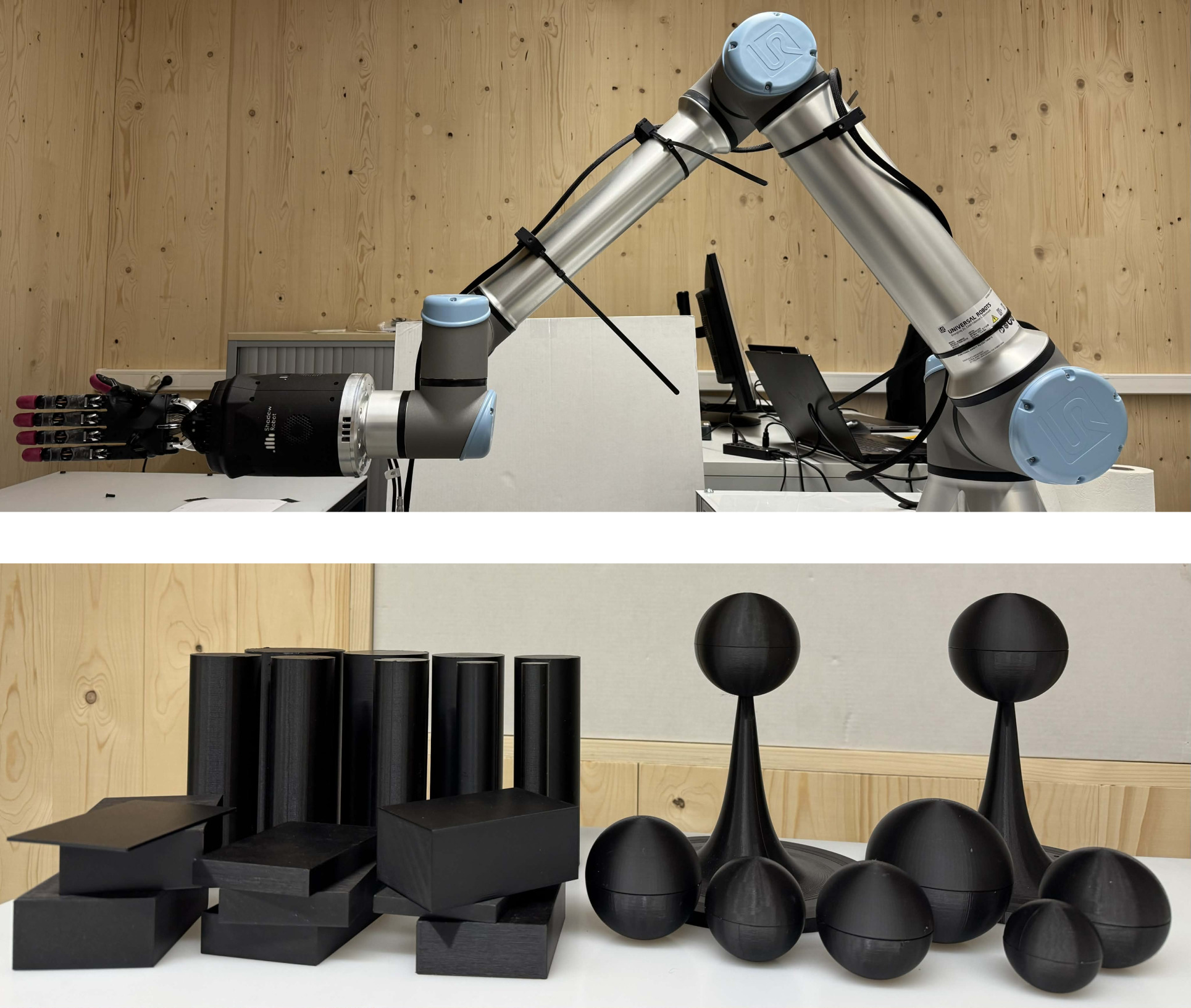
Experiments were conducted with a Shadow Dexterous Hand [ 10 ] mounted on a UR10e arm (Fig. 4 ). The hand is position controlled: its joint controllers track the closing motion computed by the planner. All computations 1 1 1 The code, including the grasping pipeline of Section IV , will be released on a GitHub page after the double-blind review process.
use VMRobotControl.jl [ 49 ] , a Julia library for the design, simulation, control, and optimization of VMC architectures.
Sources and Demonstrations
Figures are reproduced from Vanderheyden et al. See the full paper for experimental details and the project page, when the paper links one, for demonstrations and videos.
Related Papers

A Sim-to-Real Integration Pipeline for Training and Deployment of Chunk-Based VLA Manipulation Policies
Mathilde Kappel, Clémence Grislain, Mohamed Chetouani et al.
Vision-Language-Action (VLA) models have become a prominent paradigm for mapping multimodal inputs, including semantic instructions, visual observations of the scene, and proprioceptive observations, to robot actions.
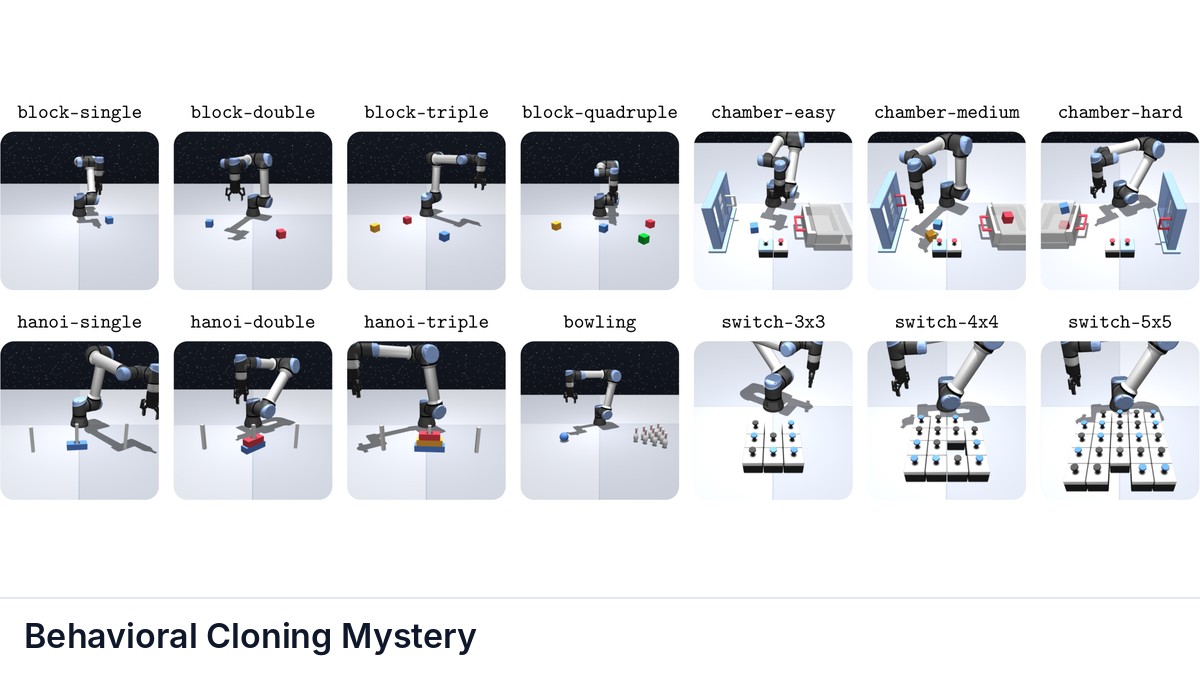
Behavioral Cloning Mystery
Seohong Park, Sergey Levine
Behavioral cloning (BC), despite its simplicity, exhibits many counterintuitive phenomena in the real world. For example, the performance of BC often keeps increasing as the model overfits more to the dataset, and fully closed-loop policies often completely fail without action chunking.
Beyond Reconstruction: What Matters in Action Tokenization for Robot Policies?
Haoran Chen, Jingtian Ji, Samuel Wheeler et al.
Autoregressive action-token policies such as vision-language-action models require action tokenizers to translate discrete token sequences into precise control actions in continuous space. Many action tokenizers learn the mapping between tokens and actions via a reconstruction objective.

Capability-Aware Arbitration for Semantic Intent-Based Shared Control
Zhaoda Du, Michael Bowman, Xiaoli Zhang
Shared control often allocates robot authority based on confidence in inferred human intent, assuming reliable autonomous execution. When this assumption fails, high intent confidence can cause over-helping.